The Asia-Pacific airline industry is entering its most profitable period since before the pandemic. After years of recovery from COVID-era losses, supply chain disruptions, and uneven demand patterns, the region's carriers are posting profit numbers that signal a genuine turning point. For Australian businesses that manufacture components, supply equipment, or provide logistics services, this profit surge is not just an industry headline. It represents a procurement pipeline that is opening right now.
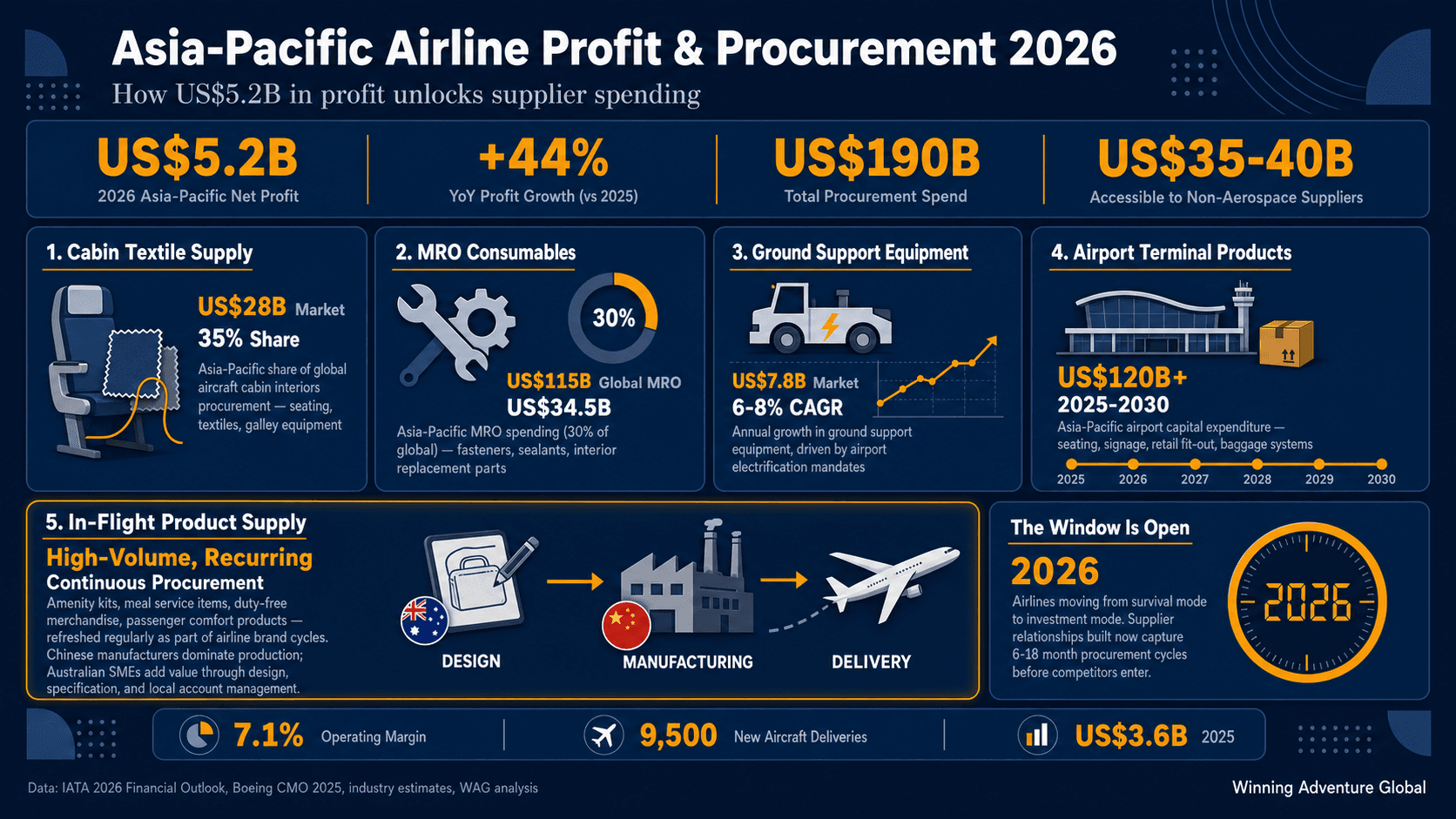
The International Air Transport Association projects that Asia-Pacific airlines will generate US$5.2 billion in net profits for the 2026 calendar year, a 44 percent increase over the US$3.6 billion posted in 2025. Passenger demand across the region grew 16.9 percent year-on-year in 2025, and forward booking data suggests that trajectory is holding. Airlines are no longer just filling seats. They are investing in fleet renewal, cabin upgrades, ground equipment, and maintenance infrastructure, and much of that spending flows through supply chains that Australian businesses can access.
This article maps exactly where the procurement dollars are going, what role China plays in the aviation supply chain, and the five specific opportunities Australian SMEs should be evaluating right now.
Asia-Pacific Aviation Profit Rebound: The Data Behind the Opportunity
Understanding the scale of the profit recovery is essential before assessing procurement opportunities. This is not a marginal improvement. The industry is moving from survival mode to investment mode, and the data reflects that shift.
IATA Profit Forecast: Asia-Pacific Leads Global Recovery
The IATA financial outlook for 2026 positions Asia-Pacific as the strongest-growing region in global aviation by net profit growth rate. The key metrics tell a clear story.
| Metric | 2024 Actual | 2025 Actual | 2026 Forecast | YoY Growth |
|---|---|---|---|---|
| Asia-Pacific net profit | US$2.1B | US$3.6B | US$5.2B | +44% |
| Passenger RPK growth | +12.4% | +16.9% | +11.8% | — |
| Passenger load factor | 82.1% | 83.6% | 84.2% | +0.6pp |
| Cargo CTK growth | +8.3% | +10.8% | +7.5% | — |
| Operating margin | 4.2% | 5.8% | 7.1% | +1.3pp |
The operating margin improvement from 4.2 percent to a projected 7.1 percent is the critical number for procurement professionals. When airlines operate at 4 percent margins, every dollar of procurement spend is scrutinised. When margins approach 7 percent, investment in product quality, cabin differentiation, and operational efficiency becomes commercially justifiable. That is the procurement window Australian businesses need to be watching.
Fleet Expansion Drives Procurement Volume
Profitability enables fleet investment, and Fleet investment creates sustained procurement demand. Boeing's 2025 Commercial Market Outlook projects that Asia-Pacific carriers will take delivery of approximately 9,500 new aircraft over the next 20 years, accounting for more than 40 percent of global deliveries. In the near term, Airbus and Boeing combined delivered over 380 aircraft to Asia-Pacific carriers in 2025, with 2026 deliveries projected above 400 units.
Each new aircraft delivery triggers a cascade of procurement activity. The aircraft itself requires cabin interiors, seating systems, galley equipment, in-flight entertainment hardware, and emergency equipment. The ground operation requires new ground support equipment, maintenance tooling, and spare parts inventory. And the airport infrastructure feeding these aircraft requires upgrades to gates, baggage handling systems, and retail concessions.
This procurement cascade is not concentrated in any single market. It flows through multi-tier supply chains that extend from aircraft manufacturers to component suppliers to raw material producers. Many of those tiers run through China, and many of the procurement categories align with manufacturing capabilities that already exist in Australia.
Need data-driven procurement intelligence for the aviation supply chain?
Asia-Pacific airlines will spend an estimated US$190 billion on procurement in 2026. Winning Adventure Global helps Australian SMEs identify which procurement categories match their manufacturing capabilities and navigate supplier qualification in China.
Get Your Procurement Opportunity AssessmentWhere Airline Procurement Dollars Flow
To identify actionable opportunities for Australian businesses, it is necessary to understand how airline procurement budgets are allocated. The spending breaks down into four major categories, each with distinct supplier requirements and entry points.
Cabin Products and Interiors
Cabin products represent the most visible procurement category and one of the most accessible for new suppliers. Airlines competing on passenger experience invest heavily in seat comfort, cabin aesthetics, and in-flight amenities. The Asia-Pacific market is particularly active in this category, driven by full-service carriers differentiating against low-cost competition and low-cost carriers upgrading their product as passenger expectations rise.
Key procurement sub-categories include:
- Aircraft seating systems and components (seat frames, cushions, tray tables, armrests)
- Cabin textiles (seat covers, curtains, carpets, headrest covers)
- Galley equipment and serviceware (trolleys, meal containers, cutlery, glassware)
- In-flight amenity kits and passenger comfort items
- Cabin lighting systems and mood lighting components
- Lavatory modules and fittings
The global aircraft cabin interiors market was valued at approximately US$28 billion in 2025, with Asia-Pacific carriers accounting for roughly 35 percent of procurement spend in this category. Chinese manufacturers have established significant market share in cabin textiles, galley equipment, and amenity kit production. Australian businesses with capabilities in textile manufacturing, precision engineering, or product design can position themselves as tier-two or tier-three suppliers in this supply chain.
Maintenance, Repair, and Overhaul (MRO)
MRO procurement accounts for the largest share of airline operating expenditure after fuel and labour. As the Asia-Pacific fleet ages and flight hours increase, MRO demand grows proportionally. IATA estimates that global MRO spending will reach US$115 billion in 2026, with the Asia-Pacific region representing approximately 30 percent of that total.
The MRO supply chain covers a vast range of components and services:
- Aircraft structural parts (fasteners, brackets, panels, composite repairs)
- Engine components and consumable parts
- Landing gear components and hydraulic system parts
- Avionics components and electrical system parts
- Consumable materials (sealants, lubricants, cleaning compounds)
- Ground support equipment maintenance parts
A significant portion of MRO component manufacturing has migrated to China over the past decade. Chinese factories produce aircraft fasteners, structural brackets, interior replacement parts, and ground support equipment components at competitive price points. For Australian engineering and manufacturing businesses, this creates a dual opportunity: supplying directly to airlines and MRO providers in the region, or supplying to Chinese manufacturers who are themselves tier-one suppliers to the aviation industry.
Ground Support Equipment
Every aircraft on the ground requires a support ecosystem of equipment: baggage loaders, passenger stairs, ground power units, air conditioning carts, tow tractors, de-icing equipment, and cargo handling systems. As Asia-Pacific airlines expand their fleets and airports add gates, ground support equipment procurement rises in lockstep.
The global ground support equipment market was valued at approximately US$7.8 billion in 2025, with projected growth of 6 to 8 percent annually through 2030. Asia-Pacific is the fastest-growing regional market, driven by airport expansion projects in China, India, Southeast Asia, and Australia.
Australian manufacturers have specific advantages in certain GSE categories. Electric ground support equipment, in particular, is a growth segment as airports mandate emissions reductions. Australian expertise in electric vehicle components, battery systems, and power management aligns with this demand. The supply chain for GSE components runs heavily through Chinese manufacturing hubs in Guangdong, Zhejiang, and Jiangsu provinces.
Airport Infrastructure and Retail
Airport infrastructure spending is the most indirect but potentially largest procurement opportunity. Asia-Pacific airports are investing heavily in terminal expansion, retail concession development, and passenger experience infrastructure. The region's airport capital expenditure is projected to exceed US$120 billion over the 2025-2030 period.
This spending creates procurement demand for:
- Terminal furniture and fixtures (seating, signage, counters, display systems)
- Retail fit-out components (shelving, display units, lighting, POS systems)
- Baggage handling system components
- Security screening equipment and accessories
- Food and beverage equipment for airport concessions
Many of these products are manufactured in China and supplied through procurement agents or direct factory relationships. Australian businesses that understand the airport procurement ecosystem and can coordinate supplier relationships across Chinese factories and Australian logistics providers are well positioned to capture this demand.
China's Position in the Aviation Supply Chain
The aviation supply chain is unusual in that it combines extremely high certification requirements for flight-critical components with relatively accessible requirements for non-critical products. Understanding where China fits in this hierarchy is essential for Australian businesses evaluating procurement opportunities.
Critical vs. Non-Critical Components
Aviation components fall into a spectrum from flight-critical to non-critical. Flight-critical components—engine parts, structural airframe components, flight control systems—require extensive certification including AS9100 quality management, NADCAP special process accreditation, and direct OEM approval. These requirements create high barriers to entry that are difficult for new suppliers to overcome.
Non-critical components, however, represent a much larger procurement volume and a much more accessible entry point. These include cabin interior parts, galley equipment, ground support components, and airport infrastructure products. For these categories, standard ISO 9001 quality management certification is typically sufficient, and procurement decisions are driven by price, quality, and delivery reliability rather than aviation-specific certifications.
Chinese manufacturers have concentrated heavily in these non-critical categories. The manufacturing clusters in Guangdong, Zhejiang, and Jiangsu provinces have developed specialised capabilities in textile production, plastic injection moulding, metal fabrication, and electronics assembly that align directly with aviation non-critical procurement requirements.
As explored in our analysis of Qantas' supply chain management strategies, airline procurement teams are actively managing supplier relationships across Chinese manufacturing clusters. The lesson for Australian businesses is that the barrier to entry is lower than most assume, provided you target the right procurement categories and approach supplier qualification systematically.
The Procurement Agent Model
Most Asia-Pacific airlines do not source directly from Chinese factories. They work through tier-one suppliers—large aerospace companies and specialised cabin product manufacturers—who in turn source components from Chinese factories. This creates an opportunity for Australian businesses to position themselves as procurement agents or tier-two suppliers who understand both the Australian business environment and the Chinese manufacturing landscape.
Winning Adventure Global has observed that Australian SMEs with strong supplier relationships in China are increasingly capturing procurement opportunities that larger competitors overlook. The reason is structural: large aerospace suppliers focus on high-value, high-certification contracts. The thousands of smaller procurement categories—replacement seat covers, galley trolley components, ground equipment spare parts—are too fragmented for their business models but perfectly suited to agile Australian businesses with China sourcing capability.
Five Procurement Opportunities for Australian SMEs
Based on the procurement categories and supply chain dynamics described above, here are the five most actionable opportunities for Australian businesses.
Opportunity 1: Cabin Textile and Soft Goods Supply
The cabin textile category—seat covers, curtains, headrest covers, carpet, blankets, and pillow covers—represents a recurring procurement need for every airline. These products wear out through regular use and require replacement on predictable cycles. A single wide-body aircraft requires hundreds of individual textile components, and an airline operating a fleet of 50 aircraft with a three-year replacement cycle is placing orders continuously.
Chinese textile manufacturers in Zhejiang and Guangdong provinces produce cabin-grade textiles that meet airline flammability and durability standards. Australian businesses can manage the design, specification, and quality assurance while coordinating production through Chinese manufacturing partners. The value-add for the Australian business is in understanding airline procurement requirements, managing compliance documentation, and providing the local account management that airlines expect from their suppliers.
Opportunity 2: MRO Consumables and Replacement Parts
MRO consumables—sealants, fasteners, cleaning compounds, protective films, and replacement interior parts—are purchased in high volumes with recurring demand patterns. These products have lower certification barriers than flight-critical components but require consistent quality and reliable delivery.
The supply chain for MRO consumables runs heavily through China, where manufacturers produce fasteners, brackets, interior panels, and plastic components to specifications that meet airline requirements. Australian businesses can aggregate demand from multiple airline or MRO customers, manage the supplier qualification process in China, and provide the logistics and inventory management that makes procurement efficient for airline customers.
Understanding air freight logistics is essential for this category. As discussed in our analysis of the Dubai International Airport freight corridor, the routing options between Chinese manufacturing and Australian destinations affect cost, transit time, and supply chain reliability. Businesses that optimise this logistics layer capture margin that competitors leave on the table.
Opportunity 3: Ground Support Equipment Components
Ground support equipment procurement is fragmented across hundreds of equipment types and thousands of component categories. Airlines and ground handling companies buy complete GSE units—baggage tractors, belt loaders, passenger stairs—from original equipment manufacturers. But those OEMs source components from a global supply base, and their component procurement is far more accessible than their finished product procurement.
Australian businesses with engineering and manufacturing capabilities can target specific component categories: electric motor assemblies, battery systems, hydraulic components, control panels, and structural fabrications. The Chinese supply base for these components is deep and competitive. The Australian business adds value through design integration, quality management, and the local support capability that GSE OEMs and airline maintenance teams require.
The electric GSE segment deserves particular attention. Airports across the Asia-Pacific region are setting electrification targets for ground operations. Electric baggage tractors, electric belt loaders, and electric pushback tugs are replacing diesel equipment. The battery systems, power electronics, and electric drive components in this equipment represent a procurement category that is growing faster than the broader GSE market.
Opportunity 4: Airport Terminal Product Supply
Airport terminal procurement operates on different timelines than airline procurement but represents larger individual contract values. When a terminal is being built or renovated, the procurement requirements are comprehensive: thousands of seats, hundreds of signage systems, extensive retail fit-out components, and back-of-house equipment.
Chinese manufacturers dominate several terminal product categories including seating systems, metal fabrication, signage manufacturing, and retail display production. Australian businesses that can manage the specification, quality assurance, and installation coordination for airport terminal projects can capture these procurement opportunities while leveraging the cost efficiency of Chinese manufacturing.
The key to this opportunity is understanding airport procurement processes. Airports typically issue tenders through formal procurement frameworks with specific qualification requirements, compliance documentation, and performance bonds. Australian businesses that invest in understanding these processes and building the necessary compliance infrastructure create a competitive moat that protects their position.
Opportunity 5: In-Flight Product and Amenity Supply
In-flight products—amenity kits, meal service items, duty-free merchandise, and passenger comfort products—represent a high-volume, recurring procurement category with relatively low certification barriers. Airlines refresh their amenity kits and service items regularly as part of brand updates and service enhancements.
Chinese manufacturers have deep capabilities in amenity kit production, textile manufacturing, plastic moulding, and printed product production—all categories that align with in-flight product procurement. Australian businesses can act as the design, specification, and account management layer while coordinating production through qualified Chinese manufacturing partners.
The economic logic for airlines is compelling: a supplier who can manage the end-to-end process from design to delivery, provide local account management, and offer competitive pricing through efficient China sourcing is more valuable than a supplier who only handles one part of the chain.
Need data-driven procurement intelligence for the aviation supply chain?
Asia-Pacific airlines will spend an estimated US$190 billion on procurement in 2026. Winning Adventure Global helps Australian SMEs identify which procurement categories match their manufacturing capabilities and navigate supplier qualification in China.
Get Your Procurement Opportunity AssessmentHow to Enter the Aviation Supply Chain
Entering the aviation supply chain requires a methodical approach. Airlines and aerospace companies operate in a regulated environment where supplier qualification is formalised and relationship-driven. The following steps provide a practical framework for Australian businesses evaluating this opportunity.
Step 1: Identify Your Target Procurement Category
Do not attempt to enter "the aviation supply chain" in general. Identify a specific procurement category where your capabilities or relationships provide a genuine advantage. The five opportunities listed above provide a starting framework, but the most successful entrants typically focus on a narrow category and build credibility before expanding.
Evaluate each category against three criteria: does it match your existing manufacturing or sourcing capability, is the certification barrier manageable, and is the procurement volume sufficient to justify the investment in qualification and relationship building.
Step 2: Understand the Certification Requirements
For non-critical components, ISO 9001 quality management certification is typically the minimum requirement. Some airlines and tier-one suppliers also require specific documentation including material certifications, process control documentation, and testing reports. Research the specific requirements for your target procurement category before approaching potential customers.
Australian import regulations also apply to any products brought into the country. Products entering Australia must meet customs requirements, biosecurity standards, and product safety regulations. Our Australia import guide provides a comprehensive overview of these requirements.
Step 3: Build Your Chinese Supply Base
Once you have identified your target category and understood the certification requirements, the next step is building qualified supplier relationships in China. This involves factory identification, capability verification, sample production, and quality system assessment.
Winning Adventure Global's factory verification process involves on-site audits that assess production capability, quality management systems, compliance documentation, and export experience. For aviation-related procurement categories, additional attention is given to material traceability, process control documentation, and the supplier's experience with international quality standards.
Step 4: Develop Your Airline Customer Relationships
Airline procurement teams are relationship-driven. They do not respond to cold emails the way consumer product buyers might. Building credibility requires demonstrating understanding of aviation procurement processes, presenting specific product capabilities with appropriate documentation, and showing patience through procurement cycles that can extend over 6 to 18 months.
The most effective approach is to start with a specific product category, present a capability package that includes product samples, compliance documentation, and pricing, and offer to fulfil a trial order before pursuing larger procurement volumes. This approach reduces risk for the airline procurement team and builds the relationship incrementally.
Risk Management in Aviation Procurement
Aviation procurement carries specific risks that Australian businesses must manage. Understanding these risks and building mitigation strategies into your approach is essential for sustainable success.
Certification and Compliance Risk
The most significant risk in aviation procurement is certification failure. If products do not meet airline specifications, flammability requirements, or quality standards, the consequences extend beyond financial loss to include reputational damage that can close procurement doors permanently.
Mitigation requires rigorous quality management throughout the supply chain. This includes supplier qualification audits, first-article inspection processes, in-process quality checks, and pre-shipment inspection. Do not rely on supplier assurances alone. Build verification into every stage of the procurement process.
Tariff and Trade Risk
Aviation components crossing international borders are subject to tariff regimes that can change rapidly. The US-China tariff dynamic has created specific complexity for products that enter the aviation supply chain, as many tier-one aerospace suppliers are US-based and tariff costs flow through to component pricing.
Managing tariff risk requires understanding the tariff classification of your products, monitoring trade policy developments, and building tariff contingency into your pricing models. The Qantas supply chain analysis referenced earlier provides detailed guidance on tariff management strategies that apply equally to the procurement categories discussed in this article.
Supplier Concentration Risk
The aviation supply chain exhibits concentration risk at multiple levels. Some component categories are dominated by a small number of manufacturers. Some airline procurement categories are supplied by a single tier-one supplier. And some Chinese manufacturing clusters specialise so narrowly that a regional disruption affects the entire supply base for a product category.
Mitigation involves qualifying backup suppliers before they are needed, maintaining safety stock for critical components, and monitoring supplier financial health and operational stability. Do not assume that a qualified supplier today will remain qualified and operational throughout your contract period.
FAQ
How large is the Asia-Pacific airline procurement market?
The Asia-Pacific airline industry's total procurement spend—including aircraft, engines, components, MRO, ground equipment, and services—is projected to exceed US$190 billion in 2026. Of this total, approximately US$35 to US$40 billion is in procurement categories accessible to non-aerospace specialist suppliers, including cabin products, ground equipment, consumables, and airport infrastructure products.
Do I need aerospace certification to supply airline procurement categories?
For non-critical components—cabin products, ground support equipment parts, airport terminal products, and in-flight amenities—aerospace-specific certifications such as AS9100 are typically not required. Standard ISO 9001 quality management certification is usually sufficient. However, specific products must meet airline specifications for flammability, durability, and performance. Verify the exact requirements for your target procurement category before investing in certification.
What is the typical procurement cycle for airline contracts?
Airline procurement cycles vary by category. Consumable products and recurring supply items typically operate on 12- to 24-month contract cycles with quarterly or monthly delivery schedules. Capital equipment procurement, such as ground support equipment or terminal products, operates on project timelines that can extend 6 to 18 months from initial inquiry to contract award. New supplier qualification typically adds 3 to 6 months to the timeline for the first engagement.
How can Australian SMEs compete with established aerospace suppliers?
Australian SMEs should not attempt to compete with established aerospace suppliers in their core categories. Large aerospace companies dominate high-value, high-certification procurement. The opportunity for SMEs lies in the fragmented, lower-certification categories that are too small or too customised for the major aerospace suppliers. Cabin textiles, ground equipment components, in-flight amenities, and MRO consumables are categories where agility and customer responsiveness matter more than scale.
What role does China play in the aviation supply chain?
China is the dominant manufacturing source for non-critical aviation components including cabin products, ground support equipment parts, and airport infrastructure products. Chinese factories in Guangdong, Zhejiang, and Jiangsu provinces have developed specialised capabilities that align with aviation procurement requirements. Australian businesses that combine China sourcing capability with local account management and compliance expertise create a value proposition that neither Chinese manufacturers nor established aerospace suppliers can replicate.
The Asia-Pacific airline profit rebound is creating procurement demand across categories that Australian businesses are well positioned to capture. The opportunity is not in competing with Airbus or Boeing for aircraft orders. It is in the thousands of smaller procurement categories—cabin products, MRO consumables, ground equipment components, terminal fittings, in-flight amenities—that airlines purchase continuously and that flow through supply chains running through China.
Businesses that move now, while the procurement pipeline is expanding, will be positioned ahead of competitors who wait until the opportunity is obvious to everyone. The window for building supplier relationships, qualifying products, and establishing customer credibility is open. The question is whether your business will be inside it.
Winning Adventure Global provides the factory verification, supplier qualification, quality management, and logistics coordination that Australian businesses need to capture aviation supply chain procurement. Whether you are evaluating a specific product category or building your broader China sourcing capability, our team can help you move from opportunity analysis to operational execution.
Explore our China Sourcing Strategy resources for more procurement guides, or contact our team to discuss how aviation supply chain procurement fits your business capabilities.
China Sourcing Strategy
Need data-driven procurement intelligence for the aviation supply chain?
Asia-Pacific airlines will spend an estimated US$190 billion on procurement in 2026. Winning Adventure Global helps Australian SMEs identify which procurement categories match their manufacturing capabilities and navigate supplier qualification in China.
Get Your Procurement Opportunity AssessmentFree initial consultation · We respond within 4 business hours