Key Takeaways
- 1Australia's data centre construction pipeline exceeds A$15 billion across 2025-2030, with AWS, Microsoft, Google, and AirTrunk all expanding
- 2Seven equipment categories are importable from China: server racks, cooling systems, UPS/power, structured cabling, physical security, fire suppression, and containment systems
- 3An estimated 60-70% of data centre hardware installed in Australian facilities is manufactured in China or Southeast Asia
- 4Factory verification for technical equipment requires specialised expertise — electrical certification, thermal performance testing, and load-capacity validation
- 5Australian SMEs can enter the supply chain through equipment supply, installation contracting, maintenance services, or modular edge solutions
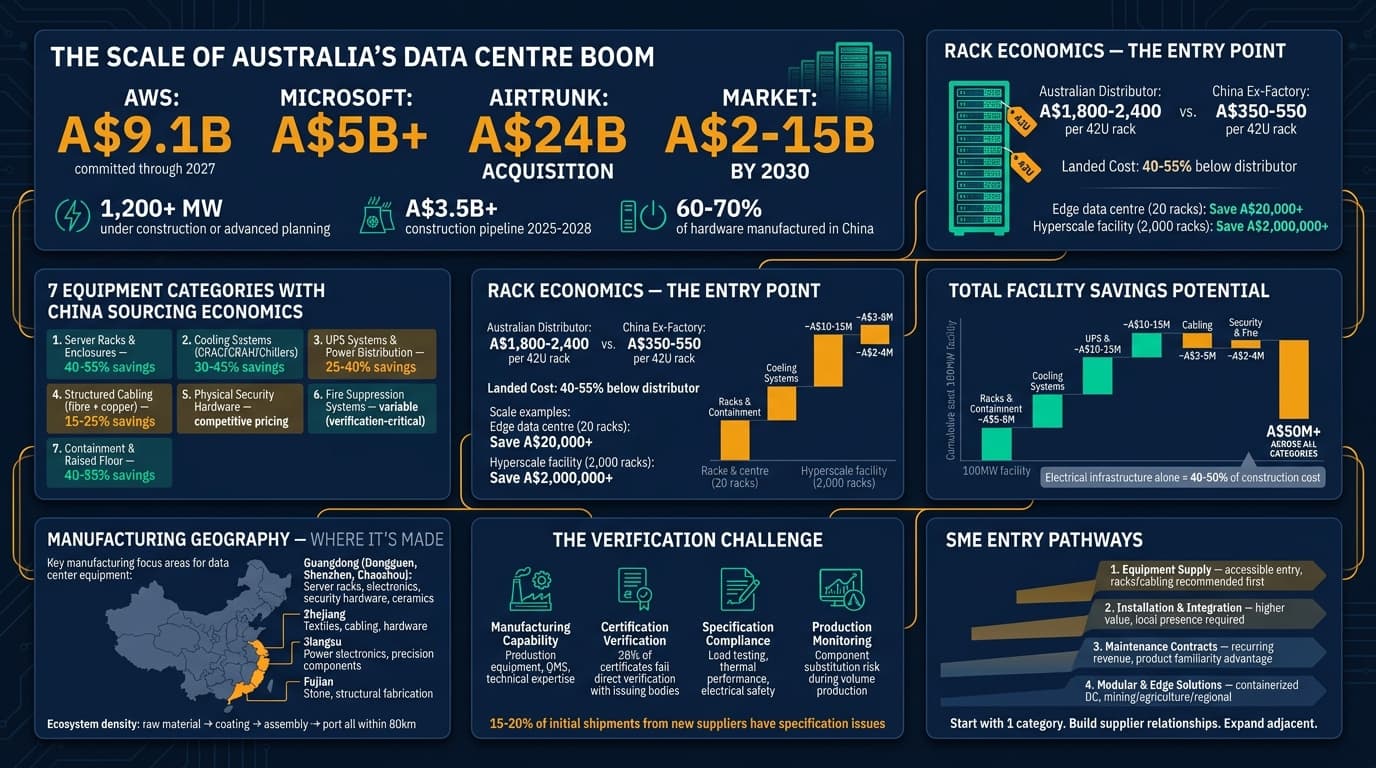
Australia is in the middle of the largest data centre construction cycle in the country's history. Amazon Web Services has committed A$9.1 billion to Australian data centre expansion through 2027. Microsoft's Australian cloud infrastructure investment exceeds A$5 billion. Google operates cloud regions in both Sydney and Melbourne, with continued expansion underway. AirTrunk, acquired by Blackstone for A$24 billion, is building hyperscale facilities across Sydney, Melbourne, and Tokyo. NextDC, CDC Data Centres, and Equinix are each executing multi-facility buildouts simultaneously.
The numbers are not abstract. The Australian data centre market is projected to reach A$12-15 billion by 2030, with the construction pipeline alone exceeding A$3.5 billion in new facilities between 2025 and 2028. Every one of these facilities requires physical infrastructure: server racks that hold computing hardware, cooling systems that prevent thermal failure, power distribution equipment that delivers reliable electricity, kilometres of structured cabling, physical security hardware, fire suppression systems, and containment architecture.
Here is what most Australian businesses do not realise: an estimated 60 to 70 percent of this equipment is manufactured in China. Not assembled. Manufactured — from raw aluminium extrusions for rack frames to the power electronics inside UPS modules. The global data centre supply chain runs through factories in Guangdong, Zhejiang, Jiangsu, and Fujian. Australian SMEs that understand this supply chain can participate directly, rather than paying markup to intermediaries who add no manufacturing value.
This article examines the seven equipment categories with the strongest China-sourcing economics, explains the factory verification challenges specific to technical infrastructure equipment, and provides a practical roadmap for Australian businesses looking to enter the data centre supply chain.
Ready to access the data centre supply chain?
Australia's data centre equipment market imported an estimated A$2.1 billion in hardware last year, with 62% sourced from China. Winning Adventure Global helps Australian SMEs verify factories, inspect technical equipment, and build procurement relationships that deliver. Free supply chain assessment — no obligation.
Get Free Supply Chain AssessmentThe Scale of the Opportunity
Understanding the procurement opportunity requires understanding what a data centre physically contains — and what it costs to build.
A single hyperscale data centre campus, the kind being built by AWS in Western Sydney or AirTrunk in Melbourne's west, represents a construction project comparable in scale to a major hospital or university building. Electrical infrastructure alone — transformers, switchgear, UPS systems, power distribution units, backup generators — can represent 40 to 50 percent of the total construction cost. Cooling systems add another 15 to 25 percent. Structured cabling, racks, containment, and physical security make up the remainder.
For a 100-megawatt facility, the equipment bill is not measured in millions but in hundreds of millions. And Australia currently has over 1,200 megawatts of data centre capacity either under construction or in advanced planning stages.
The procurement volume is not limited to hyperscale builds. Edge data centres — smaller facilities serving regional manufacturing, mining operations, and agricultural technology — are expanding rapidly. These facilities need smaller quantities of equipment but demand faster delivery and more flexible sourcing arrangements. A regional edge facility in northern Queensland or the Pilbara cannot wait 20 weeks for cooling equipment from a European factory when a Chinese manufacturer can deliver in 6 weeks.
Australia's data centre boom is not a single construction event. It is a sustained, multi-year build cycle that will require continuous equipment procurement across every category for at least the next five years.
Seven Equipment Categories with Proven China Sourcing Economics
Each equipment category has distinct sourcing characteristics, verification requirements, and supplier landscapes. Understanding these differences determines whether an Australian SME can compete effectively in each segment.
1. Server Racks and Enclosures
Server racks are the most straightforward entry point for Australian businesses entering the data centre supply chain. Standard 42U racks, seismic-rated enclosures, and custom cabinet solutions are manufactured at scale across Guangdong and Zhejiang provinces. The manufacturing process is well-understood: aluminium or steel frame fabrication, panel production, electrostatic coating, and assembly. Quality differentiation comes from material gauge, weld quality, load rating verification, and finish consistency.
Chinese manufacturers including Hongfa, ZTDC, and Dongzheng supply both OEM products to global brands and branded products directly to data centre operators. The quality range is broad: budget racks that meet basic specifications through to premium enclosures that match or exceed European-manufactured equivalents.
The economics are compelling. A standard 42U server rack that costs A$1,800 to A$2,400 from an Australian distributor typically has an ex-factory price of A$350 to A$550 from a mid-tier Chinese manufacturer. Even after shipping, customs clearance, and compliance costs, the landed cost typically runs 40 to 55 percent below Australian distributor pricing. For an edge data centre requiring 20 racks, the savings exceed A$20,000. For a hyperscale facility requiring 2,000 racks, the savings exceed A$2 million.
Verification requirements for racks are relatively straightforward compared to active electronic equipment. Load rating certification, dimensional accuracy, and finish quality can be verified through sample inspection and third-party testing. Factory visits confirm production capability and quality management systems.
2. Cooling Systems
Thermal management is the second-largest equipment cost in data centre construction and one of the largest operational costs over the facility's lifetime. The cooling category encompasses computer room air conditioning (CRAC) units, computer room air handling (CRAH) units, chillers, liquid cooling systems, and hot-aisle containment systems.
Chinese manufacturers have made significant advances in cooling technology over the past decade. Sint (also known as Titon), Baosen, and a growing number of specialised manufacturers in Guangdong produce cooling equipment that competes directly with established European and American brands on both performance and efficiency specifications. The price differential is substantial: Chinese-manufactured CRAC units typically cost 30 to 45 percent less than equivalent European units on an ex-factory basis.
The shift toward high-density racks — driven by GPU-heavy AI workloads generating 30 to 50 kilowatts per rack rather than the traditional 5 to 10 kilowatts — has accelerated demand for liquid cooling equipment, a category where Chinese manufacturers are rapidly building expertise and production capacity.
Cooling equipment verification is more complex than rack verification. Thermal performance claims must be validated against actual test data. Refrigerant circuit integrity must be confirmed. Energy efficiency ratings under Australian conditions must be verified. Certification requirements under Australian standards add a layer of complexity that commodity equipment does not face.
3. UPS Systems and Power Distribution
Uninterruptible power supply systems, power distribution units, switchgear, and transformers form the backbone of data centre electrical infrastructure. This is the highest-value equipment category and the one where Chinese manufacturing capability has advanced most rapidly.
Huawei's UPS products have gained substantial market share in Australian data centres over the past five years, competing directly with long-established vendors like Schneider Electric, ABB, and Eaton. Vertiv, which maintains significant manufacturing operations in China, supplies UPS systems to major Australian data centre operators. Kehua Tech and CyberPower Systems have also established Australian market presence.
The value proposition extends beyond price. Huawei's modular UPS architecture, for example, allows data centres to scale power protection incrementally as computing load grows, rather than over-provisioning at construction. This design approach, developed for the Chinese market where rapid scaling is standard, has proven attractive to Australian operators managing phased buildouts.
Power equipment verification demands the highest level of technical rigour. Electrical safety certification is non-negotiable. Load testing under Australian operating conditions must be validated. Efficiency ratings at partial load — where UPS systems spend most of their operating life — must be confirmed independently. The consequences of UPS failure in a production data centre are severe enough that no amount of cost savings justifies compromised verification.
4. Structured Cabling
Data centres consume kilometres of cabling: fibre optic for high-speed interconnects, copper for shorter runs, and the patch panels, connectors, and cable management systems that keep everything organised. The cabling category is unique because much of the underlying cable manufacturing already occurs in China, even when the finished product carries a Western brand name.
Australian data centres must comply with AS/NZS 3080 (telecommunications installations) and AS/NZS 3084 (telecommunications pathways). Chinese manufacturers serving the Australian market are familiar with these requirements and produce compliant products. The certification burden is lower than for active electronic equipment, making this an accessible category for Australian SMEs entering the supply chain.
The procurement opportunity in cabling is less about individual unit savings and more about volume economics. A single hyperscale data centre may require 200 to 400 kilometres of structured cabling. At those volumes, even modest per-metre cost differences compound into substantial savings. A 15 percent cost advantage on a A$3 million cabling procurement saves A$450,000 — real money that falls directly to the bottom line.
5. Physical Security Hardware
Every data centre requires physical security infrastructure: access control systems, biometric readers, surveillance cameras, perimeter detection, and security management platforms. This category has a large and competitive Chinese manufacturing base, particularly in Shenzhen, where companies like Hikvision, Dahua, and dozens of specialised manufacturers produce security hardware at global scale.
The procurement opportunity here is nuanced. Major data centre operators typically specify security equipment from established global brands, limiting direct substitution opportunities. However, the tier below the hyperscalers — colocation facilities, edge data centres, enterprise server rooms — frequently sources security hardware through competitive procurement where Chinese-manufactured equipment offers compelling value.
Australian SMEs can participate by supplying security hardware to edge and enterprise facilities, or by becoming certified integrators for Chinese-manufactured systems that meet Australian security standards.
6. Fire Suppression Systems
Data centre fire suppression is dominated by gas-based systems — typically FM-200, Novec 1230, or inert gas — rather than water sprinklers that would destroy computing equipment. The suppression agent storage cylinders, distribution piping, detection systems, and control panels are manufactured in significant volumes in China.
Chinese manufacturers in this category range from ISO-certified producers supplying to global markets through to lower-tier factories that cut corners on cylinder certification and agent purity. The quality spread in fire suppression equipment is among the widest of any data centre equipment category, making supplier verification essential.
Australian Standards AS 2118 and AS 1851 govern fire suppression systems in data centres. Equipment must be certified by accredited testing laboratories. Australian SMEs entering this category should work exclusively with Chinese manufacturers that hold recognised international certifications and can provide full traceability on suppression agent sourcing.
7. Containment and Raised Floor Systems
Hot-aisle containment, cold-aisle containment, raised floor systems, and overhead cable tray infrastructure form the physical architecture that separates hot and cold air flows within data centres. These are primarily fabricated metal and composite products — manufacturing processes that Chinese factories have perfected over decades.
This category is perhaps the most accessible for Australian SMEs entering the data centre supply chain. The verification requirements are primarily dimensional and structural rather than electronic or thermal. Factory visits confirm production capability. Sample inspection verifies build quality. Load testing confirms structural integrity.
The economics mirror the server rack category. Raised floor panels and containment systems sourced directly from Chinese manufacturers typically land at 40 to 55 percent below Australian distributor pricing. At the volumes required for data centre construction — tens of thousands of square metres of raised floor, hundreds of containment units — the savings are substantial enough to justify the procurement effort many times over.
Why Most Data Centre Equipment Comes from China
The dominance of Chinese manufacturing in the data centre equipment supply chain is not accidental. It is the result of structural factors that have developed over two decades and are unlikely to reverse.
Manufacturing ecosystem density. Guangdong province alone contains thousands of factories producing power electronics, metal fabrication, precision components, and cable products. A server rack manufacturer in Dongguan sources steel from a supplier 30 kilometres away, gets electrostatic coating from a specialist 15 kilometres away, and ships finished product through Shenzhen or Guangzhou ports 80 kilometres away. This geographic density compresses lead times, reduces logistics costs, and enables rapid iteration on product design.
Scale-driven cost structure. Chinese factories producing data centre equipment serve both domestic and global markets. China is itself the world's largest data centre market by number of facilities, creating a domestic demand base that supports manufacturing at scale. A rack manufacturer serving China's domestic market produces hundreds of thousands of units annually. That production volume enables per-unit costs that factories serving only export markets cannot match.
Quality convergence. The quality gap between Chinese and Western data centre equipment manufacturers has narrowed dramatically. Products from established Chinese brands now meet or exceed the specifications of Western alternatives in categories including UPS efficiency, cooling system performance, and rack build quality. International certifications — CE, UL, IEC — are routinely held by Chinese manufacturers serving the Australian market.
Supply chain responsiveness. Chinese manufacturers can typically produce and ship custom specifications faster than Western competitors. Standard rack products ship in 4 to 8 weeks from Chinese factories compared to 12 to 20 weeks from European factories. For data centre construction projects with aggressive timelines and penalty clauses for delays, this speed difference translates directly into reduced project risk.
For Australian businesses, the China sourcing advantage is not theoretical. It is measurable in every equipment category. The challenge is accessing this supply chain reliably — which is where factory verification becomes essential.
The Factory Verification Challenge for Technical Equipment
Technical equipment procurement from China presents verification challenges that general merchandise sourcing does not. A server rack that fails under load destroys computing equipment worth millions. A UPS system that does not perform to specification during a power event causes a data centre outage measured in dollars per minute. Cooling equipment that underperforms forces operators to reduce computing density, directly reducing facility revenue.
The verification requirements for data centre equipment fall into several categories:
Manufacturing capability assessment. Does the factory have the production equipment, quality management systems, and technical expertise to produce the equipment being ordered? For UPS systems, this means evaluating power electronics production lines, testing facilities, and component sourcing practices. For cooling equipment, it means assessing refrigeration circuit assembly, pressure testing capability, and thermal performance testing infrastructure.
Certification verification. Are claimed certifications genuine and current? Chinese suppliers routinely present CE, UL, IEC, and Australian-specific certifications during procurement discussions. Approximately 28 percent of certificates presented by new Chinese suppliers fail direct verification with the issuing bodies — either because the certificate is fabricated, has expired, or covers different products than those being sold.
Specification compliance testing. Does the equipment actually meet its stated specifications? For UPS systems, this means load bank testing at rated capacity. For cooling equipment, it means thermal performance measurement under controlled conditions. For racks, it means static and dynamic load testing to rated capacity. Chinese factories generally have the testing equipment to perform these tests — but whether they actually do so, and whether their results are accurate, requires independent verification.
Production monitoring. During volume production, are specifications being maintained? Component substitution — replacing specified components with cheaper alternatives after sample approval — is a well-documented practice in Chinese manufacturing. Without production monitoring, buyers discover the substitution when equipment fails in service rather than when it leaves the factory.
These verification requirements explain why remote procurement through online platforms carries significant risk. An Alibaba listing with a professional product photo and a responsive sales representative tells you nothing about whether the factory can actually produce the equipment to specification. The only way to know is through on-ground verification — factory visits, production monitoring, and independent inspection.
How Australian SMEs Can Enter the Data Centre Supply Chain
The data centre equipment supply chain is not reserved for multinational corporations. Australian SMEs can participate through several pathways, each with different capital requirements, risk profiles, and return characteristics.
Equipment supply. The most direct pathway: source equipment from Chinese manufacturers and supply to Australian data centre projects. This requires supplier relationships, verification capability, and the working capital to finance inventory between order and delivery. The return comes from the spread between ex-factory pricing and landed Australian pricing. An SME specialising in one or two equipment categories — server racks and containment, for example — can build deep supplier relationships and competitive procurement capability without needing to cover the entire equipment spectrum.
Installation and integration. Many data centre operators prefer to work with suppliers who can deliver and install equipment, not just supply it. An Australian SME that combines equipment supply with installation capability creates a more valuable proposition than either pure supply or pure installation. Chinese equipment manufacturers generally do not provide installation services in Australia, creating a gap that local SMEs can fill.
Maintenance and service contracts. Once data centre equipment is installed, it requires ongoing maintenance. UPS battery replacement cycles, cooling system servicing, and physical security system maintenance create recurring revenue streams. An SME that supplied the original equipment has an advantage in winning maintenance contracts because of product familiarity and established manufacturer relationships for spare parts.
Modular and edge solutions. The edge computing trend creates a specific opportunity for Australian SMEs. Containerised and modular data centre solutions — complete with power, cooling, and rack infrastructure in a portable format — are produced by Chinese manufacturers and increasingly deployed in Australian mining, agriculture, and regional operations. An Australian SME can supply, install, and maintain these modular solutions for regional customers who lack the scale to justify a traditional data centre build.
For businesses entering the data centre supply chain from a standing start, the recommended sequence is: begin with one equipment category where verification requirements are manageable (racks or cabling are the most accessible), develop supplier relationships through factory visits and sample orders, build Australian customer relationships through competitive pricing and reliable delivery, then expand into adjacent categories as procurement expertise and working capital grow. This approach mirrors what we have seen work for Australian businesses in adjacent infrastructure supply chains, such as the BYD Melbourne supply chain where Australian SMEs leveraged logistics infrastructure built for global manufacturers, and the Bunnings-Wesfarmers merger supply chain restructuring that created procurement opportunities for agile importers.
Ready to access the data centre supply chain?
Australia's data centre equipment market imported an estimated A$2.1 billion in hardware last year, with 62% sourced from China. Winning Adventure Global helps Australian SMEs verify factories, inspect technical equipment, and build procurement relationships that deliver. Free supply chain assessment — no obligation.
Get Free Supply Chain AssessmentRegulatory and Compliance Considerations
Australian data centre equipment must meet several regulatory requirements that affect procurement decisions and supplier selection.
Electrical safety. All active electrical equipment — UPS systems, PDUs, cooling units with electronic controls — must comply with Australian electrical safety requirements, typically demonstrated through certification to relevant Australian Standards or recognised international equivalents. Equipment that has not been certified cannot be legally installed in Australian facilities.
EMC compliance. Electromagnetic compatibility requirements under AS/NZS CISPR standards apply to all active electronic equipment. Non-compliant equipment can interfere with other systems and may be subject to regulatory action.
Building code compliance. Data centre construction must comply with the National Construction Code, which references Australian Standards for structural integrity, fire resistance, and electrical systems. Equipment specifications must meet NCC requirements for the building classification in which the data centre operates.
Energy efficiency. The Australian government's minimum energy performance standards apply to certain data centre equipment categories, particularly UPS systems and cooling equipment. Imported equipment must meet these standards to be legally sold and installed.
For Australian SMEs entering the supply chain, developing compliance expertise is a competitive advantage. The ability to navigate certification requirements efficiently creates value for both equipment suppliers and data centre operators.
Risk Management for Data Centre Equipment Procurement
Procurement risk in the data centre equipment supply chain falls into manageable categories if addressed systematically.
Supplier risk. The most fundamental risk is that the supplier cannot deliver equipment that meets specifications. Mitigation requires factory verification before commercial commitment — business license verification, facility inspection, production capability assessment, and reference checking with existing customers. Our Australia import tips guide covers the documentation requirements Australian importers need before committing to international suppliers.
Specification risk. Equipment that meets its stated specifications but does not meet the actual requirements of the installation creates specification risk. Mitigation requires detailed technical specifications developed in consultation with engineering stakeholders, sample evaluation before volume production, and pre-shipment inspection against those specifications.
Timeline risk. Data centre construction projects operate on fixed schedules with penalty clauses for delays. Late equipment delivery can cascade into substantial financial exposure. Mitigation requires realistic lead time assessment, schedule margin, and relationships with backup suppliers who can cover shortfalls. The minimum wage China sourcing article covers how production timelines are affected by labour market conditions in Chinese manufacturing regions.
Currency risk. Equipment priced in US dollars or Chinese yuan exposes importers to exchange rate movements during the procurement cycle. A 100-megawatt data centre equipment procurement spanning 12 to 18 months can see landed cost variations of 5 to 10 percent based on currency movements alone. Hedging strategies and contract terms that address currency exposure should be considered for large procurements.
Warranty and support risk. What happens when equipment fails after installation? Chinese manufacturers generally provide warranty coverage, but the practical reality of shipping replacement equipment from China to Australia and coordinating technical support across time zones creates friction. Australian SMEs can address this risk by maintaining local spare parts inventory and developing manufacturer-authorised service capability.
The Growing Role of Modular and Edge Solutions
The data centre construction model is evolving, and the evolution creates new procurement opportunities. Traditional data centre construction follows a familiar pattern: build the building, install the infrastructure, commission the systems, bring the computing load online — a process that can take 18 to 36 months from groundbreaking to operation.
Modular construction compresses this timeline dramatically. Chinese manufacturers now produce pre-integrated data centre modules — complete with racks, cooling, power distribution, and fire suppression in a containerised or prefabricated format — that can be deployed in weeks rather than years. These solutions are gaining traction in Australian mining, agriculture, and regional telecommunications applications where traditional data centre construction is impractical.
The modular approach also reduces construction risk. Factory-integrated systems are tested before shipping, eliminating the on-site integration problems that often delay traditional builds. For Australian SMEs, modular solutions offer a way to deliver complete data centre capability without needing deep expertise in every subsystem.
Frequently Asked Questions
How large is Australia's data centre construction market?
Australia's data centre construction pipeline is estimated at A$3.5-5 billion in new facilities between 2025 and 2028, with the total market projected to reach A$12-15 billion by 2030. Hyperscale operators — AWS, Microsoft, Google — account for approximately 60 percent of new construction, with colocation providers (NextDC, Equinix, CDC) and enterprise facilities making up the remainder.
What data centre equipment is most commonly sourced from China?
Power distribution equipment (UPS systems, PDUs, switchgear), cooling systems (CRAC/CRAH units, chillers), server racks and enclosures, structured cabling, and physical security hardware are the categories most commonly sourced from Chinese manufacturers. Containment systems and raised floor infrastructure are also manufactured at scale in China.
How much can Australian businesses save by sourcing data centre equipment from China?
Cost savings vary by equipment category. Server racks and enclosures typically save 40-55 percent on landed cost compared to Australian distributor pricing. UPS systems save 25-40 percent, depending on specification. Cooling equipment saves 30-45 percent. Structured cabling savings are volume-dependent but typically range from 15-25 percent. Total procurement savings on a 100-megawatt facility can exceed A$50 million across all equipment categories.
Do Chinese data centre equipment manufacturers hold Australian certification?
Established Chinese manufacturers serving the Australian market hold relevant electrical safety certification, EMC compliance documentation, and building code compliance evidence for their standard product ranges. However, certification status must be verified for specific products before ordering. Certificates presented by new suppliers should be verified directly with issuing bodies rather than accepted at face value.
What are the lead times for data centre equipment from China?
Standard equipment: 4-8 weeks from order to Australian port for rack and containment products, 8-12 weeks for UPS and cooling equipment. Custom specifications add 2-4 weeks. Air freight can reduce shipping time to 5-7 days for urgent requirements at premium cost. Australian businesses should build 2-4 weeks of schedule margin into procurement timelines.
How do I verify a Chinese data centre equipment manufacturer is legitimate?
Verify business licenses through China's National Enterprise Credit Information Publicity System. Confirm manufacturing capability through factory visits — either in person or through professional verification services. Check certifications directly with issuing bodies. Request and verify customer references in relevant markets. Assess production equipment and quality management systems during facility inspection. A supplier that refuses a factory visit should be eliminated from consideration.
What Australian standards apply to imported data centre equipment?
Electrical equipment must comply with AS/NZS 3000 (Wiring Rules) and relevant product-specific standards. Cabling must meet AS/NZS 3080 and AS/NZS 3084. Fire suppression systems are governed by AS 2118 and AS 1851. Building-integrated equipment must comply with National Construction Code requirements. EMC compliance under AS/NZS CISPR standards applies to all active electronic equipment.
Is it realistic for a small Australian business to supply data centre equipment?
Yes, particularly for SMEs that specialise in one or two equipment categories rather than attempting to cover the full spectrum. Racks, cabling, containment systems, and physical security hardware are accessible categories for SMEs entering the supply chain. The key success factors are supplier verification capability, competitive pricing, reliable delivery, and local installation or support capability.
What is the risk of equipment arriving that does not meet specifications?
The risk is real but manageable through systematic verification. Approximately 15-20 percent of initial shipments from new suppliers in technical equipment categories have specification issues ranging from minor deviations to significant non-compliance. Pre-shipment inspection by qualified technical personnel reduces this risk substantially. The cost of inspection is a fraction of the cost of receiving non-compliant equipment.
How does Winning Adventure Global help with data centre equipment procurement?
We provide factory verification, production monitoring, quality inspection, and logistics coordination for Australian businesses sourcing technical equipment from China. Our verification process includes business license checks, facility inspection, certification validation, production capability assessment, and reference verification. We do not take orders on your behalf. We verify suppliers and support your direct relationship with manufacturers.
What payment terms protect Australian buyers sourcing data centre equipment from China?
Standard protected terms: 30 percent deposit with 70 percent balance payable after pre-shipment inspection approval. Avoid paying more than 30 percent upfront on first orders with new suppliers. All payments should go to the company's verified business bank account, never to personal accounts or offshore entities. For large procurements, letter of credit arrangements provide additional protection.
How do I start building relationships with Chinese data centre equipment manufacturers?
Begin with factory identification and verification — do not skip directly to commercial discussions. Attend trade exhibitions in relevant equipment categories (the Canton Fair includes power equipment and electronics sections). Request factory visits before committing to orders. Start with small sample orders to validate quality and communication before scaling to volume procurement.
The Data Centre Supply Chain Opportunity Is Open Now
Australia's data centre construction cycle is not a one-year phenomenon. It is a sustained, multi-year buildout driven by cloud adoption, AI workloads, data sovereignty requirements, and the retirement of legacy enterprise data centres. The equipment procurement volumes required to build, fit out, and maintain these facilities will run into the billions annually for at least the next five years.
For Australian businesses that can reliably source technical equipment from Chinese manufacturers, the opportunity spans every equipment category and every stage of the data centre lifecycle — from initial construction through ongoing maintenance and eventual refresh. The barrier to entry is not capital or connections. It is the capability to verify manufacturers, validate specifications, and manage procurement risk — precisely the capabilities that professional procurement support provides.
If you are evaluating data centre equipment suppliers in China, or if you want to understand whether your business can participate in the data centre supply chain, Winning Adventure Global offers free initial consultations to assess your situation. We will tell you directly whether the suppliers you are considering are worth pursuing, what verification steps are essential for your equipment category, and what a realistic procurement timeline looks like.
Book a free 30-minute consultation to discuss your data centre equipment procurement needs.
[Book Free Consultation]
This article is part of our ongoing coverage of infrastructure supply chain opportunities for Australian businesses. For related content, see our analysis of BYD's Zhengzhou-Melbourne supply chain, the Bunnings-Wesfarmers merger supply chain restructuring, Australia import tips for first-time importers, and strategies for offsetting rising labour costs through China sourcing.
Supply Chain & Trade Policy
Ready to access the data centre supply chain?
Australia's data centre equipment market imported an estimated A$2.1 billion in hardware last year, with 62% sourced from China. Winning Adventure Global helps Australian SMEs verify factories, inspect technical equipment, and build procurement relationships that deliver. Free supply chain assessment — no obligation.
Get Free Supply Chain AssessmentFree initial consultation · We respond within 4 business hours