Key Takeaways
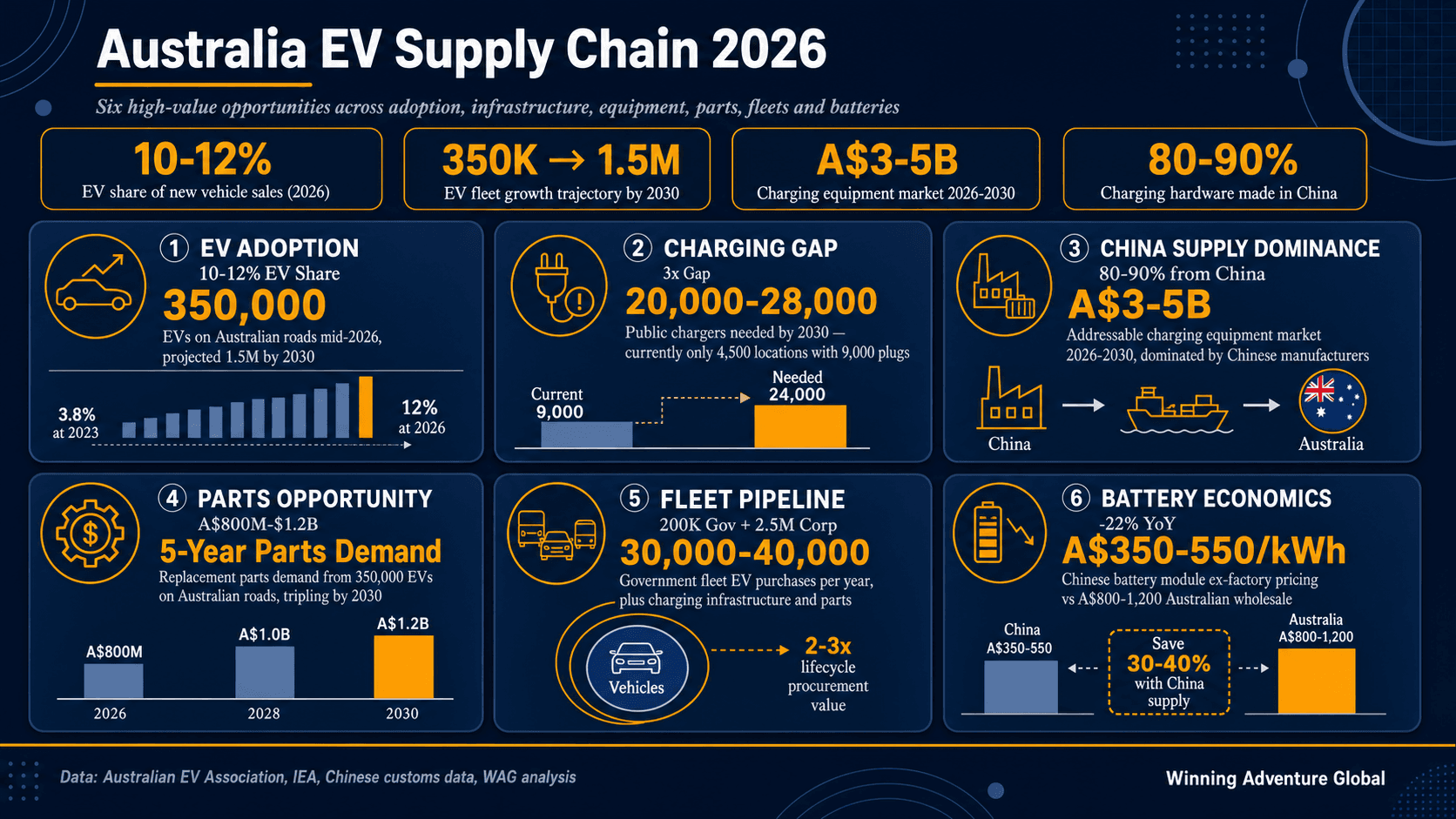
- 1Australia's EV adoption rate reached 10-12% of new vehicle sales in early 2026, but public charging infrastructure covers less than 40% of what is needed for projected 2030 demand
- 2An estimated 75-85% of global EV charging equipment, battery components, and EV replacement parts are manufactured in China
- 3Six supply chain entry points exist for Australian SMEs: charging stations, battery storage, EV parts distribution, fleet conversion services, installation and maintenance, and recycling infrastructure
- 4Australian government fleet electrification targets create a multi-billion-dollar procurement pipeline that extends beyond vehicle purchases into charging infrastructure and ongoing parts supply
- 5Factory verification for EV electrical equipment requires specialised expertise — Australian electrical safety certification, weatherproofing for Australian conditions, and grid compatibility testing
In early 2026, electric vehicles crossed a threshold in Australia that most industry observers did not expect to see until 2028. EV share of new vehicle sales reached 10 to 12 percent nationally, with the ACT exceeding 20 percent. Tesla's Model Y and BYD's Atto 3 and Seal models are now common sights in Australian suburbs. Charging stations are appearing at shopping centres, highway service stops, and apartment building car parks.
The conversation about EVs in Australia has been dominated by which car to buy. That conversation misses the larger opportunity. Every electric vehicle on Australian roads requires physical infrastructure to function: a charging station where it refuels, a battery that stores energy, replacement parts when components wear, and eventually a recycling pathway when the battery reaches end of life. These are not car purchases. They are supply chain transactions — and most of the products involved are manufactured in China.
This article is not about which EV to buy. It is about the supply chain behind every electric vehicle on Australian roads, and the six concrete opportunities available to Australian SMEs who move before the infrastructure gap becomes an infrastructure crisis.
The EV supply chain window is opening now — and it will not stay open forever.
Australian businesses that establish Chinese supplier relationships in 2026 will lock in cost advantages and capacity allocation that late entrants cannot match. Free EV supply chain assessment — no obligation.
Get Free Supply Chain AssessmentAustralia's EV Adoption: The Numbers Behind the Boom
Understanding the supply chain opportunity requires understanding the scale and trajectory of Australia's EV transition.
In the 12 months to March 2026, Australians purchased approximately 120,000 battery electric vehicles, up from 87,000 in the prior 12-month period and 44,000 the year before that. Plug-in hybrids added another 25,000 units. Combined, electrified vehicles represented roughly 14 percent of Australia's 1.1 million new vehicle sales — more than double the 6.8 percent recorded in 2024.
The growth is not evenly distributed. The ACT leads at over 20 percent EV share. New South Wales and Victoria follow at 10 to 12 percent. Queensland, Western Australia, and South Australia sit at 7 to 9 percent but are accelerating faster than the eastern states did at the same stage of adoption. Regional Australia, often dismissed as unsuitable for EVs, is seeing adoption driven by lower per-kilometre running costs and the expansion of highway fast-charging networks.
The policy environment is reinforcing market momentum. The Australian Government's National Electric Vehicle Strategy, the New Vehicle Efficiency Standard legislated in 2024 and taking full effect through 2026, and state-level incentives including stamp duty exemptions and registration discounts in most jurisdictions are collectively pulling forward demand that would otherwise have materialised over a longer period.
The accumulated result: Australia now has approximately 350,000 EVs on its roads, and that number is on track to exceed 500,000 by the end of 2026 and 1.5 million by 2030 under conservative projections. Each of those vehicles needs charging equipment, replacement parts, and eventually a new battery.
The Charging Infrastructure Gap
The most visible supply chain gap in Australia's EV transition is charging infrastructure. As of mid-2026, Australia has approximately 4,500 public charging locations with roughly 9,000 individual charging plugs. About 900 of those are DC fast chargers capable of delivering 50 kilowatts or more. The Australian Electric Vehicle Association estimates that Australia needs between 20,000 and 28,000 public charging plugs by 2030 to support projected EV adoption — roughly triple the current installed base.
The gap is not just about quantity. It is about distribution. Charging infrastructure is concentrated in capital cities and major highways, leaving regional routes, apartment-dense inner suburbs, and tourist destinations underserved. A driver from Adelaide to Broken Hill faces a charging desert. A resident of a pre-2010 apartment building in inner Melbourne may have no practical charging option at all.
The Australian Government has committed A$500 million to charging infrastructure through the Driving the Nation Fund, and state governments have collectively committed another A$300 to A$400 million. Private investment from companies including Chargefox, Evie Networks, BP Pulse, and Tesla's Supercharger network adds billions more. The total addressable market for charging equipment in Australia between 2026 and 2030 is estimated at A$3 to A$5 billion.
Here is the critical detail for Australian importers: an estimated 80 to 90 percent of the charging hardware being installed in Australia is manufactured in China. Not designed in China and assembled elsewhere. Manufactured — from the power electronics and cable management to the external enclosures and payment terminals.
Who Manufactures Australia's EV Charging Equipment
The global EV charging equipment market is dominated by Chinese manufacturers. Companies including Star Charge (Wanbang Digital Energy), TELD (Qingdao TGOOD Electric), Sinexcel, and Increase produce AC and DC charging equipment at volumes that no Western manufacturer can match. These companies supply both branded products and OEM equipment sold under Australian brand names.
| Equipment Category | Dominant Chinese Manufacturers | Approximate China Market Share | Australian Price Range (Imported) |
|---|---|---|---|
| AC Home Chargers (7-22kW) | Star Charge, Increase, Beny | 70-80% | A$450-900 landed |
| AC Commercial Chargers (22kW) | TELD, Star Charge, Sinexcel | 75-85% | A$1,200-2,500 landed |
| DC Fast Chargers (50-150kW) | Sinexcel, TELD, Star Charge | 65-75% | A$18,000-45,000 landed |
| DC Ultra-Fast (150-350kW) | TELD, Star Charge | 55-65% | A$55,000-120,000 landed |
Source: Industry interviews, trade exhibition catalogues (Canton Fair 2025-2026), Chinese customs export data.
An AC home charger that costs A$900 to A$1,500 from an Australian retailer typically has an ex-factory price from a Chinese manufacturer of A$180 to A$320. A 120-kilowatt DC fast charger that costs A$35,000 to A$55,000 from an Australian distributor typically has an ex-factory price of A$11,000 to A$18,000. The spread is not just margin — it reflects the cost of Australian electrical certification, local warranty provision, and the working capital required to hold inventory. But even accounting for those costs, the procurement economics create substantial headroom for Australian SMEs who can manage the supply chain efficiently.
The BYD Melbourne supply chain analysis demonstrates how Australian importers can access the same logistics infrastructure that global manufacturers use — the same shipping lines, ports, and freight forwarders that move EV charging equipment from Shenzhen, Shanghai, and Ningbo to Melbourne, Sydney, and Brisbane every week.
Battery Components: Australia's Missing Middle
Australia occupies a paradoxical position in the global EV battery supply chain. The country mines approximately 50 percent of the world's lithium, largely from Western Australian hard-rock spodumene operations and South American-style brine projects. Australia also produces significant volumes of nickel, cobalt, and manganese — all critical battery materials.
But Australia processes less than 1 percent of the lithium it mines into battery-grade lithium hydroxide or lithium carbonate. The processing happens in China, which controls approximately 65 percent of global lithium refining capacity, 75 percent of cathode production, 85 percent of anode production, and 70 percent of battery cell manufacturing. Australia digs the ore. Ships it to China as spodumene concentrate. Buys back finished batteries at a multiple of the raw material value.
This is well-understood at the national policy level. The Australian Government's 2026-27 Federal Budget committed A$2.5 billion to onshore battery manufacturing through the Future Made in Australia framework, and the Queensland and Western Australian governments have allocated additional funds to attract battery manufacturing investment. But building a domestic battery industry takes years. In the meantime, every battery in every Australian EV — and every battery in every home energy storage system — passes through Chinese factories.
For Australian SMEs, the battery component supply chain offers opportunities that do not require building a gigafactory. Those opportunities fall into three categories.
Battery Materials and Components
Before a battery cell exists, it requires cathode materials (lithium iron phosphate or nickel-manganese-cobalt compounds), anode materials (graphite or silicon-graphite composites), electrolytes, and separators. Chinese manufacturers in Zhejiang, Jiangsu, and Guangdong produce these materials at scale. Australian businesses involved in battery research, specialty manufacturing, or niche energy storage applications can source these materials directly from Chinese producers rather than through international chemical distributors who add markup without adding technical value.
Battery Modules and Packs
Most Australian businesses do not need individual battery cells. They need battery modules or complete packs integrated with battery management systems for specific applications: solar storage, backup power for telecommunications, electric marine propulsion, mining equipment, agricultural machinery. Chinese manufacturers including CATL, BYD, Gotion High-Tech, Eve Energy, and dozens of mid-tier producers supply complete battery modules and packs configured for these applications. The pricing trend is favourable for Australian buyers — battery pack prices declined approximately 22 percent year-on-year in early 2026 due to manufacturing overcapacity in China, a dynamic covered in detail in our analysis of China's EV market decline and its supply chain implications.
Second-Life and Repurposed Batteries
When an EV battery degrades to 70 to 80 percent of its original capacity, it is no longer suitable for vehicle use but retains substantial value for stationary storage applications. Chinese companies are building industrial-scale battery repurposing facilities that test, grade, and repackage used EV batteries for solar storage, grid stabilisation, and backup power. Australian businesses can source these second-life battery systems at 30 to 50 percent of the cost of new equivalent storage, provided they work with suppliers who can demonstrate consistent testing and grading standards. Our complete electric battery sourcing guide covers the compliance and shipping requirements specific to battery imports.
EV Parts and Accessories: The Aftermarket Opportunity
The EV aftermarket is less visible than charging infrastructure or batteries but represents the largest ongoing procurement opportunity. Every EV on Australian roads will need replacement parts over its service life: tyres, brake components, suspension parts, thermal management components, power electronics, and eventually battery replacement.
Chinese manufacturers dominate the EV parts supply chain for the same structural reasons they dominate other automotive categories: manufacturing ecosystem density, scale-driven cost structures, and production capacity that serves both China's enormous domestic EV market and export demand.
The parts categories with the strongest China-sourcing economics include:
Power electronics. Onboard chargers, DC-DC converters, motor controllers, and power distribution units are manufactured in volume across Guangdong and Zhejiang. A motor controller for a mid-range EV that costs A$2,500 to A$4,000 from an OEM parts network typically has an ex-factory price of A$600 to A$1,100 from a Chinese manufacturer.
Thermal management. Battery cooling systems, cabin heat pumps, and thermal management controllers are critical to EV performance in Australian climate conditions. Chinese manufacturers produce components that match or exceed the specifications of European equivalents at 35 to 50 percent lower cost.
Charging cables and connectors. Type 2 and CCS2 cables, portable chargers, and charging adapters are manufactured at scale in China. The landed cost for Australian-compliant charging cables sourced directly from Chinese manufacturers typically runs 40 to 60 percent below Australian wholesale pricing.
Body and interior parts. For the most popular EV models on Australian roads — Tesla Model 3 and Model Y, BYD Atto 3 and Seal, MG4 — Chinese aftermarket manufacturers produce replacement body panels, lighting assemblies, interior trim, and electronic modules. The quality range is broad, from budget parts suited to insurance repair work through to premium components that match OEM specifications.
The parts opportunity is not limited to existing EVs. Australian fleet operators, insurers, and repair networks that establish Chinese parts supply relationships today will have a structural cost advantage as the Australian EV fleet ages and replacement demand grows. The fleet of 350,000 EVs currently on Australian roads will generate an estimated A$800 million to A$1.2 billion in replacement parts demand over the next five years — and that figure triples as the fleet expands to 1.5 million vehicles by 2030.
The EV supply chain window is opening now — and it will not stay open forever.
Australian businesses that establish Chinese supplier relationships in 2026 will lock in cost advantages and capacity allocation that late entrants cannot match. Free EV supply chain assessment — no obligation.
Get Free Supply Chain AssessmentFleet Conversion: The Multi-Billion-Dollar Procurement Pipeline
The most concentrated procurement opportunity in Australia's EV transition is not individual consumers. It is fleet conversion. When a government department or corporation commits to electrifying its vehicle fleet, it does not buy one EV. It buys hundreds or thousands — along with the charging infrastructure to support them, the maintenance contracts to service them, and the parts supply agreements to keep them running.
Australian governments at all levels have committed to fleet electrification targets. The Commonwealth Government's Net Zero in Government Operations Strategy targets 75 percent of new Commonwealth fleet passenger vehicle purchases as low-emissions by 2025 and extends that across the entire fleet through 2030. The NSW Government has committed to transitioning its fleet of more than 13,000 vehicles to electric. The Victorian Government targets 100 percent zero-emission vehicle purchases for its fleet by 2030. Local councils across the country are adopting similar targets.
The total Australian government fleet — Commonwealth, state, and local — comprises approximately 200,000 vehicles. Assuming replacement at a rate of 15 to 20 percent annually, the fleet electrification pipeline represents 30,000 to 40,000 EV purchases per year, plus associated charging infrastructure, for at least the next five years.
The private sector is moving on a similar trajectory. Major fleet operators including Australia Post, Woolworths, Coles, Telstra, and mining companies with light vehicle fleets are executing electrification programs. Corporate Australia operates an estimated 2.5 million fleet vehicles, and even at a conservative 5 percent annual conversion rate, that represents 125,000 fleet EV deployments per year by 2028.
Here is what most procurement discussions miss: the vehicle purchase is the smaller part of the total procurement value over the asset's lifecycle. A fleet of 500 EVs requires approximately 250 to 350 charging stations (assuming a mix of workplace and depot charging), ongoing parts supply for maintenance and repair, battery replacement at the 8 to 12 year mark, and an electrical infrastructure upgrade at the depot site. The total procurement value over a 10-year fleet lifecycle is typically 2 to 3 times the initial vehicle purchase cost. The vehicles themselves are sourced from manufacturers. Everything else — charging stations, electrical infrastructure, parts, batteries — comes through the supply chain. And most of it comes from China.
Six Supply Chain Opportunities for Australian SMEs
The preceding sections describe the landscape. This section describes the specific pathways Australian SMEs can take to participate.
1. Charging Equipment Import and Distribution
The most direct entry point: source AC and DC charging equipment from verified Chinese manufacturers and supply to Australian installers, electricians, property developers, and fleet operators. A business importing even 50 to 100 AC chargers per month can negotiate ex-factory pricing that produces 45 to 60 percent gross margin at current Australian wholesale prices. The key requirements are Australian electrical certification (RCM compliance), local warranty capability, and relationships with the electrical contractors who specify and install charging equipment.
2. Battery Storage System Integration
Rather than importing battery cells, Australian SMEs can source complete battery modules or packs from Chinese manufacturers and integrate them into storage systems for specific applications. A solar installer currently buying battery storage from Australian distributors at A$800 to A$1,200 per kilowatt-hour can source equivalent or better-specified battery modules from Chinese manufacturers at A$350 to A$550 per kilowatt-hour ex-factory. The integration work — battery management system configuration, enclosure fabrication, Australian compliance certification — adds cost but also adds value that justifies the business's margin.
3. EV Parts Wholesale Distribution
The aftermarket parts opportunity favours businesses that establish supplier relationships early. An Australian SME that builds a catalogue of 50 to 100 common EV replacement parts sourced from verified Chinese manufacturers, holds modest inventory in an Australian warehouse, and supplies to repair networks and fleet maintenance operations can build a business on the spread between ex-factory and wholesale pricing. The volume commitment required is modest — an initial order of A$50,000 to A$100,000 across a parts catalogue — and the recurring demand is guaranteed by the expanding Australian EV fleet.
4. Fleet Electrification Consulting and Equipment Supply
Fleet electrification is complex. Fleet managers must evaluate vehicle options, plan charging infrastructure, upgrade electrical capacity at depots, train maintenance staff, and manage the operational transition from liquid fuel to electricity. Most fleet operators lack the internal expertise to manage this transition. An Australian SME that combines technical consulting with equipment supply — charging stations, electrical infrastructure components, maintenance equipment — sourced from Chinese manufacturers can deliver a complete solution rather than a commodity product.
5. Charging Infrastructure Installation and Maintenance
The physical installation of EV charging equipment is inherently local. A Chinese manufacturer cannot send an electrician to Warrnambool or Port Hedland to install a DC fast charger. Australian electrical contractors who develop specialised EV charging installation capability, build relationships with Chinese equipment suppliers, and offer ongoing maintenance contracts are positioning themselves in a market segment where demand will exceed supply for years.
6. Battery Recycling and Repurposing Infrastructure
Australia currently has limited domestic capability for EV battery recycling and repurposing. The Australian Government's A$2.5 billion battery manufacturing investment includes recycling infrastructure, but private sector participation will be essential. Chinese companies including GEM Co., Brunp Recycling (a subsidiary of CATL), and Ganfeng Lithium have developed industrial-scale battery recycling operations that Australian businesses can study, partner with, or source equipment from. An Australian SME that establishes battery collection, testing, grading, and repurposing capability — potentially in partnership with Chinese technology providers — is building infrastructure for a waste stream that will grow from approximately 2,000 tonnes annually in 2026 to an estimated 50,000 to 80,000 tonnes annually by 2035.
Supply Chain Risk and Factory Verification
Every opportunity described above requires the same foundation: confidence that the manufacturer you are sourcing from can deliver equipment that meets Australian standards and performs reliably under Australian conditions. The verification requirements for EV electrical equipment are more demanding than general merchandise sourcing for several reasons.
Electrical safety certification. All active electrical equipment sold in Australia — chargers, power electronics, battery systems with AC connections — must carry the Regulatory Compliance Mark and comply with relevant Australian Standards. Chinese manufacturers routinely present CE, UL, and IEC certifications during procurement discussions. The gap between claimed certification and verified certification is significant: approximately 25 to 30 percent of certificates presented by new Chinese electrical equipment suppliers fail direct verification with issuing bodies. The solution is straightforward but frequently skipped: verify every certification before committing to an order. Our Australia import tips guide covers the documentation Australian importers must confirm before placing international orders.
Grid compatibility. EV charging equipment must interface correctly with Australian electricity grid specifications, which differ from Chinese and European standards. Voltage, frequency stability, power quality, and communication protocol requirements must be confirmed for each product. A charger that works on China's 220-volt 50-hertz grid may not comply with Australian AS/NZS 3000 wiring rules or the specific grid connection requirements of Australian distribution network service providers.
Environmental durability. Australian conditions — extreme heat in the interior, coastal salt exposure, high UV radiation, and in some regions, cyclonic wind loads — subject outdoor electrical equipment to stresses that laboratory testing in temperate climates does not replicate. Charging equipment rated for European conditions may fail prematurely in Port Hedland or Mount Isa. Specification verification must account for Australian environmental conditions, not just international standards.
After-sales support and warranty. When a DC fast charger installed at a regional highway service stop fails, the cost of downtime is measured in lost revenue and stranded drivers. Australian SMEs supplying charging equipment need manufacturer warranty arrangements that cover parts and labour, technical support available during Australian business hours, and spare parts availability that does not depend on sea freight lead times. These requirements must be negotiated and documented before procurement, not discovered after installation.
The common thread across all these risk categories is that remote verification — checking a supplier's claims through websites, video calls, and emailed certificates — is insufficient. Factory verification, either through in-person visits or professional verification services, is the minimum standard for electrical equipment procurement where failure carries safety risk and commercial liability. For related verification methods, our data centre equipment supply chain analysis covers the factory verification requirements for technical infrastructure equipment in comparable detail.
Frequently Asked Questions
How fast is Australia's EV adoption actually growing?
EVs represented approximately 10 to 12 percent of Australian new vehicle sales in early 2026, up from roughly 7 percent in 2024 and 3.8 percent in 2023. The growth rate is approximately 40 to 50 percent year-on-year. At current trajectory, EVs are projected to reach 20 to 25 percent of new sales by 2028 and 40 to 50 percent by 2030. The fleet of EVs on Australian roads is approximately 350,000 as of mid-2026 and projected to exceed 1.5 million by 2030.
Why does most EV equipment come from China?
Structural factors that developed over two decades: Chinese manufacturers invested early and heavily in EV supply chain production capacity, China's domestic EV market (the world's largest at 60 percent of global sales) created enormous demand that supports manufacturing scale, and the manufacturing ecosystem density in provinces like Guangdong and Zhejiang compresses supply chain costs and lead times. An EV charger manufacturer in Shenzhen sources power electronics from a supplier 40 kilometres away, metal enclosures from a fabricator 30 kilometres away, and ships finished product through Yantian port 60 kilometres away. This geographic density is difficult to replicate elsewhere.
What Australian standards apply to imported EV charging equipment?
EV charging equipment must comply with AS/NZS 3000 (Wiring Rules), AS/NZS 3008 (cable selection), AS/NZS 4777 (grid connection of energy systems), and product-specific standards including AS IEC 61851 (EV conductive charging systems) and AS IEC 62196 (plugs, socket-outlets, and vehicle connectors). Active electrical equipment must carry the Regulatory Compliance Mark. Charging stations with embedded payment or communication systems may have additional requirements under Australian communications regulations.
How much can Australian businesses save by sourcing EV equipment from China?
Cost savings vary by equipment category. AC home chargers: 45 to 60 percent below Australian wholesale on a landed basis. Commercial AC chargers: 40 to 55 percent. DC fast chargers: 35 to 50 percent. Battery modules for stationary storage: 40 to 55 percent. EV replacement parts: 35 to 60 percent depending on component complexity. These savings assume direct factory relationships, consolidated shipping, and Australian compliance certification managed by the importer.
What are the lead times for EV equipment from China?
Standard AC charging equipment: 2 to 4 weeks from order to Australian port. DC fast charging equipment: 4 to 8 weeks. Battery modules and packs: 6 to 10 weeks depending on specification. Custom or high-volume orders add 2 to 4 weeks. Air freight can reduce shipping time to 5 to 7 days for urgent requirements at approximately 3 to 5 times sea freight cost. Australian businesses should build 3 to 4 weeks of schedule margin into procurement timelines for first orders with new suppliers.
Is it realistic for a small Australian business to compete in the EV supply chain?
Yes, particularly for businesses that specialise in one or two equipment categories rather than attempting to cover the full spectrum. An electrical contractor adding AC charger supply to its service offering does not need to compete with national charging network operators. An auto parts distributor adding EV-specific components to its catalogue does not need to build a gigafactory. The EV supply chain has entry points at every scale, from sole traders installing residential chargers through to national distributors supplying fleet operators. Our experience with more than 200 Australian SMEs sourcing from China confirms that the supply chain is accessible to businesses of all sizes when approached systematically.
How do I verify that a Chinese EV equipment manufacturer is legitimate?
Verify business licenses through China's National Enterprise Credit Information Publicity System. Confirm manufacturing capability through factory visits — either in person or through professional verification services. Check electrical safety certifications directly with issuing bodies, not from copies provided by the supplier. Request and independently verify customer references in comparable markets (Australia, New Zealand, or countries with similar electrical standards). Assess production facility, testing equipment, and quality management documentation. A supplier that refuses a factory visit should be eliminated from consideration for electrical equipment procurement.
What is the difference between AC and DC EV charging equipment for procurement purposes?
AC chargers deliver alternating current to the vehicle's onboard charger, which converts it to direct current for the battery. They are simpler, cheaper (A$450-2,500 landed), and manufactured by a larger number of Chinese factories. DC fast chargers convert AC to DC externally and deliver high-power direct current directly to the battery. They are technically complex, more expensive (A$18,000-120,000 landed), and manufactured by a smaller number of specialised Chinese producers. AC charger procurement is accessible to SMEs with general electrical product experience. DC charger procurement requires deeper technical verification and higher working capital.
When should Australian businesses enter the EV supply chain?
Now. Supplier capacity is not unlimited, and the businesses that establish relationships, verify manufacturers, and build inventory positions in 2026 will have structural advantages that late entrants cannot replicate. The charging infrastructure gap is widening. Fleet electrification procurement is accelerating. The Australian EV fleet is growing by approximately 10,000 vehicles per month. Each month of delay means more Australian demand is being served by established importers, more supplier production capacity is being allocated to existing customers, and more market share is being claimed by competitors who moved earlier. The window is open. It will not stay open indefinitely.
How does Winning Adventure Global help with EV supply chain procurement?
We provide factory verification, production monitoring, quality inspection, and logistics coordination for Australian businesses sourcing EV-related equipment from Chinese manufacturers. Our verification process includes business license checks, facility inspection, electrical certification validation, product testing coordination, and on-ground production monitoring. We do not take orders on your behalf or add markup to your procurement. We verify suppliers and support your direct relationship with manufacturers — giving you confidence that the equipment you order will meet Australian standards and perform as specified.
The EV Supply Chain Window Is Open Now
Australia's EV transition has reached a point where the supply chain opportunity is larger than the vehicle purchase opportunity. Every one of the 350,000 EVs currently on Australian roads — and every one of the 1.5 million projected by 2030 — requires charging equipment, replacement parts, and eventually a new battery. Most of that equipment is manufactured in China. Most of it is imported through supply chains that Australian SMEs can access today.
The barrier to entry is not capital or connections. It is the capability to identify the right equipment categories, verify the right manufacturers, and manage the procurement, compliance, and logistics process from factory to Australian delivery. These are learnable capabilities — but they are easier to develop with experienced support, and they are easier to develop before demand peaks than after.
More than 200 Australian SMEs have used our sourcing and verification network to establish Chinese supplier relationships across infrastructure, industrial equipment, and automotive categories. The businesses among them that entered the EV supply chain in 2024 and 2025 are now scaling procurement volumes as Australian demand accelerates. The businesses that enter in 2026 will capture the next phase of growth. The businesses that wait until 2027 or 2028 will find that the best supplier relationships, the most favourable pricing, and the largest procurement contracts have already been allocated to earlier entrants.
If you are evaluating EV equipment suppliers in China, or if you want to understand whether your business can participate in the EV supply chain, Winning Adventure Global offers a free initial consultation to assess your situation. We will tell you directly which equipment categories match your business capabilities, what verification steps are essential for those categories, and what a realistic procurement timeline and cost structure look like.
Get Your Free EV Supply Chain Assessment
This article is part of our ongoing coverage of supply chain opportunities for Australian businesses. For related content, see our analysis of BYD's Zhengzhou-Melbourne supply chain, the Australia data centre equipment supply chain, and our essential guide to Australian import requirements.
Supply Chain & Trade Policy
The EV supply chain window is opening now — and it will not stay open forever.
Australian businesses that establish Chinese supplier relationships in 2026 will lock in cost advantages and capacity allocation that late entrants cannot match. Free EV supply chain assessment — no obligation.
Get Free Supply Chain AssessmentFree initial consultation · We respond within 4 business hours