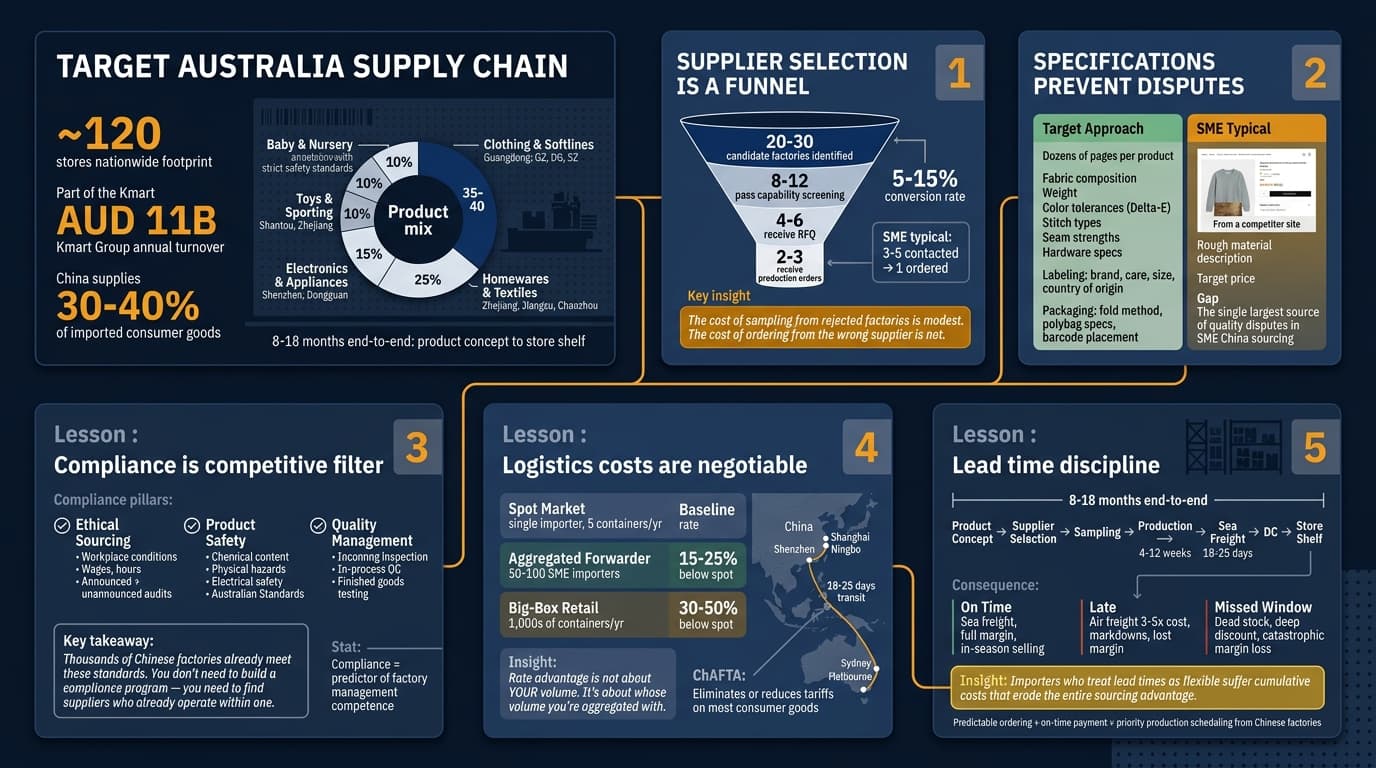
Target Australia occupies a peculiar position in the country's retail landscape. It is neither the cheapest discount department store -- that title belongs to its sibling Kmart -- nor the most premium, a space Myer and David Jones compete over. Instead, Target sits in what retail analysts call the "mid-market squeeze," offering clothing, homewares, electronics, toys, and baby products at price points above Kmart but below department store premium lines. With approximately 120 stores nationwide and annual revenue contributing significantly to the Kmart Group's roughly AUD 11 billion turnover, Target moves an enormous volume of product through Australian retail channels every year.
What makes Target relevant to Australian SME importers is not its brand positioning or store count. It is the supply chain behind the shelves. Target Australia sources thousands of stock-keeping units from manufacturing hubs across China, Bangladesh, Vietnam, and India, with Chinese factories supplying the largest share by volume and value. The procurement machinery that feeds those 120 stores -- the supplier selection, the compliance infrastructure, the logistics network, the inventory management -- represents a working template for how products move from factory floors in Guangdong and Zhejiang to retail shelves in Melbourne and Brisbane.
Australian SME importers who understand how this supply chain works can extract lessons that apply directly to their own sourcing operations. You do not need Target's purchasing volume to benefit from its procurement discipline.
Struggling to compete with big-box retail on price?
Winning Adventure Global helps Australian SMEs build supply chains that reduce costs without sacrificing quality. Our China-based team verifies factories, negotiates terms, and manages production — so you get big-retail sourcing economics at your scale.
Book a free sourcing assessmentTarget Australia's Product Mix and What It Reveals About Sourcing
Target's merchandise strategy divides into five broad categories that collectively drive its sourcing decisions. Understanding this product mix illuminates why certain Chinese manufacturing regions dominate particular categories, and how product characteristics shape supplier selection.
Clothing and softlines represent the largest category, accounting for approximately 35 to 40 percent of Target's floor space and revenue. This includes men's, women's, and children's apparel, footwear, accessories, and underwear. The supply base for this category concentrates heavily in Guangdong province -- particularly Guangzhou, Dongguan, and Shenzhen -- where decades of garment manufacturing have created dense clusters of factories, fabric mills, trim suppliers, and logistics providers. Target's clothing suppliers typically operate at annual production volumes exceeding AUD 5 million, with dedicated production lines, in-house pattern-making, and compliance certifications covering ethical sourcing, chemical safety, and quality management.
Homewares and home textiles form the second-largest category at roughly 25 percent of the mix. This spans bedding, towels, kitchenware, dinnerware, home decor, furniture, and storage solutions. The supplier geography is more varied than clothing: textiles concentrate in Zhejiang and Jiangsu provinces, ceramics and glassware in Guangdong's Chaozhou region, and furniture across both Guangdong and Fujian. The category's sourcing complexity is higher than clothing because it spans multiple manufacturing technologies -- weaving, injection moulding, ceramics firing, woodworking -- each requiring different supplier qualification criteria.
Electronics, entertainment, and small appliances make up approximately 15 percent of Target's offering. This category is dominated by Shenzhen and Dongguan manufacturers, reflecting the Pearl River Delta's concentration of electronics component supply chains. Target's electronics suppliers must navigate compliance requirements that are among the most stringent in retail: Australian electrical safety standards, electromagnetic compatibility, energy efficiency labelling, and e-waste regulations. The compliance burden is high, which has a filtering effect -- smaller factories without dedicated compliance teams cannot economically serve this category.
Toys, sporting goods, and seasonal products occupy roughly 10 percent, with supplier concentrations in Shantou (Guangdong) for toys and broader Zhejiang manufacturing clusters for sporting goods. The baby and nursery category rounds out the mix at approximately 10 percent, with strict safety standards creating high barriers to supplier entry.
For Australian SME importers, the product mix analysis contains an actionable insight: the supplier clusters that serve Target are the same clusters available to smaller buyers, provided the importer can meet minimum order quantities and compliance expectations. The factories that produce for Target do not exclusively serve Target -- they maintain relationships with buyers of varying sizes. Understanding which manufacturing clusters produce which categories makes supplier discovery more targeted and efficient.
What to do
When researching suppliers for a product category, identify which Chinese manufacturing cluster dominates that category in Australia's retail supply chain. Guangdong for garments and electronics, Zhejiang for textiles and hardware, Fujian for stone and ceramics. Searching within the correct cluster dramatically improves supplier quality compared to platform-wide searches without geographic filtering.
How the Big-Box Retail Supply Chain Actually Works
Target Australia's supply chain follows a model that is standard across Australian big-box retail -- Kmart, Big W, and to some extent Bunnings operate variations of the same structure. Understanding this model matters because it shapes the supplier landscape that SME importers also navigate. When Target changes supplier requirements, those changes cascade through the factories that serve Australian retail broadly.
The model begins with a merchandising team in Target's Melbourne head office that determines which products to range for upcoming seasons. Category buyers develop product briefs specifying design, materials, quality standards, target retail price, and projected volumes. These briefs go to Target's sourcing offices -- some in-house, some through third-party buying agents -- located in Shanghai, Shenzhen, and Hong Kong.
The sourcing offices identify candidate factories, issue requests for quotation, and coordinate the sampling process. A typical product development cycle runs 6 to 12 months for seasonal categories like apparel, and 3 to 6 months for replenishment categories like basic homewares. Factories produce samples, samples are reviewed and revised, and once approved, production orders are issued.
The production cycle itself -- factory floor to container loading -- runs 4 to 12 weeks depending on product complexity, factory capacity, and raw material availability. Consolidation warehouses in Shenzhen and Shanghai combine orders from multiple factories into full container loads bound for Target's Australian distribution centres. Sea freight transit from Chinese ports to Melbourne or Sydney takes 18 to 25 days, followed by customs clearance, quarantine inspection where applicable, and road transport to distribution centres.
From distribution centres, products are allocated to individual stores based on sales data, store format, and local demographics. Target's inventory management system -- integrated within the Wesfarmers retail technology platform -- uses demand forecasting algorithms to determine reorder quantities and timing.
The entire chain, from product concept to store shelf, typically spans 8 to 18 months. For Australian SME importers accustomed to 6 to 12 week sourcing timelines, the extended planning horizon of big-box retail reveals an important lesson: lead time discipline is not an option at this scale. Late deliveries mean empty shelves, lost revenue, and markdowns on seasonal product that arrives after its selling window.
The Bunnings-Wesfarmers merger integration, which is currently restructuring procurement across Wesfarmers' retail brands, provides a parallel case study in how retail consolidation affects supplier relationships. For a detailed examination of those dynamics, see our analysis of the Bunnings Wesfarmers merger supply chain impact.
5 Supply Chain Lessons for Australian SME Importers
Target's supply chain is not simply a larger version of what an SME importer does. The scale creates qualitatively different dynamics. But the underlying principles -- how suppliers are selected, how quality is managed, how logistics are structured -- contain lessons that apply regardless of order volume. The five lessons below are drawn from how Target and comparable retailers manage their China sourcing operations, adapted to the scale and resources of Australian SME importers.
Lesson 1: Supplier Selection Is a Funnel, Not a Search Result
When Target identifies a new supplier, the process typically begins with 20 to 30 candidate factories identified through sourcing offices, trade fairs, and industry referrals. That list narrows to 8 to 12 factories that pass initial capability screening -- verified business licenses, export history, production capacity, and client references. After factory audits, 4 to 6 receive requests for quotation. After sample evaluation and commercial negotiation, 2 to 3 may receive production orders. The conversion rate from initial candidate to active supplier runs between 5 and 15 percent.
Most SME importers operate a dramatically shorter funnel. They search on Alibaba or Made-in-China, contact 3 to 5 suppliers, request quotes from 2 or 3, and place an order with 1. The problem is not that this approach cannot work -- many businesses have built successful supplier relationships this way. The problem is that compressing the funnel increases the probability of selecting a supplier who looked good on a platform profile but cannot actually deliver.
The lesson: widen the supplier identification phase. Identify 10 to 15 candidate factories before narrowing. Request samples from at least 3 before committing to a production order. The cost of sampling from factories you do not ultimately select is modest compared to the cost of placing a production order with the wrong supplier.
Sourcing Discipline
Factories that survive a competitive selection process -- where they know other candidates are being evaluated -- tend to perform better on pricing, quality, and communication than factories that believe they have won the business by default. A wider funnel creates competitive tension that benefits the buyer.
Lesson 2: Specifications Prevent Disputes, Not Conversations
Target's product specifications run to dozens of pages for complex products and several pages even for simple items. A garment specification includes fabric composition, weight, colour references with lab-tested Delta-E tolerances, stitch types and counts, seam strengths, hardware specifications, labelling requirements (brand label, care label, size label, country of origin), packaging specifications (folding method, insert card, polybag material and thickness, barcode placement), and carton markings.
The typical SME importer's specification often consists of a product photo from a competitor's website, a rough material description, and a target price. The gap between these two approaches to specification is the single largest source of quality disputes in SME China sourcing.
The lesson: invest in specification detail upfront. A one-page specification that covers dimensions, materials, colours (with reference standards), packaging, and labelling prevents more disputes than weeks of back-and-forth communication after the wrong product arrives. The specification is not a conversation starter. It is a contract.
Lesson 3: Compliance Is Not a Cost Centre -- It Is a Competitive Filter
Target Australia, like all major Australian retailers, imposes compliance requirements on its Chinese suppliers that cover ethical sourcing (workplace conditions, wages, working hours), product safety (chemical content, physical hazards, electrical safety), environmental management (wastewater treatment, chemical disposal), and quality management (incoming material inspection, in-process quality control, finished goods testing).
These requirements are not optional. Target's supplier code of conduct is enforced through announced and unannounced factory audits -- audits conducted by third-party firms with local Chinese offices that understand how to identify non-compliance even when factories attempt to conceal it. Factories that fail audits lose their approved status and their access to Target orders.
For SME importers, the compliance infrastructure that Target maintains may seem irrelevant -- you are not a billion-dollar retailer, and your suppliers will not submit to the same audit regime. But the compliance ecosystem that big-box retail has created in Chinese manufacturing matters for two reasons.
First, it means there are thousands of Chinese factories that already meet international compliance standards, maintain auditable records, and understand what Australian buyers expect. These factories exist. They can be identified and engaged by SME importers. You do not need to build a compliance programme -- you need to find suppliers who already operate within one.
Second, the compliance differential between factories that serve Australian retail and those that do not is a quality signal. A factory that maintains ethical sourcing certifications, product testing protocols, and quality management systems is statistically far more likely to deliver conforming product on schedule than a factory that does not. Compliance is not a bureaucratic exercise. It is a predictor of factory management competence.
Lesson 4: Logistics Cost Structures Are Negotiable at Lower Volumes Than You Think
Target negotiates ocean freight rates based on annual container volumes measured in the thousands. This volume leverage produces per-container rates that are 30 to 50 percent below what a small importer shipping 5 containers per year would pay on the spot market. The rate gap is real and structural.
But the gap narrows when importers engage freight forwarders with consolidated buying power. A mid-sized freight forwarder serving 50 to 100 Australian SME importers can aggregate volume that approaches meaningful negotiation leverage with shipping lines. The forwarder passes a portion of the volume discount to its clients. The importer who ships 5 containers per year through the right forwarder may pay rates 15 to 25 percent below spot market -- not Target's rate, but far better than the published tariff.
The lesson: logistics cost advantage is not purely a function of your own volume. It is a function of whose volume you are aggregated with. An importer shipping modest volumes through a forwarder that specialises in the China-Australia route and aggregates significant total volume will achieve materially better rates than an importer buying shipping on a transactional basis. For foundational guidance on navigating Australian import logistics, see our Australia import tips guide.
Lesson 5: Lead Time Discipline Determines Whether You Are a Business or a Hobby
Target's supply chain operates on lead times measured in months, with seasonal product development starting a year or more before the product reaches shelves. The discipline this requires -- locked specifications, confirmed production slots, booked shipping, allocated distribution centre capacity -- is non-negotiable. A factory that misses a production window for a seasonal product creates a cascade of costs: air freight instead of sea freight (3 to 5 times more expensive), markdowns on product that arrives late, and lost margin on product that misses the season entirely.
Most SME importers do not face the same consequences from late deliveries. A shipment that arrives 3 weeks late may mean a temporary stock-out rather than a catastrophic seasonal miss. But the pattern is instructive: importers who treat lead times as flexible suffer cumulative costs -- rush production charges, premium freight, lost sales during stock-outs -- that erode the sourcing cost advantage they are trying to capture.
The lesson: build lead time buffers into your planning, communicate production timelines clearly to suppliers, and treat the agreed delivery date as a commitment rather than an estimate. Australian importers who develop a reputation for predictable ordering and on-time payment receive better treatment from Chinese factories -- priority production scheduling, first access to capacity, and more willingness to accommodate last-minute changes -- than importers who are perpetually rushing.
Struggling to compete with big-box retail on price?
Winning Adventure Global helps Australian SMEs build supply chains that reduce costs without sacrificing quality. Our China-based team verifies factories, negotiates terms, and manages production — so you get big-retail sourcing economics at your scale.
Book a free sourcing assessmentWhat Target's Supply Chain Means for Australian SME Importers
The practical question most Australian SME importers face is not whether they should copy Target's supply chain -- that is not possible at a fraction of the volume. The question is what specific elements of Target's procurement model can be adapted to smaller-scale operations, and where SME importers have structural advantages that big-box retail cannot replicate.
The elements worth adapting are the ones described in the five lessons above: a wider supplier selection funnel, detailed specifications, supplier compliance verification, aggregated logistics purchasing, and lead time discipline. None of these requires Target's volume. All of them require attention and process investment that many SME importers skip because they seem optional. They are not optional. They are what separates professional import operations from the hobbyists who eventually lose money and quit.
The structural advantages that SME importers hold over big-box retail are equally important to understand. Big-box retail sourcing is optimised for volume, consistency, and cost -- not for speed, flexibility, or uniqueness. An SME importer can place a trial order of 500 units with a factory that Target would never consider because the volume is too small for their planning cycle. An SME importer can identify a trending product and have stock on the water in 8 weeks, while Target's product development cycle means the trend may have peaked before their product reaches shelves. An SME importer can build a brand identity around a specific niche -- Australian-designed homewares, ethically produced children's clothing, performance outdoor gear -- that a mass-market department store cannot credibly occupy.
The strategic position for Australian SME importers is not to compete with Target on price. It is to compete on dimensions where big-box retail's scale creates rigidity: speed, curation, storytelling, and customer relationship. The supply chain elements borrowed from Target's model -- the sourcing discipline, the specification rigour, the compliance awareness -- create a foundation of cost efficiency and quality reliability. The differentiation elements -- niche, brand, speed, service -- create the competitive advantage that makes the business worth running.
This strategic approach becomes particularly relevant as Australian retail wages continue rising. For an examination of how China sourcing can offset domestic cost pressures, see our analysis of how China sourcing strategies offset the 2026 minimum wage rise.
Frequently Asked Questions
Is Target Australia connected to the American Target stores?
No. Target Australia and Target Corporation (United States) are completely separate companies with no ownership connection. Target Australia is owned by Wesfarmers Limited, an Australian conglomerate, through its Kmart Group division. The Target brand name in Australia was originally licensed from the American company decades ago, but the licensing arrangement ended and Target Australia now operates independently. The two retailers have different product ranges, different suppliers, different store formats, and different supply chains. The American Target has no presence in the Australian market.
What portion of Target Australia's products come from China?
While Target Australia does not publicly disclose exact sourcing percentages by country, China is the largest single source of products by both volume and value, consistent with the broader Australian retail sector where China accounts for approximately 30 to 40 percent of imported consumer goods. The concentration is highest in clothing, home textiles, electronics, toys, and hardgoods categories where Chinese manufacturing clusters offer integrated supply chains that competing sourcing countries cannot yet match. Bangladesh and Vietnam are significant secondary sources for apparel, and India is growing as a source for home textiles. The China-Australia Free Trade Agreement, which eliminates or reduces tariffs on most consumer goods, reinforces China's position as the dominant sourcing country for Australian department store retail.
Can a small Australian business supply products to Target Australia?
Yes, but the pathway is specific and the barriers are real. Target Australia, like most large retailers, maintains a formal supplier registration and onboarding process. Prospective suppliers must demonstrate financial stability, production capacity sufficient to supply Target's order volumes (which are typically higher than what a small business initially expects), compliance with Target's ethical sourcing and product safety standards, and the ability to integrate with Target's electronic data interchange (EDI) systems for ordering and invoicing. Small businesses that successfully supply Target typically start by serving a niche category or a regional store pilot before expanding to broader distribution. The most common mistake small businesses make when approaching Target is underestimating the compliance burden and the working capital required to fund production before Target's payment terms kick in. Working with a sourcing partner that understands Target's supplier requirements can help small businesses prepare for the supplier qualification process.
How do Target's supplier compliance requirements compare to other Australian retailers?
Target's supplier compliance requirements are broadly similar to those of Kmart (its sister brand), Big W, and Myer. All major Australian retailers require suppliers to meet ethical sourcing standards covering wages, working hours, workplace safety, and environmental management at minimum, and most require product safety testing to Australian standards. Where Target differs from discount competitors like Kmart is in quality expectations -- Target's mid-market positioning means its acceptable quality limits (AQLs) are typically stricter than Kmart's for comparable product categories. Suppliers serving Target should expect more stringent quality inspection standards, particularly for apparel and homewares where fabric quality, stitching, and finishing are subject to closer scrutiny than in the pure discount segment.
What shipping routes do Target Australia's Chinese suppliers typically use?
Target Australia's Chinese suppliers predominantly ship via ocean freight from the major container ports of Shenzhen (Yantian and Shekou terminals), Shanghai, and Ningbo. Shenzhen handles the majority of Guangdong-manufactured goods including electronics, toys, and garments. Shanghai and Ningbo serve Zhejiang and Jiangsu manufacturers producing home textiles, hardware, and homewares. Transit times to Australian ports are 18 to 25 days depending on the specific port pair, with Melbourne and Sydney receiving the largest share of container volume. For urgent replenishment or late seasonal product, some shipments move via air freight through Hong Kong, Shenzhen, or Guangzhou airports, though the cost premium restricts air freight to a small fraction of total volume. Australian SME importers using the same port pairs benefit from the established shipping infrastructure and the availability of freight forwarders with China-Australia route expertise.
How has Target Australia's supply chain changed since the Wesfarmers acquisition of Kmart Group?
Target Australia has been part of Wesfarmers since 2007, when Wesfarmers acquired the Coles Group which included Target at that time. The more significant supply chain changes came through the 2016 to 2020 restructuring, when Wesfarmers consolidated Target and Kmart under a single Kmart Group division with shared back-office functions including procurement, logistics, and technology platforms. This restructuring saw many Target stores converted to Kmart format or closed entirely, reducing store count from approximately 300 to the current approximately 120. The supply chain impact included supplier rationalisation -- overlapping suppliers serving both Kmart and Target saw their relationships consolidated -- and increasing use of shared distribution infrastructure. The ongoing Bunnings-Wesfarmers merger integration, which covers procurement consolidation across Wesfarmers' retail portfolio, is extending similar dynamics to the hardware segment.
Australian Retail & Import
Struggling to compete with big-box retail on price?
Winning Adventure Global helps Australian SMEs build supply chains that reduce costs without sacrificing quality. Our China-based team verifies factories, negotiates terms, and manages production — so you get big-retail sourcing economics at your scale.
Book a free sourcing assessmentFree initial consultation · We respond within 4 business hours