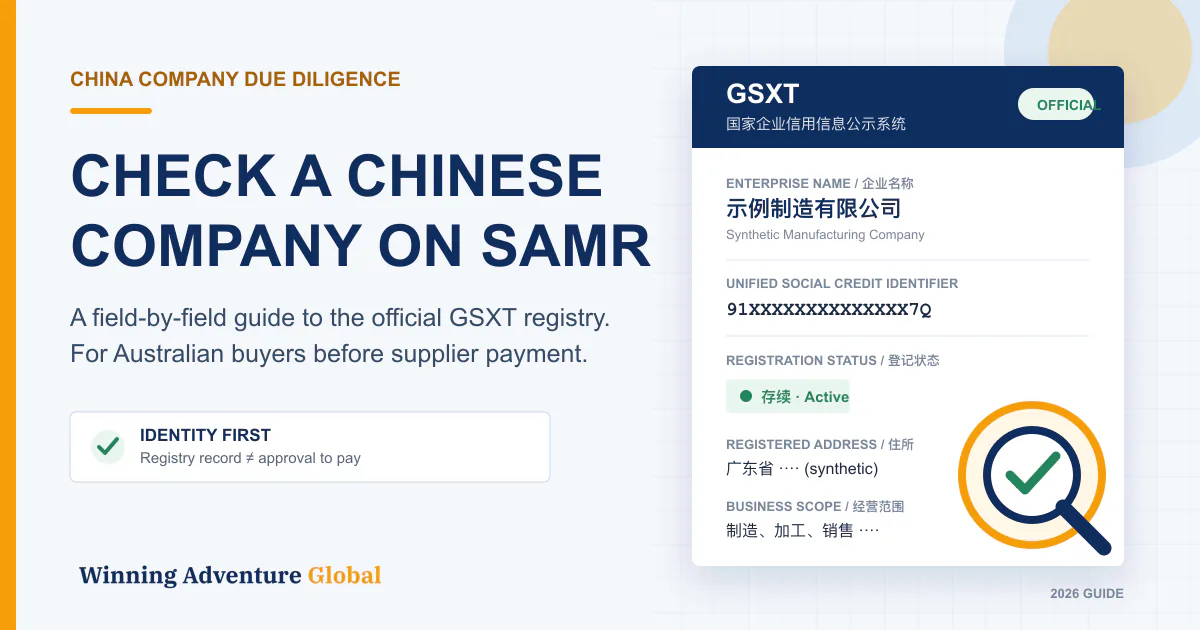
Key Takeaways
- 1SAMR is the regulator; the public company-search system Australian buyers use is GSXT
- 2Search with the exact Chinese legal name or the 18-character Unified Social Credit Identifier
- 3Compare the registry record with the business licence, contract, invoice, and bank beneficiary before payment
- 4A manufacturing-related business scope supports a supplier's claim but does not prove it owns or operates a factory
- 5An active registration confirms that the registry contains a matching legal-entity record, not that the supplier is capable, trustworthy, or safe to pay
Before you pay a Chinese supplier, ask for two things: its exact legal company name in Chinese and its Unified Social Credit Identifier. Then compare both against China's official public company record.
This check is often described as a "SAMR search." More precisely, the State Administration for Market Regulation (SAMR) oversees the company registration system, while the public search portal is the National Enterprise Credit Information Publicity System, known by its Chinese abbreviation, GSXT.
A GSXT record can confirm that a legal entity is recorded under a particular name, identifier, address, status, and business scope. It cannot tell you whether the supplier owns the factory in its photos, can meet your specifications, or is safe to pay. Treat the registry check as an identity check at the start of supplier verification, not as approval to place an order.
How to Check a Chinese Company on the Official GSXT System
Start with information supplied by the company itself. A storefront name, English trading name, email signature, or marketplace brand is not enough. Chinese registry records are tied to the legal name in Chinese and the Unified Social Credit Identifier shown on the business licence.
1. Collect the legal search details
Ask the supplier for:
- Its full Chinese legal company name
- Its 18-character Unified Social Credit Identifier
- A current copy of its business licence
Keep the original files and message thread. If the supplier sends a cropped licence, ask for the full document with all fields visible. The copy is an input to the check, not proof by itself.
2. Open the official GSXT domain
Use the official government portal at gsxt.gov.cn. Check the domain before entering company details because commercial company-search sites can look official in search results.
Access conditions can change. The site may present a verification challenge, rate limit, regional page, or session error. Do not assume an English interface will be available, and do not treat a temporary access failure as evidence that the company does not exist.
3. Search by the Chinese name or identifier
The Unified Social Credit Identifier is usually the cleanest input because names can have similar characters, abbreviations, or regional variants. If the code returns no usable result, search the exact Chinese legal name as printed on the licence.
Avoid translating the English company name back into Chinese. A supplier may trade under a brand that bears little resemblance to the registered entity.
4. Open the matching entity record
Do not stop at a list of similar names. Open the record and compare at least the legal name, identifier, registration status, address, establishment date, legal representative, and business scope.
If several entities have similar names, the Unified Social Credit Identifier should distinguish them. If the code on the licence belongs to a different name, pause the transaction and ask the supplier to explain the mismatch in writing.
5. Record what you checked
Save a dated screenshot or PDF of the relevant fields and note the date of the search. Registration data can change, and a saved record lets your team show what was reviewed before a contract or payment was approved.
For a meaningful audit trail, record the input used, the matching result, any mismatch, who resolved it, and the evidence accepted. A screenshot with no search date or transaction context is hard to use later.
How to Read a GSXT Company Record
The labels below are the fields an Australian buyer is most likely to compare. The precise display can vary by entity type and local registration authority.
| Chinese field | English meaning | What to compare | What it does not prove |
|---|---|---|---|
| 企业名称 | Registered company name | Business licence, contract, invoice, bank beneficiary | That the company is the factory in its marketing |
| 统一社会信用代码 | Unified Social Credit Identifier | Licence, contract header, invoice, company records | That the entity is active, capable, or trustworthy |
| 登记状态 | Registration status | Current status and any abnormal or deregistration notation | That an active company is safe to pay |
| 法定代表人 | Legal representative | Licence and formal company documents | That this person is your salesperson or account contact |
| 住所 / 注册地址 | Domicile or registered address | Licence, contract, supplier explanation, physical site | That production takes place at that address |
| 成立日期 | Establishment date | Supplier history claims and dated documents | Experience in your product or export market |
| 注册资本 | Registered capital | The record and claims made during due diligence | Cash on hand, solvency, or production capacity |
| 经营范围 | Business scope | Claimed role, product category, manufacturing or trading activities | Ownership of machinery, staff, or a factory |
| 登记机关 | Registration authority | Issuing authority shown on the licence | Product compliance or export approval |
Read the status before reading the sales story
Status wording is not perfectly uniform across every province and entity type, but several categories deserve different treatment.
| Status or notation | Practical reading for a buyer | Next step |
|---|---|---|
| 存续 / 在业 / 开业 | The entity appears registered as operating | Continue the remaining checks; do not treat this as payment approval |
| 经营异常名录 | The entity has been listed for a registration or reporting issue | Read the reason and date, request an explanation, and confirm whether it was remedied |
| 吊销 | The business licence has been revoked | Do not contract or pay without specialist legal review and a documented resolution |
| 注销 | The entity has been deregistered | Do not contract with or pay that entity |
| 迁入 / 迁出 or another transition notation | The file may be moving between registration authorities | Confirm the current record, address, and effective dates before proceeding |
An abnormal-operation notation is not the same as deregistration. It can arise from matters such as an annual-report issue or an address problem, but the reason still matters. Read the actual entry instead of collapsing every non-standard status into "fraud."
The reverse is also true: a normal status does not confirm the company pays its debts, controls a production site, or will perform your contract.
What the Unified Social Credit Identifier Tells You
The Unified Social Credit Identifier (统一社会信用代码) is the 18-character identifier used for registered organisations in China. It contains numbers and permitted letters, so "18-digit code" is inaccurate.
At a high level, the characters encode the registering authority category, entity type, administrative division, organisation identifier, and a final check character. The governing coding rules are set out in Chinese national standard GB 32100-2015.
For a buyer, the identifier has three useful jobs:
- It reduces confusion between companies with similar names.
- It lets you match a business licence to the official record.
- It gives you one stable identifier to compare across due-diligence files.
A code that fails the expected format deserves investigation, but a code that looks valid proves very little on its own. Someone can copy a valid identifier from another company. The useful test is whether the identifier opens the matching official record and whether that legal entity is the one named throughout your transaction.
Do not compare only the last few characters. Compare all 18 characters, especially when the licence was supplied as a low-resolution image.
Registration Findings That Require Further Checks
Most mismatches have more than one possible explanation. The job is to resolve the explanation before payment, not to guess which one applies.
| Finding | Possible explanation | Next action |
|---|---|---|
| No result appears | Typo, wrong legal name, query friction, recent change, or an entity that cannot be reconciled | Search both the exact Chinese name and identifier; request a full licence; do not pay while the entity remains unresolved |
| English brand differs from the Chinese entity | Normal trading name, group brand, affiliate, or impersonation | Ask who owns the brand and ensure the contracting entity is identified in writing |
| Licence name differs from the GSXT result | Old document, corporate change, altered document, or wrong entity | Request a current licence and supporting change record; compare dates and identifiers |
| Business scope has no manufacturing language | Trading company, outsourced manufacturing, narrowly or broadly drafted scope | Ask for the actual manufacturer's legal entity and verify the production site separately |
| Registered address differs from the claimed factory | Office registration, branch site, moved premises, leased factory, or undisclosed intermediary | Obtain the production address and evidence linking the registered entity to that site; verify it remotely or on the ground |
| Company is newly established | New venture, restructuring, new subsidiary, or limited operating history | Check who owns the operation, prior entities, staff, equipment, contracts, and order-specific capability |
| Registered capital looks low for the claims | Normal capital structure, staged contribution, asset-light trader, or inflated capability claim | Do not infer solvency from the number; verify financial and operational claims through other evidence |
| Legal representative differs from the person signing | Authorised employee, outdated document, affiliate, or unauthorised signatory | Request proof of signing authority and confirm the company chop and contract entity |
| Abnormal-operation entry appears | Reporting, address, or other compliance issue | Read the dated reason and removal history; request an explanation and evidence of correction |
Business scope is supporting evidence, not a factory certificate
Manufacturing, production, or processing language in the business scope supports a claim that the entity is permitted to conduct those activities. It does not prove the company owns machinery, employs production workers, or makes your product at the site you were shown.
Likewise, a scope focused on wholesale, import, export, or trade suggests an intermediary role, but it does not automatically make the company dishonest. Some Australian buyers intentionally work with trading companies because they consolidate products or manage smaller orders. The commercial problem is an undisclosed intermediary, not the label itself. Our factory versus trading company guide explains how to verify the operating role beyond the registry.
An address is a lead, not a verdict
A registered office can differ from a production address for legitimate reasons. The company may operate a branch, lease a production site, or register at an administrative office. A residential or commercial address should trigger questions, but it does not prove fraud.
Ask for the actual production address and evidence connecting it to the registered entity. Then compare maps, live video, shipping records, lease or ownership documents where appropriate, and on-site observations.
Cross-Check the Registry Against the Licence, Contract, Invoice and Bank Account
The registry becomes useful when it is compared with the documents that control the transaction. Lay the documents side by side and trace the legal entity through the deal.
| Document or record | Field to match | If it differs |
|---|---|---|
| GSXT record | Chinese legal name and Unified Social Credit Identifier | Treat this as the reference identity and verify that the record is current |
| Business licence | Name, identifier, address, legal representative, date | Ask for a current full copy and explain any corporate change |
| Contract or purchase agreement | Contracting party's full legal name and identifier | Correct the party before signing; do not contract only with a brand name |
| Quotation or pro forma invoice | Issuing entity and payment instructions | Ask why another entity is invoicing and document the relationship |
| Tax or commercial invoice | Issuer's legal name | Reconcile it with the seller and contract entity |
| Bank beneficiary | Account name and bank jurisdiction | Verify any personal, third-party, offshore, or newly changed account before transfer |
The lowest-friction structure is one registered company acting as seller, contract party, invoice issuer, and bank beneficiary. China sourcing transactions do not always follow that structure. A Hong Kong affiliate may collect foreign currency, an export agent may appear in shipping documents, or a factoring arrangement may redirect payment.
Those arrangements are not automatically improper. They do, however, create another legal relationship that must be documented. Ask for a written explanation, proof of the relationship, payment authorisation, and contract wording that tells you who remains responsible for the goods. For higher-value transactions, have your legal or banking adviser review the structure.
Never accept "our finance team uses this account" as the complete explanation. And if bank details change during the deal, confirm the change using a known phone or video contact rather than replying inside the same email thread. Our guide to paying Chinese suppliers safely covers payment structure and account-change controls in detail.
What a GSXT Record Cannot Prove
A matching, active company record answers a narrow question: does this legal entity appear in the official registration system under these recorded details?
It does not establish:
- That the company owns or operates a factory
- That the production floor in photos or video belongs to the company
- That it can make your product at the required quality, volume, or deadline
- That its ISO, test, product, or export certificates are genuine and applicable
- That it is financially stable or has enough working capital for your order
- That the salesperson is authorised to bind the company
- That the bank account in an email belongs to the registered entity
- That an active company will perform the contract or return your deposit
This is why marketplace badges and registration checks should feed into a broader verification process. If you found the company online, read how to verify an Alibaba supplier. If the sales story feels inconsistent, use the China supplier scams field guide to structure the questions without treating every mismatch as proof of deception.
Company Registration Checklist Before You Pay
Run this checklist before approving a first deposit:
- Obtain the full Chinese legal company name
- Obtain and compare all 18 characters of the Unified Social Credit Identifier
- Open the matching record on the official GSXT domain
- Record the search date and save the relevant result
- Read the exact registration status and any abnormal-operation entry
- Compare the GSXT name and identifier with the current business licence
- Check whether the business scope supports the role the supplier claims
- Identify the actual production address rather than assuming it is the registered address
- Name the correct legal entity in the contract
- Reconcile the quotation, invoice, and bank beneficiary with that entity
- Document any affiliate, export-agent, or third-party payment relationship
- Escalate unresolved identity, status, address, or payment mismatches before sending funds
The registry result should sit in the supplier file alongside licence copies, contracts, certificate checks, call notes, and site evidence. That creates a repeatable approval process instead of a one-off browser search.
When to Escalate to On-the-Ground Supplier Verification
Remote registration checks are a sensible first filter. Escalate when the cost of being wrong is larger than the cost of checking further.
Common triggers include:
- A deposit or tooling payment you cannot comfortably lose
- A mismatch between the registry, licence, invoice, contract, or bank account
- A supplier claiming to manufacture while the registered scope or address does not support that story
- Regulated, safety-critical, customised, or brand-sensitive products
- Production capacity claims that cannot be tested from documents
- Refusal to show a live production line or provide current records
- A late request to pay a new, personal, offshore, or third-party account
Our supplier verification service checks the legal entity and transaction documents, confirms the claimed address and operating role, and can verify the site in China before an Australian buyer pays. When the decision depends on machinery, quality systems, capacity, or process control, a full factory audit in China is the stronger next step. If you would rather have one team run these checks as part of a complete sourcing job, see the stages of our China sourcing service.
Frequently Asked Questions
How do I check if a Chinese company is registered?
Ask for the exact Chinese legal name and 18-character Unified Social Credit Identifier, then search the official National Enterprise Credit Information Publicity System at gsxt.gov.cn. Open the matching entity record and compare the name, identifier, status, address, establishment date, legal representative, and business scope with the supplier's current business licence and your transaction documents.
What is the difference between SAMR and GSXT?
SAMR is China's State Administration for Market Regulation, the national regulator responsible for market regulation and the company registration framework. GSXT is the National Enterprise Credit Information Publicity System, the public portal used to search company registration and publicity records. Buyers often say "check SAMR," but the practical public search is performed through GSXT.
What is a Unified Social Credit Identifier?
It is the 18-character identifier assigned to a registered organisation in China. It combines letters and numbers and is used to distinguish legal entities in official records. Compare the complete identifier across the GSXT record, business licence, and transaction documents. A correctly formatted identifier alone does not prove that the person using it represents that company.
Can I search GSXT using an English company name?
Do not rely on an English name. The registered record is tied to the company's Chinese legal name and Unified Social Credit Identifier, while an English storefront or brand may be translated in several ways. Ask the supplier for the Chinese name and identifier shown on its business licence.
Is a GSXT company search free, and will I need to log in?
The official portal is a public information system, but its access flow can change and may include verification challenges, regional routing, session controls, or other anti-automation measures. Check the current official interface directly. Do not rely on a third-party article's promise that the process will always be available without verification or account steps.
Does an active registration mean the supplier is safe to pay?
No. An active status indicates that the legal entity appears registered as operating. It does not prove factory ownership, production capability, certificate validity, financial stability, authority of the salesperson, control of a bank account, or future contract performance. Complete the document, payment, and capability checks before sending funds.
Does a manufacturing business scope prove the company owns a factory?
No. Manufacturing or processing language supports the supplier's claimed role, but the company may outsource production, operate at another address, or have no current capability for your product. Verify the production site, equipment, workers, process, and order-specific capacity separately.
What should I do if the contract and bank account names differ?
Pause the payment and ask for a written explanation of the relationship. The difference may involve an affiliate, export agent, factoring provider, or another legitimate arrangement, but the payment authority and responsibility for the goods must be documented. Reconfirm changed bank details through a known contact outside the email thread and obtain professional advice for a material transaction.
Can Winning Adventure Global check the company for me?
Yes. Winning Adventure Global can check the registration record, compare the business licence and transaction documents, investigate address and entity mismatches, and verify claimed capability in China. The result is a written supplier verification report prepared before you approve the deposit.
Sources and Methodology
- National Enterprise Credit Information Publicity System (GSXT), official company publicity portal
- State Administration for Market Regulation (SAMR), official website
- National Standard Information Public Service Platform, GB 32100-2015: Coding rule of the unified social credit identifier for legal entities and other organizations
- Australian Department of Foreign Affairs and Trade, China country brief
This guide explains a due-diligence method, not the legal effect of any one company's record. Field labels and access flows can vary by jurisdiction, entity type, and date. No real supplier identifier, address, legal representative, or bank detail has been reproduced in the examples.
Andy Liu· Founder, Winning Adventure Global
2026-07-16 · 14 min read
How Winning Adventure Global helps
Source new suppliers in five clear stages, meet the factories in person, or buy one piece of the work on its own.
China Sourcing Agent
Five stages from an A$800 deposit per product category to goods from a factory you approved.
Learn moreFactory Visits in China
We accompany you to meet the factories face to face, with transport, hotel, meals and interpretation arranged. Quoted per itinerary.
Learn moreVerification, Audits & Inspections
Supplier verification, factory audits and quality inspections on their own, each quoted per project.
Learn moreChina Sourcing Strategy
Need the company checked before you pay?
We verify the legal entity, documents, address, and claimed production capability, then give you a written report before your deposit leaves Australia.
Free initial consultation · We respond within 4 business hours