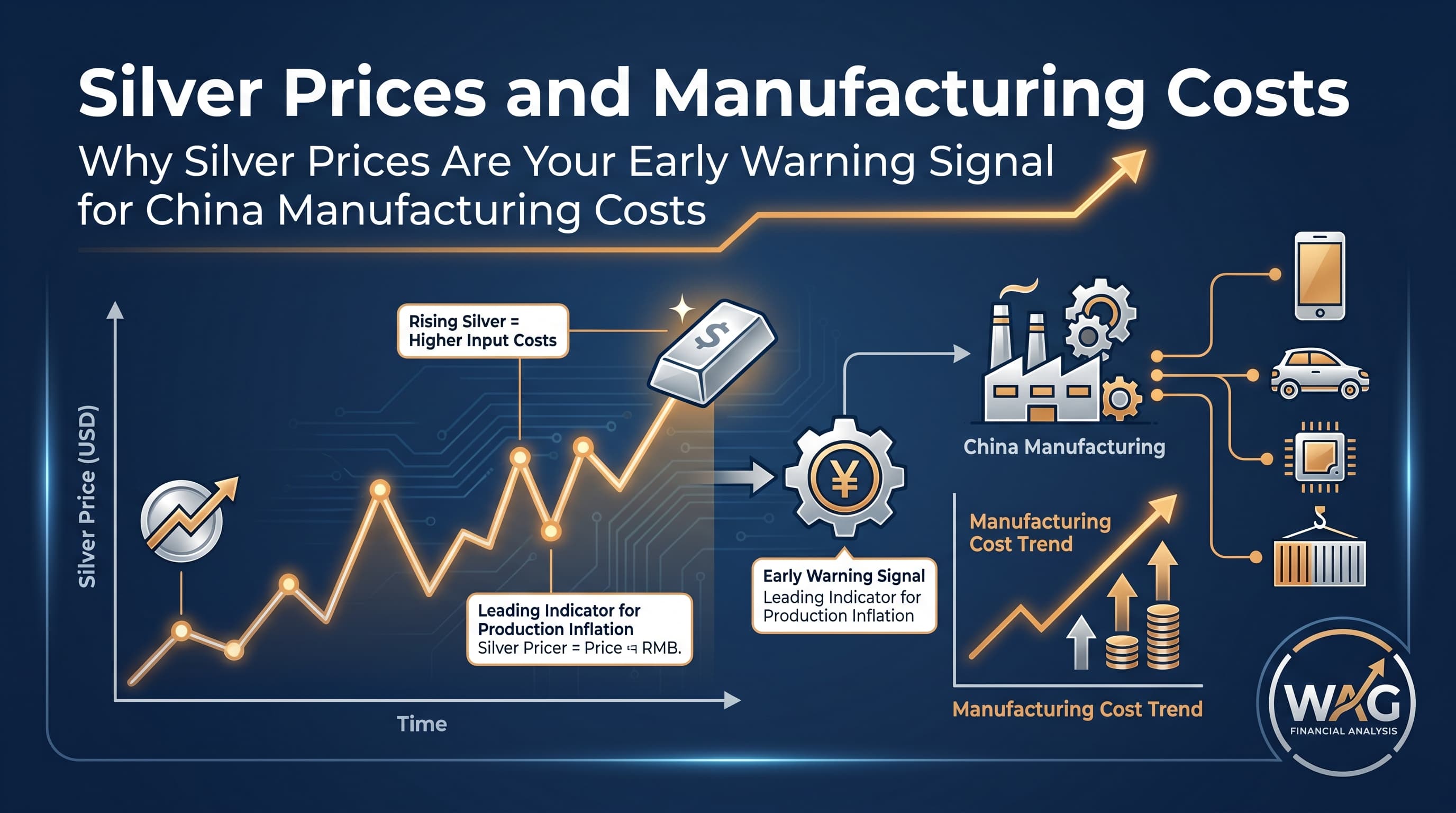
When you receive a quotation from your Chinese factory, you are looking at a price that was calculated weeks earlier — using raw material costs that were themselves set on global commodity markets. The London Metal Exchange (LME) sets benchmark prices for copper, aluminium, nickel, and precious metals including silver. These prices flow through to factory input costs with a predictable delay of roughly four to six weeks.
Understanding this transmission mechanism does not make you a commodities trader. It makes you a better buyer. When you know that a commodity price movement signals an upcoming change in factory quotations, you can time your orders to the most favourable point in the cycle — locking in lower prices before your competitors do.
How Commodity Prices Flow Through to Factory Quotations
The Transmission Timeline
The process follows a consistent pattern:
- LME price changes — Commodity markets move daily based on supply data, macroeconomic signals, and geopolitical events
- Chinese domestic spot prices adjust — Within 3–7 days, Chinese domestic commodity prices (tracked by Shanghai Futures Exchange) follow the LME movement
- Factory purchasing departments react — Factories buy raw materials on a rolling basis; their next purchase cycle incorporates the new prices
- Factory cost structure updates — Within 2–3 weeks, the factory's average cost of inputs shifts
- Quotations to buyers are revised — When you request a new quotation or when the factory sends a price update, the revised input costs are reflected
For long-term supply arrangements, factories typically review pricing quarterly. But when commodity prices move significantly — more than 10% in a single month — factories will issue price adjustment notices to buyers proactively.
Which Commodities Matter Most
For Chinese manufacturing, the most relevant commodities are:
| Commodity | Use in Chinese Manufacturing | Price Benchmark |
|---|---|---|
| Copper | Electrical components, wiring, plumbing, electronics | LME Grade A |
| Aluminium | Structural components, packaging, consumer goods casings | LME |
| Silver | Electronics, jewellery, solar panels, plating | LME |
| Steel | Machinery, construction, infrastructure components | China domestic (SHFE) |
| Polypropylene / Plastics | Packaging, consumer goods, automotive components | Asia domestic spot |
Silver is particularly important for Australian importers because it is used in the electronics manufacturing that dominates Guangdong and Zhejiang province factories — the same provinces where most WAG clients source their products.
Reading the Signal: What Silver Prices Are Telling You Right Now
Recent silver price movements have been noteworthy. After a period of relative stability in early 2026, silver began trending upward in April-May 2026, driven by increased industrial demand (particularly from solar panel manufacturing in China) and renewed investor interest in precious metals as an inflation hedge.
For Australian businesses sourcing from China, a rising silver price is a leading indicator that your next quotation may be higher than the last one you received. If you have a standing order with a factory, the window to lock in the current price before the next revision is narrowing.
Practical Example: LED Component Import
Consider an Australian business that imports LED light components from a factory in Shenzhen. The factory uses silver-bearing solder in the LED mounting process. When silver prices rise by 8% over a six-week period, the factory's raw material costs for solder alone increase by a proportionally significant amount.
The factory's quotation to the Australian buyer, issued four weeks after the silver price movement, reflects this new cost. If the buyer placed their order before the price movement, they received the old price. If they wait, they pay the new price — plus the factory knows the commodity market has moved and may not be flexible on the quoted adjustment.
The Optimal Order Timing Framework
WAG has developed a commodity-aware ordering approach for clients who import regularly from China. The framework operates on a simple principle: place orders when commodity prices are in a favourable cycle, and build inventory buffers that carry you through unfavourable cycles.
Step 1: Identify Your Commodity Exposure
Map your product catalogue to the commodities used in its manufacture. Focus especially on:
- Silver: Electronics, LED components, solar panels, jewellery, plating
- Copper: Electrical goods, wiring, plumbing, motors
- Aluminium: Structural goods, packaging, automotive parts
- Steel: Machinery, furniture (tubular steel frames), construction
Step 2: Monitor the LME Price Trend
You do not need to watch commodity markets daily. A weekly check of LME prices for your relevant metals is sufficient. Set up a free LME price alert service or check the LME website every Monday morning.
Look for trend direction — is the price moving up, down, or sideways? A sustained move in one direction for three or more consecutive weeks is a stronger signal than day-to-day noise.
Step 3: Calculate Your Timing Threshold
For your most price-sensitive product lines, calculate a threshold that triggers action. For example:
"If the LME silver price increases by more than 5% from the price at the time of my last order, I will place my next order within two weeks — before my factory's next quotation cycle updates."
This removes the emotional decision from purchasing and creates a systematic approach.
Step 4: Communicate with Your Factory
Chinese factories respond well to buyers who demonstrate commodity market awareness. If you contact your supplier and say, "I understand silver prices have moved — I'd like to place my next order before the next quotation cycle to lock in current pricing," you signal professionalism and often receive more cooperative pricing treatment.
Factories are accustomed to buyers who simply react to quotes. A buyer who demonstrates understanding of the underlying cost drivers earns credibility that translates into better pricing.
Long-Term Contracts vs Spot Orders: Managing the Trade-Off
Long-Term Contracts
A one-year supply agreement with a fixed or formula-based pricing structure provides budget certainty and protects against commodity price spikes. However, it also means you do not benefit if commodity prices fall during the contract period.
When to use: For product lines with high volume and stable demand, where margin predictability is more important than optimising every purchase price.
Spot Orders
Buying product-by-product at the prevailing quotation gives you maximum flexibility to time orders to favourable commodity cycles. However, you face price uncertainty on every order and may face stock shortages if lead times are long.
When to use: For new product lines, seasonal items, or products with high commodity sensitivity where the savings from good timing exceed the administrative cost of active management.
Hybrid Approach
Many WAG clients use a hybrid approach: fix 60–70% of their annual volume under a long-term agreement for supply security, and manage the remaining 30–40% as spot orders timed to commodity cycles. This gives the best of both worlds — supply security plus price optimisation.
A Real Scenario: How One Client Uses This Approach
A Brisbane-based importer of electronic components from Shenzhen works with three product lines sourced from two factories in Guangdong province. Their approach:
- They monitor copper and silver prices weekly (these are their primary commodity exposures)
- When the LME copper price drops more than 4% from their last order price, they place their next spot order within 10 days
- Their annual contract with Factory A covers 65% of their volume at formula pricing; the remaining 35% is spot orders timed to commodity cycles
- In the 18 months since implementing this approach, they estimate they have saved approximately 4.2% on their commodity-exposed product lines compared to the previous approach of ordering on an as-needed basis
The saving comes not from dramatic commodity calls but from consistent application of the timing framework.
FAQ: Commodity Prices and China Factory Quotations
Q: How quickly do commodity price changes show up in factory quotes? A: Typically 4–6 weeks. Factories that buy raw materials on a weekly cycle will reflect price changes within two to three purchase cycles.
Q: Can I ask my factory to honour an old price even if commodity prices have moved? A: You can always ask. Factories are more likely to accommodate this request if you have a long-term relationship, have been a consistent volume buyer, and give them advance notice of your order intent.
Q: Is silver price volatility typical, or is the current environment unusual? A: Silver tends to be more volatile than industrial metals like copper or aluminium because it has both industrial and investment demand drivers. The current environment — with strong solar panel demand from China's manufacturing sector — is contributing to elevated industrial demand for silver.
Q: Should I use commodity futures contracts to hedge my exposure? A: For most Australian SMEs importing from China, futures contracts are not practical due to the capital requirements, expertise needed, and contract sizes. The timing-based ordering approach described in this article is more accessible.
Q: Which products are most sensitive to silver price movements? A: Products where silver is a direct input cost — electronics with silver-bearing solders, silver-plated hardware, solar panels, LED components. Products where silver is a minor component relative to labour and other materials will see less direct price impact.
Q: Can WAG help me identify which of my product lines are most commodity-price sensitive? A: Yes. In a strategy consultation, we can review your product catalogue with you and map each line to its commodity exposure. We can then help you develop a commodity-aware ordering framework.
Q: Should I place a larger order now to buffer against future price increases? A: This depends on your storage capacity, working capital availability, and the shelf life of your product. A buffer order makes sense for non-perishable products with predictable demand. Avoid over-ordering on speculative grounds — the cost of carrying excess inventory often exceeds the commodity savings.
Q: How does the AUD/USD exchange rate interact with commodity price movements? A: The AUD/USD exchange rate adds a second layer to commodity-driven cost changes. When LME prices rise but the Australian dollar weakens against the US dollar, the effective cost increase for Australian importers compounds. Tracking both LME prices and AUD/USD alongside each other provides a more complete picture of actual cost pressures than either indicator alone.
Q: What is the relationship between Chinese domestic inflation and factory quotation changes? A: Chinese domestic inflation — driven by wage growth, energy costs, and regulatory compliance — creates baseline cost pressure that compounds commodity-driven price movements. When commodity prices rise and domestic inflation pushes simultaneously, factories may issue price adjustments more frequently than the standard 4-6 week commodity transmission cycle would suggest. Australian buyers should be alert to factory communications citing "general cost increases" beyond commodity inputs.
Q: Which LME metals should Australian importers of consumer goods monitor most closely? A: For most Australian consumer goods importers, copper and aluminium are the most broadly relevant because they appear in so many product categories. Silver matters specifically for electronics and solar panel importers. Steel affects furniture, machinery, and construction importers. Monitoring copper first provides the widest view of industrial commodity trends affecting Chinese manufacturing costs.
Silver Price and Australian Manufacturing Cost Context
Why Silver Signals Broader Commodity Trends
Silver occupies a unique position among commodities relevant to Chinese manufacturing. Unlike copper or aluminium, which primarily serve industrial functions, silver has dual demand drivers that make it a leading indicator for broader commodity movements. When investors flee to precious metals during uncertainty, silver prices rise before industrial demand signals would suggest. When industrial demand drives silver upward, other metals typically follow.
For Australian businesses, this means silver price movements provide two types of signals. Investment-driven silver rallies indicate macroeconomic uncertainty that may affect shipping costs, consumer demand, and currency stability. Industrial-demand-driven rallies signal strengthening Chinese manufacturing activity that typically precedes broader commodity price increases across copper, aluminium, and steel.
Understanding which driver is moving silver prices helps Australian buyers interpret the signal appropriately. A purely investment-driven silver rally may not translate into immediate factory quotation changes if Chinese industrial demand remains weak. An industrial-demand-driven silver rally almost certainly precedes broader commodity price increases that will affect factory costs within weeks.
Australian Importers and Silver Exposure by Product Category
Different product categories carry different silver exposure levels. Australian businesses importing electronics face the highest silver price sensitivity because electronics manufacturing uses silver in solders, contacts, and circuit components. Furniture manufacturers using tubular steel frames face lower silver exposure but may see cost impacts through steel prices that move with general industrial commodity trends.
Consumer goods importers face variable silver exposure depending on product composition. Products with significant electronic components — small appliances, lighting products, consumer electronics — carry higher silver exposure than textile or basic plastic goods. Mapping your product catalogue against silver price sensitivity helps prioritise which product lines deserve the most active commodity timing attention.
For businesses importing multiple product categories from the same Chinese factory, commodity price movements affect different product lines at different times depending on how each line's input composition responds to global commodity conditions. A systematic approach to commodity monitoring helps identify which quotation requests deserve urgent attention when commodity markets move.
Integrating Commodity Awareness into Procurement Operations
Building Internal Commodity Monitoring Capability
Developing commodity awareness within your procurement team requires establishing systematic monitoring without creating administrative burden. The key is frequency and consistency over granularity. Daily commodity market monitoring creates stress and false signals. Weekly review of LME prices for your relevant metals creates a rhythm that builds intuition over time without overwhelming procurement staff.
Setting up LME price alerts eliminates the need for active monitoring. Most commodity data services offer free or low-cost alert products that notify you when specific price thresholds are crossed. An alert when silver moves more than 5% in either direction from your last order price creates a natural trigger for quotation review without requiring daily market attention.
Internal communication protocols matter as much as monitoring systems. When commodity prices move significantly, procurement staff should know how to interpret the movement and what actions it should trigger. A simple internal reference guide linking commodity movements to quotation revision timelines removes the need for individual judgment calls on every price alert.
Communicating Commodity Cycles to Internal Stakeholders
Australian businesses with internal stakeholders — finance teams, sales departments, leadership — often find that commodity price movements create unnecessary alarm when not properly contextualised. A rising silver price that triggers a quotation revision looks concerning to non-procurement staff who do not understand the 4-6 week transmission lag built into factory quotations.
Proactively communicating commodity cycle expectations to finance and sales teams prevents misaligned pricing decisions. When sales teams know that commodity prices have moved and quotations will follow, they can communicate realistic pricing expectations to customers before quotations arrive. When finance teams understand the timing between commodity movements and actual cost changes, they can plan cash flow accordingly.
The internal communication does not need to be technically detailed. A simple framework explaining that commodity price changes take 4-6 weeks to flow through to factory quotations, that the procurement team monitors these cycles, and that significant price movements trigger proactive quotation reviews provides sufficient context for most internal stakeholders to make appropriate decisions.
Commodity Cycles and Supplier Relationship Quality
Why Commodity-Aware Buyers Get Better Treatment
Chinese factories differentiate between buyers who demonstrate genuine commodity awareness and those who simply react to quotations. A buyer who understands that a factory's quotation revision reflects underlying commodity movements rather than arbitrary pricing decisions earns different treatment than a buyer who views every price change as a negotiating opportunity.
This matters because factory-buyer relationships function on trust and mutual respect. Factories that view buyers as partners rather than opponents are more likely to offer favourable payment terms, priority production scheduling, and flexible minimum order quantities. A buyer who demonstrates commodity literacy signals that they understand the factory's business context and are likely to be a reliable long-term customer.
Australian businesses that consistently demonstrate commodity awareness often receive preferential pricing treatment when commodity markets move against factories. When a factory faces rising input costs, buyers who understand this context and offer advance orders receive priority treatment over buyers who demand price concessions without acknowledging the factory's cost reality.
Long-Term Commodity Strategy for Steady Importers
For Australian businesses with stable, ongoing import volumes from China, developing a long-term commodity strategy creates systematic advantages over reactive procurement. A commodity strategy that specifies target prices for each major commodity, order timing thresholds based on commodity movements, and communication protocols with factories provides a framework for consistent decision-making.
The long-term strategy should align with your business planning cycle. If your business plans annual volumes in advance, align commodity monitoring with your planning cycle so that commodity price analysis informs volume commitments before they become binding. If your business responds to market demand with more frequent orders, align commodity monitoring with your order timing so that price signals trigger appropriate actions.
Factories respect buyers who demonstrate long-term strategic thinking. A buyer who approaches commodity management as a systematic discipline rather than a series of reactions to price changes earns a different quality of relationship than a buyer who treats every order as an isolated transaction. This relationship quality compounds over time into tangible procurement advantages. For businesses seeking to build long-term factory relationships in China, commodity awareness represents one of the most accessible differentiators.
Commodity prices are subject to global market forces and can be affected by events outside any individual's control. The strategies described in this article are procurement approaches, not investment or financial advice. Conduct your own assessment or consult a financial advisor for commodity market positions.
China Sourcing Strategy
Want to build a commodity-aware sourcing strategy?
Winning Adventure Global helps Australian businesses time their China orders to commodity price cycles, reducing costs and improving supplier relationships.
Book a free strategy callFree initial consultation · We respond within 4 business hours