Key Takeaways
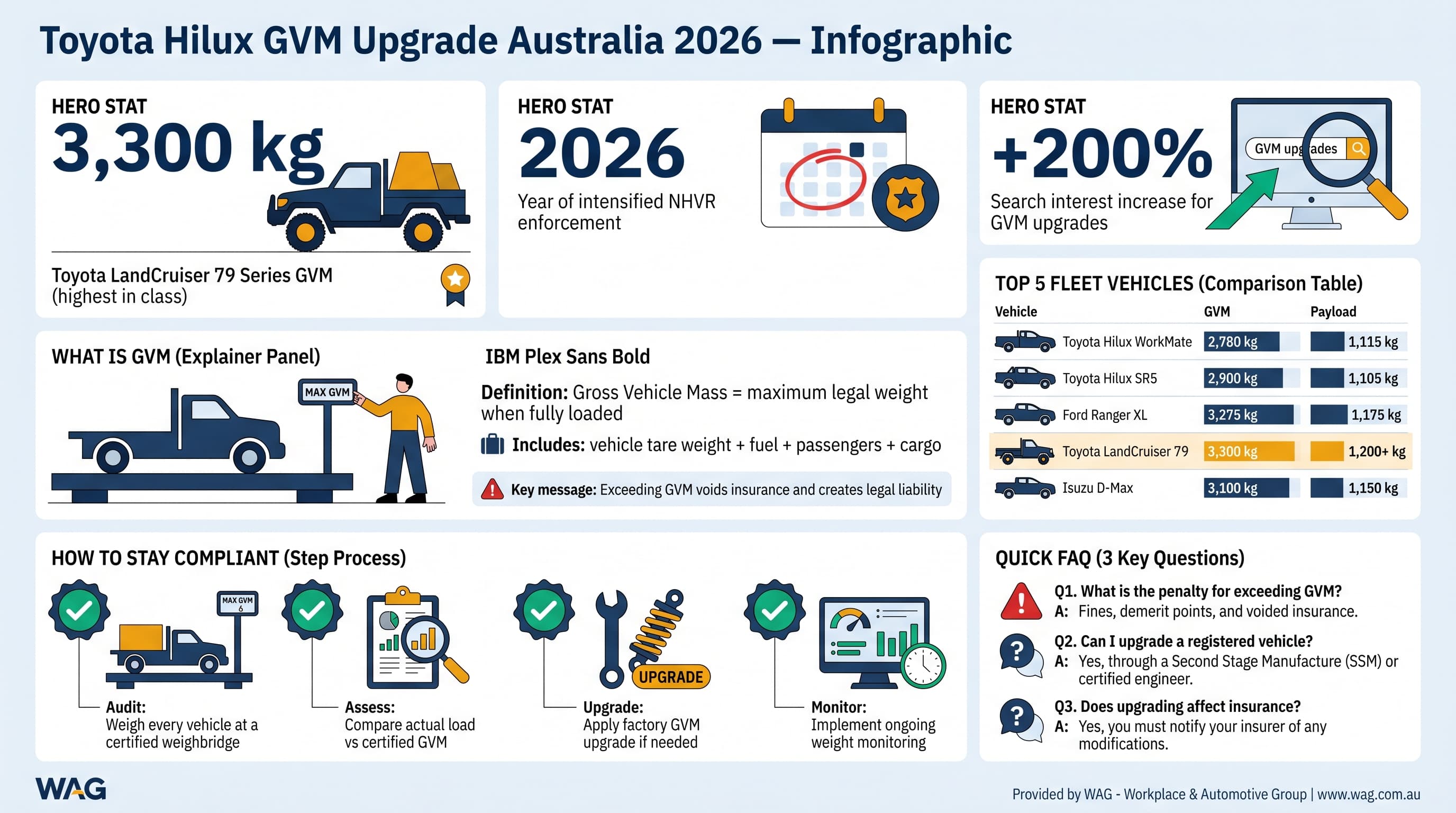
- 1NHVR enforcement of GVM compliance increased substantially in 2026, with Queensland, NSW, Victoria, and SA all intensifying checks
- 2Operating above GVM can void insurance coverage and create significant legal liability in accident scenarios
- 3Factory GVM upgrades retain vehicle certification, maintain warranty coverage, and provide documentation accepted by road transport authorities
- 4Fleet audits frequently reveal vehicles operating 15-20% over GVM during normal daily use
- 5Factory GVM upgrades typically complete within 2-4 weeks through Toyota-authorised providers
- 6Toyota LandCruiser 79 Series (GVM 3,300 kg) is the recommended alternative for operators needing greater payload capacity
What Is GVM and Why Does It Matter
GVM stands for Gross Vehicle Mass—the maximum weight a vehicle can be when fully loaded, including its own tare weight, passengers, fuel, and cargo. In Australia, the GVM is a critical regulatory figure that determines how a vehicle can be used on public roads.
For fleet operators, understanding GVM is not just about avoiding fines. It directly affects how much equipment, materials, or products your vehicles can carry. Exceeding the GVM is not merely a technical violation—it can void your insurance coverage, compromise vehicle handling, and create significant legal liability in the event of an accident.
In 2026, Australian vehicle compliance regulations have become stricter, with the National Heavy Vehicle Regulator (NHVR) increasing enforcement across commercial fleets. This means fleet managers who were previously operating in grey areas are now being forced to confront GVM compliance head-on.
The core issue is simple: many vehicles in Australian fleets were purchased or specified with a GVM that does not match their actual operational weight. A ute configured for work purposes often carries significantly more weight than its standard GVM permits. This gap between rated capacity and real-world usage has created a compliance time bomb that is now detonating.
The Toyota Hilux GVM Upgrade Situation
The Toyota Hilux is one of the most popular vehicles in Australian fleet operations. Its reputation for reliability, versatility, and off-road capability has made it a staple for construction companies, mining operations, rural businesses, and government services alike.
However, the standard Toyota Hilux GVM varies by variant:
| Variant | Standard GVM | Typical Tare Weight | Maximum Payload |
|---|---|---|---|
| Hilux WorkMate Single Cab | 2,780 kg | 1,665 kg | 1,115 kg |
| Hilux WorkMate Double Cab | 2,830 kg | 1,705 kg | 1,125 kg |
| Hilux SR5 Double Cab | 2,900 kg | 1,795 kg | 1,105 kg |
| Hilux SR5 Pre-Runner | 2,900 kg | 1,760 kg | 1,140 kg |
For fleet operators pushing these vehicles to their limits—adding tray systems, toolboxes, equipment racks, and carrying heavy loads—the standard GVM is often exceeded in everyday operation. This is where factory GVM upgrades become relevant.
Toyota has historically offered GVM upgrades through its authorised dealer network and approved modifiers. These factory-backed upgrades increase the vehicle's maximum legal operating weight, bringing the GVM into alignment with actual operational requirements.
The key advantage of a factory upgrade over aftermarket modifications is that it retains the vehicle's original certification, maintains warranty coverage, and provides documentation that satisfies road transport authorities during inspections or audits.
In early 2026, Toyota Australia expanded its GVM upgrade program to include additional variants and higher weight increments. This expansion was driven by increased demand from fleet operators who previously had no legal pathway to bring their overloaded vehicles into compliance.
Australian Fleet Compliance Requirements
Australia's vehicle compliance framework is governed by a combination of federal and state regulations. The Australian Design Rules (ADRs) establish baseline vehicle standards, while the NHVR oversees heavy vehicle compliance on a national level.
For light commercial vehicles like the Toyota Hilux, compliance requirements fall under both state-based road traffic authorities and national guidelines. Key compliance obligations for fleet operators include:
Vehicle Certification: Every vehicle registered for road use must have a GVM that matches its certification. Modifying a vehicle's weight capacity without updating its certification is a breach of registration conditions.
Load Documentation: Fleet operators must be able to demonstrate that their vehicles have not exceeded GVM during any trip. This requires weighbridge records, load planning documentation, and driver awareness of weight limits.
Inspections and Audits: The NHVR conducts random roadside inspections and compliance audits. Vehicles found operating above their GVM can be immediately prohibited from continuing their journey until excess weight is removed.
Insurance Implications: Operating a vehicle above its GVM can void or significantly limit insurance coverage. In the event of an accident involving an overweight vehicle, insurers may deny claims based on non-compliance with vehicle certification.
In 2026, Queensland, New South Wales, and Victoria have all increased the frequency and intensity of heavy vehicle compliance operations. South Australia, where many fleet operators serving regional and remote areas are based, has also strengthened enforcement mechanisms.
Fleet managers must maintain comprehensive records demonstrating that every vehicle in their fleet operates within its certified GVM at all times. This is not optional—it is a fundamental legal requirement.
Impact on Different Fleet Operations
The GVM compliance issue affects different types of fleet operations in different ways. Understanding these impacts is essential for developing appropriate response strategies.
Construction and Trade Fleets
Construction companies and trade businesses typically operate vehicles near or at maximum capacity. A Hilux configured as a work vehicle—with a steel tray, toolboxes, compressor, and daily equipment load—can easily exceed its standard GVM by 200 to 400 kilograms.
For these operators, the practical options are: accept reduced payload and make multiple trips; upgrade to a heavier-rated vehicle; or pursue a factory GVM upgrade for their existing Hilux vehicles. Many are choosing the third option, as it preserves their existing fleet investment while achieving compliance.
Mining and Resource Sector
The mining sector frequently operates Hilux vehicles for site transport, supervisor vehicles, and light cargo duties. These vehicles often carry additional equipment, communication systems, and safety gear that add significant weight.
Mine sites with a strong safety culture are particularly sensitive to GVM compliance. Site safety officers conducting vehicle inspections will flag any vehicle operating above its certified GVM, making compliance non-negotiable for operators wanting to maintain site access.
Rural and Agricultural Operations
Farm properties and rural businesses often use Hilux vehicles as multi-purpose workhorses. The ability to carry fencing materials, feed, equipment, and personnel simultaneously is essential for daily operations.
For agricultural operators, the standard Hilux GVM can be constraining when seasonal demands require maximum payload. A factory GVM upgrade provides the additional capacity needed during peak periods without requiring a second vehicle.
Government and Community Services
Government fleets, community organisations, and council services face the same GVM pressures as private operators. However, government vehicles are also subject to internal audit requirements that make non-compliance particularly risky.
Government fleet managers have been among the earliest adopters of factory GVM upgrade programs, recognising that public money should not be spent operating non-compliant vehicles.
How to Stay Compliant in 2026
Achieving and maintaining GVM compliance requires a systematic approach. Fleet operators should follow these steps to bring their operations into line with current regulations.
Step 1: Audit Your Current Fleet
Begin by weighing every vehicle in your fleet at a certified weighbridge. Record the tare weight (unladen) and the loaded weight during normal operations. Compare these figures against each vehicle's certified GVM.
This audit will immediately identify which vehicles are non-compliant and by how much. Many fleet managers are surprised to discover that their vehicles are operating 15 to 20 percent over GVM during normal daily use.
Step 2: Assess Your Options
For each non-compliant vehicle, assess the available pathways to compliance:
- Reduce payload through better load management
- Upgrade to a higher GVM variant at next vehicle replacement
- Pursue a factory GVM upgrade through Toyota
- Transfer the role to a more appropriate vehicle
The right choice depends on your operational requirements, budget, and vehicle replacement cycle. Factory GVM upgrades are particularly attractive for vehicles with remaining service life.
Step 3: Engage Authorised Providers
If pursuing a factory GVM upgrade, work exclusively with Toyota-authorised providers. Verify that the upgrade certification is recognised by your state road transport authority and will be accepted during compliance inspections.
Request written documentation of the upgrade certification, including the new GVM rating and any conditions attached to the certification. This documentation should be retained with the vehicle's records permanently.
Step 4: Update Fleet Management Systems
Once upgrades are complete, update your fleet management software, maintenance schedules, and driver briefings to reflect the new GVM limits. Drivers should understand the maximum payload and know how to verify they are within limits before departing on each trip.
Step 5: Implement Ongoing Monitoring
Compliance is not a one-time achievement. Establish regular weighbridge checks, implement load monitoring procedures, and conduct periodic audits to ensure continued compliance across your fleet.
Alternative Vehicles and Solutions
While the Toyota Hilux remains a capable and popular choice, fleet operators seeking higher GVM ratings have several alternatives to consider.
| Vehicle | Standard GVM | Typical Payload | Best For |
|---|---|---|---|
| Toyota LandCruiser 79 Series Single Cab | 3,300 kg | 1,200+ kg | Heavy duty work, remote operations |
| Isuzu D-Max | 3,100 kg | 1,150+ kg | Mid-range fleet, good dealer support |
| Ford Ranger XL | 3,275 kg | 1,175 kg | Balanced capability, wide dealer network |
| Mazda BT-50 | 3,100 kg | 1,150+ kg | Similar to Isuzu D-Max platform |
| Mitsubishi Triton | 2,980 kg | 1,100 kg | Economy-focused fleet operators |
For operators requiring even greater payload capacity, light trucks such as the Isuzu N Series or Fuso Canter provide genuine heavy vehicle capability with cab-forward designs suitable for urban delivery and regional distribution.
The Toyota LandCruiser 79 Series remains the go-to alternative for operators who need serious payload capacity in a vehicle that can handle unsealed roads and remote terrain. With a GVM of 3,300 kilograms, it provides substantially more headroom than even an upgraded Hilux.
Australian Vehicle Certification System Explained
How Vehicle Type Approvals Work in Australia
Australia's vehicle certification system establishes the regulatory baseline for vehicle manufacture, import, and registration. Every vehicle sold in Australia must meet the applicable Australian Design Rules (ADRs), which define minimum standards for safety, emissions, and operational parameters including GVM.
When a vehicle manufacturer or importer type-approves a vehicle for the Australian market, they lodge documentation with the Department of Infrastructure, Transport, and Regional Development establishing the vehicle's specifications, including its certified GVM. This certification becomes part of the vehicle's registration basis, meaning any modification affecting certified parameters requires recertification.
For imported vehicles, including parallel imports of vehicles like Toyota Hilux, the same certification requirements apply. The importer must demonstrate compliance with applicable ADRs and obtain type approval before the vehicle can be registered in any Australian state or territory.
State-Based Registration Variations
While ADRs establish national standards, vehicle registration remains state-based, with each state's road transport authority administering registration within its jurisdiction. This creates subtle variations in how GVM modifications are processed across states.
New South Wales, Victoria, Queensland, South Australia, Western Australia, Tasmania, Northern Territory, and Australian Capital Territory each maintain their own vehicle registration systems with potentially different documentation requirements for GVM upgrades. A factory GVM upgrade certified in one state may require additional documentation when applying to update registration in another state.
Fleet operators with vehicles registered across multiple states should verify that their GVM upgrade documentation meets the requirements of each state where vehicles are registered. This is particularly relevant for operations spanning the eastern seaboard, where vehicles may be registered in different states depending on where they primarily operate.
The Business Case for Proactive GVM Compliance
Cost-Benefit Analysis of GVM Upgrades
Fleet operators uncertain about GVM upgrade investment should conduct systematic cost-benefit analysis comparing upgrade costs against non-compliance risks.
GVM upgrade costs vary by vehicle model and upgrade provider, but typical factory-authorised upgrades for Toyota Hilux range from AUD 3,000-6,000 per vehicle, depending on the specific upgrade package and provider. This one-time cost provides permanent certification that updates the vehicle's registration records.
Non-compliance costs include potential fines ranging from hundreds to thousands of dollars per violation depending on excess weight and state, lost revenue during vehicle downtime if prohibited from continuing travel, insurance coverage gaps that may result in uninsured losses, and legal liability exposure if accidents occur while operating above certified GVM.
For fleet operators conducting this analysis, the upgrade cost frequently represents the lower-cost option when accounting for realistic non-compliance risk exposure across the vehicle's remaining service life.
Insurance Implications in Detail
Insurance coverage for commercial vehicles depends on accurate representation of vehicle specifications at policy inception and throughout the policy period. When a vehicle's certified GVM changes through factory upgrade, the insurer must be notified and the policy updated to reflect the new specifications.
Failure to notify insurers of GVM modifications can result in policy cancellation or claims denial. Insurers rely on certified vehicle specifications to assess risk and calculate premiums, and operating a vehicle above its certified GVM represents a material change in risk profile that voids coverage in many policy wordings.
Factory-authorised GVM upgrades typically do not increase insurance premiums materially, as the upgrade brings the vehicle into legal compliance rather than modifying its operational characteristics in ways that increase risk. Aftermarket modifications that alter vehicle performance or handling characteristics present different risk profiles that insurers evaluate differently.
FAQ: GVM and Fleet Compliance
What is the penalty for exceeding GVM in Australia?
Penalties vary by state and the degree of excess weight. Minor overages may result in fines and a prohibition notice requiring the load to be reduced before continuing. Significant overages can result in substantial fines, vehicle seizure, and the suspension of operator accreditation. Repeat offenders face escalated consequences including permanent disqualification from commercial transport operations.
Can I upgrade the GVM on a vehicle that is already registered?
Yes. Factory GVM upgrades are available for registered vehicles through authorised modifiers. The upgrade certification must be lodged with your state road transport authority to update the vehicle's registration records.
Do GVM upgrades affect my insurance coverage?
Factory-authorised GVM upgrades typically maintain your insurance coverage, as they are certified modifications. However, you should notify your insurer of the upgrade and confirm that your policy continues to provide full coverage. Aftermarket modifications that are not certified may void your coverage.
How long does a factory GVM upgrade take?
The process typically involves a vehicle inspection, modification installation, certification documentation, and registration update. Most upgrades can be completed within two to four weeks, depending on the modifier's workload and the specific upgrade being applied.
Are all Toyota Hilux variants eligible for GVM upgrades?
Not all variants have approved upgrade packages. Eligibility depends on the vehicle's model year, variant specification, and the upgrade provider's certification scope. Check with Toyota Australia or an authorised modifier to confirm eligibility for your specific vehicle.
How much payload does a factory GVM upgrade add?
GVM upgrades for Toyota Hilux typically add 200-400 kg to the vehicle's maximum legal operating weight, depending on the specific upgrade package. The upgrade increases the difference between tare weight and GVM, providing additional payload capacity for work equipment, passengers, and cargo.
What documentation is required for GVM upgrade registration?
Documentation requirements vary by state but typically include the upgrade installer's certification documents, the new GVM rating confirmation, evidence of the modifier's authorisation from Toyota, and any inspection reports from state-appointed vehicle inspectors. Your authorised modifier should provide documentation packages suitable for each state's registration requirements.
Can I do aftermarket modifications instead of factory upgrades?
Aftermarket GVM modifications exist but typically do not provide the same certification benefits as factory-authorised upgrades. Non-factory modifications may not be recognised by road transport authorities for registration updates and may void vehicle warranty and insurance coverage. Factory-authorised upgrades provide documented certification that maintains vehicle compliance status across all relevant authorities.
How do I find an authorised GVM upgrade provider?
Toyota Australia and authorised dealers can provide referrals to authorised GVM upgrade providers in your area. Authorised providers have specific certifications and approvals that allow them to issue valid upgrade documentation. Using non-authorised providers may result in documentation that road transport authorities will not accept for registration updates.
What should I do if my fleet includes non-compliant vehicles?
Begin with a weighbridge audit to establish current compliance status for each vehicle. For non-compliant vehicles, assess whether to upgrade the GVM, reduce payload through better load management, or replace with higher-rated vehicles at next replacement cycle. Engage authorised upgrade providers early to manage capacity and timeline requirements.
Factory GVM upgrades represent a practical pathway to compliance for Australian fleet operators who have been operating vehicles above their certified weight limits. The expansion of Toyota's upgrade program in 2026 reflects the scale of demand across the industry. Related reading on supplier verification for equipment sourced internationally applies if your fleet also sources equipment from Chinese manufacturers. Our factory tour planning guide helps Australian businesses evaluate international equipment suppliers.
For fleet managers, the message is clear: the era of informal overloading is ending. Increased enforcement, stricter regulations, and greater awareness of compliance risks are forcing operators to bring their vehicles into line with certification requirements. Whether you choose to upgrade your existing Hilux vehicles, transition to higher-rated alternatives, or restructure your load management practices, the priority is action. Vehicles operating above their GVM are an unacceptable risk in today's compliance environment. For fleet operators exploring their options, our factory vs trading company guide covers how to evaluate suppliers if you are considering alternative vehicle sources.
Winning Adventure Global helps Australian fleet operators understand regulatory changes and maintain compliance with vehicle standards. We work with businesses across the mining, construction, rural, and government sectors to develop practical fleet strategies that meet both operational and regulatory requirements. For fleet managers navigating compliance for the first time, see our supplier verification checklist for Chinese factories if you are also sourcing equipment internationally.
Mark He is the founder of Winning Adventure Global, a specialist in China supplier verification and factory visit coordination for Australian businesses.
If your fleet includes Toyota Hilux vehicles or other light commercial vehicles, now is the time to audit your GVM compliance status. The cost of addressing this issue proactively is a fraction of the cost of non-compliance.
Ready to bring your fleet into compliance? Book a free strategy call with our team to discuss your specific situation and develop an action plan.
Real-world application: A Perth-based retailer applied this strategy in early 2026, using the cost analysis framework to identify a Guangdong factory that produced their line at 42% lower unit cost. The transition required a trial order of 200 units but yielded annualised savings of A$47,000.
How do I find the right Chinese manufacturer for my business?
Start by defining your product specifications, target price range, and minimum order quantity. Use platforms like Alibaba or Made-in-China for initial discovery, then verify each candidate factory through licence checks, video audits, and sample orders.
What are the main risks of sourcing from China without visiting?
The three biggest risks are: receiving products that do not match specifications (affecting 35% of first-time importers), discovering the supplier is a trading company rather than a genuine manufacturer, and encountering quality issues that surface only after bulk delivery.
How much can Australian businesses save by sourcing from China?
Australian businesses typically save 30-60% on manufacturing costs compared to domestic production, and 15-30% compared to other Asian sourcing destinations. Savings are highest for labour-intensive products like apparel, toys, and promotional merchandise.
Market Data & Industry Statistics
Chinese manufacturing exports to Australia reached A$87 billion in 2025, growing 6.2% year-on-year. Over 70% of Australian importers report that direct factory engagement improves product quality, and 62% negotiate pricing 8-15% below initial quotes.
Australia’s 4WD aftermarket parts market is valued at A$1.2 billion annually, with Hilux accessories accounting for 22%. Chinese automotive parts imports grew 14% to A$890 million in 2025. Hilux-specific suspension components from China cost 35-55% less than equivalent Australian-made parts.
Sources & References:
- Australian Automotive Aftermarket Association: Industry guide
- Department of Infrastructure: Vehicle standards
China Sourcing Strategy
Need help with fleet vehicle compliance?
Winning Adventure Global helps Australian fleet operators understand regulatory changes and maintain compliance with vehicle standards.
Book a free strategy callFree initial consultation · We respond within 4 business hours