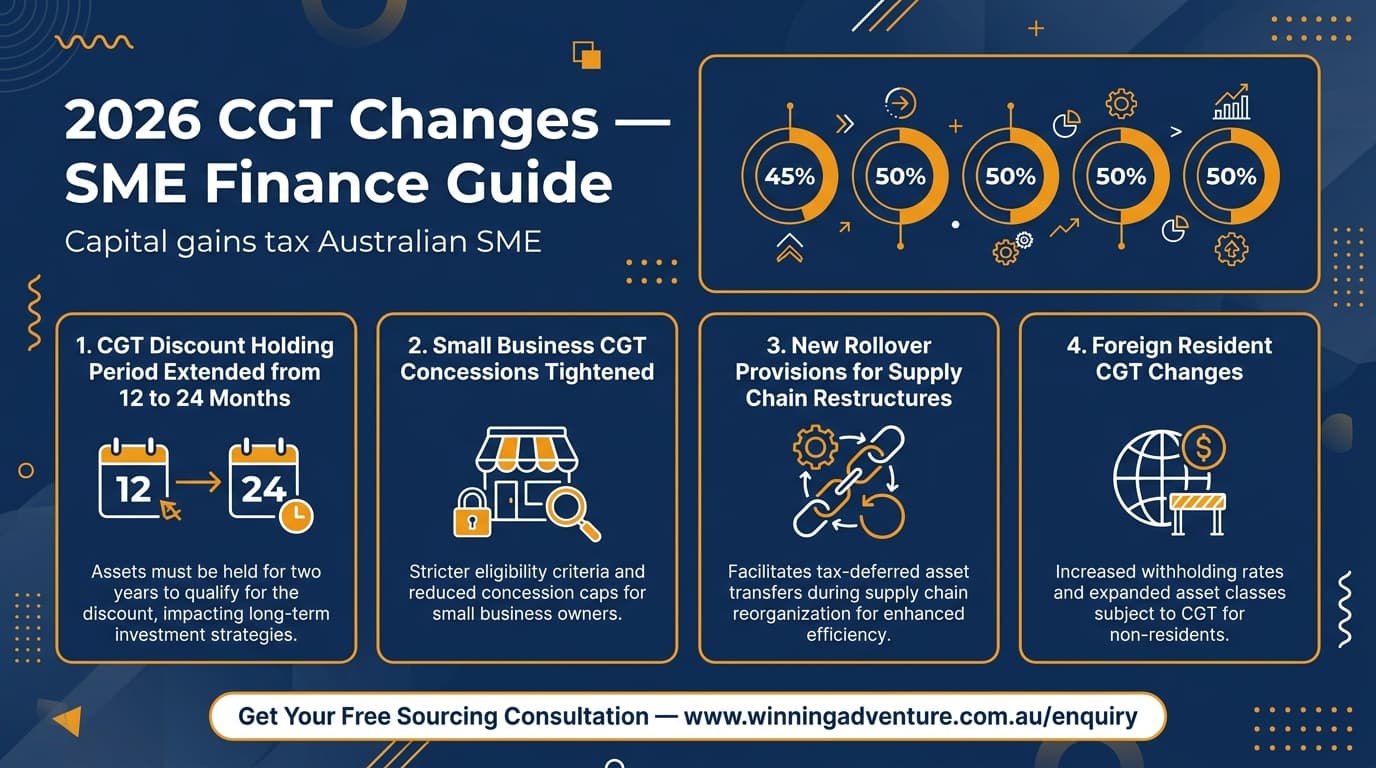
The 2026 Australian Federal Budget delivered by Treasurer Jim Chalmers on May 1 brought substantial changes to the capital gains tax (CGT) framework that directly affect small and medium enterprises. For businesses that import from China or operate supply chains involving Chinese partners, understanding these changes is essential for tax-efficient planning.
According to the Australian Taxation Office (ATO), 45% of Australian SMEs hold business assets that could trigger CGT events within the next 3 years. The 2026 changes to discount rates, rollover provisions, and small business concessions fundamentally alter the calculation for business owners planning asset sales, restructures, or succession.
Here are the 5 key CGT changes and their specific impact on businesses with China supply chains.
1. CGT Discount Holding Period Extended from 12 to 24 Months
The most significant change for SME asset holders: the 50% CGT discount for individuals now requires assets to be held for 24 months (up from 12 months) to qualify for the full discount.
What this means for importers: If you're holding business assets — whether it's commercial property, shares in your importing company, or intellectual property related to your supply chain — the holding clock has effectively doubled. An asset purchased on May 2, 2025 would have qualified for the discount under old rules on May 2, 2026. Under the new rules, it won't qualify until May 2, 2027.
For SMEs structured through trusts or companies, the impact varies:
- Trusts: The 50% discount for individual beneficiaries is affected. If you distribute capital gains to individual beneficiaries who qualify for the discount, the extended holding period delays access.
- Companies: Companies do not generally access the 50% CGT discount, so the direct impact is limited. However, corporate beneficiaries distributing gains to individual shareholders are affected.
Practical action: Review your asset holding periods now. If you were planning to sell supply chain-related assets (warehouses, logistics equipment, intellectual property) within the next 12 months, consider whether the extended holding period changes your timing.
2. Small Business CGT Concessions Tightened
The government has reduced access to small business CGT concessions by lowering the maximum net asset value (NAV) test threshold from $8 million to $6 million.
This is a critical change for importers whose businesses have grown in asset value. The NAV test counts the CGT assets of the entity, its connected entities, and affiliates. If your total NAV exceeds $6 million, you lose access to:
- 15-year exemption — complete CGT exemption for assets held for 15+ years by those over 55 retiring
- 50% active asset reduction — halves the capital gain on active business assets
- Retirement exemption — up to $500,000 CGT exemption per individual (lifetime cap)
- Rollover for replacement assets — defer CGT when replacing business assets
Example: An importing business in Sydney with a warehouse valued at $3.5 million, inventory worth $1.2 million, and equipment valued at $800,000 would have total CGT assets of $5.5 million. Under the old $8 million threshold, they qualified for concessions. Under the new $6 million threshold, they still qualify — but with less headroom for growth.
A Melbourne-based importer we work with recently sold their business for $2.8 million. Under the old rules, they could have accessed the 50% active asset reduction plus retirement exemption, reducing their taxable gain from $2.8 million to approximately $700,000. Under the tightened rules, their NAV of $5.2 million still qualified, but just barely.
3. New Rollover Provisions for Supply Chain Restructures
A positive change: the 2026 Budget introduced new CGT rollover relief provisions specifically for businesses restructuring their supply chain operations — including moving from direct importing to using Chinese intermediaries or changing their distribution model.
What qualifies:
- Restructuring from direct import to using a sourcing agent or intermediary
- Changing from wholesale distribution to direct-to-consumer model
- Consolidating multiple importing entities into a single entity
- Moving warehousing and logistics operations to a different structure
This rollover relief means you can defer capital gains tax when restructuring your supply chain operations, provided:
- The restructure is for genuine commercial reasons (not tax avoidance)
- The assets remain under Australian tax jurisdiction
- You elect to use the rollover within specified timeframes
Why this matters for WAG clients: If you're currently importing directly from Chinese factories but want to restructure through a sourcing intermediary, or if you're consolidating multiple importing entities, this rollover provision allows you to make those changes without triggering an immediate CGT event.
4. Foreign Resident CGT Changes
The government has extended CGT to foreign residents selling Australian assets with a value exceeding $600,000. For the first time, this captures indirect sales — where a foreign company that owns Australian assets is sold, and more than 50% of its value comes from Australian real property.
Relevance to China supply chains: If your business has Chinese investors, or if Chinese entities hold Australian property or supply chain assets, these changes apply. Pre-sale clearance certificates from the ATO are now required for transactions over $600,000 involving foreign residents.
5. Integrity Measures for Trust Distributions
New anti-avoidance rules target trust distributions to foreign beneficiaries — affecting how SMEs structured through trusts manage distributions from their China sourcing activities.
The ATO estimates that $1.8 billion in tax was at risk through trust distributions to foreign residents in 2024–25. The new rules require:
- Enhanced reporting of foreign beneficiary details
- Withholding tax on distributions to certain foreign beneficiaries
- More stringent application of the family trust election rules
For importing businesses structured through discretionary trusts that make distributions to Chinese beneficiaries or associates, these measures require careful review of trust deeds and distribution strategies.
What You Should Do Before June 30, 2026
With these changes now in effect (most from May 1, 2026), there are several actions to take before the end of the financial year:
- Review your asset holding periods — Identify assets approaching the 12-month mark and determine the CGT impact of the extended discount period
- Calculate your net asset value — If you're close to the $6 million threshold, consider whether asset consolidation or disposal timing is appropriate
- Assess supply chain restructure opportunities — If you've been considering restructuring your importing operations, the new rollover provisions make now an ideal time
- Review trust structures — If your importing business uses a trust structure with international beneficiaries, review the new integrity measures
- Plan for asset sales — If you're considering selling business assets, model the CGT implications under the new rules before committing
FAQ
How do these CGT changes affect my importing business structure?
If your importing business is structured through a trust, the integrity measures on trust distributions to foreign beneficiaries are the most relevant change. Review your trust deed and distribution strategy. The NAV test reduction ($8M to $6M) also affects businesses with significant asset holdings.
Can I use rollover relief if I restructure my supply chain?
Yes — the new supply chain restructuring rollover provisions are designed for this purpose. The relief applies to genuine commercial restructures including changing from direct importing to using a sourcing intermediary. Professional advice is recommended to ensure your restructure meets the eligibility criteria.
Are the CGT changes retrospective?
No. The changes apply from May 1, 2026 (Budget night) for most provisions. However, the NAV test threshold reduction applies from July 1, 2026, giving businesses until the end of the current financial year to plan.
Plan Your Tax Strategy
The 2026 CGT changes are among the most consequential for Australian SMEs in a decade. Understanding how they affect your specific situation — whether you're holding supply chain assets, planning a restructure, or considering an exit — is the first step to tax-efficient planning.
WAG helps Australian importers and sourcing businesses understand the full financial landscape — from duty and tariff structures to tax implications. Start with a free consultation to discuss how these changes affect your business.
Get Your Free Sourcing Consultation →
Sources & References:
- Australian Taxation Office: ato.gov.au
- 2026-27 Federal Budget Papers: budget.gov.au
- Treasury Laws Amendment Act 2026
- CPA Australia Tax Guide 2026
Business Strategy
Worried About How CGT Changes Affect Your Business?
The 2026 CGT changes could significantly impact your business structure and exit strategy. We help Australian importers and sourcing businesses understand the implications and plan accordingly. Free initial consultation.
Get Your Free Sourcing ConsultationFree initial consultation · We respond within 4 business hours