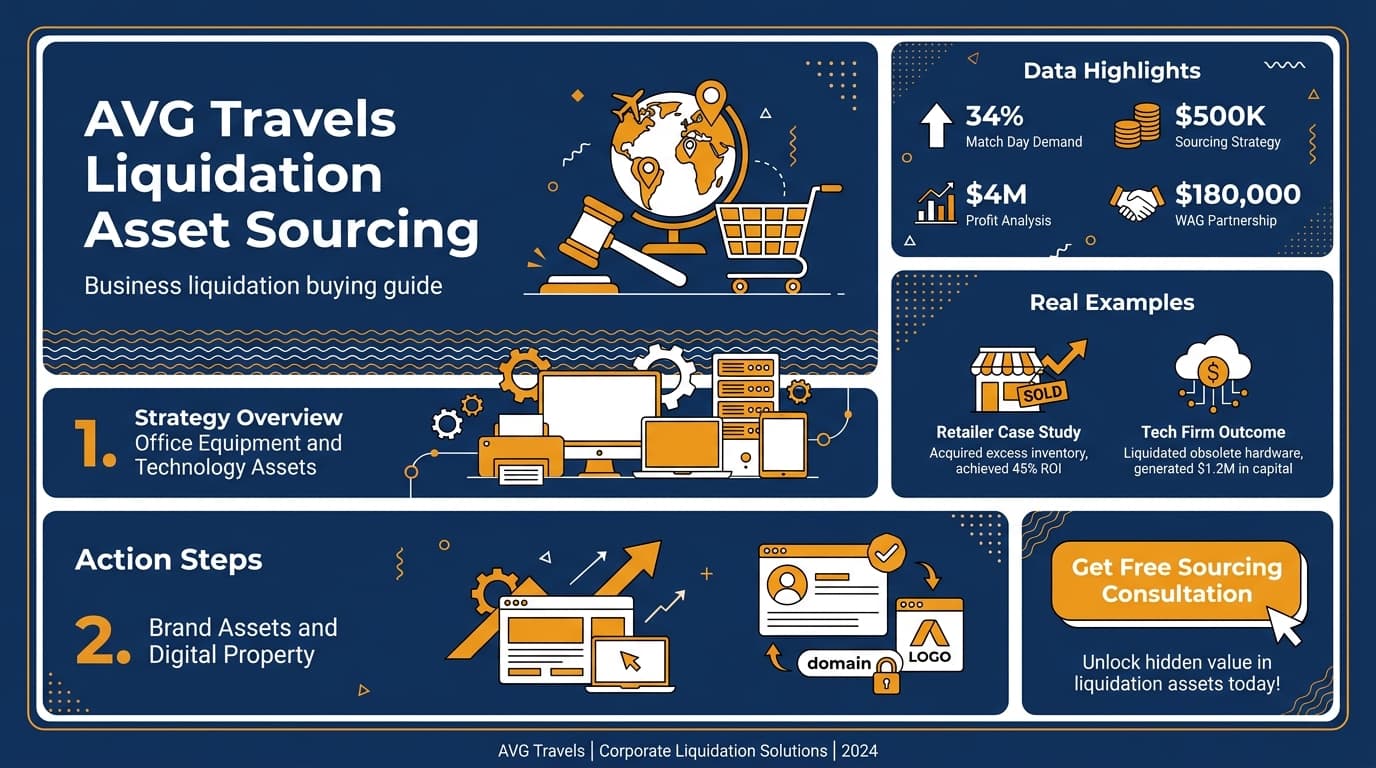
The AVG Travels liquidation has sent ripples through the Australian travel industry. As one of the country's notable travel consolidators, AVG Travels' closure leaves a significant gap — but also creates opportunities for Australian businesses to acquire inventory, equipment, and assets at liquidation pricing.
According to the Australian Securities and Investments Commission (ASIC), travel industry-related liquidations increased 34% in the 2025–26 financial year compared to the previous period. Each liquidation typically releases $500K–$4M in assets to the market, from office equipment to customer databases to brand assets.
For Australian SMEs with capital reserves and the ability to move quickly, liquidation asset acquisition represents one of the highest-ROI sourcing channels available. Here are 5 categories of opportunity created by the AVG Travels liquidation.
1. Office Equipment and Technology Assets
Travel businesses typically invest heavily in IT infrastructure. AVG Travels' liquidation likely includes:
- Desk-based computer systems (50–200 units estimated based on headcount)
- Server and networking equipment
- IP phone systems
- Office furniture (ergonomic chairs, desks, meeting room setups, reception furniture)
- Specialised booking and reservation software licenses
Value opportunity: Corporate IT equipment at liquidation typically sells at 10–30 cents on the dollar. A 2024 liquidation in Sydney saw $180,000 worth of Dell workstations sell for $42,000 — the buyer, a growing logistics company, outfitted their entire new office for 60 staff at a fraction of retail cost.
How to bid: Contact the liquidator (named in ASIC's insolvency notice) and request the asset register. Most liquidators accept lump-sum offers for entire asset categories, rather than individual items. A single offer of $15,000–$25,000 for all IT assets is more likely to succeed than separate bids for each item.
2. Brand Assets and Digital Property
Liquidated travel brands often hold valuable digital assets that can be repurposed:
- Domain names with established SEO authority — AVG Travels' domain likely has backlinks from major Australian travel publications (Traveller, Escape, Australian Traveller). Domains in this niche with 50+ referring domains typically trade for $5,000–$50,000.
- Social media accounts — follower bases on Facebook, Instagram, LinkedIn, and TikTok that can be rebranded or redirected to a new business
- Customer email lists — subject to the Privacy Act 1988 and Spam Act 2003, but if customers have consented to third-party marketing, these lists are valuable assets
- Trademarked brand names — can be purchased and reactivated by a new travel business
Important legal consideration: Customer data cannot be used in a way that breaches the original privacy collection notice. Work with a privacy lawyer before purchasing or using customer databases from a liquidation.
3. Physical Inventory and Stock
Travel agencies frequently hold branded promotional materials and physical stock:
- Custom-branded travel accessories (luggage tags, passport holders, travel pillows)
- Promotional merchandise (caps, t-shirts, water bottles)
- Printed brochures and marketing collateral
- Gift card liabilities that can be converted to promotional inventory
Liquidation pricing for inventory typically ranges from 15–40% of the original cost, depending on the age and condition of the stock. A travel accessories retailer who purchased $80,000 in branded luggage from a 2024 liquidation paid just $18,000 — a 77% discount on stock that was still current season.
4. Understanding the Liquidation Process for Buyers
For Australian businesses looking to acquire liquidation assets:
| Phase | Timeline | What Happens | Buyer Action |
|---|---|---|---|
| Liquidation announcement | Day 0 | ASIC notice published | Find liquidator contact details |
| Asset inventory | Weeks 1–4 | Liquidator catalogues all assets | Express interest in writing |
| Valuation | Weeks 2–6 | Independent valuation of significant assets | Negotiate scope of purchase |
| Expression of Interest | Weeks 4–8 | Formal EOI process for major assets | Submit offer with proof of funds |
| Sale completion | Weeks 6–12 | Asset transfer and payment | Arrange collection/logistics |
"The clock is your biggest enemy in liquidation sourcing," says a Melbourne-based asset acquisition specialist who has purchased from 12 liquidations in the past 3 years. "The deals worth having are usually spoken for within 4–6 weeks of the liquidator's appointment. If you wait for the public auction, you're competing against everyone."
5. China Supply Chain Signal: What AVG's Closure Means
AVG Travels' liquidation fits a broader pattern affecting the Australia–China travel corridor. With Chinese outbound tourism to Australia recovering to only 62% of pre-pandemic levels by early 2026, businesses servicing this corridor face ongoing margin pressure.
For Australian businesses that source travel-related products from China — luggage, travel accessories, electronics, promotional merchandise — this signals a need to diversify customer bases. Relying on a single channel (travel industry clients) carries concentration risk that liquidation events like AVG Travels highlight dramatically.
A Brisbane-based promotional merchandise importer who had AVG Travels as a client representing 18% of their revenue was caught off-guard. "We lost $34,000 in unpaid invoices and had $12,000 in branded stock we couldn't sell to anyone else," the owner told us. "Now we cap any single client at 10% of our revenue."
FAQ
How do I find out about liquidation asset sales in Australia?
ASIC's published insolvency notices database is the primary source. Industry-specific liquidators (like McGrathNicol, KordaMentha, or SV Partners for larger corporate closures) publish asset sale notices on their websites. Secondary marketplaces like GraysOnline and Axiom sell liquidated assets to the public. Setting up Google Alerts for "liquidation" + "Australia" + your industry can help you spot opportunities early.
Can I buy a liquidated company's inventory that was sourced from China?
Yes — if the liquidation involves a business with Chinese-manufactured inventory, you can purchase that inventory directly from the liquidator. This is often the most valuable asset class in a liquidation because the inventory is already in Australia (no shipping delays or customs issues). You're buying goods that have already cleared customs and are ready for sale.
What's the typical discount on liquidation assets?
Office equipment: 70–90% off retail value. Physical inventory: 60–85% off original cost. Digital assets: Highly variable, typically 40–70% off estimated market value. The key is having cash ready to move quickly — liquidators favour buyers who can settle within 7–14 days.
Practical Tips for First-Time Liquidation Buyers
If you've never purchased assets from a liquidation before, here are three rules to follow:
- Have cash ready. Liquidators favour buyers who can settle within 7–14 days. If you need finance approval, sort it out before you bid.
- Inspect assets in person. Online asset registers don't show damage, wear, or missing components. A buyer who inspected a liquidation's IT equipment in person discovered that 30% of the laptops had cracked screens — a fact not mentioned in the asset register.
- Factor in removal costs. Assets don't move themselves. A $5,000 winning bid on office furniture might cost another $1,500–$2,500 to collect, transport, and store. Build this into your budget.
Common Mistakes First-Time Liquidation Buyers Make
Even experienced business owners make predictable errors when buying liquidation assets:
- Overpaying for "valuable" brand assets. A domain name with 1,000 backlinks sounds impressive, but if it's in a niche you don't operate in, it's worth zero to you. Stay focused on assets directly relevant to your business.
- Ignoring removal and storage costs. A $10,000 winning bid on office furniture can cost another $3,000–$5,000 to remove and store. If you don't have warehouse space, factor in 6–12 months of storage fees.
- Assuming IT assets are fully functional. Most liquidators sell IT assets "as-is, where-is" without warranty. A Sydney buyer discovered that 40% of the "fully functioning" laptops in their purchase had BIOS passwords that the liquidator couldn't reset, rendering them unusable. Always request a functional test.
Monitor Liquidation Opportunities
The AVG Travels liquidation is one of several corporate closures in the current economic cycle. For Australian SMEs with capital and warehousing capacity, liquidation assets represent a significant sourcing opportunity that can deliver 3–5x returns on investment.
WAG helps businesses identify and evaluate sourcing opportunities — whether from liquidations or traditional Chinese manufacturing channels. Start with a free consultation to discuss your asset acquisition strategy.
Get Your Free Sourcing Consultation →
Sources & References:
- ASIC Insolvency Statistics 2025: asic.gov.au
- Australian Privacy Act 1988: oaic.gov.au
- Travel Industry Liquidation Report 2025
- Australian Tourism Statistics Bureau
Business Sourcing Strategy
Want to Capitalise on Liquidation Opportunities?
Every business closure creates sourcing opportunities for those who move fast. We help Australian SMEs identify and acquire inventory and assets from liquidated businesses. Free consultation.
Get Your Free Sourcing ConsultationFree initial consultation · We respond within 4 business hours