Key Takeaways
- 1China business tours reveal supplier realities that no online profile can show — always verify in person before committing
- 2The Canton Fair in April and October is the most efficient way to shortlist suppliers across multiple categories in one trip
- 3Supplier verification on the ground catches red flags that screening services miss — always ask to see the actual production floor
- 4Australian businesses that visit factories before placing orders save an average of 6 weeks in the sample revision cycle
- 5Never commit to a supplier on the day of the visit — compare at least two or three factories before deciding
Australian businesses sourcing from China face a fundamental problem: the distance between what you see online and what actually exists on the factory floor. A polished Alibaba profile, a professional-looking website, a competitive quote — these tell you very little about whether a supplier can actually deliver your order at the quality and volume you need.
The solution is a China business tour: a structured visit to verify factories, meet suppliers, and build the relationships that protect your supply chain long-term.
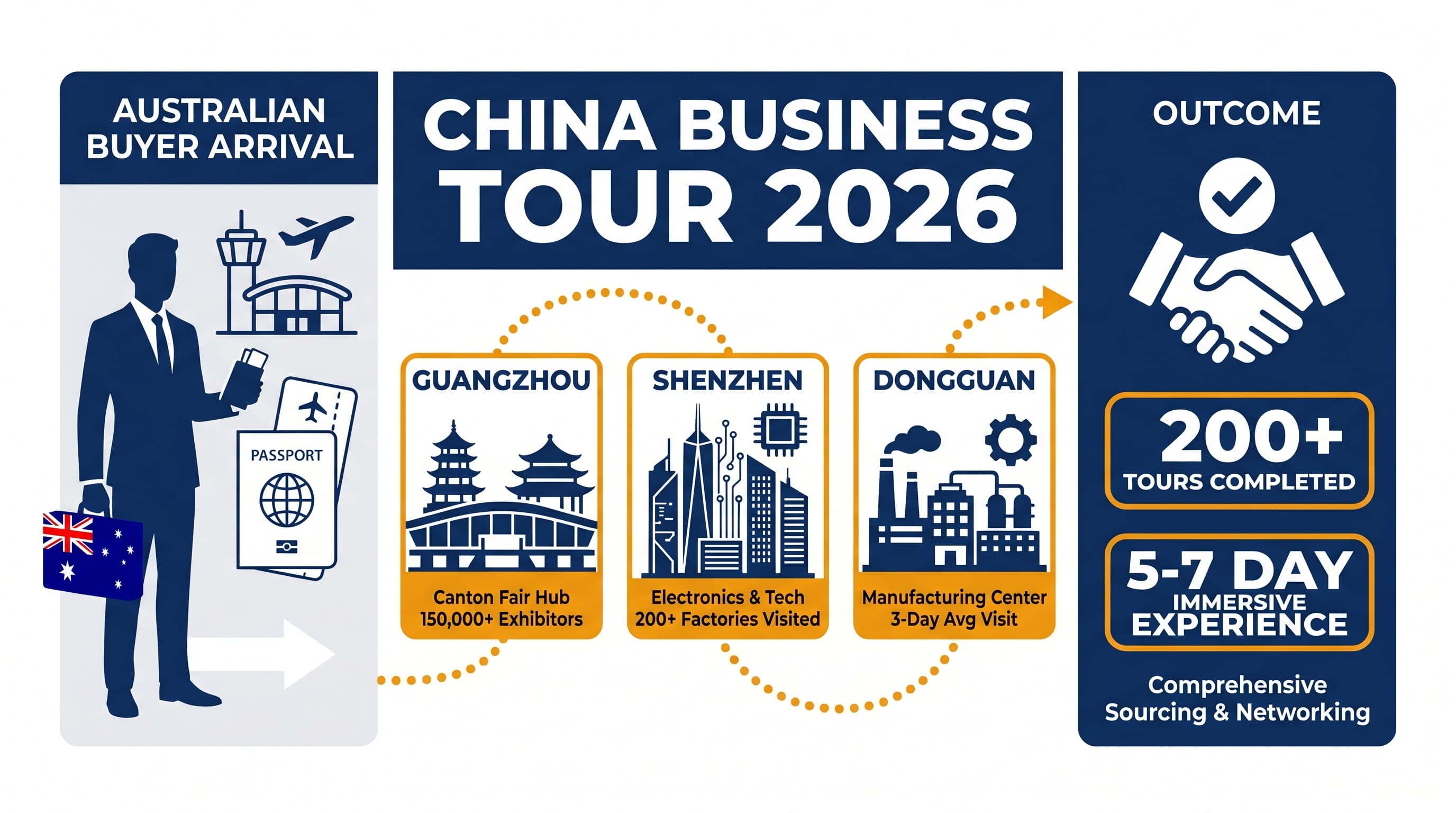
Winning Adventure Global coordinates China business tours for Australian companies across all major manufacturing hubs. Based in Adelaide with an on-ground team in China, we have conducted 200+ factory visits since 2018.
What Is a China Business Tour?
A China business tour is a planned visit to China for the purpose of supplier verification, factory inspection, and business development. For Australian businesses, it typically involves:
- Visiting one or more factories to assess production capacity, quality systems, and export experience
- Meeting with suppliers to negotiate terms and build relationships
- Attending trade events such as the Canton Fair in Guangzhou
- Conducting quality control inspections and sample reviews
- Visiting multiple cities to compare suppliers across China's manufacturing regions
The typical duration is 5-7 days. Shorter trips (2-3 days) work for focused visits to a specific city. Longer trips (7-10 days) allow you to visit multiple manufacturing hubs and attend the Canton Fair.
What to do
Plan your China business tour around the sample revision cycle, not just the first meeting. The visit should compress your decision timeline — use it to get samples right in person rather than waiting weeks for remote iterations.
Why Australian Businesses Need Face-to-Face Verification
Every Australian business we work with has the same concern: "How do I know this supplier is real?"
The answer is always the same: you visit.
Online screening tools, third-party verification reports, and trade references all have blind spots. They cannot tell you:
- Whether the factory is actually running the production line they claim
- How many workers are on the floor that day (not in the brochure)
- Whether the supplier has genuine export experience or is a trading company posing as a factory
- How the quality control team actually operates during production
- Whether the person you are negotiating with has authority to make commitments
Only being on the ground answers these questions.
Ready to plan your China business tour?
We shortlist 2-3 pre-verified factories matched to your industry, accompany you on the ground with full translation, and handle all coordination from arrival to departure.
Start your enquiryThe China Business Tour Process
Phase 1: Pre-Trip Planning (2-4 Weeks Before Travel)
Before boarding the plane, you need to be strategic about which factories to visit. Walking into a factory without pre-visit research wastes time and gives the supplier all the power in the conversation.
What to do before you travel:
- Define your product requirements clearly — specific specs, volumes, timeline, and quality standards. Vague requirements produce vague quotes.
- Shortlist 3-5 factories per product category — do not rely on a single supplier for anything critical. Use the Canton Fair, industry directories, and referrals to build your list.
- Research each factory's export history — ask specifically about shipments to Australia, the US, and Europe. Experienced exporters have track records.
- Prepare a technical checklist — based on your product, list the specific things you need to verify on the floor (machine types, QC procedures, packaging standards, etc.)
- Arrange your itinerary — plan which cities to visit, coordinate with each factory on specific dates, and book accommodation near each manufacturing hub.
What to do
Request a video call with each shortlisted factory before you visit. This serves two purposes: it validates that they are a real operation, and it gives you specific questions to ask when you are on the ground.
Phase 2: On-Ground Factory Visits
When you arrive at a factory, the goal is information gathering — not commitment.
Day-of-visit protocol:
- Ask to see the production floor first — before the showroom, before the meeting room. The floor tells you the real story.
- Observe active production lines — how many lines are running? What is the current order queue? This tells you about real capacity, not advertised capacity.
- Meet the production manager, not just the sales team — sales people show you what they want you to see. Production managers show you what actually happens.
- Ask specific questions — "What is your MOQ for this product?" "What happens if a shipment fails QC at customs?" "Can you show me your QC documentation for last month's export to [country]?"
- Take photos and notes systematically — document machine types, worker count, floor layout, packaging areas, and warehouse capacity. Compare these against what was advertised.
Red flags to watch for:
- Refusal to show the production floor on the day of the visit
- Fast agreement to every request without pushback (a "yes" culture that over-promises)
- ISO certificates on walls but no visible QC procedures on the floor
- Export claims that cannot be backed up with specific shipment examples
- Salespeople who cannot introduce you to the production manager
Ready to plan your China business tour?
We shortlist 2-3 pre-verified factories matched to your industry, accompany you on the ground with full translation, and handle all coordination from arrival to departure.
Start your enquiryPhase 3: Post-Trip Decision Making
The most common mistake Australian buyers make is committing to a supplier before they have compared options.
Decision framework:
- Do not commit on the day — factory tours are designed to give you information. The purchase decision happens after you leave, when you can compare what you saw across multiple suppliers.
- Request samples from your top two choices — even if a factory looks perfect on the visit, always get physical samples before placing a production order.
- Negotiate terms with the top two — use competition between suppliers to improve pricing and payment terms. Never disclose that you are also considering another factory.
- Start with a small pilot order — even after a successful visit, your first production run should be smaller than your eventual volume. This tests the supplier's operational execution before you scale.
Key Manufacturing Hubs for Australian Businesses
Shenzhen and the Pearl River Delta
Shenzhen is the global centre for electronics manufacturing and rapid prototyping. For Australian businesses sourcing consumer electronics, smart home devices, phone accessories, or tech products, Shenzhen is the primary destination.
Key areas:
- Baoan District — electronics manufacturing clusters
- Longhua District — smart hardware and consumer electronics
- Dongguan — industrial manufacturing and precision components
Guangzhou and Foshan
Guangzhou and Foshan form the heart of China's manufacturing belt for consumer goods, furniture, textiles, and industrial equipment. Foshan is particularly important for furniture and building materials. Guangzhou hosts the Canton Fair and is the gateway for most business visitors.
Key areas:
- Guangzhou Panyu — automotive parts and machinery
- Foshan Shunde — furniture, ceramics, and appliances
- Guangzhou Baiyun — logistics and export hubs
Shanghai and the Yangtze River Delta
Shanghai is the centre for premium manufacturing, industrial equipment, and automotive components. Businesses sourcing higher-specification products often find their suppliers in this region.
What to do
Australia-based businesses importing from China are increasingly subject to country-of-origin labeling requirements and customs documentation standards. Make sure your chosen supplier has experience with Australian import regulations before committing to a shipment.
The Canton Fair: Why It Should Be on Every Business Tour
The China Import and Export Fair (Canton Fair) runs twice a year in Guangzhou — in April and October. It is the largest trade fair in the world, with over 25,000 exhibitors across three phases.
Why Australian businesses should attend:
- Efficient supplier shortlisting — in two or three days at the fair, you can meet more verified suppliers than in weeks of online searching
- Cross-category sourcing — one visit covers electronics, furniture, textiles, machinery, and consumer goods simultaneously
- Price benchmarking — get quotes from multiple suppliers for the same product in one location
- Factory verification — many factories exhibit at the fair; use it as a pre-screening step before scheduling on-ground visits
Canton Fair phases:
| Phase | Dates | What It Covers |
|---|---|---|
| Phase 1 | Mid April / October | Electronics, household appliances, machinery, hardware |
| Phase 2 | Late April / October | Consumer goods, gifts, household items, furniture |
| Phase 3 | Early May / November | Textiles, shoes, bags, medicine, sportswear |
For factory tour planning, attending the Canton Fair before visiting factories gives you a shortlist in hand before you board the plane.
Ready to plan your China business tour?
We shortlist 2-3 pre-verified factories matched to your industry, accompany you on the ground with full translation, and handle all coordination from arrival to departure.
Start your enquirySupplier Verification: What to Look For on the Ground
Supplier verification is the core purpose of a China business tour. Here is what to check:
Production Capacity
- Actual floor space vs. stated facility size
- Number of active production lines vs. stated capacity
- Current order queue and delivery commitments
- Subcontracting relationships (is the factory using third-party workshops?)
Quality Control Systems
- QC procedures during production (not just at final inspection)
- Testing equipment on the floor
- Defect rates and how they are measured
- Certification maintenance (ISO, CE, etc.)
Export Experience
- Specific export history to Australia, US, Europe
- Customs clearance experience (ask: "have you had a shipment rejected at customs?")
- Documentation capability (can they produce the CO, COO, and inspection certificates you need for Australian customs?)
Communication and Responsiveness
- English proficiency of technical staff (not just sales)
- Responsiveness to technical questions before and during the visit
- Transparency about limitations and challenges
What to do
Ask to see their last three export shipments. Any factory with genuine export experience will have this information readily available. If they hesitate or give vague answers, that is a signal to dig deeper.
Negotiation Tactics for Australian Buyers
Chinese business culture operates differently from Australian business culture. Understanding these differences before you negotiate is not optional — it is essential.
Speed Signals
In Australian business culture, fast responses signal commitment. In Chinese business culture, a fast "yes" to every request often signals that the supplier is telling you what you want to hear. Suppliers who push back on unrealistic timelines or specifications are showing you their operational reality.
The Face Concept
"Guanxi" (relationships) and "mianzi" (face) are foundational to Chinese business culture. Publicly contradicting or embarrassing a supplier during negotiations damages the relationship and makes agreements harder to reach. Constructive feedback delivered privately is more effective than direct confrontation.
The Commitment Question
Chinese suppliers often say "we can do that" without meaning it as a binding commitment. Always follow up verbal agreements in writing and have your bilingual guide confirm understanding on both sides before you leave the meeting.
Payment Terms
Standard payment terms for first orders are typically 30% deposit, 70% balance against copy of Bill of Lading. Be cautious of suppliers who demand 50% or more deposit for first orders — this is a signal they do not have the export experience to manage cash flow confidence.
Ready to plan your China business tour?
We shortlist 2-3 pre-verified factories matched to your industry, accompany you on the ground with full translation, and handle all coordination from arrival to departure.
Start your enquiryRelated Articles
- 7 Things I Learned Visiting Chinese Factories for 8 Years — Practical insights from 200+ factory visits
- Complete Guide to China Business Travel for Australian Companies 2026 — Travel logistics, visa, and itinerary planning
- Sydney Businesses: China Factory Visit Strategy — Case study and city-specific guidance
- How to Verify a Chinese Supplier — The 6-step verification framework
Frequently Asked Questions
How long should I plan for a China business tour?
A productive China business tour is typically 5-7 days. This allows time to visit 2-3 factories in different cities, attend the Canton Fair (if timing aligns), and have follow-up meetings. Shorter 2-3 day trips work for focused visits to a specific supplier or city.
What is the best time of year to visit China on business?
The best time for a China business tour is April or October, aligned with the Canton Fair in Guangzhou. April and October also offer the most comfortable weather for travelling between manufacturing hubs. Avoid Chinese New Year (late January to mid-February) when most factories shut down for 2-4 weeks.
How many factories should I visit in one trip?
Visit at least two factories for the same product category before making any decision. Comparing suppliers side-by-side gives you benchmarks for pricing, quality, and communication quality that a single visit cannot provide.
What should I bring to a factory visit?
Bring: your product specifications (printed and digital), a printed checklist of verification items, business cards, a camera or phone for documentation, and a bilingual guide if your Mandarin is limited. Do not bring样品 (samples) for comparison unless you have specific quality benchmarks to reference.
How do I verify a factory is a real manufacturer and not a trading company?
Ask to see the production floor on the day of the visit — trading companies cannot show you their own manufacturing operation. Ask for business license documentation showing the scope of permitted manufacturing activities. Ask to meet the production manager, not just sales staff. Check whether they can provide a manufacturing footage video from their own facility.
China Business Tour
Ready to plan your China business tour?
We shortlist 2-3 pre-verified factories matched to your industry, accompany you on the ground with full translation, and handle all coordination from arrival to departure.
Start your enquiryFree initial consultation · We respond within 4 business hours