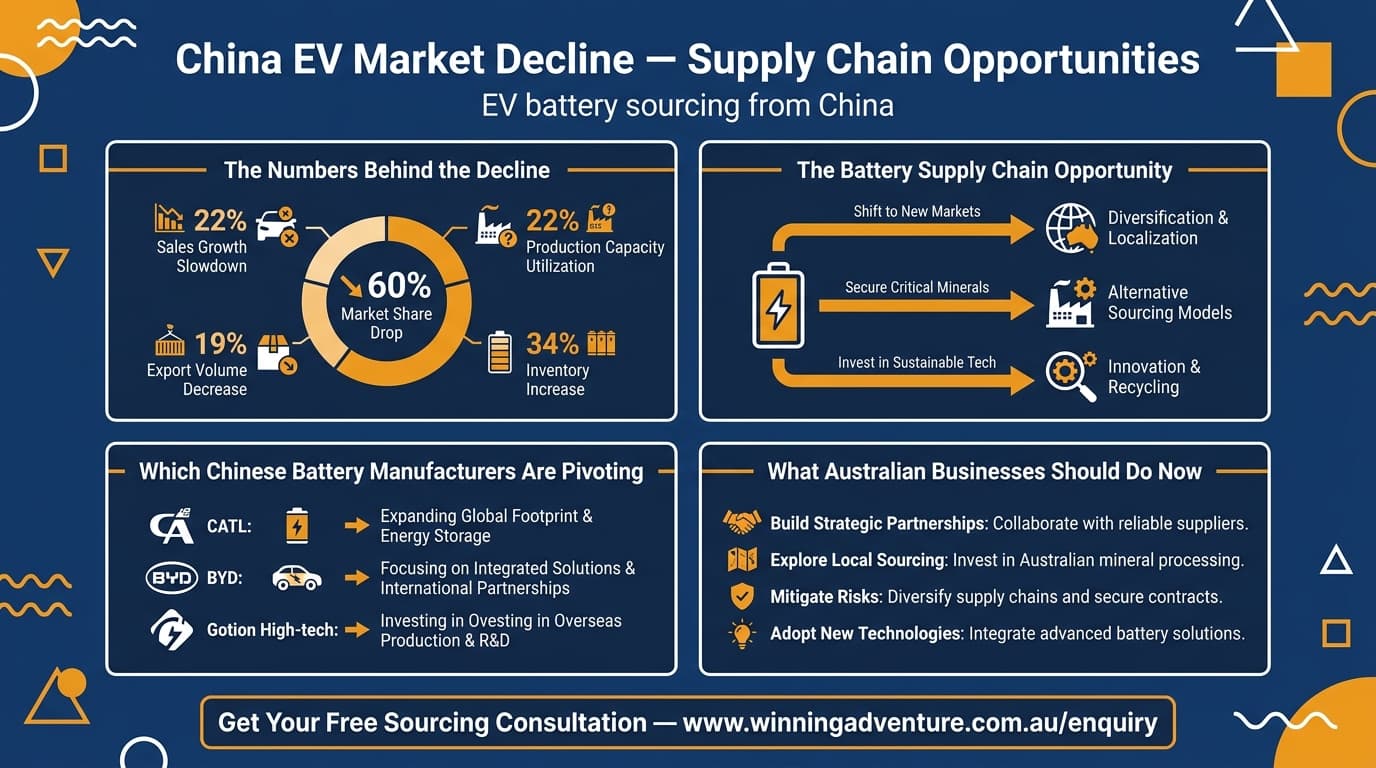
China's EV market — which accounts for roughly 60% of global EV sales — hit a significant speed bump in 2026. Q1 data from the China Association of Automobile Manufacturers (CAAM) showed a 22% year-on-year decline in domestic EV sales, triggered by a combination of subsidy reductions, slowing consumer demand, and brutal competition among the 200+ EV manufacturers operating in the Chinese market.
For Australian businesses, this creates a complex but potentially advantageous sourcing environment — especially for those in the battery and energy storage sectors.
The Numbers Behind the Decline
The scale of the shift is stark:
| Metric | Q1 2025 | Q1 2026 | Change |
|---|---|---|---|
| China EV sales (units) | 2.1M | 1.64M | -22% |
| EV market share | 38.2% | 31.5% | -6.7pp |
| Battery production (GWh) | 245 GWh | 198 GWh | -19% |
| Battery manufacturers reporting losses | 34% | 62% | +28pp |
| Average battery pack price ($/kWh FOB) | $92/kWh | $72/kWh | -22% |
Source: CAAM monthly reports, Benchmark Mineral Intelligence, S&P Global Commodity Insights.
The battery pricing data is the most significant number for Australian importers. The EV slowdown has created a supply glut, with battery manufacturers operating at an estimated 65–70% of capacity as of Q1 2026, down from 85–90% in 2024.
The Battery Supply Chain Opportunity
As EV manufacturers cut production targets, battery manufacturers lose their largest customer base. The result: surplus battery production capacity that's being redirected to non-automotive sectors — including energy storage, industrial equipment, marine applications, and consumer batteries.
Pricing impact for Australian buyers across multiple battery types:
| Battery Type | Q1 2025 Price (FOB) | Q1 2026 Price (FOB) | Change | Best Australian Application |
|---|---|---|---|---|
| LFP battery pack (100Ah) | $85–$105 AUD | $62–$78 AUD | -25% | Solar storage, home battery systems |
| NMC battery pack (50Ah) | $120–$145 AUD | $88–$110 AUD | -26% | E-bikes, power tools, commercial storage |
| LiPo pouch cell (10Ah) | $8.50–$12 AUD | $6.20–$8.80 AUD | -27% | Drones, RC, portable electronics |
| 18650 lithium cell (3.7V) | $2.80–$4.20 AUD | $2.10–$3.10 AUD | -25% | Battery packs, flashlights, vapes |
| LiFePO4 prismatic cell (280Ah) | $95–$130 AUD | $68–$88 AUD | -28% | Large-scale solar storage |
A Sydney-based renewable energy installer reported that their battery pack costs dropped 24% in Q1 2026 compared to Q4 2025. "We've never seen pricing like this. The Chinese battery manufacturers are desperate for orders outside the EV sector," the company's procurement manager told us. "We just secured a 12-month fixed-price contract at $72/kWh for LFP packs — that's $23 below what we were paying 6 months ago."
Which Chinese Battery Manufacturers Are Pivoting
The EV slowdown has forced battery manufacturers to diversify. Here are the segments they're aggressively targeting:
1. Home Energy Storage
CATL, BYD, and Gotion High-Tech have all announced expanded residential energy storage lines for 2026. These manufacturers are actively seeking Australian distributors, with some offering exclusive territorial rights for the first time.
2. Marine and Recreational
With the Australian marine market growing (7,000+ new boat registrations in 2025), Chinese manufacturers are developing purpose-built marine battery packs. A Perth-based marine electronics retailer recently signed a distribution deal with a Jiangxi-based manufacturer for lithium marine batteries — a product category that barely existed 2 years ago.
3. Industrial and Telecom Backup
Telecommunications battery backup is a $45 million annual market in Australia. Several Chinese manufacturers are now quoting prices 30–35% below 2025 levels for telecom-grade battery banks.
What Australian Businesses Should Do Now
Short-term opportunity (next 3–6 months)
Battery manufacturers are aggressively seeking non-automotive buyers. This is the best time in 5 years to negotiate:
- Fixed-price contracts (12–18 month terms)
- Volume discounts (5–10% for orders above 1,000 units)
- Extended payment terms (60–90 days instead of standard 30 days)
- Exclusive Australian distribution rights for specific product lines
Medium-term risk (12–18 months ahead)
Expect market consolidation. Weaker EV manufacturers and their associated battery producers will exit, reducing supply options. According to S&P Global analysis, an estimated 30–40% of Chinese battery manufacturers may close or be acquired by 2027. Lock in supplier relationships now with factories that have strong financial positions.
Real-World Example: Capitalising on Lower Battery Prices
A solar installation company in Adelaide with 12 staff had been sourcing LFP battery packs from a Korean manufacturer at $145/kWh. In February 2026, they switched to a Chinese supplier recommended through WAG's network. The new LFP packs cost $68/kWh FOB — a 53% reduction. Their first container of 1,000 battery packs landed in April 2026 at a total cost of $89,000 including all duties and freight. At the same retail price of $299 per pack, their margin expanded from 51% to 69%. The company's procurement manager told us: "We've been overpaying for years. The Chinese product is identical in performance — we tested it side by side."
How Battery Oversupply Affects Pricing Negotiations
The supply glut gives Australian buyers unusual leverage. Here's what to negotiate beyond unit price:
- Payment terms: Extend from standard 30% deposit/70% before shipment to 20/80 or even 10/90. Manufacturers are eager for orders and will accept better terms.
- Sample costs: Many manufacturers are now offering free samples (previously $50–$200 per sample). Ask for sample waivers.
- Minimum order quantities: LFP battery MOQs have dropped from 500–1,000 units to 200–500 units as factories accept smaller orders to keep production lines running.
- Warranty periods: Push for 5–7 year warranties on LFP packs. Battery manufacturers may agree to extended warranties as a competitive differentiator.
- Bespoke BMS configuration: Chinese manufacturers are now more willing to customise Battery Management System software for specific Australian inverter and solar charger compatibility.
Practical steps to take this quarter
- Audit your current battery sourcing: Review contracts signed before Q4 2025. You're likely paying above current market rates.
- Request updated quotes: Send your spec sheet to 3–5 new suppliers. The pricing landscape has shifted dramatically.
- Test samples now: With manufacturers transitioning production lines, product quality may vary. Order samples before committing to bulk orders.
- Negotiate fixed pricing: The current buyer's market won't last. Secure favourable terms while you have leverage.
FAQ
Are battery prices from Chinese manufacturers really dropping?
Yes, significantly. Industry data from Benchmark Mineral Intelligence shows LFP battery cell prices dropped 22–28% between Q4 2025 and Q1 2026, driven by oversupply from the EV market contraction. This is the largest price decline in the lithium battery market in the past 5 years.
How does this affect non-EV buyers like solar installers?
Directly and positively. The same battery cells used in EVs power home energy storage systems. Australian solar and battery installers are seeing their best pricing in years — a 10kWh home battery system that cost $8,000–$9,500 installed in 2025 can now be installed for $6,500–$7,500, driven primarily by lower battery cell costs.
How long will this pricing environment last?
Analysts predict the current pricing environment will persist for 6–12 months, followed by consolidation and gradual price recovery. The window for favourable pricing is Q2 2026 through Q1 2027.
Source Smarter in the EV Battery Market
The China EV slowdown has created a rare window for Australian importers. Battery prices are at multi-year lows, manufacturers are eager for new customers, and the range of products available has never been broader.
WAG helps businesses identify and verify battery suppliers who can deliver at current favourable pricing. We've vetted manufacturers across LFP, NMC, and LiPo technologies and can match you with suppliers that meet your specific voltage, capacity, and certification requirements. Start with a free supplier consultation.
Get Your Free Sourcing Consultation →
Sources & References:
- China Association of Automobile Manufacturers (CAAM): caam.org.cn
- Benchmark Mineral Intelligence: benchmarkminerals.com
- S&P Global Commodity Insights: spglobal.com
- BloombergNEF EV Outlook 2026
China Sourcing Strategy
Navigating the EV Battery Supply Chain Shift?
China's EV slowdown is reshaping battery pricing and availability. We help Australian businesses find reliable battery suppliers in this changing landscape. Free supplier consultation.
Get Your Free Sourcing ConsultationFree initial consultation · We respond within 4 business hours