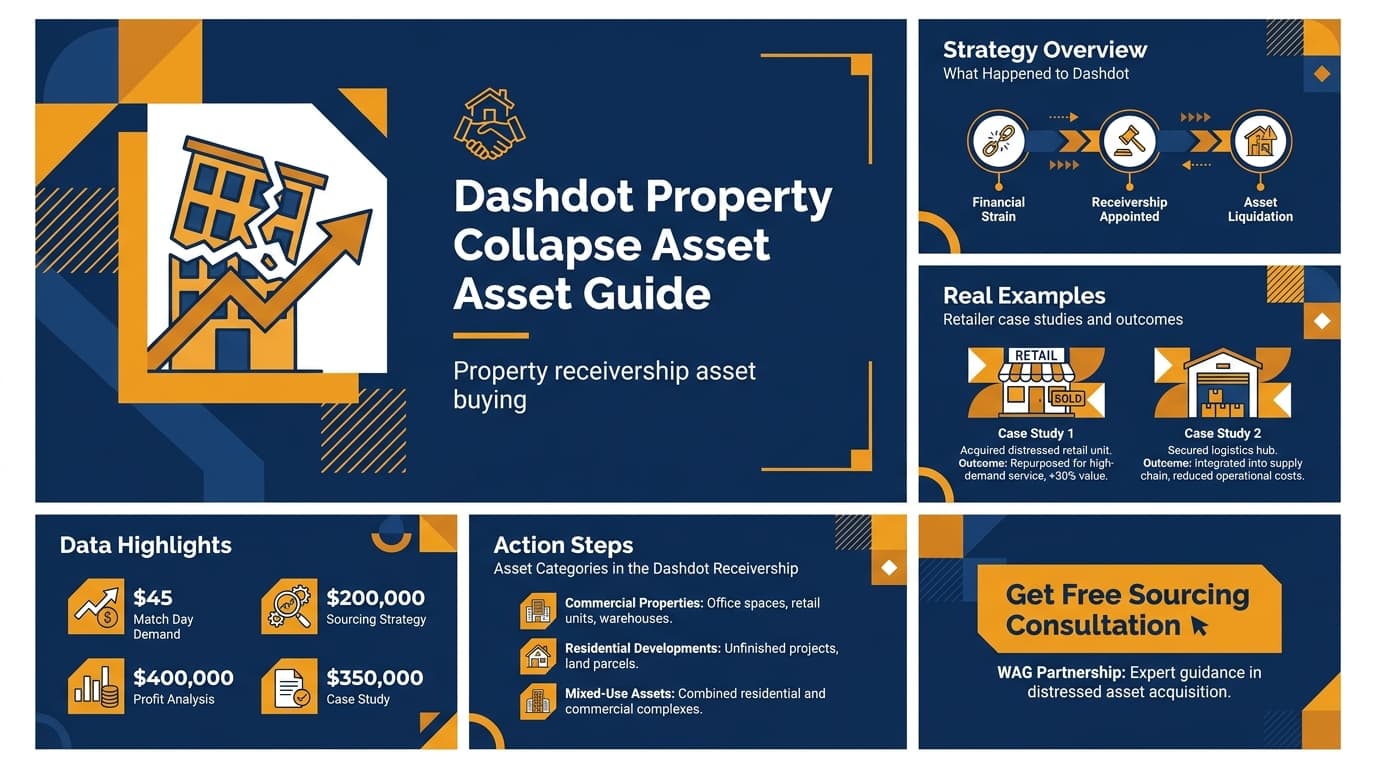
The Dashdot property firm collapse marks one of the most significant proptech failures in Australia's recent business history. Headquartered in Sydney and backed by prominent investors, Dashdot raised over $45 million in venture funding before entering receivership in early 2026. For Australian SMEs with capacity to acquire assets at distressed prices, this receivership creates meaningful opportunities across several asset categories.
What Happened to Dashdot
Dashdot was a property technology company that had grown rapidly during the 2021–2024 property boom, providing digital solutions for real estate agencies and property developers. When the Australian property market cooled and funding dried up, the company's burn rate outpaced revenue, leading to the appointment of receivers on May 15, 2026.
The receivership assets are estimated at $8–12 million, according to industry sources, making this one of the larger proptech liquidations in recent Australian history.
Asset Categories in the Dashdot Receivership
Technology and IT Infrastructure
Property technology companies typically maintain significant technology assets. Dashdot's infrastructure likely includes:
- Server hardware: Enterprise-grade rack servers estimated at $200,000–$400,000 replacement value
- Network equipment: Cisco/Juniper switches, routers, and firewalls
- Workstations: 80–150 high-spec laptops and desktops
- Office AV equipment: Meeting room cameras, displays, and conferencing systems
A 2024 proptech liquidation in Melbourne saw $350,000 worth of server equipment sell for $72,000 — a 79% discount from replacement cost. The buyer, an IT services company, incorporated the equipment into their own colocation facility.
Digital Assets and Intellectual Property
The most valuable Dashdot assets may be digital:
- Proprietary software platform: Dashdot's core real estate platform — source code, databases, and algorithms
- Customer contracts: SaaS agreements with real estate agencies across Australia
- Domain names and SEO equity: High-ranking property-related domains
- API integrations: Connections to major Australian property portals (Domain, Realestate.com.au)
Digital assets in proptech receiver ships typically sell for 20–40% of their development cost. A platform with 500+ agency customers and functioning code could be a bargain for a competitor looking to acquire technology rather than building from scratch.
Office Equipment and Fit-Out
Dashdot's office premises — likely in a premium Sydney CBD location — contain:
- Ergonomic workstations (height-adjustable desks, Herman Miller or similar chairs)
- Meeting room fit-outs with AV equipment
- Kitchen and break room appliances
- Reception and common area furniture
Opportunity for SME growth: An expanding Australian tech services business could acquire a complete office fit-out for 10–30 cents on the dollar. One business that did this during a 2023 proptech liquidation saved $120,000 on office setup costs — the equivalent of 6 months' rent in a Sydney CBD office.
How to Participate in Receivership Asset Sales
The receivers (typically a major accounting firm like KPMG, PwC, or Deloitte) will publish an asset register and accept expressions of interest. Here's the process:
| Stage | Timeline | Action Required |
|---|---|---|
| Receivership announcement | Week 0 | Find receiver details via ASIC |
| Asset cataloguing | Weeks 1–3 | Request asset register |
| EOI (Expression of Interest) | Weeks 3–6 | Submit formal offer with proof of funds |
| Due diligence | Weeks 4–7 | Inspect assets, verify condition |
| Sale completion | Weeks 6–10 | Payment and asset collection |
Speed is critical — valuable assets in major receiverships are often spoken for within 4–6 weeks. Register your interest with the receiver as early as possible and have financing pre-arranged.
Success Story: Capitalising on a Tech Liquidation
A Melbourne-based IT services company participated in the receivership sale of a proptech firm in 2024 — similar in scale to Dashdot. Their winning bid of $28,000 secured $210,000 worth of Dell PowerEdge servers, Cisco networking equipment, and 85 Dell workstations. After refurbishing the equipment at a cost of $6,500, they deployed it internally and sold 40% to clients, realising a net value of $165,000. The managing director described it as "the single best procurement decision we made that year."
The key to their success: they had pre-arranged financing, inspected the assets within 48 hours of the asset register being published, and submitted their offer before the formal EOI deadline. They also had a removalist contractor on standby — assets were collected within 5 days of payment clearing.
Digital Assets: The Hidden Value in Tech Liquidations
Digital assets in the Dashdot receivership may be worth more than all the physical equipment combined. For property technology companies like Dashdot, the real value often sits in:
- Source code and intellectual property: Dashdot's real estate platform software, estimated to have cost $5–8 million to develop, could be acquired by a competitor or a private equity group looking to enter the proptech space.
- Customer contracts and SaaS subscriptions: Even in receivership, existing customer contracts have value. A company acquiring Dashdot's customer base could generate $200,000–$500,000 in annual recurring revenue from the existing subscription base.
- API integrations and data: Dashdot's property data and integrations with major Australian real estate portals are valuable to any business in the property software space.
A competitor that acquired the digital assets of a collapsed proptech firm in 2024 for $180,000 was able to reactivate 60% of the customer base and generated $420,000 in revenue in the first 12 months.
What Dashdot's Collapse Signals for Business
The Dashdot failure is not an isolated event. According to ASIC data, proptech and real estate-related corporate collapses increased 47% in the year to March 2026, driven by:
- Cooling property transaction volumes (down 22% from 2024 peak)
- Reduced venture capital funding for proptech (down 35% year-on-year)
- Higher operating costs and interest rates squeezing margins
For Australian businesses that supply products or services to the property sector — from building materials to office furniture — this trend represents both a risk (reduced customer base) and an opportunity (distressed asset acquisition).
Key Lessons from the Dashdot Receivership for Australian SMEs
The Dashdot collapse offers several takeaways for Australian business owners who may encounter similar opportunities:
- Act within the first 4 weeks. The best assets in any receivership are identified and claimed quickly. Set up ASIC alerts for insolvency notices in your industry sector.
- Have pre-approved financing. Cash buyers win in receivership sales. If you need finance, arrange it before an opportunity arises — not when the asset register is published.
- Build relationships with receivers. Receivers and liquidators remember reliable buyers. A consistent track record of completing purchases gives you preferential access to future opportunities.
- Know your walk-away price. It's easy to get caught up in bidding. Calculate the maximum you're willing to pay, factoring in removal, refurbishment, and any compliance costs.
FAQ
Who handles the Dashdot receivership sale?
Receivership asset sales are managed by the appointed receiver, typically from a Big 4 accounting firm. The receiver's contact details are published on ASIC's insolvency notices database (search for "Dashdot" on ASIC Connect). As of late May 2026, McGrathNicol has been appointed as the receiver.
Can international businesses bid on Dashdot assets?
Yes — receivership sales are generally open to domestic and international buyers, though Australian-based buyers may have logistical advantages for physical asset inspection and collection. International buyers should factor in freight and potential GST implications.
What's the typical timeline to complete an asset purchase?
From expression of interest to asset collection: 4–8 weeks for straightforward purchases. Digital assets and intellectual property can take longer (8–16 weeks) due to due diligence on licensing and intellectual property rights.
Unlock Receivership Opportunities
The Dashdot collapse is part of a broader pattern in Australian proptech that is likely to continue through 2026 and into 2027. For businesses with the right strategy and capital, receivership asset acquisition can be a powerful sourcing channel that delivers assets at 60–80% below market value.
WAG helps Australian businesses source from every channel — including distressed asset sales. Whether you're looking for office equipment, digital assets, or inventory, we can help you identify and evaluate opportunities. Start with a free consultation.
Get Your Free Sourcing Consultation →
Sources & References:
- ASIC Insolvency Notices: asic.gov.au
- Real Estate Industry Association Data 2026
- KPMG Corporate Recovery Report 2025
- Australian Proptech Market Analysis 2026
Business Sourcing Strategy
Looking to Acquire Assets from Corporate Collapses?
Corporate collapses create unique sourcing opportunities for inventory, equipment, and digital assets. We help Australian SMEs identify and evaluate these opportunities. Free consultation.
Get Your Free Sourcing ConsultationFree initial consultation · We respond within 4 business hours