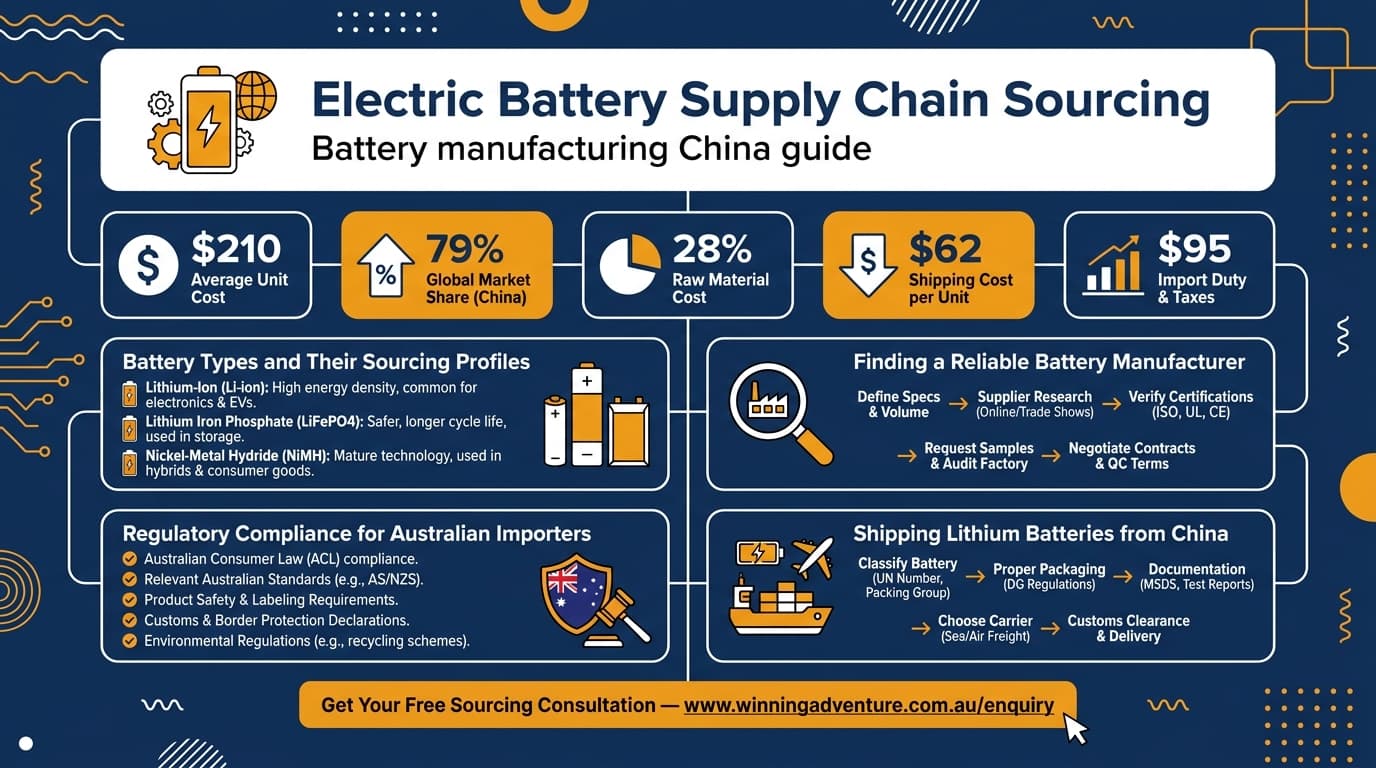
The global electric battery market is projected to reach $210 billion by 2030, and China remains the undisputed manufacturing leader, producing 79% of the world's lithium batteries according to BloombergNEF. For Australian businesses — from solar installers to equipment manufacturers — understanding how to source batteries from China is increasingly essential.
With the 2025–26 EV market shift creating favourable pricing conditions (battery pack prices down 22–28% year-on-year), now is an ideal time to establish or expand battery sourcing operations. But battery sourcing involves risks and complexities that don't apply to general merchandise.
This guide covers everything from battery chemistry selection to dangerous goods shipping to Australian compliance requirements.
Battery Types and Their Sourcing Profiles
Understanding which battery type to source is the first critical decision. Each chemistry has different applications, costs, and shipping requirements:
| Battery Type | Best For | FOB Price (2026) | Duty Rate | Shipping Class | Cycle Life |
|---|---|---|---|---|---|
| LFP (LiFePO4) | Solar storage, home batteries, EVs | $62–$95/kWh | 5% | Class 9 DG | 3,000–5,000 |
| NMC | Power tools, e-bikes, commercial | $88–$130/kWh | 5% | Class 9 DG | 1,000–2,000 |
| LiPo | Drones, RC, portable electronics | $6–$15/pouch | 5% | Class 9 DG | 300–500 |
| Lead-acid | UPS, backup, automotive | $0.15–$0.30/Wh | 5% | Non-DG | 200–500 |
| Sodium-ion (emerging) | Grid storage, stationary | $55–$80/kWh | 5% | Class 9 DG | 4,000–6,000 |
Key takeaway: LFP (Lithium Iron Phosphate) offers the best balance of safety, cycle life, and cost for most Australian applications. It's also the safest lithium chemistry for shipping, with the lowest thermal runaway risk.
Finding a Reliable Battery Manufacturer
Battery manufacturing is a specialised industry. General textile factories cannot produce batteries. Here's how to find genuine battery manufacturers:
Verification checklist for battery factories:
| Criteria | What to Check | Red Flags |
|---|---|---|
| Business license scope | Must include "battery manufacturing" or "lithium battery" | General "electronics" license |
| UN 38.3 certification | Current test report for each battery model | Expired or missing certification |
| ISO 9001:2015 | Quality management system certification | No certification or expired |
| Export history | Proven track record to Australia/US/EU | Only domestic Chinese sales |
| Factory inspection | Video call showing actual production lines | Can't show factory floor |
| Material safety data sheet | MSDS for each battery chemistry | Generic or template MSDS |
A Perth-based solar company that vetted 12 battery factories before selecting a supplier in Zhejiang province spent 6 weeks on due diligence — including a video factory tour and independent verification of UN 38.3 certificates. That upfront investment saved them from a potentially costly mistake when they discovered one "manufacturer" was actually a trader buying from multiple factories and relabelling products.
Regulatory Compliance for Australian Importers
All lithium batteries imported into Australia must comply with a complex regulatory framework:
Mandatory requirements:
- Australian Dangerous Goods Code (ADG 7.5) — governs transport within Australia after import
- ACCC mandatory safety standards — batteries sold to consumers must meet specific safety requirements
- UN 38.3 certification — the mandatory testing standard for lithium cell transport safety. This is non-negotiable. Every battery model you import must have a valid UN 38.3 test report from an accredited laboratory.
- IEC 62133 — international safety standard for portable sealed alkaline and lithium cells
- State environment protection authorities — some states require battery importers to register as battery waste scheme participants
Consequence of non-compliance: The ACCC issued $2.4 million in fines for non-compliant battery imports in 2025. Beyond fines, non-compliant batteries can be seized and destroyed by Australian Border Force.
Shipping Lithium Batteries from China
This is the most complex and costly part of battery sourcing. Lithium batteries are classified as dangerous goods (Class 9) under international shipping regulations.
Shipping options and costs:
| Method | Cost | Transit Time | Volume Limit | Requirements |
|---|---|---|---|---|
| Sea freight (DG container) | $3,500–$6,000 AUD | 25–30 days | 20ft container | UN packaging, 30% SOC max |
| Air freight (restricted) | $12–$18/kg | 5–8 days | Small samples only | 30% SOC, limited quantity |
| Rail + sea | Not recommended | 35+ days | N/A | Vibration damage risk |
All lithium battery shipments must comply with these requirements:
- Packed in UN-specification packaging (marked with UN performance mark)
- Accompanied by Material Safety Data Sheet (MSDS)
- Accompanied by UN 38.3 test summary for each cell/battery type
- Shipped at ≤30% state of charge (SOC)
- Labelled with Class 9 miscellaneous dangerous goods label
- Transport document (DG declaration) prepared by trained personnel
The 30% SOC rule is critical. Batteries shipped at full charge are significantly more dangerous in the event of a short circuit or damage during transit. Some Australian importers have had entire containers rejected at origin because batteries were at 50–60% SOC. A Melbourne importer lost $45,000 in 2024 when their container of fully charged power banks was discovered during a random inspection and returned to the factory at their expense.
Quality Control Protocols for Battery Imports
Battery quality issues can be catastrophic (fire, explosion) or costly (premature failure, capacity below spec). Implement these QC protocols:
Pre-production quality assurance:
- Request cell specification sheets from the manufacturer
- Verify UN 38.3 test reports (check expiry dates)
- Confirm cycle life ratings in writing
- Request third-party capacity testing (SGS or Bureau Veritas)
During production:
- Mid-production inspection of cell assembly and BMS (Battery Management System) integration
- Random sampling: test 5% of production batch for capacity, internal resistance, and voltage
- Verify BMS functionality (over-charge, over-discharge, short circuit protection)
Pre-shipment inspection:
- 100% visual inspection for physical damage (bulging, leaking, terminal damage)
- Random voltage check on 10% of units
- Verify correct labelling and documentation
Landed Cost Calculation Example
Here's a realistic total cost breakdown for importing LFP battery packs from China:
| Cost Item | Amount (AUD) | Notes |
|---|---|---|
| 1,000 x 100Ah LFP packs @ $72/kWh | $72,000 | FOB Shenzhen |
| Sea freight (20ft DG container) | $4,500 | China→Melbourne |
| Marine insurance (0.5% of cargo value) | $360 | Recommended for DG cargo |
| Customs brokerage | $350 | Per shipment |
| Import duty (5% of FOB value) | $3,600 | Various tariff heading 8507 |
| GST (10% of total landed) | $8,081 | Collected by Customs |
| QC inspection (SGS) | $650 | Pre-shipment inspection |
| Domestic freight (warehouse) | $550 | Melbourne/Sydney to customer |
| Total landed cost | $90,091 | Per unit: ~$90/pack |
At a typical retail price of $220–$280 per pack for a 100Ah LFP battery, the gross margin is 60–68%.
FAQ
What certifications do I need to import batteries from China?
UN 38.3 (transport safety certification) and MSDS (Material Safety Data Sheet) are mandatory for every lithium battery import. For consumer products, IEC 62133 (international safety standard) and AS/NZS 62368 (Australian standard for audio/video/IT equipment) may also apply. Request all three from your factory before production begins.
Is now a good time to source batteries from China?
Yes. The 2025–26 EV market slowdown has created a battery oversupply, with prices down 22–28% compared to 12 months ago. This buyer's market is expected to persist for 6–12 months before consolidation reduces supply options. The window for favourable pricing is Q2 2026 through Q1 2027.
How do I verify a Chinese battery manufacturer is legitimate?
Request UN 38.3 test reports from an accredited laboratory (not the factory's own certificate), conduct a video factory tour showing actual production lines, check their business license scope includes battery manufacturing, ask for references from 2–3 Australian or Western clients, and consider a third-party factory audit through SGS, Bureau Veritas, or QIMA.
Source Batteries Safely and Profitably
Battery sourcing requires specialised knowledge — from factory verification to dangerous goods shipping to Australian compliance. The current market conditions make it the best time in years to establish or expand battery sourcing, but the regulatory complexity means getting it wrong is expensive.
WAG helps Australian importers navigate every step of the battery sourcing process. We've vetted manufacturers across LFP, NMC, and LiPo technologies and can connect you with factories that meet Australian compliance standards. Start with a free consultation.
Get Your Free Sourcing Consultation →
Sources & References:
- BloombergNEF Battery Survey 2025: about.bnef.com
- ACCC Product Safety — Batteries: productsafety.gov.au
- Australian Dangerous Goods Code 7.5: ntc.gov.au
- International Electrotechnical Commission IEC 62133
China Sourcing Strategy
Looking for Reliable Battery Suppliers in China?
Battery sourcing involves more than just finding a factory — it's about safety compliance, shipping logistics, and quality assurance. We connect Australian importers with verified Chinese battery manufacturers. Free consultation.
Get Your Free Sourcing ConsultationFree initial consultation · We respond within 4 business hours