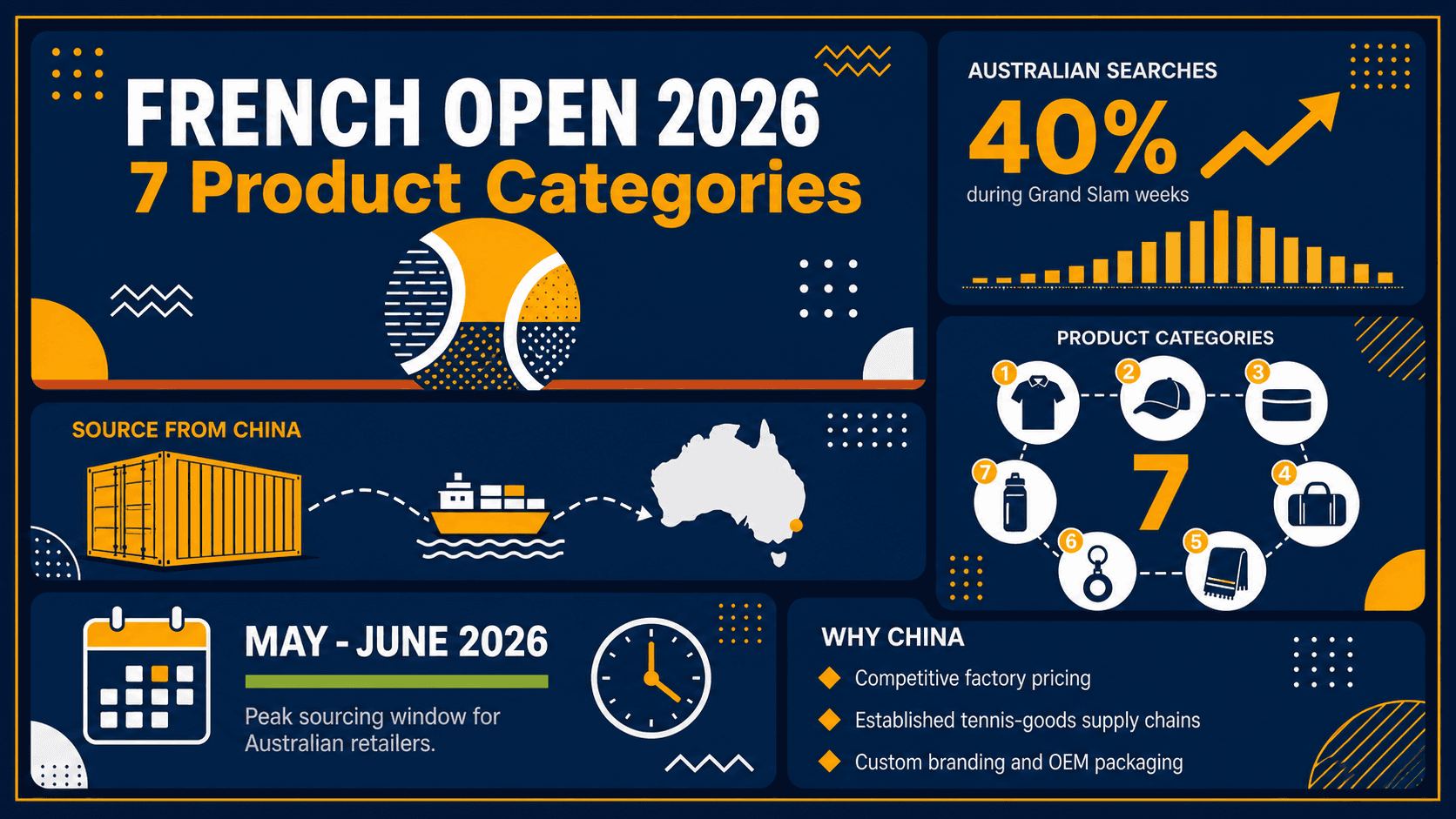
The French Open 2026 kicks off at Roland Garros on 24 May, and for the next three weeks, millions of Australians will be glued to their screens watching the world's best tennis players battle it out on the red clay of Paris. What most Australian retailers overlook is what happens between points: fans buying merchandise.
Tennis merchandise demand in Australia does not spread evenly across the year. It spikes around Grand Slams, and the French Open -- coming right as the Australian winter sets in and people turn to indoor sports and lounge viewing -- creates a unique buying window that smart retailers are already preparing for.
This article covers seven product categories Australian retailers, e-commerce sellers, and tennis clubs should be sourcing from Chinese manufacturers right now to capture the French Open 2026 merchandise wave.
Why the French Open Drives Tennis Merchandise Sales in Australia
The French Open occupies a distinctive position in the Australian sporting calendar. Unlike the Australian Open in January, which pulls fans to Melbourne Park in person, Roland Garros is watched almost entirely from home. The time difference works favourably: evening matches in Paris begin in the early morning in Sydney and Melbourne, creating a ritual of waking up to tennis that lasts the full fortnight.
This at-home viewing pattern translates into specific purchasing behaviour. Fans watching from their lounge rooms browse online stores during changeovers. They search for tennis apparel they see players wearing. Parents whose kids have just taken up tennis after watching the tournament look for junior gear. Club players, inspired by what they have watched, upgrade their own equipment bags and accessories.
The numbers back this up. Tennis Australia reports that club registration enquiries increase 18-22 percent in the month following each Grand Slam. Google Trends data for Australia shows that searches for "tennis shirt," "tennis cap," and "tennis bag" spike 40-60 percent during Roland Garros week compared to the monthly average. Retailers who have inventory ready when those searches convert capture revenue that competitors without stock simply forfeit.
For a deeper look at how Roland Garros shapes the broader tennis supply chain, see our Roland Garros tennis equipment sourcing guide, which covers the equipment side of the market in detail.
7 Tennis Product Categories to Source from China for French Open 2026
Chinese manufacturers produce the overwhelming majority of the world's tennis merchandise. Understanding which categories offer the best margins, the shortest lead times, and the strongest demand during Grand Slam season is the difference between a profitable tournament run and a warehouse full of unsold stock.
1. Performance Tennis Polos and T-Shirts
The tennis polo is the highest-volume apparel item sold during Grand Slam season. Australian consumers look for moisture-wicking polyester fabric, UPF 50+ sun protection, and designs that echo the clay-court colour palette: terracotta, navy, white, and muted green.
Chinese factories in Guangdong and Zhejiang provinces can produce custom tennis polos at AUD 6-9 per unit landed, with minimum order quantities as low as 200 pieces per design. At a retail price of AUD 39.95-59.95, gross margins typically run 78-85 percent.
Key specification requirements for Australian retailers: request 160-180 GSM polyester microfiber with anti-odour treatment, flatlock seams to prevent chafing during play, and a relaxed athletic fit that suits the broader Australian body profile. Always request a pre-production sample and wash-test it yourself before approving bulk production -- colour bleeding under Australian washing conditions is the single most common quality failure on first production runs.
2. Structured Tennis Caps and Visors
Caps are the second-highest-volume tennis merchandise category and the one with the most reliable year-round demand. During Grand Slam weeks, cap sales increase an additional 30-40 percent as fans buy headwear to wear while playing or simply to signal their tennis interest.
Chinese manufacturers offer structured six-panel caps with moisture-wicking sweatbands at AUD 3.50-5.50 landed per unit. Embroidery adds approximately AUD 0.80-1.20 per cap depending on stitch count. Visors, which are particularly popular with female tennis consumers in Australia, land at AUD 2.80-4.50 per unit and retail for AUD 19.95-29.95.
One Adelaide-based online retailer we work with ordered 500 custom tennis caps in a clay-court-inspired colourway with simple embroidered branding. Landed cost: AUD 4.20 per unit. Retail price: AUD 24.95. They sold 430 units during the 2025 Roland Garros window alone -- AUD 10,728 in revenue from AUD 2,100 in product cost.
3. Tennis Wristbands and Headbands
Wristbands and headbands are the ultimate low-risk entry product for retailers testing tennis merchandise for the first time. They are light, cheap to ship, have high perceived value at retail, and carry margins that are difficult to match in any other product category.
A standard terry cotton wristband 3-pack lands at AUD 1.20-1.80 from factories in Yiwu or Ningbo. Retail pricing typically sits at AUD 9.95-12.95, generating 85-89 percent gross margins. Headbands, which have seen a resurgence driven by Instagram and TikTok tennis influencers, land at AUD 1.50-2.50 and retail for AUD 14.95-19.95.
The colour strategy matters here. Clay-court colours (terracotta, burnt orange, cream) sell during the French Open window. Bright whites and pastels sell during the Australian summer and Australian Open. Stocking both seasonal colourways extends the product's selling window across multiple Grand Slams.
4. Microfibre Sports Towels
Tournament-grade sports towels are a surprisingly strong seller during Grand Slam season. Tennis fans who play themselves understand the value of a proper microfibre towel that dries quickly and does not hold odour. Those who watch from home buy them for gym use and summer sports.
Chinese manufacturers produce 400-500 GSM microfibre towels with sublimation printing at AUD 4.50-7.50 landed. Custom designs with tennis-themed graphics or motivational text add no meaningful cost since sublimation printing handles full-colour artwork as easily as single-colour logos. Retail pricing ranges from AUD 24.95 for a standard size to AUD 39.95 for an oversized tournament towel.
The margin sweet spot sits in the middle of this range: a 400 GSM towel landing at AUD 5.80 and retailing at AUD 29.95 produces a gross margin that supports profitable advertising spend on Meta and Google, making this category particularly attractive for e-commerce sellers.
5. Tennis Bags and Backpacks
Tennis-specific bags represent a higher-ticket item with strong margins and a purchase cycle driven by tournament exposure. When fans watch professional players walk onto court carrying matching equipment bags, the desire to own one themselves is immediate and powerful.
Chinese manufacturers in Fujian and Guangdong provinces produce tennis backpacks, 3-racket bags, and 6-racket tournament bags at landed costs ranging from AUD 12 for a basic backpack to AUD 28 for a full tournament bag with thermal lining and shoe compartment. Retail pricing runs AUD 49.95-129.95, with gross margins of 72-80 percent.
The quality bar is higher for bags than for soft goods like wristbands. Stitching integrity, zipper quality, and strap durability are the three failure points that generate returns. Request samples from at least three factories and physically stress-test zippers and straps before committing to a production run. A bag that fails after three months of club use generates a return, a negative review, and a lost customer -- the AUD 2 you save on a cheaper zipper is never worth it.
6. Promotional Products and Corporate Tennis Gifts
The corporate and promotional products market for tennis merchandise is substantially larger than most retailers realise. Tennis clubs order branded merchandise for member welcome packs and tournament prizes. Corporate tennis days -- a staple of Australian business networking -- require branded giveaways. Coaching academies need branded apparel and accessories for their junior programs.
Chinese promotional product manufacturers can produce branded tennis-themed items at volumes and price points that make bulk orders viable:
| Product | MOQ | Landed Cost/Unit | Typical Client |
|---|---|---|---|
| Branded tennis balls (3-pack) | 500 | AUD 2.50-4.00 | Corporate events |
| Custom drink bottles | 300 | AUD 2.00-3.50 | Tennis clubs |
| Logo-printed sweat towels | 200 | AUD 3.00-5.00 | Coaching academies |
| Branded grip tape | 1,000 | AUD 0.80-1.50 | Pro shops |
| Custom keyrings | 500 | AUD 0.60-1.20 | Tournament prizes |
The promotional products channel is particularly valuable because it generates recurring orders. A tennis club that orders 200 branded caps for its members this season will reorder next season. Corporate clients who run an annual tennis day will need fresh merchandise every year. These are not one-off tournament plays -- they are ongoing revenue streams that build with each successful order.
7. Junior Tennis Kits and Kids Apparel
Junior tennis participation in Australia grew 12 percent in 2025-2026, and parents are the most reliable purchasers in the tennis merchandise market. When a child takes up tennis, the parent buys everything: the racquet, the shoes, the bag, the hat, the wristbands, the water bottle. And because kids grow out of their gear, the purchase cycle resets every 12-18 months.
Chinese manufacturers with dedicated childrenswear production lines produce junior tennis apparel that meets Australian safety standards (AS/NZS 1249:2014 for sleepwear-adjacent products, AS/NZS 1957:1998 for textile labelling). Junior polo shirts land at AUD 4.50-6.50 per unit, junior caps at AUD 2.80-4.00, and complete junior starter kits (cap, wristband, towel, bag) at AUD 12-18 landed.
The margin structure on junior products is slightly lower than adult equivalents because the retail price ceiling is lower -- parents will pay AUD 29.95 for a kids' tennis shirt but not AUD 49.95. However, the purchase frequency and multi-item basket size more than compensate. A parent buying for a junior player typically spends AUD 80-150 in a single transaction across 3-5 items.
Ready to source these categories? Whether you are starting with 200 caps or building a full tennis merchandise range, we will match you with Chinese factories that have proven experience in your chosen product categories. No guesswork, no factory roulette -- just suppliers who have already delivered for Australian retailers.
Get Matched with Verified Factories →
Lead Times and Planning for the French Open 2026 Window
The French Open runs from 24 May to 7 June 2026. If you are reading this in early June, the sea freight window for pre-tournament inventory has closed. But here is what matters: the demand window does not end when the final is played.
Post-tournament demand typically runs 2-4 weeks after the trophy is lifted, driven by fans who discovered tennis during the event and are now ready to buy. Air freight from Chinese factories takes 5-8 days door-to-door, meaning production orders placed now can still arrive in time to capture the post-tournament demand tail.
More importantly, the French Open is one of four annual demand peaks. Inventory ordered now that does not sell out during Roland Garros will sell during Wimbledon (30 June - 13 July) and the US Open (25 August - 7 September). Tennis merchandise is not a single-event play -- it is a category you build across the full Grand Slam calendar.
For retailers thinking ahead to the 2027 season, the optimal timeline is:
| Action | Timing | Why |
|---|---|---|
| Factory identification and sampling | October-November 2026 | Factories have capacity between peak seasons |
| Pre-production samples approved | December 2026 | Before Chinese New Year shutdown |
| Bulk production order placed | January 2027 | Post-CNY production slots fill fast |
| Sea freight departure | February 2027 | 18-25 days to Australian ports |
| Inventory in warehouse | March 2027 | 8 weeks before tournament for marketing build-up |
This timeline gives you two full months to photograph products, build collection pages, run pre-launch ads, and seed products with influencers before the tournament buzz begins.
How to Choose a Chinese Sportswear Manufacturer
Not every apparel factory can produce tennis merchandise to Australian market standards. A factory that makes promotional t-shirts for corporate events may not have experience with moisture-wicking performance fabrics or the quality expectations of sports consumers.
When evaluating Chinese sportswear manufacturers, focus on five areas:
Category-specific experience. Ask to see samples of previous tennis or activewear production. A factory that has produced for sports brands understands performance fabric sourcing, seam construction for athletic movement, and colour consistency across production runs -- all of which differ from general apparel manufacturing.
Fabric sourcing capability. The difference between a tennis shirt that sells for AUD 49.95 and one that ends up on a clearance rack is fabric quality. Ask manufacturers which fabric mills they source from and request fabric composition certificates. Polyester microfiber from reputable Chinese mills (Shenzhou International, for example, which supplies major global sportswear brands) performs materially better than generic polyester from unknown sources.
Minimum order flexibility. For retailers testing tennis merchandise for the first time, a factory that demands 1,000 units per design is not the right partner. Look for manufacturers offering 200-300 unit MOQs with tiered pricing that rewards larger orders rather than penalising smaller ones. The ability to start small and scale is more valuable than the lowest per-unit price at high volumes.
Communication and responsiveness. The single greatest predictor of a successful factory relationship is clear, timely communication. If a factory takes four days to respond to a simple question during the sampling phase, they will take four days to respond when a production issue needs urgent resolution. WeChat response time during initial engagement is a surprisingly reliable proxy for overall communication quality.
Quality control infrastructure. Ask whether the factory has in-house QC staff on each production shift, what inspection standards they follow (AQL 2.5 is standard for apparel), and whether they accept third-party inspection before shipment. A factory that resists third-party inspection is a factory you should not work with.
FAQ
Can Australian retailers sell French Open branded merchandise without a licence?
Official Roland Garros and French Open branding, including the tournament logo and the "Roland Garros" name used in a trademark context, is protected intellectual property owned by the French Tennis Federation (FFT). Selling merchandise bearing official tournament marks requires an FFT licensing agreement, which is generally not accessible to small and medium retailers.
However, selling tennis-themed merchandise that uses clay-court colours, generic tennis terminology, and original designs is fully legal without a licence. Most of the market demand for "French Open merchandise" is actually for tennis-themed products that evoke the tournament rather than for officially licensed items specifically. A terracotta-coloured tennis cap with an original design sells just as well as one with the official logo -- and does not require navigating international licensing agreements.
What is the minimum investment to start sourcing tennis merchandise from China?
A first test order across 3-4 product categories -- for example, 200 caps, 500 wristband packs, 200 t-shirts, and 100 towels -- costs approximately AUD 3,500-5,500 landed including sea freight and duties. At typical tennis merchandise margins, this generates AUD 12,000-18,000 in retail revenue if sold through. The key is starting with categories that have the highest margin-to-risk ratio: wristbands and caps require the smallest upfront investment and carry the highest percentage margins.
How do Chinese manufacturers handle seasonal colour matching for Grand Slam merchandise?
Professional Chinese sportswear manufacturers use Pantone colour matching for fabric dyeing and printing. When you specify a terracotta for French Open-themed merchandise, provide the exact Pantone code (for Roland Garros clay court reference, Pantone 18-1440 TCX "Chili Oil" is a close match) rather than describing the colour in words. Request lab dip approval before bulk fabric dyeing begins -- this is a small dyed fabric swatch the factory produces for your approval, and it is the last checkpoint before the full production run commits to a specific colour.
What shipping method should Australian retailers use for tennis merchandise?
Sea freight is the standard for cost-effective tennis merchandise importing, running 18-25 days from major Chinese ports (Shenzhen, Shanghai, Ningbo) to Australian ports (Sydney, Melbourne, Brisbane). For a standard pallet of apparel and accessories, sea freight costs approximately AUD 400-800.
Air freight reduces transit time to 5-8 days but costs roughly 3-4 times more per kilogram. It makes sense for small, high-value items (caps, wristbands, accessories) during urgent tournament-driven restocking, and for pre-production samples that need to arrive quickly for approval. Most retailers use sea freight for their main inventory order and reserve air freight for in-season replenishment of unexpectedly strong sellers.
How does the French Open merchandise opportunity compare to the Australian Open?
The Australian Open in January generates the largest absolute tennis merchandise sales volume in Australia because it is a local event with 1.2 million attendees and wall-to-wall domestic media coverage. However, the French Open offers a different advantage: less competition. Most Australian retailers who stock tennis merchandise focus their inventory and marketing around the Australian Open. By May and June, many of those same retailers have shifted attention to winter sports and winter apparel.
This means a retailer who specifically prepares for the French Open merchandise window faces fewer competitors in search rankings, social media advertising auctions, and marketplace listings. The total market is smaller than the Australian Open window, but the share of market available to a prepared retailer is substantially larger. For a comprehensive look at the Australian tennis market landscape and Tennis Australia's commercial operations, see our Tennis Australia market analysis.
Source Your French Open 2026 Merchandise Now
The clay-court season is here, and Australian tennis fans are ready to buy. Whether you are an established sports retailer looking to add a tennis merchandise line, an e-commerce seller targeting the Grand Slam search surge, or a tennis club wanting branded gear for your members, Chinese manufacturing delivers the combination of quality, customisation, and margin that makes the category work.
Winning Adventure Global has connected Australian businesses with verified Chinese sportswear manufacturers for tennis merchandise across all seven categories covered in this article. We handle factory identification, sample coordination, quality inspection, and logistics -- so you can focus on selling while we manage the supply chain.
One Melbourne-based sports retailer we work with launched their tennis merchandise line in March 2025 with an initial order of AUD 4,200 across four product categories. By the end of the US Open in September, they had generated AUD 31,500 in tennis merchandise revenue from a total inventory investment of AUD 12,800 -- a return that would have been impossible through domestic wholesale channels at the same scale.
The French Open starts on 24 May. The inventory decisions you make this week determine whether you capture the tournament demand or watch it pass by.
Get Your Free Supplier Shortlist →
China Sourcing Strategy
Want your tennis merchandise ready before the French Open hits?
Australian retailers: we'll match you with Chinese factories that deliver custom tennis apparel and fan gear — with lead times fast enough for the 2026 tournament season. Free supplier shortlist.
Get Free Supplier ShortlistFree initial consultation · We respond within 4 business hours