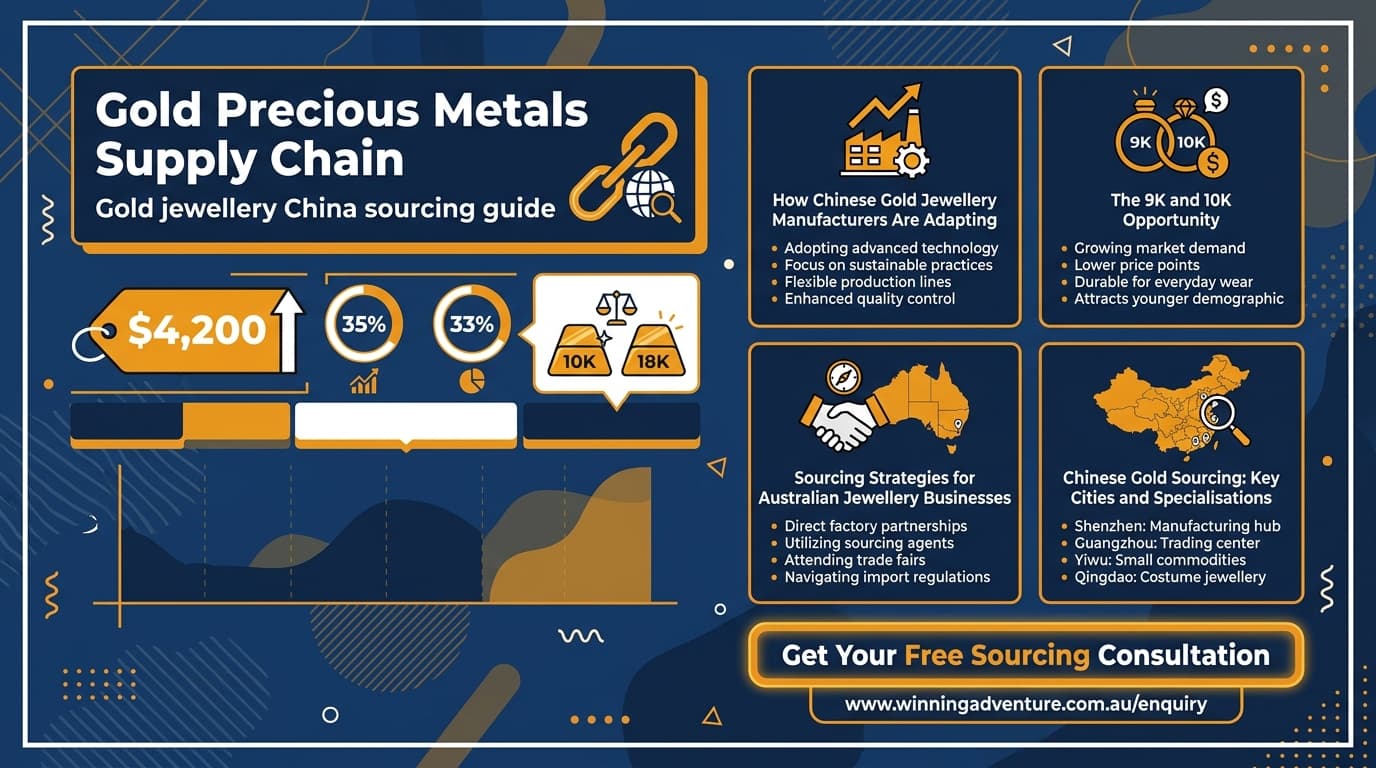
Gold has reached unprecedented price levels in 2026, with the spot price crossing AUD $4,200 per ounce in Q1 2026 — a 35% increase from Q1 2025 levels. For Australian jewellery businesses, this creates a challenging environment: raw material costs are up, consumer price sensitivity is high, and supply chain margins are under pressure from multiple directions.
China, as the world's largest gold jewellery producer (33% of global production according to the World Gold Council's 2025 report), is both a source of supply and a bellwether for industry trends. How Chinese manufacturers are adapting to record gold prices directly affects Australian jewellery importers' options and pricing.
How Chinese Gold Jewellery Manufacturers Are Adapting
Chinese manufacturers have implemented several strategies to manage record gold prices:
| Strategy | Description | Impact on Australian Buyers |
|---|---|---|
| Weight reduction | Producing lighter pieces at same visual dimensions (hollow construction, thinner walls) | Lower per-unit cost but potential perceived value risk |
| Karat mix shift | More 9K/10K production, less 18K/22K | More affordable entry price points for budget-conscious consumers |
| Gold-filled alternatives | Gold-bonded products (5% gold by weight) gaining popularity | New product category at 15–20% of solid gold cost |
| Alloy innovation | New alloy formulations reducing minimum gold content while maintaining appearance | Technical specifications need careful evaluation |
| Hollow casting | Advanced hollow casting techniques achieving 40–50% weight reduction | Same visual appearance at half the gold cost |
A Melbourne jewellery retailer who imports from Chinese manufacturers reported that switching from hollow casting (a technique where the centre of the piece is empty, reducing gold weight by 40–50% while maintaining the same outer dimensions) for their pendant range reduced their per-unit gold cost from $180 to $95. The pieces looked identical to solid gold pendants and customers couldn't tell the difference.
The 9K and 10K Opportunity
The most significant trend in 2026 is Australian consumers shifting toward lower-karat gold as 18K becomes prohibitively expensive. According to the Australian Jewellery Association, 9K gold jewellery sales grew 58% in 2025 and are projected to grow another 40% in 2026.
Chinese manufacturers have responded decisively. Guangdong province's jewellery manufacturing hub has tripled its 9K and 10K production capacity since 2024. The pricing advantage is compelling:
| Karat | Gold Content | Material Cost (AUD/g) | Typical Retail Markup |
|---|---|---|---|
| 9K (375) | 37.5% | $28–$35/g | 3–5x |
| 10K (417) | 41.7% | $32–$40/g | 3–5x |
| 14K (585) | 58.5% | $45–$55/g | 3–4x |
| 18K (750) | 75% | $58–$70/g | 2.5–3.5x |
Key insight for Australian jewellery businesses: 9K jewellery offers a 50–55% material cost saving compared to 18K while still meeting the Australian legal minimum for "gold" labelling. The Australian Competition and Consumer Commission (ACCC) mandates that any product described as gold must contain at least 9 karats (37.5% gold by weight).
Sourcing Strategies for Australian Jewellery Businesses
Strategy 1: Lock in fixed-price contracts
With gold prices volatile (±3–5% daily moves not uncommon), Chinese manufacturers may offer fixed-price contracts for 30–60 day periods. Negotiate these terms before spot prices move further upward.
Strategy 2: Diversify karat offerings across customer segments
Consider offering a range of karat options to capture different price points:
- Premium line: 18K for engagement rings and heirloom pieces
- Mid-range: 14K for everyday jewellery
- Entry-level: 9K for fashion jewellery and gifts
Strategy 3: Explore gold-filled and vermeil options
Gold-filled jewellery (5% gold by weight bonded to a base metal core) and vermeil (gold-plated sterling silver) offer the look of solid gold at a fraction of the material cost. Chinese gold-filled production quality has improved significantly — a Shenzhen-based manufacturer we vetted in 2025 passed 5-year tarnish testing and 20,000-cycle abrasion testing.
Strategy 4: Negotiate around Chinese holidays
Chinese factory pricing follows seasonal patterns. Place orders during the lull periods (March–April after Chinese New Year, and October–November before Christmas rush) when factories are more willing to negotiate on pricing and payment terms.
Chinese Gold Sourcing: Key Cities and Specialisations
| City/Region | Specialisation | Best For |
|---|---|---|
| Shenzhen (Shuibei) | Fine jewellery, high-karat (18K/22K) | Premium jewellery lines |
| Guangzhou (Panyu) | Mass production, mixed karat | Mid-range volume orders |
| Shanwei | Gold-filled and costume jewellery | Entry-level and fashion ranges |
| Yiwu | Gold-plated and vermeil | Trend fashion jewellery |
Quality Control for Gold Jewellery Imports
When importing gold jewellery from China:
Purity verification: Insist on XRF (X-ray fluorescence) testing certification from an accredited laboratory for each production batch. In 2024, the ACCC seized $1.2 million in jewellery that was labelled 18K but tested at 12K.
Weight verification: Gold jewellery prices are fundamentally driven by gold weight plus manufacturing margin. Verify that every piece's gold weight matches the specification. Hollow pieces should state both gross weight and estimated gold weight.
Stamping requirements: Australian consumer law requires all gold jewellery to be stamped with the karat mark (9K, 14K, 18K, etc.) and a manufacturer's or importer's trademark.
FAQ
Are Chinese gold prices tracking the global spot price?
Yes. Chinese gold pricing is closely linked to global spot prices via the Shanghai Gold Exchange (SGE). There is typically a 1–2% premium for domestic Chinese demand, but export-oriented manufacturers price at near-spot plus a manufacturing margin of 5–15% depending on design complexity.
Is now a good time to source gold jewellery from China?
For established products, yes — but manage the price risk through shorter order cycles and fixed-price contracts. For new product development, consider gold-filled or 9K alternatives to test the market at lower material cost before committing to higher-karat production.
What's the minimum order for a Chinese gold jewellery factory?
MOQs for gold jewellery vary significantly: 100–300 pieces for simple designs (plain bands, stud earrings), 50–100 pieces for complex designs (detailed pendants, filigree work). Some factories accept trial orders of 20–50 pieces at a premium manufacturing cost (adds 15–25%).
Real Story: Adapting to Gold Price Pressure
A family-run jewellery business in Adelaide with 3 retail stores faced a crisis when gold prices surged past $4,000/oz in 2025. Their 18K line had been their bread-and-butter, but customers were balking at the prices. They made two strategic changes:
First, they introduced a 9K range sourced from a Chinese manufacturer in Panyu, Guangzhou. The 9K pieces looked visually identical to their 18K line but retailed at 55–60% lower prices. Second, they developed a gold-filled vermeil collection for fashion-forward younger customers who wanted the gold look without the price tag. Within 6 months, 9K and vermeil accounted for 40% of their revenue, and their overall sales actually increased 12% year-on-year despite the gold price surge.
The owner's reflection: "We thought customers would trade down to silver. Instead, they traded down to lower karat gold — as long as it still said 'gold' on the tag."
The Hallmark Import Code Advantage for Jewellery
One significant cost advantage when importing gold jewellery from China is the tariff classification. Gold jewellery (heading 7113) is duty-free under the Australia-China Free Trade Agreement (ChAFTA) for goods meeting the rules of origin. This means zero import duty on gold jewellery from China — compared to 5% for most other product categories.
To claim the duty-free rate, your Chinese manufacturer must provide a Certificate of Origin (FTA form) attesting that the jewellery was substantially produced in China. Without this certificate, the general tariff rate applies.
This duty advantage, combined with China's manufacturing expertise and competitive pricing, makes Chinese-sourced gold jewellery even more attractive for Australian importers.
Source Gold Jewellery Strategically
Record gold prices demand a strategic approach to sourcing. The businesses that thrive in this environment will be those that diversify their karat offerings, negotiate smart contract terms, and build long-term relationships with reliable Chinese manufacturing partners.
WAG helps Australian jewellery businesses find and verify Chinese manufacturing partners across all karat grades and product categories. We handle factory vetting, sample management, and quality assurance. Start with a free consultation.
Get Your Free Sourcing Consultation →
Sources & References:
- World Gold Council: gold.org
- Shanghai Gold Exchange: sge.com.cn
- Australian Jewellery Association Market Report 2025
- ACCC Product Safety — Jewellery: productsafety.gov.au
- DFAT Australia-China Free Trade Agreement: dfat.gov.au
China Sourcing Strategy
Managing Gold Price Volatility in Your Supply Chain?
Record gold prices are reshaping jewellery supply chains. We help Australian jewellery businesses find reliable Chinese manufacturing partners and navigate volatile pricing. Free consultation.
Get Your Free Sourcing ConsultationFree initial consultation · We respond within 4 business hours