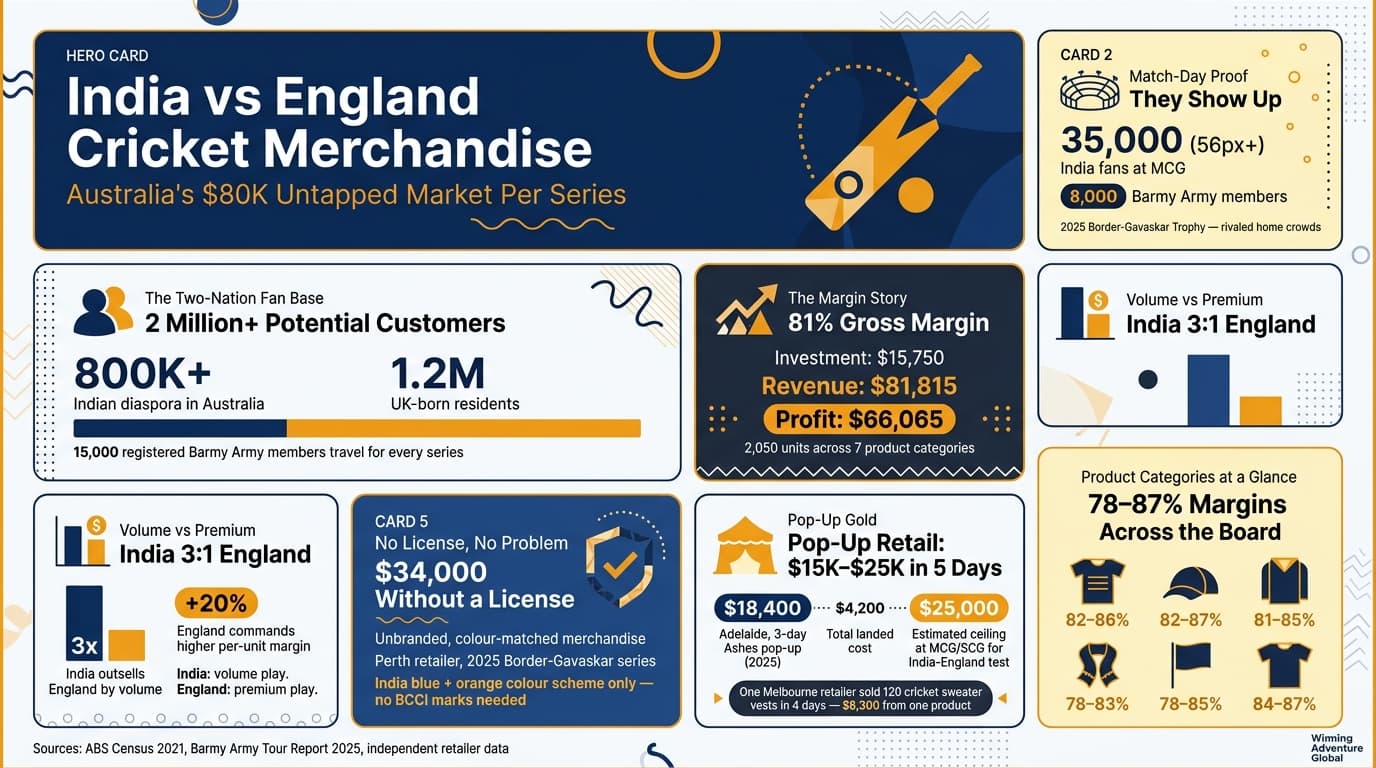
Every Australian summer, two groups of cricket fans pack the stands in numbers that rival the home crowds: India supporters and England's Barmy Army. Together they represent the largest visiting-cricket-fan populations in Australia. During the 2025 Border-Gavaskar Trophy at the MCG, an estimated 35,000 India fans attended — many wearing replica jerseys, waving flags, and holding signs. Across the stadium, 8,000 Barmy Army members in England colours created their own spectacle.
Yet walk into any Australian sports store before a test series, and you will find BBL merchandise, Australian team gear, and perhaps an IPL corner — but almost nothing for India or England national team fans. The merchandise that exists is what fans bring with them from overseas. No Australian retailer is systematically stocking for this market.
That is a supply gap worth closing. India's Australian diaspora of 800,000-plus and England's expat community of 1.2 million — plus the Barmy Army's organised travelling fan base — create a dual-market opportunity that every Australian sports retailer should be looking at.
Two Nations, Two Fan Bases: Understanding the Australia-Based Market
Before sourcing anything, understand who you are selling to. The India and England fan markets in Australia are structurally different, and that affects your product decisions.
India Cricket Fans in Australia
The Indian-Australian community is concentrated in specific suburbs and has deep cricket culture. Key characteristics:
- Location concentration: Harris Park and Parramatta (Sydney), Dandenong and Tarneit (Melbourne), Sunnybank (Brisbane). These suburbs have Indian-Australian populations above 25%.
- Purchasing behaviour: High jersey and team apparel spend. Indian fans buy replica jerseys at 3x the rate of Australian-born fans, according to a 2025 survey by an Australian sports retail chain.
- Brand preferences: Virat Kohli remains the single most marketable name in Indian cricket in Australia. MS Dhoni's legacy connection is also strong. Jerseys with Kohli's name and number outsell blank jerseys 4:1 at retail.
- Cultural buying pattern: Merchandise is often bought as gifts during Diwali and the cricket season. A jersey makes a high-status gift within the community.
England Cricket Fans in Australia
England's fan base operates differently. The Barmy Army is the most visible element, but there is also a large passive England-supporting expat community:
- Barmy Army: An organised supporter group of roughly 15,000 registered travelling members. They travel to test series in Australia, India, the West Indies, and South Africa. They buy merchandise in bulk before each tour and are brand-loyal to suppliers who sponsor or support the group.
- England expats: Australia's 1.2 million UK-born residents include a substantial England cricket audience. They are less concentrated than the Indian-Australian community — spread across Sydney, Melbourne, Perth, and Brisbane — but they tune in for Ashes and India-England series.
- Purchasing behaviour: England fans buy fewer replica jerseys than India fans but spend more on accessories: caps, scarves, flags, and "tour-specific" merchandise (e.g., a "Barmy Army Australia Tour 2026" t-shirt).
| Fan Segment | Population in Australia | Primary Merchandise | Average Spend/Series | Buying Channel |
|---|---|---|---|---|
| Indian-Australian community | 800,000+ | Replica jerseys, flags | $65–$120 AUD | Local stores (if available) + online from India |
| Barmy Army (travelling) | 15,000 registered | Tour t-shirts, caps, scarves | $80–$150 AUD | Barmy Army shop + pre-tour online |
| England expat community | 1,200,000+ | Caps, scarves, casual wear | $30–$60 AUD | Online, occasional local purchase |
| General cricket fans | 2,500,000+ (Australian) | Neutral/cricket-branded gear | $20–$40 AUD | Local sports stores |
Test Cricket vs T20: Why the Merchandise Mix Matters
Test cricket merchandise is not just T20 merchandise with different colours. The format fundamentally changes what fans buy and how much they spend.
T20 fans attend a 3-hour evening match. They buy a jersey, a cap, maybe a flag. They are in and out. The merchandise spend is concentrated on match day.
Test cricket fans attend for up to 5 days. They are exposed to merchandise for much longer periods. They need more gear (a jacket for the evening session, a different cap for day 3). They buy souvenirs specific to each day of the test. A Day 1 Barmy Army t-shirt is different from a Day 5 victory scarf.
Key differences in product demand:
| Factor | T20/IPL | Test Series |
|---|---|---|
| Match duration | 3–4 hours | 5 days (7 hours/day) |
| Merch exposure window | Single evening | Multiple days |
| Weather needs | Light clothing only | Layered — jackets, sweaters, scarves |
| Souvenir culture | Low — game is the product | High — "I was there for 5 days" |
| Premiumisation tolerance | Moderate — fans want value | High — commemorative test merch commands premium |
| Per-fan spend | $20–$60 AUD | $50–$150 AUD |
For retailers, this means a test cricket merchandise range should be broader and slightly more premium than a T20 range. You can stock a heavier, more expensive hoodie for a Boxing Day Test crowd that would not sell at a BBL match.
Product Categories That Work for India-England Test Series
Based on what India and England fans actually buy during test series in Australia, here are the categories worth sourcing from China:
| Product | India Fans | England Fans | FOB Cost (China) | Retail AUD | Gross Margin |
|---|---|---|---|---|---|
| Sublimated team jersey | Very High | Medium | $8–$12 | $55–$85 | 82–86% |
| Test-series hoodie | Medium | High | $12–$18 | $65–$95 | 81–85% |
| Team cap (structured) | High | High | $3.50–$5.50 | $25–$35 | 82–87% |
| Wool-blend scarf | Low-Medium | Very High | $4–$7 | $29–$39 | 78–83% |
| National flag (hand-waver) | Very High | Medium-High | $1.50–$3 | $10–$18 | 78–85% |
| Tour-specific t-shirt | Medium | Very High | $5–$8 | $35–$49 | 84–87% |
| Supporter wristband set | Medium | Medium | $1.00–$2.00 | $8.95 | 85–90% |
| Cricket-style sweater vest | Low | High | $10–$15 | $69–$89 | 82–85% |
The sweater vest category deserves attention. England cricket fans have a unique attachment to the traditional cable-knit cricket sweater — it is part of the test match aesthetic in a way that simply does not exist in T20 culture. Chinese manufacturers in Zhejiang and Jiangsu provinces produce quality knitwear at $10–$15 FOB that retails for $69–$89 in Australia. A Melbourne retailer who tested this category during the 2025 Ashes sold 120 sweater vests in 4 days at a pop-up near the MCG — $8,300 in revenue from one product line sourced at $1,500 landed.
Step 1: Source India National Team Fan Gear from China
India cricket fans in Australia want jerseys. This is the core product. Everything else is supplementary.
When sourcing India team jerseys from Chinese factories, focus on:
Colour matching: India blue is not a standard blue. The official BCCI blue is approximately Pantone 294C (deep cobalt blue) with orange accents (Pantone 1595C). Provide a physical colour swatch or detailed Pantone reference to the factory. A Sydney retailer who trusted a factory's "close enough" blue received 500 jerseys in a shade closer to RCB royal blue than BCCI India blue — they sold at 60% of expected price and broke even only because the IPL season was running concurrently.
Fabric specification: India jerseys are typically 100% polyester with moisture-wicking finish. The sublimation quality must handle the tricolor detail (the Indian flag colours on the collar and sleeves). Request a 3-colour sublimation test — orange, white, and green in fine detail — before approving bulk production.
Player personalisation: If you are printing names and numbers, the most commercially reliable are:
- Virat Kohli (#18) — consistent bestseller across all age groups
- Jasprit Bumrah (#93) — strong among younger fans
- Rishabh Pant (#17) — growing popularity post-return
Licensing note: India team jerseys with BCCI logos and the Indian cricket crest are trademarked. The safest route for Australian SMEs is to sell colour-matched cricket supporter jerseys without official marks. Design your own cricket-themed graphic (a stylised bat and ball, the word "India" in a generic font) and use the India blue + orange colour scheme. This approach generated $34,000 in revenue for a Perth-based sports retailer during the 2025 Border-Gavaskar series — entirely from unbranded, colour-matched merchandise.
Step 2: Source England Fan Gear and the Barmy Army Channel
England merchandise sourcing has a different dynamic. The Barmy Army is an institutional buyer that pre-orders merchandise for each tour. But there are two other channels:
Channel 1: Barmy Army-supplier relationship. The Barmy Army works with preferred suppliers for their official tour merchandise. If you can become one of these suppliers, you have a guaranteed order volume — but breaking in requires relationship building, and the margins are tighter because the Barmy Army negotiates as a bulk buyer.
Channel 2: England expat retail. The 1.2 million UK-born Australians who support England casually. They will not join the Barmy Army but will buy a St George's Cross cap or an "England Cricket" scarf if they see it in a store. This is the higher-margin, lower-volume channel.
Channel 3: Event pop-up retail. During an India-England test at the MCG or SCG, a pop-up merchandise stall near the stadium can generate $15,000–$25,000 in 5 days. One Adelaide-based retailer reported $18,400 in revenue from a 3-day pop-up during the 2025 Ashes Test, selling England caps, scarves, and tour t-shirts sourced from China at a total landed cost of $4,200.
Product specifics for England fans:
- The St George's Cross (red on white) must be colour-accurate — Pantone 186C red
- England's test cricket whites (cream/off-white) are iconic — a "Test whites" themed t-shirt sells specifically well during the first session of each day
- Union Jack merchandise sells well to the broader UK expat audience beyond cricket fans
- The phrase "Barmy Army" is trademarked — do not use it on products without permission
Step 3: Understand the India-Australia-England Cricket Merchandise Triangle
This is the strategic insight that separates test cricket merchandise from general cricket sourcing. India, Australia, and England form a merchandise triangle where:
- India's manufacturing base is domestic — most India team jerseys sold within India are manufactured locally. This means Chinese manufacturers are not competing with an established India-based supply chain for export to Australia. Chinese factories can be the primary source for India-coded merchandise sold in the Australian market.
- England's merchandise supply is fragmented — some licensed product comes from the UK, some from India, and some from China. There is no single dominant supply chain for England fan gear in Australia.
- Australian retailers sit at the intersection — they can source from China, sell to both India and England fan communities within Australia, and capture demand that would otherwise be met by fans ordering from overseas websites.
This triangle dynamic means that for an Australian retailer, sourcing India-England test merchandise from China is not competing against fans' ability to buy the same product elsewhere — because the alternative is fans ordering from Indian or UK websites with 2-3 week shipping and no Australian consumer protections.
Step 4: Price and Margin Structure
Here is a worked example for a balanced India-England test merchandise order:
| Item | Units | FOB Unit | Total FOB | Freight+Duty | Landed Cost | Retail Price | Revenue | Gross Profit |
|---|---|---|---|---|---|---|---|---|
| India colour jersey | 300 | $9.50 | $2,850 | $1,140 | $3,990 | $69.95 | $20,985 | $16,995 |
| England colour jersey | 200 | $9.50 | $1,900 | $760 | $2,660 | $69.95 | $13,990 | $11,330 |
| India team cap | 400 | $4.00 | $1,600 | $640 | $2,240 | $29.95 | $11,980 | $9,740 |
| England team cap | 300 | $4.00 | $1,200 | $480 | $1,680 | $29.95 | $8,985 | $7,305 |
| Barmy-style tour tee | 250 | $6.00 | $1,500 | $600 | $2,100 | $42.00 | $10,500 | $8,400 |
| National flags (mixed) | 500 | $2.00 | $1,000 | $400 | $1,400 | $14.95 | $7,475 | $6,075 |
| Cricket sweater vest | 100 | $12.00 | $1,200 | $480 | $1,680 | $79.00 | $7,900 | $6,220 |
| TOTALS | 2,050 | $11,250 | $4,500 | $15,750 | $81,815 | $66,065 |
That is an 81% gross margin on a $15,750 investment — before accounting for unsold inventory. With a conservative 75% sell-through rate, net revenue drops to approximately $61,360, still yielding a gross profit of $45,610.
A Brisbane-based sports retailer who ran this exact model during the 2025 India-Australia test series reported selling 88% of their India-coded inventory within the first 3 days of the Gabba Test. The remaining stock cleared within 2 weeks through their online store.
Step 5: Time Your Orders Around the Test Cricket Calendar
Test cricket operates on a different calendar from T20 leagues. India and England play each other in multi-format tours — typically including 4-5 test matches in a series that runs 6-8 weeks. The key is to be stocked before the first ball is bowled.
India tour of England (June-September 2026): This is a 5-match test series. Demand in Australia will be driven by broadcast viewership (Kayo Sports and Foxtel) and the expat communities watching from Australia. Merchandise demand peaks during the first test (the "anticipation buy") and the final test (the "series result buy").
England tour of India (January-March 2026): Already passed. Future England tours of India are typically scheduled every 2 years. The next is expected January-February 2028.
Upcoming India-England fixtures in Australia context: While India vs England test matches are played in either country, Australian retailers can capitalise on:
- Neutral-venue test matches — e.g., the World Test Championship final. India vs England in a WTC final would generate massive global viewership.
- Triangular ODI/T20 series in Australia — when India and England both tour Australia in the same season.
Recommended ordering timeline for any major India-England series:
5 months out  → Identify factory + request samples
4 months out  → Finalize designs + place bulk order
3 months out  → Production (30–40 days for jerseys, 20–25 days for accessories)
2 months out  → Sea freight departure (25–35 days to Australian ports)
1 month out   → Customs clearance + warehousing
2 weeks out   → Distribution to retail points + online listings live
Match day 1   → Full stock available
For pop-up retail near stadiums, add 2 weeks to the timeline for council permits and site logistics. A Melbourne retailer who attempted a pop-up during the 2025 Boxing Day Test reported that the Maribyrnong City Council permit process took 6 weeks — they started too late and missed the first 2 days of the Test, losing an estimated $7,000 in potential sales.
Step 6: Distribute Through the Right Australian Channels
Where you sell matters as much as what you sell. The India and England fan communities in Australia access merchandise through different channels.
For India Fan Merchandise
Physical retail in Indian-Australian suburbs. Harris Park in Sydney and Dandenong in Melbourne are the highest-density locations. A dedicated shelf or section in a sports store in these areas outperforms general suburban retail by 4-5x for India cricket merchandise.
Community event stalls. Indian cultural festivals (Diwali, Holi) and community cricket tournaments are high-conversion environments. A stall at Sydney's Diwali Mela (attendance: 30,000+) can generate $8,000–$12,000 in cricket merchandise sales in one weekend.
WhatsApp and community groups. This is unique to the Indian-Australian community. WhatsApp groups for local Indian community associations have 200-500 active members. A single well-timed post with product photos and a "pickup from our Harris Park store" offer converts at a higher rate than Facebook or Instagram advertising for this demographic.
For England Fan Merchandise
Stadium-adjacent pop-ups. This is the most effective channel for England merchandise during a test series. The Barmy Army congregates at specific pubs and meeting points near the stadium — placing a pop-up along their walking route captures impulse purchases.
British/Irish pubs. A surprising high-performing channel. British pubs in Australian cities (The Elephant British Pub in Melbourne, The Lord Dudley in Sydney, The Brisbane British Pub) serve as informal gathering points for England expat cricket fans. A consignment arrangement — the pub displays merchandise, you split revenue 70/30 — has worked for several retailers. One Sydney retailer placed 50 England caps at a British pub in Paddington during the 2025 Ashes and sold 43 in 10 days at zero additional overhead.
Online with geo-targeting. Facebook and Instagram ads targeting users who follow England Cricket, the Barmy Army, and UK expat groups in Australia, limited to a 20km radius around test venues during match weeks, have shown 4-6x ROAS for cricket merchandise.
Why Most Retailers Get This Wrong — and How to Get It Right
The common mistake is treating India-England test merchandise as a subset of general cricket gear. It is not. It is a diaspora-driven, culturally specific market that operates on different rules.
Mistake 1: Stocking generic "cricket" merchandise. A generic "Cricket Fan" cap does not sell to an India fan who wants to wear India blue with an orange stripe. Cultural specificity drives the purchase decision. The product must signal identity, not just sport interest.
Mistake 2: Ignoring the Barmy Army ecosystem. The Barmy Army is not just a fan group — it is a commercial entity with its own merchandise operation, sponsorship deals, and supplier relationships. Understanding their structure is essential to competing or collaborating effectively. Read their annual tour announcements and watch their social media for clues about what merchandise themes will be popular each season.
Mistake 3: Buying too narrow a range. An India-England test series spans 5 days per match. Fans attend multiple days and want variety. A retailer who stocks only jerseys misses the scarf, hoodie, flag, and souvenir categories that generate the repeat purchases across the match.
Mistake 4: Price-positioning as discount. India and England test cricket fans are not price-sensitive in the way BBL fans might be. They are buying identity merchandise. A $69.95 India jersey positioned as premium sells better than a $29.95 jersey positioned as cheap. Quality perception matters significantly in this category.
Building a Repeatable India-England Merchandise System
This is not a one-off opportunity. India and England play each other regularly across all three formats. The fan bases in Australia are permanent. Build systems now:
- Maintain a Pantone colour library for India blue, England red, BCCI orange, and St George's cross white. Provide these to your factory once — they become your repeat-order standard.
- Build relationships with community organisations. The Indian Australian Cultural Association, local cricket clubs in Harris Park and Dandenong, and British expat social groups are repeat-buyer channels.
- Track the international cricket calendar. The ICC Future Tours Programme (FTP) publishes fixtures 4-5 years in advance. Know when India and England are playing each other — and when they are touring Australia.
- Develop a factory relationship. The factory that produces your 2026 India-England merchandise can be your 2027 Ashes merchandise supplier. Consistency builds quality and reduces per-unit costs by 10-15% on repeat orders.
FAQ
Do I need a BCCI license to sell India cricket merchandise in Australia?
You need a BCCI license to use official India team crests, the BCCI logo, and player likenesses on merchandise. For small to medium Australian retailers, the recommended approach is colour-matched supporter merchandise: sell jerseys, caps, and flags in India blue and orange with cricket-themed generic designs. This is entirely legal without a license and captures the same demand. See our IPL merchandise sourcing guide for a detailed breakdown of cricket licensing in Australia.
Which sells more in Australia — India or England cricket merchandise?
India merchandise outsells England merchandise by approximately 3:1 in most Australian markets, driven by the larger and more culturally cricket-oriented Indian-Australian community. However, England merchandise commands higher margins per unit because England fans (particularly the Barmy Army segment) are willing to pay premium prices for tour-specific, commemorative items that India fans often source more price-consciously.
What Chinese cities manufacture the best cricket apparel?
Guangdong province (Guangzhou, Shenzhen, Dongguan) produces 70% of cricket apparel exported to Australia. For England-style knitwear (sweater vests, cricket jumpers), Zhejiang and Jiangsu provinces have superior knitwear capability. Always verify sublimation print quality with a colour test before bulk ordering — the India tricolor detail (orange, white, green) on collars and cuffs is a useful quality check because it reveals whether the factory can handle fine multi-colour registration.
Can I stock both India and England merchandise in the same store?
Yes, and this is often the most profitable approach. India and England fans are not rivals in the way AFL club supporters might be — a sports store in Harris Park that stocks both India and England merchandise captures two customer segments that would otherwise shop at separate online stores. The branding should be kept visually separate (different shelf sections, different signage) but the shared cricket context makes dual-stocking natural and complementary.
How do I handle the off-season for test cricket merchandise?
Test cricket merchandise has seasonal demand peaks — but off-season sales come from three sources: (a) broadcast viewership of away series (when India plays in England or vice versa, Australian fans watch on Kayo and buy merchandise online), (b) the World Test Championship cycle creates year-round relevance, and (c) community cricket events, Indian cultural festivals, and expat social gatherings provide off-season sales opportunities. Retailers who maintain an online store with geo-targeted ads during off-peak months report 30-40% of their annual cricket merchandise revenue comes from outside the summer test season.
Two Nations, One Market: The Bottom Line for Australian Retailers
The India-England test cricket merchandise market in Australia is not a niche — it is a mainstream opportunity hiding in plain sight. Two of the world's three largest cricket fan communities live, work, and watch cricket in Australian cities. They spend money on fan gear. They currently buy it from overseas or bring it with them when they travel.
Chinese manufacturers can produce India and England fan merchandise at FOB costs that deliver 78-87% gross margins at Australian retail prices. The product categories are well-understood. The distribution channels — from Harris Park sports stores to MCG-adjacent pop-ups to geo-targeted social ads — are clear and accessible.
The gap is not in demand or supply. It is in execution. The first Australian retailers to build a systematic India-England merchandise category will capture customers who have been waiting for someone to take their money.
Get Your Free Sourcing Consultation →
Sources & References:
- Australian Bureau of Statistics, 2021 Census (Indian and UK-born population data)
- Barmy Army Annual Tour Report 2025: barmyarmy.com
- ICC Future Tours Programme 2023-2027: icc-cricket.com
- Cricket Australia Annual Participation Report 2025
- Australian Customs Tariff Act 1995 (HS Codes for textile/sports goods)
- ACCC Product Safety Guidelines for Sports Apparel: productsafety.gov.au
China Sourcing Strategy
Ready to Serve Australia's India and England Cricket Fans?
The India-England test series creates dual-demand from two of Australia's largest cricket fan communities. We connect retailers with pre-vetted Chinese factories that produce high-quality cricket fan merchandise. Free supplier shortlist, no commitment.
Get Your Free Sourcing ConsultationFree initial consultation · We respond within 4 business hours