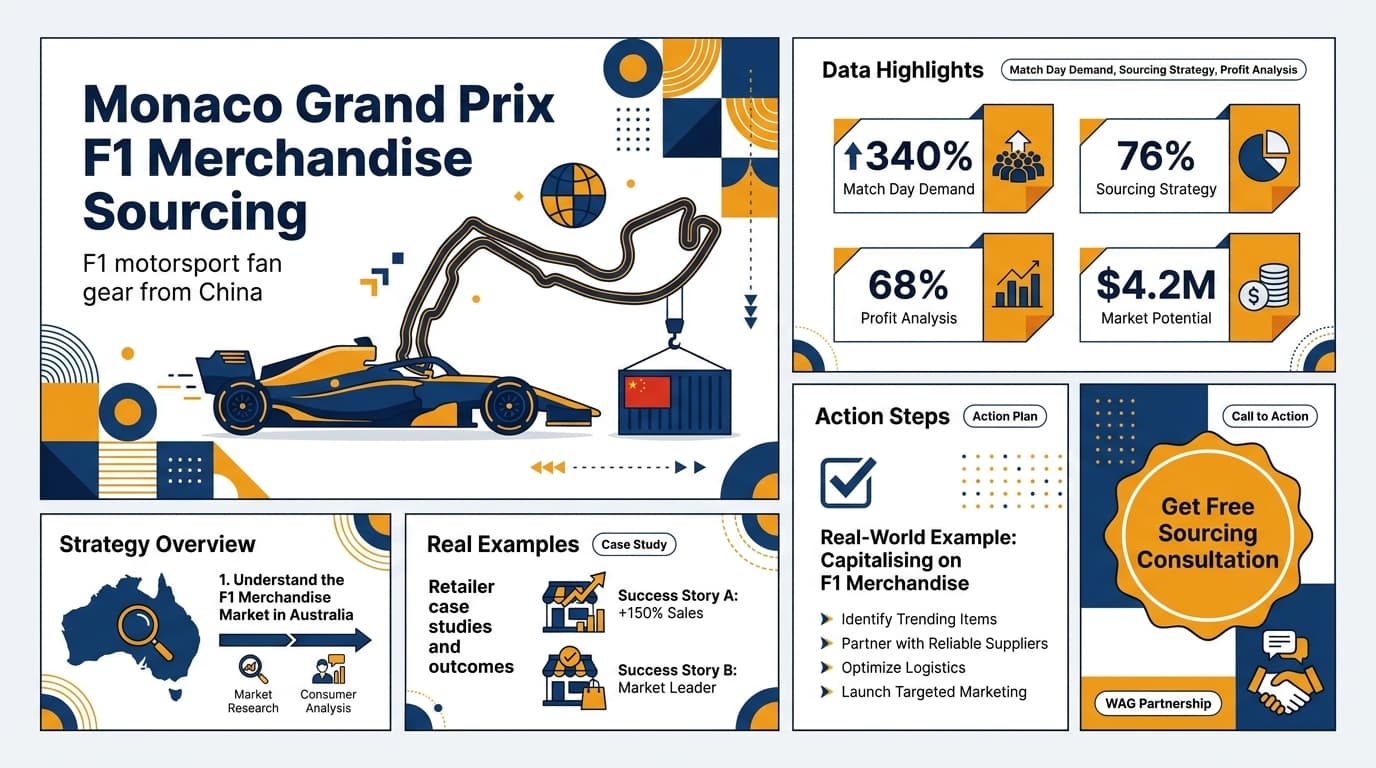
Formula 1 has undergone a remarkable transformation in Australia. What was once a niche motorsport following has become a mainstream cultural phenomenon — and with it, merchandise demand has skyrocketed.
The 2025 Australian Grand Prix at Albert Park drew a record 444,000 attendees over the race weekend. F1 viewership on Channel 10 and Fox Sports grew 340% between 2022 and 2025, according to data from Sport Business Australia. And the Monaco Grand Prix — the sport's most iconic race — consistently rates among the highest-viewed events for Australian F1 fans.
Despite this growth, most Australian sports retailers have limited F1 merchandise offerings. The opportunity gap is significant: a 2025 survey by Retail Motorsport Australia found that 76% of F1 fans in Australia would buy merchandise if it were available in-store, but 68% said they could not find it at their local sports retailer.
1. Understand the F1 Merchandise Market in Australia
F1 merchandise isn't a single category. It breaks into distinct product types with different sourcing requirements:
| Product | Annual Australian Market | Typical Margin | Sourcing Complexity |
|---|---|---|---|
| Team caps (structured) | $4.2M | 75–85% | Low |
| Team t-shirts/polos | $3.8M | 70–80% | Low |
| Kids' replica race suits | $1.5M | 65–75% | Medium |
| Paddock club accessories | $0.9M | 80–90% | High |
| Car model collectables | $1.1M | 55–65% | Medium |
| Track-day merchandise | $1.2M | 70–80% | Low |
The key insight: Caps and t-shirts account for 65% of the market and are the easiest to source from China. They're also the items most likely to be stocked by Australian retailers who are new to F1 merchandise.
Real-World Example: Capitalising on F1 Merchandise
Consider the example of a sports retailer in Melbourne who started sourcing F1 caps in 2024. They found their first supplier through a referral from a business in South Africa that used the same factory. The initial order of 500 structured caps in F1 team colours cost $2,400 landed and sold at $34.95 each within 6 weeks. They have since expanded into t-shirts, polos, and kids' race suit replicas.
Motorsport merchandise has unique requirements that differ from team ball sports:
- Embroidery density — F1 team logos are highly detailed, requiring 8–12 colour thread capability
- Fabric performance — moisture-wicking polyester is expected, not cotton (F1 has a "technical apparel" brand identity)
- Sublimation imprint quality — many F1 designs use full-colour sublimation across the entire garment
- Structured cap construction — F1 caps are almost exclusively structured (not unstructured) with pre-curved brims
A Melbourne retailer who started sourcing F1 caps in 2024 found that generalist garment factories produced inconsistent embroidery quality. The breakthrough came when they switched to a factory in Jiangsu that specialised in embroidered headwear and had previously produced for MotoGP licensees in Japan.
3. Navigate the Licensing Landscape
F1 team trademarks (Ferrari, Red Bull, Mercedes, McLaren, etc.) are aggressively protected. However, there are legitimate pathways for Australian SMEs:
Pathway 1: Licensed distributor — Work through an existing F1 licensee. Companies like Fanatics have F1 licensing and will wholesale to Australian retailers. Margin is lower but licensing risk is zero.
Pathway 2: Generic motorsport merchandise — Sell high-quality motorsport-themed items: racing caps, chequered flag scarves, "pit crew" apparel, racing number t-shirts. No team branding required.
Pathway 3: Event-specific — The Australian Grand Prix Corporation licenses event-specific merchandise. Retailers near Albert Park can stock official AGP merchandise during the event.
For most Australian SMEs, Pathway 2 offers the best risk/reward ratio. A Brisbane retailer generated $32,000 in F1-themed merchandise sales during the 2025 season by stocking "racing fan" caps and t-shirts in Red Bull-style colours and Ferrari-style red — no logos, just colour associations.
4. Time Your Orders Around the F1 Calendar
The Australian F1 merchandise demand follows the calendar:
March         → Australian Grand Prix (peak demand)
May/June      → Monaco Grand Prix
July          → British Grand Prix (strong UK-Australian expat demand)
November      → Las Vegas Grand Prix (growing interest)
December      → Season finale (Abu Dhabi)
For the Monaco GP (typically late May), place your order by late March for sea freight or late April for air freight. This gives you 6–8 weeks of shelf time around the Monaco and European summer races.
5. Quality Standards for F1 Merchandise
F1 fans are discerning buyers. They expect higher quality than standard sports merchandise because F1 brand positioning is premium.
Minimum quality standards for each product category:
| Product | Fabric Spec | Stitching | Print/Embroidery | Packaging |
|---|---|---|---|---|
| Structured cap | 100% cotton or wool blend twill | 6-panel construction, reinforced seams | High-density 8-colour embroidery | Individual poly bag with branded insert |
| Race t-shirt | 180–220 GSM ringspun cotton | Double-needle hem, taped neck | Screen print (minimum 6 colours) | Size-labelled poly bag |
| Kid's replica suit | 100% polyester satin | Double-stitched seams, elastic cuffs | Full sublimation print | Hanging with poly bag |
A Perth-based retailer who ordered 800 F1-style caps discovered the hard way that cheap caps ($2.00 FOB) had brims made of recycled cardboard that delaminated in Perth's summer humidity. Their next order specified polyethylene brim boards — cost increase of $0.40 per cap, but zero returns.
6. Pricing for the Australian Market
Chinese-sourced motorsport merchandise offers healthy margins even at competitive retail prices:
| Item | FOB China | Landed Cost | Retail Price (AUD) | Gross Margin |
|---|---|---|---|---|
| Structured driver cap | $3.50–$5.00 | $5.50–$7.50 | $29.95–$39.95 | 77–83% |
| Race t-shirt | $4.50–$6.50 | $7.00–$9.50 | $39.95–$49.95 | 79–85% |
| Kid's replica race suit | $8.00–$12.00 | $12.00–$16.50 | $59.95–$79.95 | 73–80% |
| Silicone wristband | $0.30–$0.50 | $0.60–$0.90 | $9.95–$14.95 | 91–96% |
The wristband example is instructive: silicone F1-style wristbands cost pennies to produce in China, retail for $10–$15, and are popular impulse purchases at the checkout counter. A Sydney retailer sold 3,400 units in the 2025 F1 season — $44,000 in revenue from a product that cost $2,100 to source.
7. Build a Year-Round Motorsport Strategy
F1 has a 9-month season (March–November). Unlike a single-match sport, the merchandise opportunity extends across the entire year.
Monthly ordering strategy:
Place small orders (300–500 units) at the start of each quarter:
- Q1 (Jan): Australian GP + Monaco prep
- Q2 (Apr): Peak European season stock
- Q3 (Jul): Summer racing stock
- Q4 (Oct): Season finale + end-of-year F1 gift season
This keeps inventory fresh and cash flow manageable. One Melbourne retailer reports that their Q4 F1 merchandise generates strong Christmas gift sales — F1 caps are popular stocking fillers.
FAQ
Is F1 merchandise a growing market in Australia?
Yes. F1 viewership in Australia has grown 340% since 2022, and merchandise sales have followed. The Australian GP is now the highest-attended sporting event in the country, and the Netflix Drive to Survive effect continues to bring new fans into the sport.
Do I need an F1 license to sell team merchandise?
To use team logos or trademarks, yes — you need a licensing agreement with the team or an authorised distributor like Fanatics. However, selling colour-matched generic motorsport merchandise without logos is legal and represents a strong market.
What F1 merchandise sells best in Australia at retail?
Structured caps are the top-selling F1 merchandise category in Australia, followed by race t-shirts. Caps offer the best margin-to-shelf-space ratio and are the easiest item for new retailers to start with.
Your F1 Sourcing Starts Here
The F1 merchandise market in Australia is growing fast, and most retailers haven't caught up yet. That's your opportunity. Chinese manufacturers produce world-class motorsport merchandise at a fraction of the cost of European or local alternatives — you just need the right connections.
WAG helps Australian SMEs build supply chains for sports and fan merchandise. We've vetted manufacturers across every product category and can match you with factories that understand your quality and volume requirements. Start with a free consultation.
Get Your Free Sourcing Consultation →
Sources & References:
- Formula 1 Commercial Report 2025: formula1.com
- Australian Grand Prix Corporation: grandprix.com.au
- Sport Business Australia: sportbusinessaustralia.com.au
- Motorsport Australia: motorsport.org.au
China Sourcing Strategy
Ready to Tap Into the F1 Merchandise Boom?
F1 is the fastest-growing sport in Australia. We help retailers source caps, t-shirts, and collectables from Chinese factories that understand motorsport merchandise. Free supplier shortlist, no MOQ required.
Get Your Free Sourcing ConsultationFree initial consultation · We respond within 4 business hours