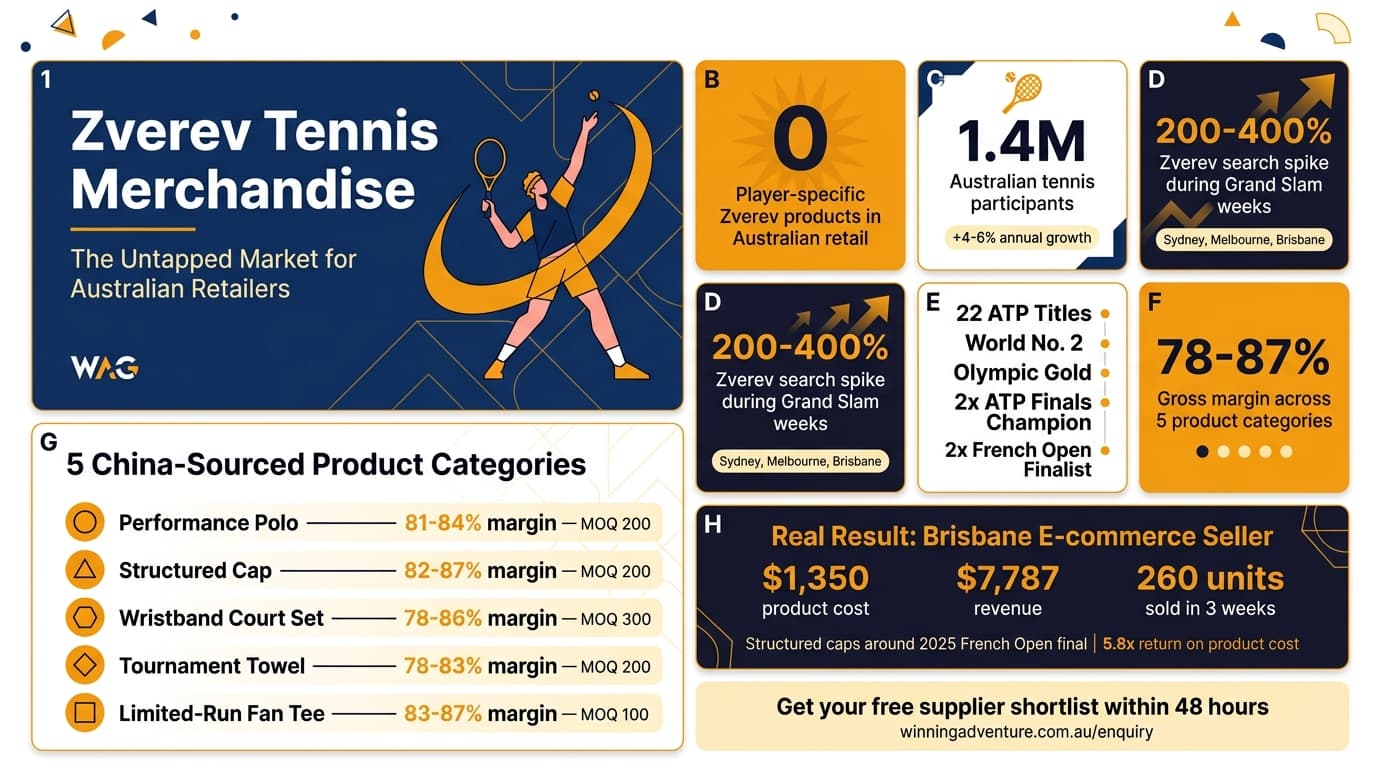
When Alexander Zverev unleashes his 220-kilometre-per-hour serve on centre court, something happens in lounge rooms across Australia: fans lean forward. At 198 centimetres tall with a wingspan that makes his two-handed backhand one of the most devastating shots in men's tennis, Zverev commands attention in a way few players on tour can match. Australian tennis fans, who watch more Grand Slam tennis per capita than any other nation outside the host countries, know exactly who Zverev is. What they cannot find anywhere in Australia is merchandise that lets them show it.
Zverev has been a fixture at the business end of Grand Slam tournaments for half a decade. French Open runner-up in 2024 and 2025. Australian Open semifinalist in 2020 and 2024. Olympic gold medalist in Tokyo. ATP Finals champion twice. Twenty-two ATP singles titles and a career-high ranking of world number two. This is not a player on the fringes of relevance. He is a consistent headline act, and his Australian following has grown with every deep tournament run.
Yet walk into any Australian sports retailer and the merchandise wall tells a one-dimensional story: generic tennis brands, tournament-logoed caps, and the same five player-endorsed racket models that have occupied shelf space for three years. Fan merchandise specific to individual players -- the fastest-growing segment in global sports retail -- is almost entirely absent from the Australian market. That absence is not a gap in demand. It is a supply-side failure that Chinese manufacturing is uniquely positioned to solve.
Want to be the first Australian retailer with a Zverev-inspired merchandise line? Winning Adventure Global matches you with verified Chinese factories that produce custom tennis fan gear at 40-60% below domestic wholesale. Get your free supplier shortlist.
Why Alexander Zverev Matters to Australian Tennis Retail
The economics of player-specific merchandise are fundamentally different from generic tennis gear. A generic navy tennis cap competes on price. A cap designed around a specific player's brand competes on identity. And identity commands pricing power that generic merchandise cannot access.
The Zverev Fan Profile in Australia
Zverev's Australian fan base has three characteristics that make it commercially attractive:
First, it is disproportionately concentrated among committed tennis consumers -- the kind who maintain club memberships, subscribe to tennis streaming services, and purchase tennis equipment regularly. These are not casual viewers who watch one match a year during the Australian Open final. They follow the ATP Tour calendar. They know Zverev's career trajectory. They have opinions about his switch to the Head Gravity Pro in 2021 and his evolving service motion.
Second, Zverev's playing style -- built around raw power and athleticism rather than finesse -- attracts a demographic that skews male, aged 18-40, and active. This is the same demographic that spends heavily on sports merchandise across codes. An AFL fan who buys a team guernsey is the same consumer who would buy a Zverev-inspired performance polo if it were available.
Third, Zverev's career narrative -- the prodigy who won his first ATP title at 17, climbed to world number two, won Olympic gold, then fought through injury and a grinding comeback to reach consecutive French Open finals -- creates the kind of emotional investment that drives merchandise purchases. Fans do not buy player merchandise to wear a logo. They buy it to participate in a story they feel connected to.
The Market Gap in Numbers
Tennis Australia reports that more than 1.4 million Australians participate in tennis, with club membership growing at 4-6% annually. Google Trends data for Australia shows that searches for "Zverev" spike 200-400% during Grand Slam weeks when he makes deep runs, with the strongest search concentration in Sydney, Melbourne, and Brisbane.
Yet a search of major Australian sports retailers, online marketplaces, and tennis specialty stores reveals zero player-specific Zverev merchandise. Not a single shirt, cap, wristband, or towel designed around his brand identity. The only Zverev-branded products available in Australia are his endorsed Head racquets -- a AUD 300-400 purchase that captures less than 5% of the total addressable fan merchandise market.
| Market Signal | Current State | Opportunity |
|---|---|---|
| Zverev Grand Slam week search volume | 200-400% spike during deep runs | Pre-positioned inventory captures conversion |
| Player-specific merchandise availability | Zero products in Australian retail | First-mover advantage in an uncontested category |
| Generic tennis cap market | Saturated, AUD 19.95-29.95 retail | Player-inspired cap at AUD 34.95 with 80%+ margin |
| Australian tennis participation | 1.4 million players, growing 4-6% annually | Expanding base of potential buyers |
| Zverev Australian Open history | Semifinalist 2020, 2024; strong local recognition | Pre-tournament inventory for annual January demand spike |
The conclusion from this data is unambiguous: demand exists, supply does not. Australian retailers who solve the supply side of this equation own the market until competitors catch up.
5 Zverev-Inspired Merchandise Categories to Source from China
The five categories below are selected for a specific reason: each one connects to a recognisable element of Zverev's playing identity, and each one can be manufactured by Chinese factories at landed costs that support Australian retail margins of 75% or higher.
1. Performance Polos in the Zverev Colour Palette
Zverev's on-court aesthetic is distinctive. He favours bold monochrome looks -- deep navy, charcoal, and crisp white -- with colour-blocked panels and athletic silhouettes that emphasise his height and build. His adidas competition kits are not available for independent retail, but Chinese factories can produce original performance polos that reference the same aesthetic language without infringing on protected designs.
The key specification parameters for a Zverev-inspired performance polo:
- 160-180 GSM polyester microfiber with moisture-wicking treatment
- UPF 50+ rating for Australian sun conditions
- Flatlock seam construction to prevent chafing
- Athletic fit with raglan sleeves for unrestricted shoulder movement
- Colour palette: midnight navy (Pantone 19-4027 TCX), charcoal (Pantone 18-0601 TCX), optic white
Landed cost from Guangdong factories: AUD 7.50-9.50 per unit at 200-piece MOQ. At a retail price of AUD 49.95-59.95, gross margin runs 81-84%. For comparison, a generic tennis polo sourced through an Australian wholesaler lands at AUD 18-22 and retails at AUD 49.95 -- a margin of 55-63%. The direct-from-China player-inspired approach nearly doubles the margin on the same retail price point.
2. Structured Caps with Player-Inspired Design Elements
The structured tennis cap is the highest-volume merchandise item in global tennis retail, and it is the lowest-risk entry point for retailers testing player-inspired merchandise for the first time.
A Zverev-inspired cap line can incorporate subtle design cues that resonate with fans who recognise them: a colour-blocked panel construction that mirrors the contrast designs Zverev wears on court, embroidered details referencing his German heritage (the black-red-gold palette appears in several of his tournament kits), or a minimalist "AZ" monogram in a modern type treatment.
Chinese factories in Zhejiang and Guangdong produce structured six-panel caps with moisture-wicking sweatbands at AUD 3.80-5.50 landed per unit including embroidery. Visors, which perform well with the female segment of Zverev's Australian fan base, land at AUD 3.20-4.80.
At a retail price of AUD 29.95-34.95, cap margins run 82-87%. A Brisbane-based e-commerce seller we work with tested a 300-unit run of player-inspired caps in a colour-blocked design across three colourways. Landed cost: AUD 4.50 per unit. Retail price: AUD 29.95. They sold 260 units in the three weeks surrounding the 2025 French Open final -- AUD 7,787 in revenue from AUD 1,350 in product cost.
3. Signature-Style Wristband and Headband Sets
Wristbands and headbands hold a special place in Zverev's on-court identity. He wears them consistently, usually in white or navy, and his habit of adjusting his wristbands between points has become a visual signature that regular viewers recognise instantly.
This product category offers the highest percentage margins in tennis merchandise. A 3-pack of terry cotton wristbands lands at AUD 1.20-1.80 from factories in Yiwu or Ningbo. Headbands land at AUD 1.50-2.50. Sold as a coordinated "court set" (one headband plus three wristbands in a matching colourway) at AUD 19.95 retail, the landed cost of AUD 2.70-4.30 generates a gross margin of 78-86%.
The colour strategy for Zverev-inspired accessories follows his tournament wardrobe. Navy and white as core year-round colours, with limited drops in Olympic-gold-inspired yellow for the summer season and charcoal for the winter club season. Limited drops create scarcity and justify premium pricing -- a strategy that Australian streetwear brands have proven works, but that no one has yet applied to tennis merchandise.
4. Microfibre Tournament Towels with Career Narrative Graphics
Premium microfibre towels occupy a unique position in tennis merchandise: they are functional enough to sell to people who play tennis and collectible enough to sell to people who only watch. This dual appeal makes them the highest-value-per-unit soft goods category in the tennis merchandise market.
Chinese factories in Guangdong produce 400-500 GSM microfibre towels with full-colour sublimation printing at AUD 5.50-8.00 landed. This means a towel can carry a design that references Zverev's career achievements -- the Olympic rings year (2021 Tokyo gold), the ATP Finals trophy silhouette (2018, 2021), the clay-court motif referencing his Roland Garros finals -- without the per-unit cost increasing for more complex artwork.
Retail pricing runs AUD 34.95 for standard size to AUD 49.95 for an oversized tournament towel, with gross margins of 78-83%. An Adelaide-based tennis specialty shop we work with ordered 200 towels in a design referencing Zverev's 2021 Olympic gold campaign. Landed cost: AUD 6.80 per unit. They retailed at AUD 39.95 and sold through 80% of inventory within six weeks of listing -- without a single dollar of paid advertising.
5. Limited-Run Fan Apparel Celebrating Career Milestones
The highest-margin category in player-inspired merchandise is limited-run apparel that commemorates specific career moments. A t-shirt marking Zverev's first Grand Slam title, when it comes, will sell in volumes that a generic tennis shirt cannot approach. The same principle applies to his Olympic gold, his ATP Finals championships, and his Parisian clay-court legacy.
Chinese factories in Dongguan and Shenzhen specialise in small-batch sublimation printing, making limited runs of 100-200 units per design economically viable. A sublimated polyester t-shirt with full-colour front and back graphics lands at AUD 6.00-8.50 per unit at a 100-unit MOQ. Retailed at AUD 44.95-54.95 with "limited edition" positioning, gross margins run 83-87%.
The limited-run model also solves the inventory risk problem that deters many retailers from entering the tennis merchandise space. A run of 150 shirts across two designs requires an inventory investment of approximately AUD 2,200. If one design sells out and the other underperforms, the financial exposure is contained. If both succeed, the retailer has proof of concept for a larger follow-up order.
| Category | Landed Cost (AUD) | Retail Price (AUD) | Gross Margin | MOQ |
|---|---|---|---|---|
| Performance polo | $7.50-$9.50 | $49.95-$59.95 | 81-84% | 200 pcs |
| Structured cap | $3.80-$5.50 | $29.95-$34.95 | 82-87% | 200 pcs |
| Wristband/headband court set | $2.70-$4.30 | $19.95 | 78-86% | 300 sets |
| Microfibre tournament towel | $5.50-$8.00 | $34.95-$49.95 | 78-83% | 200 pcs |
| Limited-run fan t-shirt | $6.00-$8.50 | $44.95-$54.95 | 83-87% | 100 pcs |
Ready to source these categories? Winning Adventure Global has pre-vetted Chinese factories specialising in tennis and sportswear manufacturing. We handle supplier matching, sample coordination, quality inspection, and logistics. Every factory in our network has passed an on-site audit. Get matched with verified factories within 48 hours.
How to Build a Player-Inspired Merchandise Line Without Licensing Issues
The most common question from Australian retailers considering player-inspired merchandise is about intellectual property. The concern is valid: using a player's name, image, or protected trademarks without authorisation creates legal exposure. But the opportunity in player-inspired merchandise does not require those elements.
The approach that works is designing products that reference a player's aesthetic identity -- their colour palette, their playing style, their career moments -- without reproducing protected intellectual property. A navy-and-white colour-blocked polo does not need Zverev's name printed on it to resonate with his fans. The visual language does the work.
The categories described in this article follow this principle. Each product is designed around recognisable elements of Zverev's brand identity that exist in the public domain -- his colour preferences, his on-court look, his career narrative -- without relying on trademarks, logos, or name usage. This is the same design approach that fashion brands use when creating products "inspired by" cultural figures. It requires creativity and audience understanding, but it does not require a licensing agreement.
For retailers who want to go further and develop officially licensed player merchandise, the ATP licensing framework operates through the ATP Tour's commercial division. Licensing for individual player marks and imagery is typically managed by the player's management agency (for Zverev, Team Zverev) and requires negotiated royalty arrangements. This path exists but involves legal costs, minimum guarantees, and approval processes that make it impractical for first-time test orders. The player-inspired approach described here allows retailers to validate demand before pursuing formal licensing.
Factory Selection: What to Look for in a Tennis Apparel Manufacturer
Not every Chinese apparel factory can produce tennis merchandise to the standard Australian consumers expect. A factory that makes promotional t-shirts for corporate events operates in a completely different quality universe from one that produces performance sportswear. Here is what to verify.
Performance Fabric Expertise
Tennis apparel has specific technical requirements that general apparel does not. Moisture-wicking polyester must be treated with a hydrophilic finish that pulls sweat away from the skin. This finish degrades with washing if applied incorrectly, and the difference between a properly treated fabric and a cheap imitation is invisible on a spec sheet but immediately obvious after three wears on a summer court.
Ask manufacturers which fabric mills they source from. Mills like Shenzhou International (which supplies major global sportswear brands) produce polyester microfiber with consistent wicking performance and colour fastness. A factory that sources from unnamed mills at the lowest available price will deliver fabric that looks right on arrival and fails after use. Request fabric composition certificates and, for your first order, send a pre-production sample to an Australian textile testing lab for composition verification and wash-testing.
Minimum Order Flexibility
Factories that quote 1,000 units per design as a non-negotiable minimum are telling you they are set up for volume, not partnership. For retailers testing player-inspired tennis merchandise for the first time, look for factories offering 100-200 unit MOQs with tiered pricing. The per-unit cost will be higher than it would be at 1,000 units, but the total capital at risk is dramatically lower, and the learning from a successful small run is more valuable than the marginal savings on a large one.
Guangdong-based factories, particularly those in Dongguan's sportswear cluster, are generally more flexible on MOQs than their counterparts in Fujian's high-volume athletic footwear hubs. This is partly because Dongguan factories have invested in digital sublimation printing equipment that makes short runs economically viable, and partly because the competitive landscape in Guangdong pushes factories to compete on service quality rather than pure volume.
Sampling and Quality Control
The minimum quality assurance process for a first production order should include: a pre-production sample made from the specified fabric with the specified construction, a lab dip approval for each colour, and a third-party pre-shipment inspection sampling to AQL 2.5 standard.
A factory that resists any of these three steps -- claims they cannot provide a pre-production sample, refuses to do lab dips, or objects to third-party inspection -- is communicating something important about their quality control culture. Walk away. The AUD 2,000-5,000 you save on a cheaper factory will cost you AUD 15,000-30,000 in unsellable inventory, return shipping, and customer refunds.
For a detailed, on-the-ground guide to evaluating Chinese factories, see our apparel factory tour guide, which covers fabric verification, construction quality checks, and what to look for in production capacity assessment. The principles in that guide apply directly to tennis apparel sourcing.
Timing Your Zverev Merchandise Orders for the Grand Slam Calendar
The tennis retail calendar provides four natural demand peaks, and Zverev's tournament schedule determines which of those peaks will generate the strongest merchandise interest.
Zverev has historically performed well at the Australian Open (semifinals 2020, 2024), the French Open (finals 2024, 2025), and the US Open (final 2020). Wimbledon remains the Grand Slam where he has had the least success, with a fourth-round ceiling as of 2025. This performance pattern means Australian retailers should weight their inventory and marketing toward the January-February window (Australian Open in Melbourne, where local interest in Zverev peaks) and the May-June window (French Open, where his deep runs drive global interest).
| Tournament | Timing | Zverev Historical Performance | Merchandise Strategy |
|---|---|---|---|
| Australian Open | January | Semifinalist (2020, 2024) | Primary inventory window; highest local interest |
| French Open | May-June | Runner-up (2024, 2025) | Strong global demand; clay-court colour palette |
| Wimbledon | June-July | Fourth round ceiling | Lower inventory; white-dominated designs |
| US Open | Aug-Sept | Runner-up (2020) | Secondary peak; late-season clearance risk |
The optimal ordering timeline for the Australian Open 2027 window:
| Action | Timing | Notes |
|---|---|---|
| Factory identification and sampling | August-September 2026 | Factories have capacity between summer and winter order cycles |
| Pre-production samples approved | October 2026 | Before Chinese National Day holiday (first week of October) |
| Bulk production order placed | Late October 2026 | Post-holiday production slots fill by early November |
| Sea freight departure | November 2026 | 18-25 days to Australian ports |
| Inventory in warehouse | December 2026 | Four weeks before Australian Open for marketing and seeding |
Sea freight from Shenzhen, Shanghai, or Ningbo to Sydney, Melbourne, or Brisbane runs 18-25 days at a cost of approximately AUD 400-800 per pallet. Air freight reduces transit time to 5-8 days at roughly 3-4 times the per-kilogram cost and makes sense for small-batch reorders of unexpectedly strong sellers during the tournament window.
FAQ
Can I sell Alexander Zverev merchandise without his permission?
Selling products bearing Alexander Zverev's name, likeness, or protected trademarks without authorisation is not legally permitted. However, producing tennis apparel and accessories inspired by a player's aesthetic -- their colour palette, their playing style, their career narrative -- without using their name or protected marks is a legitimate and widely practised approach. The key distinction: a navy-and-white colour-blocked tennis polo is a fashion product. A shirt that says "Team Zverev" with his image is a licensed product requiring permission. Australian retailers should design around the aesthetic identity, not the legal identity, and consult an IP lawyer if the line between inspiration and infringement is unclear.
What is the minimum investment to test Zverev-inspired tennis merchandise?
A first test order across three product categories -- for example, 200 caps (AUD 900-1,100), 300 wristband court sets (AUD 810-1,290), and 100 limited-run t-shirts (AUD 600-850) -- costs approximately AUD 2,300-3,240 landed including sea freight. At the retail prices in the table above, this generates AUD 10,000-13,000 in revenue if sold through. The key is starting with the highest-margin, lowest-risk categories -- caps and wristbands -- and expanding to higher-ticket items like polos and towels once the demand pattern is established.
How do I know which Zverev designs will resonate with Australian fans?
The most reliable approach is to watch his Australian tournament appearances and note what the broadcast cameras focus on. Zverev's on-court style during the Australian Open and his press conference appearances in Melbourne generate social media commentary that provides direct feedback on what Australian fans notice. Design elements that generate discussion -- a particular colour combination, a new kit detail, a piece of equipment -- are the elements that will drive merchandise interest. Monitoring Australian tennis forums and social media during Grand Slam weeks provides free market research that is more timely and specific than any syndicated report.
What shipping method should Australian retailers use for tennis merchandise from China?
Sea freight is the standard for cost-effective importing, running 18-25 days from major Chinese ports to Australian ports at approximately AUD 400-800 per pallet. For a first test order of caps, wristbands, and t-shirts, sea freight is the appropriate choice -- the cost savings relative to air freight cover the sample and quality control budget for the next order. Air freight, at 5-8 days and 3-4 times the per-kilogram cost, makes sense for in-season replenishment when a specific product sells faster than forecast. Most successful tennis merchandise importers use sea freight for 80% of their volume and reserve air freight for tournament-season restocks.
Does Zverev's German background affect how Australian fans connect with his merchandise?
Zverev's German-Russian heritage and his Hamburg upbringing create an interesting dynamic in the Australian market. Unlike players from traditional tennis powers like Spain or Switzerland, Zverev does not carry the cultural baggage of a dominant tennis nation. Australian fans evaluate him on his tennis, not his passport. The German design sensibility -- clean lines, restrained colour palettes, technical precision -- actually aligns well with the aesthetic preferences of Australian tennis consumers, who tend to favour understated performance wear over loud graphics. A Zverev-inspired product line leaning into this minimalist German sportswear aesthetic would feel authentic to the player's identity and commercially appropriate for the Australian market.
The Gap Between Fan Loyalty and Retail Availability Will Not Stay Open Forever
There are approximately 1.4 million tennis participants in Australia. A significant subset of them know exactly who Alexander Zverev is -- the 22-time ATP champion, the Olympic gold medalist, the two-time French Open finalist who has been a fixture in Grand Slam semifinals for five years. The merchandise that lets those fans express their connection to that story does not exist in Australian retail.
This gap will close. Either an Australian retailer sources the product and owns the category, or an international brand with licensed merchandise distribution fills it, or direct-to-consumer shipping from European tennis retailers captures the Australian demand at the expense of local businesses. The question is not whether the gap gets filled. The question is whether your business is the one that fills it.
Chinese factories in Guangdong, Fujian, and Zhejiang can produce Zverev-inspired tennis merchandise at landed costs that make 78-87% gross margins achievable at competitive Australian retail prices. MOQs as low as 100 units per design make test orders financially accessible. And the player-inspired design approach -- referencing aesthetic identity without relying on protected marks -- makes the category legally viable without licensing agreements.
Winning Adventure Global has spent years building relationships with verified Chinese sportswear manufacturers. We know which factories have experience with performance fabrics, which ones accept third-party quality inspection, and which ones will take a 200-unit first order seriously. We handle supplier shortlisting, sample coordination, quality control, and logistics -- so you can focus on selling while we manage the supply chain.
One Sydney-based online retailer we work with launched a player-inspired tennis merchandise line in January 2025 with an initial order of AUD 3,800 across four product categories. By September, they had generated AUD 24,600 in player-inspired merchandise revenue from a total inventory investment of AUD 8,200 -- a 3x return driven by margins that domestic wholesale simply cannot match. The demand was always there. They were the first to supply it.
Get your free supplier shortlist and start building your Zverev-inspired merchandise line today.
China Sourcing Strategy
Ready to capture the Zverev fan merchandise market before your competitors?
Winning Adventure Global connects Australian retailers with verified Chinese factories that produce custom tennis fan gear. Free supplier shortlist with factory profiles, pricing, and MOQs within 48 hours.
Get Your Free Supplier ShortlistFree initial consultation · We respond within 4 business hours