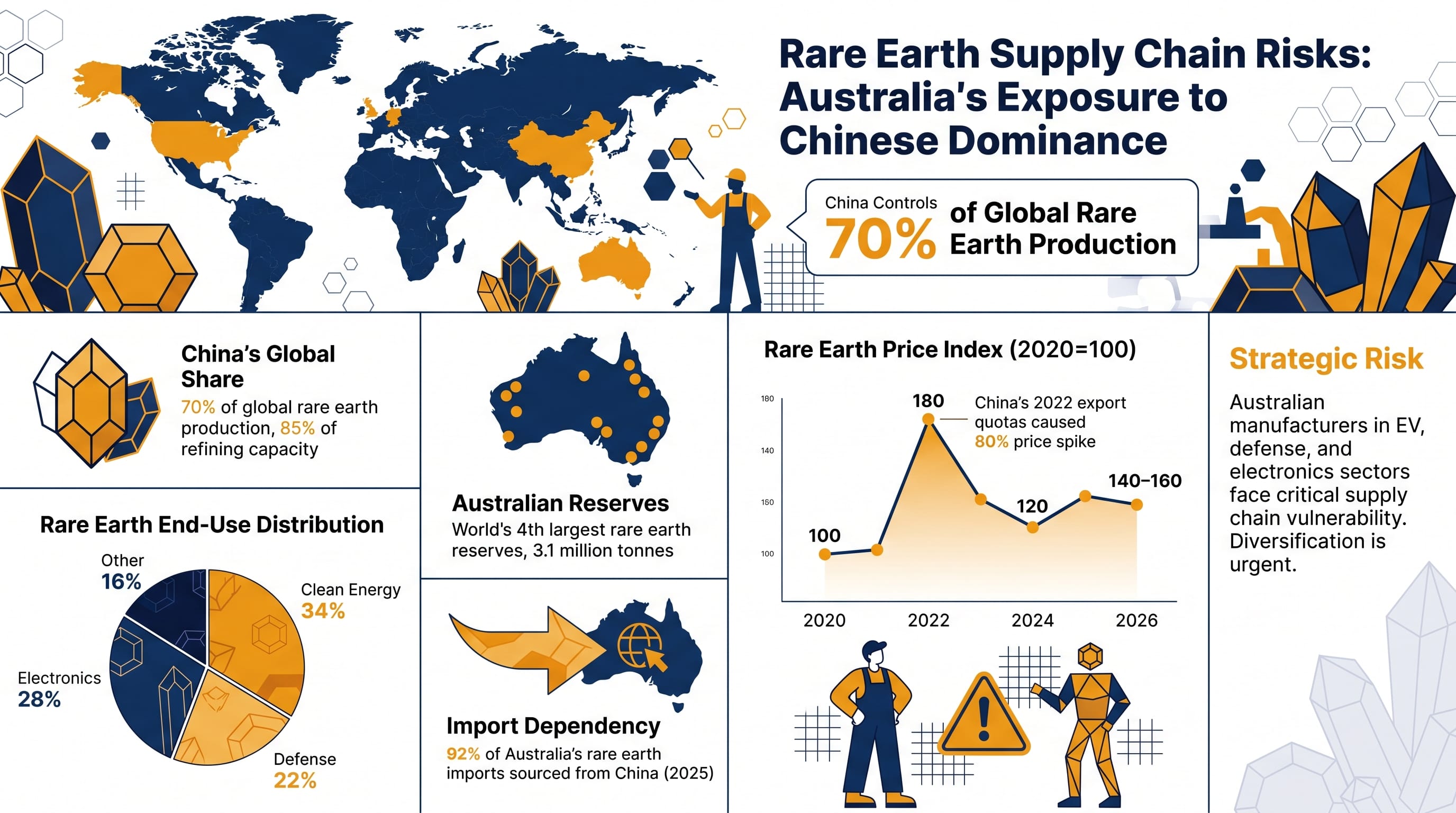
When our auditors walk into a Chinese factory producing electric motors, generators, or electronic components, the rare earths are already in the room. They are in the neodymium magnets that make the motor spin. They are in the battery chemistry. They are in the display screen. And almost all of them — regardless of what the final product label says — were processed in China.
This matters to Australian importers for a reason that goes beyond geopolitics. If your supplier cannot tell you where their rare earth components come from, they cannot tell you whether their own supply chain is secure. And if their supply chain falters — whether through price spikes, export restrictions, or production disruptions — yours falters too.
In our experience verifying Chinese suppliers, the manufacturers that have their supply chain mapped are the exception, not the rule. Most know the price of their raw materials. Few know the country of origin. This article explains what is actually happening in rare earth supply chains and the practical steps you can take to protect your business.
What Rare Earths Are — and Where They Show Up in Your Supply Chain
Rare earth elements (REEs) are seventeen metallic elements used in products most Australian businesses import from China. They are not especially rare geologically. What is rare is the processing infrastructure needed to turn ore into usable material.
China operates approximately 85% of the world's rare earth refining capacity and produces over 90% of the world's neodymium-iron-boron permanent magnets — the strongest type of commercial magnet available.
For Australian importers, this means rare earths appear in:
- Electric motors and generators — neodymium and praseodymium are essential for high-strength permanent magnets used in EV motors, industrial machinery, and wind turbine generators
- Consumer electronics — vibration motors in smartphones, speakers, hard disk drives, and display screens all contain rare earth components
- Batteries and energy storage — lanthanum is used in hybrid vehicle batteries; battery management systems often contain rare earth sensors
- Medical and defence equipment — MRI machines and guided-missile guidance systems depend on rare earth compounds where alternatives typically underperform
If your business imports products containing any of these components, your supply chain has rare earth exposure — whether you know it or not.
How Chinese Processing Dominance Developed
China's position in rare earth processing is not a natural resource story. While China holds around 35% of global rare earth reserves (Australia holds an estimated 6–8%), it controls over 80% of processing capacity. This imbalance is the result of decades of deliberate industrial policy.
In the 1980s and 1990s, strict environmental regulations pushed Western rare earth processors out of business or offshore. China, with lower environmental compliance costs and government-backed investment, filled the gap. Today, the concentration means that rare earths mined in Australia, lithium from Bolivia, and cobalt from the Democratic Republic of Congo all pass through Chinese refineries before becoming usable materials.
The economic effect is not abstract. When China imposed rare earth export quotas in 2011, neodymium prices jumped from approximately US$20 per kilogram to over US$200 per kilogram within a year. Manufacturers using neodymium magnets — from EV producers to wind turbine manufacturers — faced sudden cost spikes they could not pass through to customers.
What This Means for Australian Importers
Most Australian businesses sourcing manufactured goods from China have three categories of rare earth risk, whether they realise it or not:
Price risk through your supply chain. You may not buy rare earths directly. But your supplier does. When rare earth prices spike, your supplier either absorbs the increase (until they can no longer compete) or passes it to you. Either way, the stability of your landed cost depends on a market you cannot see and do not control.
Supplier concentration risk. If your Chinese supplier depends on a rare earth component that is only available from one processor, your supplier has a single point of failure. In our factory audits, we have found suppliers who did not realise their own magnet supplier was the sole source for a critical component — until that supplier hit production constraints.
Regulatory and reputational risk. As Australian regulators and large buyers increase scrutiny of supply chain provenance — particularly for rare earths used in defence, medical, and clean-energy applications — importers are being asked to demonstrate that their materials are ethically sourced. If your supplier cannot trace their own inputs, you cannot make that demonstration.
How We Assess Rare Earth Exposure When Verifying Suppliers
When we conduct factory audits for clients sourcing products that likely contain rare earths — electric motors, generators, batteries, medical equipment, defence components — we add specific questions to our verification checklist:
- Does the supplier know the source of their rare earth-containing components? (Most do not — and that in itself is a finding.)
- Do they have alternative suppliers for those components? (If not, the supply chain has a single point of failure.)
- Have they experienced raw-material price volatility in the past 12 months, and how did they manage it?
- Can they provide material declarations from their own suppliers that specify rare earth content and country of origin?
The answers often reveal risks the buyer was unaware of. In one engagement, a client importing electric motors from a Guangdong manufacturer discovered that the supplier's neodymium magnets came from a single processor in Jiangxi province — a processor that had already notified the supplier of an upcoming 18% price increase on the next order. The client had already quoted their customer a fixed price for the next 12 months.
Identifying that risk before the price increase hit gave the client time to negotiate, source alternative quotes, and adjust their pricing model. Without the audit, the margin erosion would have been discovered when the invoice arrived.
Practical Steps to Protect Your Supply Chain
Most Australian businesses cannot eliminate rare earth dependency from their supply chains — the materials are too embedded in modern manufacturing. But you can take practical steps to understand and manage the exposure:
Audit your direct purchases. Review your bill of materials and identify which products or components are likely to contain rare earths. Ask your supplier for declarations. If they cannot provide them, that is a risk signal.
Diversify supplier relationships. If your current supplier depends on a single rare earth processor, identify alternative suppliers now — before a disruption forces you to. This is standard supply chain hygiene, not overreaction.
Consider strategic inventory. For components where rare earths are critical and substitution is difficult, holding a safety buffer can protect against short-term price spikes or supply interruptions.
Build traceability into your supplier agreements. Add a requirement for your Chinese suppliers to disclose the country of origin of their rare earth-containing components and to notify you of any changes. Over time, this becomes a competitive advantage as traceability requirements tighten.
The Outlook
Non-Chinese rare earth processing capacity is developing, but slowly. Lynas Corporation operates the only significant non-Chinese refinery at scale, and Australian mining companies are developing domestic processing projects. The timeline for meaningful diversification from Chinese processing is measured in years to a decade.
For the foreseeable future, the practical strategy for Australian importers is not to eliminate Chinese rare earth dependency — it is to understand your actual exposure, verify your suppliers' supply chains, and build the transparency that lets you make informed decisions when the market shifts.
That is where our work starts. When we audit a factory, we are not just checking whether the building exists and the machines run. We are asking the questions your business would ask if you were standing on the production floor yourself.
Need to understand your supply chain's rare earth exposure? We include supplier input-material traceability as part of our factory audits and supplier verification. Book a free consultation to discuss your specific situation.
Andy Liu
2026-05-21 · 10 min read
How Winning Adventure Global helps
Whichever way you source from China, you get someone you can trust on the ground. Choose the approach that fits your business.
One-Time Procurement
A single purchase executed well — travel to China with our guide or let us handle it remotely.
Compare servicesFactory Tour + Supply Chain
Visit China with a bilingual guide, audit production in person, and build a long-term supply chain.
Compare servicesRemote Verification + Supply Chain
Deep supplier verification and ongoing procurement management — without leaving Australia.
Compare servicesChina Sourcing Strategy
Worried about critical-mineral supply chain exposure?
We help Australian businesses identify and verify component suppliers in China — so you know exactly where your materials come from. Free supplier consultation.
Free initial consultation · We respond within 4 business hours