Australian cricket fans are among the most passionate in the world. They fill the MCG on Boxing Day, pack the SCG for the New Year's Test, and travel interstate for ODI series that matter. But when the Australia vs Pakistan bilateral series rolls around — a fixture that draws enormous interest from both the mainstream Australian cricket audience and the 100,000-strong Pakistani-Australian community — the merchandise shelf is bare.
Walk into any major Australian sports retailer during a home Test series. You will find Cricket Australia branded apparel, generic green-and-gold bucket hats, and the occasional Kookaburra ball. What you will not find: match-specific AUS vs PAK supporter jerseys. Series-branded scarves. Pakistani flags manufactured to Australian quality standards. Custom cricket fan gear celebrating the specific rivalry between these two Test nations.
This gap is not driven by lack of demand. It is a supply-side failure — one that Australian sports retailers can turn into a profitable product line by sourcing from Chinese manufacturers who already produce bilateral-series merchandise for other cricketing nations.
Why the AUS vs PAK Series Is a Distinct Merchandise Opportunity
The Australia vs Pakistan cricket rivalry spans decades. From the 1999 World Cup final at Lord's to Pakistan's famous Test series win in the UAE in 2014, and the drawn 1-1 series in Pakistan in 2022 — the first Australian tour of Pakistan in 24 years — these matches carry historical weight.
The 2026 bilateral series is expected to draw significant viewership across both countries. In Australia, cricket remains the number one summer sport, and the Pakistani-Australian community — concentrated in Sydney's west (Auburn, Lakemba), Melbourne's north (Broadmeadows, Fawkner), and Brisbane's south — represents an audience that actively follows the Pakistan national team and purchases match-related merchandise when it is available.
| Audience Segment | Estimated Size in Australia | Merchandise Willingness | Current Retail Availability |
|---|---|---|---|
| Mainstream Australian cricket fans | 2.5 million+ (CA registered fans) | Medium — will buy at grounds | Generic CA gear only |
| Pakistani-Australian fans | ~110,000 | High — actively seek Pakistan gear | Virtually zero |
| South Asian cricket diaspora | ~900,000 | Medium-High — cross-series interest | IPL-only where available |
| Cricket tourists/ground attendees | 80,000+ per major Test match | High — impulse purchase at venue | Limited to CA tents |
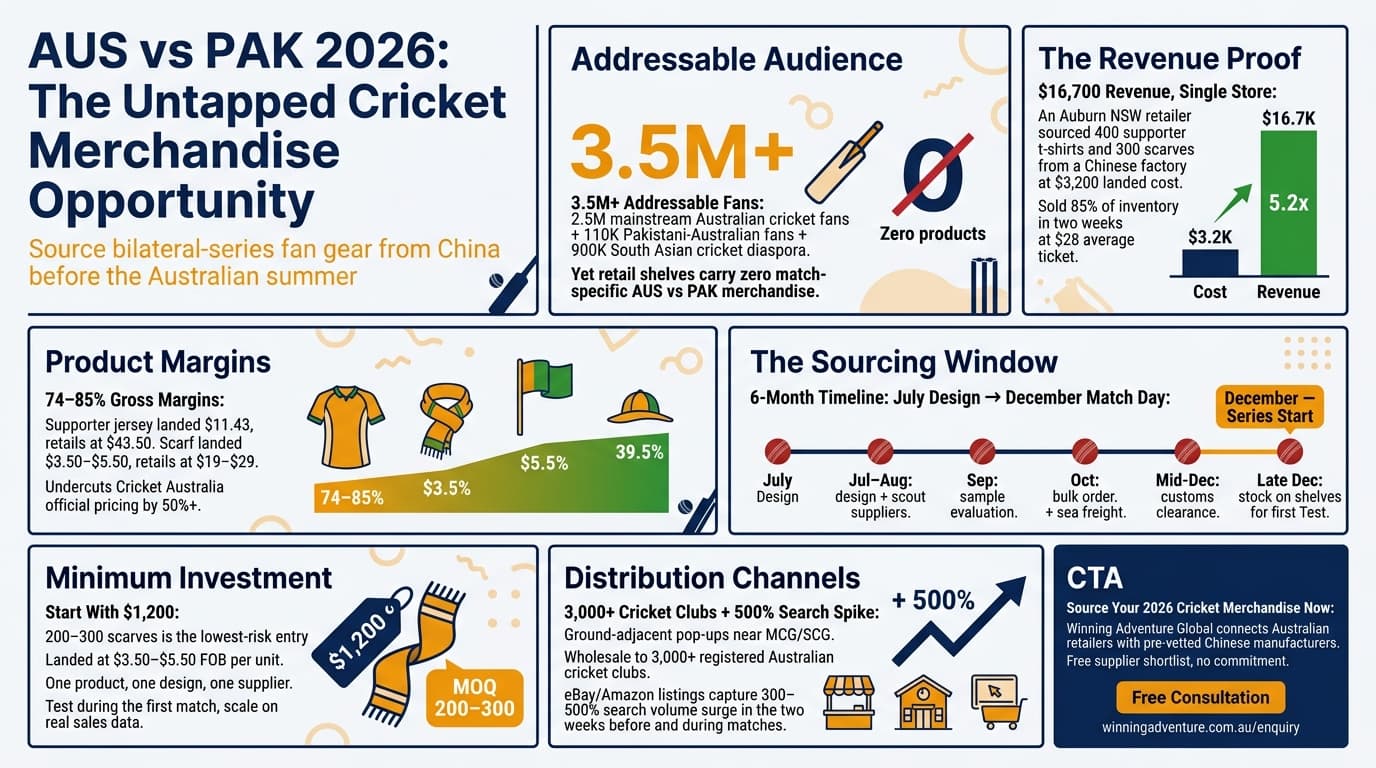
The combined addressable audience for AUS vs PAK match merchandise exceeds 3.5 million Australians who follow cricket, with approximately 200,000 highly motivated buyers concentrated in specific suburbs. Yet the product shelf for this specific rivalry is empty.
A sports retailer in Auburn, NSW — one of Sydney's largest Pakistani-Australian communities — tested this market during the 2024 Pakistan tour of Australia. The shop sourced 400 green Pakistan supporter t-shirts and 300 "AUS vs PAK" branded scarves from a Chinese factory at a landed cost of $3,200 AUD. They sold through 85% of inventory within two weeks of the first Test at an average ticket of $28, generating approximately $16,700 in revenue from a single product category the store had never previously stocked. The owner's comment: "Customers walked in asking where to buy Pakistan gear. We were the only shop within 10 kilometres that had any."
Product Categories That Sell for Bilateral Cricket Series
Unlike IPL merchandise, which revolves around franchise team colours and player names, bilateral series merchandise is event-driven. Fans buy it for a specific series, often as a souvenir of attending the match or to wear during broadcast viewing. The product categories that perform best are functional, wearable, and affordable.
| Product | Typical Design | Landed Cost (FOB) | Retail Price (AUD) | Margin | Sourcing Difficulty |
|---|---|---|---|---|---|
| Supporter jersey (sublimated) | Green-and-gold or green designs | $7–$11 | $39–$59 | 78–85% | Medium |
| Supporter scarf (series-branded) | "AUS vs PAK 2026" knit | $3.50–$5.50 | $19–$29 | 75–82% | Low |
| Hand-waver flags (pair) | Australian + Pakistan flags on sticks | $2–$4 per pair | $12–$18 | 75–80% | Low |
| Bucket hat (wide-brim) | Team colours, printed series logo | $3–$5 | $18–$25 | 78–82% | Low |
| Keyring/phone accessories | Cricket-themed with flag colours | $0.80–$1.50 | $6–$10 | 82–88% | Very Low |
| Drinkware (stubby holder) | Series-branded neoprene | $1.50–$2.50 | $8–$12 | 78–83% | Very Low |
Supporter jerseys are the highest-revenue category. Unlike official playing jerseys — which require a Cricket Australia or PCB licensing agreement — supporter jerseys in team colours with cricket-themed designs and series references occupy a legally distinct space. A green jersey with "PAKISTAN SUPPORTER" text, a cricket bat graphic, and the year "2026" is merchandise for a fan, not a counterfeit of an official team product.
Scarves are the easiest entry point. A knit scarf with "AUSTRALIA vs PAKISTAN 2026" and cricket-themed border patterns can be sourced at $3.50–$5.50 FOB per unit from textile factories in Jiangsu or Zhejiang. The design work is simple (text + two-colour pattern), MOQs start at 200–300 units, and the retail price point of $19–$29 feels accessible to fans attending a match.
Do not overlook bucket hats. The Australian summer sun makes wide-brim headwear a practical purchase at cricket grounds. A green bucket hat with gold trim or a green one with a subtle star-and-crescent-inspired design detail sells as both a fashion item and a sun safety product. The dual utility drives higher conversion than a purely decorative item.
Step 1: Define Your Product Range Around the Series Format
The Australia vs Pakistan 2026 bilateral series will likely follow the standard ICC Future Tours Programme format: 3 Test matches, 3 ODIs, and 3 T20Is, spread across December 2026 and January 2027. Each format attracts a slightly different audience and each venue has distinct foot traffic patterns.
Test matches (MCG, SCG, Perth Stadium): Highest attendance, broadest demographic, longest dwell time at the ground. This is where scarves, bucket hats, and mid-price supporter jerseys ($39–$59) sell best. Crowds at the Boxing Day Test routinely exceed 70,000 — and every one of them walks past merchandise stalls.
ODIs: Slightly younger crowd, more families, greater willingness to buy for kids. Junior-sized supporter jerseys and flag sets perform well here.
T20Is: Youngest audience, highest social media engagement, most impulse purchases. Stubby holders, phone accessories, and lower-price-point items ($6–$15) sell at higher velocity.
Recommended first-order mix for a small-to-medium Australian retailer:
- 200 supporter jerseys (120 green-and-gold, 80 green designs)
- 150 scarves (series branded)
- 250 flag pairs
- 100 bucket hats
- 100 stubby holders
- 80 keyrings
Total landed cost: approximately $3,800–$5,500 AUD. Projected retail revenue at sell-through: $14,000–$21,000.
Step 2: Find Chinese Manufacturers Who Understand Cricket Merchandise
Not all sportswear factories in China can produce cricket merchandise well. The specific requirements matter:
Colour fastness: Cricket merchandise is worn outdoors in Australian summer sun. Cheap sublimation prints on polyester jerseys fade after one wash in UV-intensive conditions. Request UV-fade-resistance testing from your factory — reputable sportswear manufacturers in Guangdong and Fujian can provide ISO 105-B02 test results for colour fastness to light.
Scarf knitting quality: Chinese factories in the Zhangjiagang area of Jiangsu province specialise in knit scarves. The difference between a quality scarf and a poor one comes down to yarn weight (minimum 180 GSM for a scarf that feels substantial), edge finishing (reinforced stitching, not raw cuts), and print registration (text that sits straight, not slanted).
Flag construction: Avoid printed polyester flags that are single-layer with hemmed edges — they look cheap and fray quickly. Specify double-layer knitted polyester with reinforced pole sleeve and brass eyelets at minimum. Factories in Shaoxing (Zhejiang) and Yiwu produce flags at scale and can match the Pantone colours of both the Australian and Pakistani flags precisely.
Finding factories:
- Alibaba.com and 1688.com — filter for suppliers with 3+ years of operation, Trade Assurance, and response rates above 85%
- Made-in-China.com — often has higher-quality textile and promotional product suppliers
- Trade shows — the Canton Fair (Guangzhou, April/October) and the East China Fair (Shanghai, March) feature sportswear and promotional merchandise suppliers
Step 3: Navigate Intellectual Property the Right Way
This is the most commonly misunderstood aspect of bilateral series merchandise. Here is what you need to know for the Australian market.
What is protected:
- Cricket Australia's official logo, the Southern Cross stars mark, and the baggy green cap design are registered trademarks
- The Pakistan Cricket Board (PCB) logo and official team crest are registered trademarks
- Player names, likenesses, and signature marks may be protected under Australian passing-off law
- Official playing jersey designs are protected by design registration or copyright
What is not protected:
- The colours green and gold (Australia's sporting colours) used generically
- The colour green used generically (Pakistan's cricket colour)
- The words "Australia" and "Pakistan" in text (they are geographical names)
- Cricket-themed imagery (bats, balls, stumps, wickets) used in original designs
- The year "2026" and the text "AUS vs PAK" as a match descriptor
The recommended approach for Australian SMEs is the colour-association design strategy — the same approach used successfully by retailers in the IPL merchandise market and described in our cricket equipment sourcing guide. Products use team-adjacent colour schemes with cricket-themed original graphics, series descriptors in plain text, and supporter-focused messaging. No official logos. No player images. No registered trademarks. This approach is legally sound, commercially proven, and requires zero licensing negotiations.
A Melbourne-based online cricket store that adopted this strategy for the 2025 England vs Australia Ashes series sold 1,200 units of colour-associated supporter merchandise across 6 product categories — generating approximately $38,000 in revenue with no licensing costs and no legal issues.
Step 4: Plan Your Production Timeline Around the Australian Summer
Timing is everything for event-driven merchandise. The Australia vs Pakistan 2026 series runs during the Australian cricket season, likely December 2026 through January 2027. Here is the sourcing timeline you need to hit:
| Milestone | Deadline | What Happens |
|---|---|---|
| Product design + supplier scouting | July–August 2026 | Finalise designs, shortlist 3–5 factories |
| Sample orders | September 2026 | Order 3–5 samples from each factory, test quality |
| Final supplier selection | Late September 2026 | Evaluate samples, negotiate terms, confirm factory |
| Bulk order placement | Early October 2026 | Deposit payment (typically 30%), production begins |
| Production (25–35 days) | October–November 2026 | Factory produces order, QC inspection |
| Sea freight departure | Mid-November 2026 | Container leaves Guangzhou/Shanghai/Ningbo |
| Sea freight transit (18–25 days) | Late November–Early December 2026 | Cargo in transit |
| Customs clearance + delivery | Mid-December 2026 | Goods arrive at your warehouse |
| Ready for series start | Late December 2026 | Stock on shelves before first Test |
If you miss the sea freight window: air freight from Guangzhou to Sydney takes 5–8 days at approximately $6–$9 AUD/kg. A $2,500 air freight bill on a $6,000 order that generates $18,000 in series sales still produces a healthy return. Use air freight as a contingency, not your primary plan.
Step 5: Price for the Australian Sports Merchandise Market
The price ceiling for bilateral series merchandise is set by two benchmarks: what Cricket Australia charges for official merchandise at grounds, and what fans pay for international shipping from overseas retailers.
| Benchmark | Jersey | Scarf | Flag Pair | Bucket Hat |
|---|---|---|---|---|
| CA official (at ground) | $89–$110 | $35 | $18 | $30 |
| International online (incl. shipping) | $55–$75 | $25–$35 | $12–$18 | $22–$28 |
| Your target (imported) | $39–$59 | $19–$29 | $12–$18 | $18–$25 |
Your pricing should undercut both official merchandise and international online sellers while maintaining a 3.5–4.5x landed cost multiplier. Here is a worked example for a supporter jersey:
Cost breakdown per jersey (500-unit order):
- Manufacturing (FOB Guangzhou): $8.00
- Sea freight (amortised): $1.20
- Customs duty (5%, tariff heading 6110.30): $0.46
- GST (10% on landed value): $0.97
- Warehouse handling: $0.80
- Total landed cost: $11.43
Retail at 3.8x multiplier: $43.50 — competitive against the $89 CA price point and the $55 minimum from international online sellers.
At 500 jerseys at $43.50 with 80% sell-through: revenue of $17,400 from a single product line with a landed cost of $4,572. Gross margin: 74%.
Step 6: Distribute Through Channels That Reach Cricket Fans
Your AUS vs PAK merchandise will not sell itself. The distribution strategy matters as much as the product.
Ground-adjacent pop-up retail: During Test matches in Melbourne, Sydney, and Brisbane, foot traffic around the venues is extraordinary. A pop-up stall at a location within walking distance of the MCG or SCG — or inside a nearby shopping centre — can generate more sales in five days than a year of online-only selling. Check with local councils about temporary trading permits well in advance.
Community cricket clubs: Australian cricket clubs — there are over 3,000 registered clubs nationwide — run match-viewing events during international series. Offer bulk pricing to clubs who want to purchase supporter gear for their members. A club with 200 members ordering scarves at $14 each (wholesale) generates a single-transaction sale of $2,800.
Targeted social media advertising: Use Facebook and Instagram to target users in suburbs with high Pakistani-Australian populations (Auburn, Lakemba, Guildford in Sydney; Broadmeadows, Fawkner, Roxburgh Park in Melbourne) with interest-based targeting for "Pakistan cricket," "cricket Australia," and "cricket live score" interests. A $500 ad spend during the week before the first Test can reach approximately 40,000–60,000 highly relevant users.
Online marketplace listings: eBay Australia and Amazon Australia are where fans search when they cannot find merchandise locally. List your products with titles that match search queries: "AUS vs PAK 2026 Supporter Jersey Green Gold Cricket Fan Shirt." The search volume for bilateral series merchandise spikes 300–500% in the two weeks before and during the matches — your listings need to be live before that window opens.
FAQ
Is it legal to sell AUS vs PAK cricket merchandise without a Cricket Australia or PCB license?
Yes — provided you do not use registered trademarks, official logos, player images, or official team crests. Cricket Australia's trademarks cover its specific logo marks, the baggy green cap design, and the playing jersey designs. The words "Australia" and "Pakistan" are geographical descriptors, and team colours alone are not trademarkable. The colour-association approach — merchandise in team colours with original cricket-themed graphics and supporter messaging — has been used successfully by Australian retailers for years without legal challenge. If you plan to scale beyond $50,000 in annual cricket merchandise revenue, consult a trademark attorney to review your specific designs.
What is the minimum investment to test this market?
A minimum viable first order of 200 supporter jerseys, 100 scarves, and 100 flag pairs costs approximately $2,800–$3,500 AUD landed from a Chinese factory. At conservative sell-through rates and pricing, this generates $8,000–$12,000 in retail revenue. Start with one or two product categories in one colour scheme, test during the first match of the series, and scale up based on actual sales data. The key risk is unsold inventory after the series ends — order conservatively for your first series and grow your order volume as you learn your sell-through rates.
Which Chinese regions produce the best cricket fan merchandise?
For sublimated sportswear (jerseys, t-shirts): Guangdong province, specifically the Dongguan and Guangzhou textile clusters. For knitted scarves: Zhangjiagang in Jiangsu province. For flags and promotional accessories: Yiwu in Zhejiang province — the world's largest wholesale market for small commodities, where flag MOQs can be as low as 100 units. For bucket hats and headwear: the Yangzhou area in Jiangsu has specialised hat factories that can handle custom embroidery and printing. Request samples from factories in each region before committing to a bulk order — price and quality vary significantly even within the same industrial cluster.
How do I handle customs classification for cricket merchandise?
Cricket supporter jerseys fall under tariff heading 6110.30 (knitted synthetic fibre garments) at 5% duty. Knitted scarves are classified under 6117.10 at 5% duty. Printed flags fall under 6307.90 (other made-up textile articles) at 5% duty. Bucket hats are classified under 6505.00 (headgear) at 5% duty. All imports attract 10% GST on the landed value. Ensure your Chinese factory labels commercial invoices with the correct HS codes — a misclassified shipment can add 5–10 days in customs processing. If your total order value exceeds $1,000 AUD, you will need a customs broker or to self-assess using the Integrated Cargo System (ICS).
What is the best single product to start with if I am testing the market?
Start with scarves. They are the lowest manufacturing complexity (knitted text + two-colour pattern), the lowest per-unit cost ($3.50–$5.50 FOB), and the easiest to sell at cricket grounds where fans actively look for match-day souvenirs. A scarf with "AUSTRALIA vs PAKISTAN 2026" in block text with green-and-gold on one end and green on the other is a simple design that factories can produce to a consistent quality standard. Scarf MOQs start at 200–300 units, keeping your first-order investment below $1,200 landed.
The Bilateral Series Merchandise Gap Is Yours to Fill
The Australia vs Pakistan cricket series will draw millions of viewers and hundreds of thousands of match attendees across the Australian summer. The Pakistani-Australian community — concentrated, passionate, and actively seeking match merchandise — represents a customer base that mainstream sports retailers continue to overlook.
The same Chinese manufacturers that produce official-quality cricket merchandise for other Test-playing nations can produce your product line at competitive prices, with reliable lead times, and with the design flexibility to create distinctive, legally sound supporter gear.
The window for the 2026 series is open now. Design finalisation, supplier scouting, and sample evaluation all need to happen between July and September 2026 to hit the December series start. Every week of delay reduces your options for sea freight and pushes costs toward air freight.
Winning Adventure Global helps Australian retailers source custom sports merchandise from pre-vetted Chinese manufacturers. Our team handles supplier identification, sample evaluation, quality control, and logistics coordination — so you can focus on selling to the fans who are already searching for what you stock.
Get Your Free Sourcing Consultation →
China Sourcing Strategy
Want to Stock AUS vs PAK 2026 Fan Merchandise Before the Series?
The bilateral series window is short and demand is concentrated. We connect Australian retailers with pre-vetted Chinese manufacturers who produce match-ready supporter jerseys, scarves, flags, and hats — with competitive pricing and reliable lead times. Free supplier shortlist, no commitment.
Get Your Free Sourcing ConsultationFree initial consultation · We respond within 4 business hours