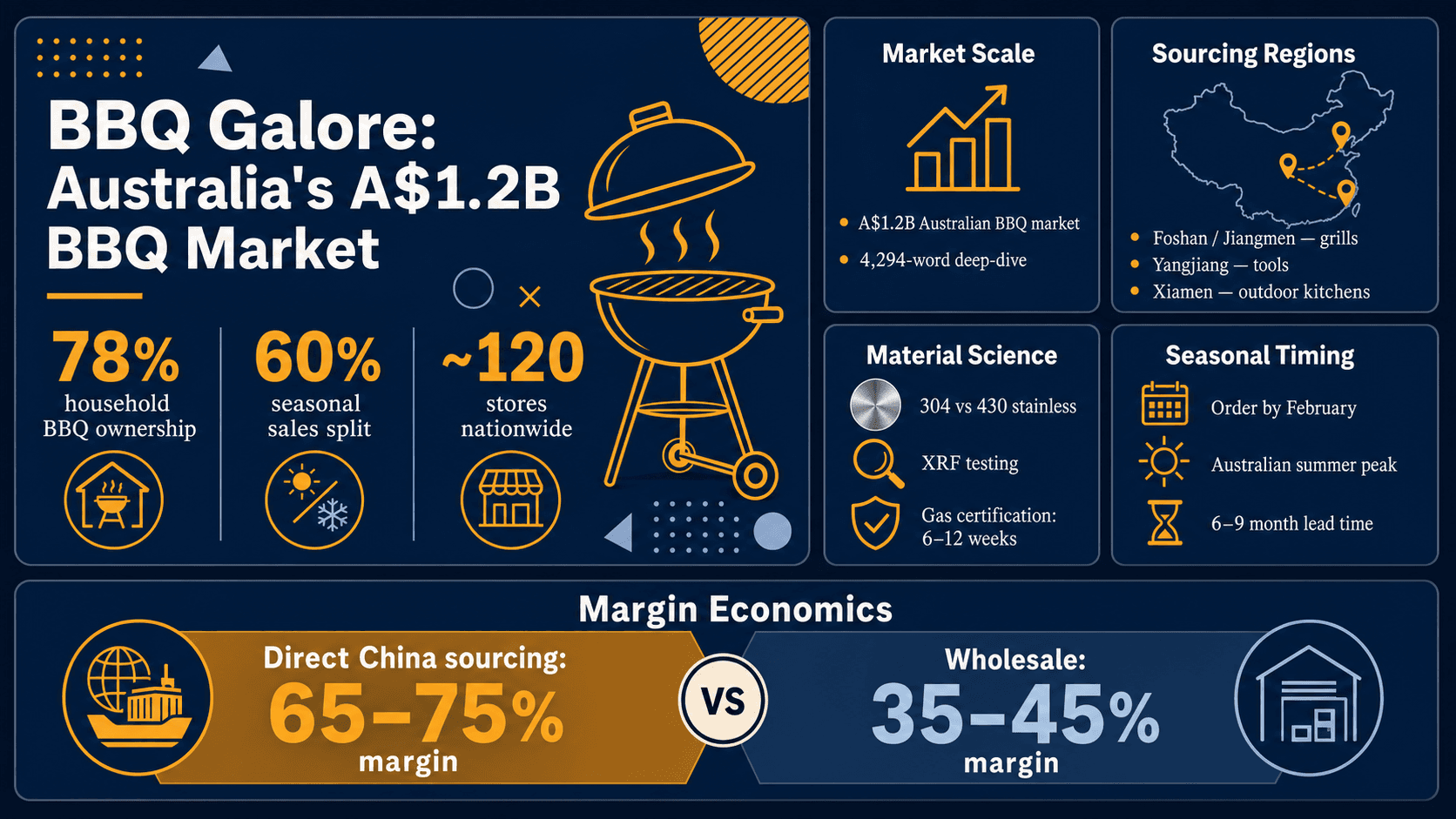
Australia is a country that cooks outdoors. With more than 60 percent of households owning a barbecue and the outdoor cooking market estimated at over AUD 1.2 billion annually, the barbecue is not a seasonal novelty. It is a fixture of Australian domestic life, as central to the weekend as a trip to the beach or a cricket match on the radio. Against this cultural backdrop, BBQ Galore has built the country's largest specialty barbecue and outdoor living retail chain, operating more than 70 stores nationwide from Cairns to Hobart with a product range that spans gas barbecues, charcoal grills, electric cooktops, smokers, pizza ovens, patio heaters, and fully integrated outdoor kitchen systems.
What makes BBQ Galore relevant to Australian SME importers is not the store count or the brand recognition. It is the supply chain behind the shelves. The barbecues, smokers, accessories, and outdoor kitchen components that fill those 70-plus stores arrive through a procurement network that extends deep into Chinese manufacturing clusters, and the way that network operates contains lessons for any Australian business importing outdoor cooking products, whether it competes with BBQ Galore, supplies it, or serves a different segment of the market entirely.
Australian SMEs that understand where BBQ products are manufactured, how retail supply chains in this category function, and what compliance obligations attach to outdoor cooking equipment can build sourcing operations that deliver genuine cost advantages without sacrificing quality or safety.
Ready to import BBQ and outdoor cooking products from China?
The Australian BBQ market is worth over AUD 1.2 billion annually, and 78% of Australian households own a barbecue. Winning Adventure Global helps SMEs source grills, smokers, outdoor kitchen equipment, and accessories from verified Chinese manufacturers at competitive landed costs.
Book a free sourcing consultationBBQ Galore's Product Range and the Chinese Manufacturing Map
BBQ Galore's product range divides into four broad categories, each sourced from distinct manufacturing clusters in China. Mapping these categories to their manufacturing origins is the first step toward understanding the supply chain opportunity for Australian importers.
Gas Barbecues and Grills
Gas barbecues represent the largest category by both sales volume and floor space. BBQ Galore carries brands including Weber, BeefEater, Ziggy, Everdure, and Masport, spanning portable two-burner units under AUD 300 through to six-burner freestanding models exceeding AUD 3,500. The manufacturing base for gas barbecue bodies concentrates in Guangdong province, specifically the stainless steel fabrication clusters in Foshan, Jiangmen, and Zhongshan. These cities host factories that produce barbecue bodies, cooking grates, burner assemblies, and gas manifolds at scale, with integrated supply chains that include nearby stainless steel mills, tube bending facilities, and powder coating lines.
The Pearl River Delta's dominance in gas barbecue manufacturing is not accidental. It reflects decades of investment in metal fabrication technology, a dense network of component suppliers that reduces logistics cost within the manufacturing cluster, and a workforce experienced in the specific welding, finishing, and assembly techniques that gas barbecue production requires. A factory in Foshan producing 50,000 barbecue units annually draws on a local supply base that includes stainless steel sheet suppliers in Foshan itself, gas valve manufacturers in nearby Zhongshan, ignition system producers in Shunde, and packaging suppliers within trucking distance. This geographic concentration of the supply chain is a structural advantage that competing manufacturing regions cannot easily replicate.
Charcoal Grills and Smokers
Charcoal-fuelled products occupy the enthusiast segment of the market driven by American-style low-and-slow barbecue culture that has grown substantially in Australia over the past decade. Kamado-style ceramic grills, offset smokers, barrel smokers, and kettle grills sourced from Chinese manufacturers compete alongside imported American brands like Traeger and Camp Chef at price points from AUD 200 to AUD 2,000-plus.
The Chinese manufacturing base for charcoal grills and smokers is more geographically diverse than for gas barbecues. Porcelain-enamelled steel kettle grills concentrate in Guangdong and Zhejiang. Cast iron smokers and grill grates come from foundries in Hebei and Shanxi provinces, where coal and iron ore proximity historically supported heavy casting industries that have pivoted toward consumer product manufacturing. Ceramic kamado grills source from Fujian and Guangdong, where ceramics manufacturing expertise developed over centuries in the pottery and tile industries transfers directly to the high-temperature ceramic bodies that kamado cooking requires. The supply base is fragmented relative to gas grills, meaning importer diligence in supplier selection is correspondingly more important.
Outdoor Kitchen Systems
The outdoor kitchen category represents the highest-value and fastest-growing segment of the market. Built-in barbecue units, modular cabinetry, stone benchtops, outdoor refrigeration, sink modules, and weather-resistant storage systems assemble into permanent outdoor cooking installations that can cost AUD 5,000 to AUD 50,000-plus. BBQ Galore has invested heavily in this category through its concept stores, and the margin structure justifies the floor space.
Chinese sourcing for outdoor kitchen components spans multiple manufacturing categories. Stainless steel built-in barbecue units come from the same Guangdong fabrication clusters that produce freestanding gas grills, but with higher-grade 304 stainless steel and more demanding finishing standards. Aluminium and stainless steel cabinetry components come from extrusion and sheet metal specialists in Guangdong and Zhejiang. Stone and engineered-stone benchtop materials source from Fujian and Guangdong stone processing centres. The complexity of outdoor kitchen sourcing lies in coordinating components from multiple factories, ensuring dimensional compatibility across manufacturers, and managing the quality standards appropriate for a permanent installation rather than a portable appliance.
Accessories, Tools, and Consumables
The accessory category -- grill covers, cleaning tools, thermometers, rotisserie kits, pizza stones, smoking chips, barbecue sauces, and rubs -- generates high inventory turnover and strong margins. This category sources from the broadest range of Chinese manufacturing regions. Stainless steel tools and accessories come from Yangjiang in Guangdong, a city renowned for cutlery and kitchen tool manufacturing. Textile grill covers source from Zhejiang and Jiangsu, where outdoor fabric manufacturing clusters serve the global patio furniture market. Ceramic pizza stones source from the same Fujian and Guangdong kilns that produce kamado grills. The accessory category rewards importers who can aggregate orders across product types to achieve container-load shipping economics from multiple factories.
What to do
When sourcing BBQ and outdoor cooking products from China, identify which manufacturing cluster produces your specific product category. Searching within the correct geographic cluster -- Foshan for gas grill fabrication, Yangjiang for stainless steel tools, Hebei for cast iron components -- produces dramatically better supplier quality than generic platform searches without geographic filtering. The factory that produces excellent gas barbecues is unlikely to be the factory that produces excellent ceramic pizza stones.
How BBQ Galore's Supply Chain Operates
BBQ Galore's supply chain follows a procurement model that is standard across Australian specialty retail but adapted to the specific demands of outdoor cooking products. Understanding how this model works provides a reference architecture for Australian SME importers building or improving their own sourcing operations.
The procurement process begins with category management at BBQ Galore's head office. Buyers determine seasonal ranges, identify gaps in the product assortment, and develop briefs specifying product type, materials, features, target retail price, and projected volumes. These briefs go to sourcing teams that work with both international brands -- negotiating Australian distribution rights for brands like Weber and Traeger -- and with Chinese manufacturers producing BBQ Galore's private-label and exclusive products.
For private-label products, the sourcing journey typically involves identifying 10 to 20 candidate factories, narrowing to 5 to 8 through capability screening, requesting samples from 3 to 5, and placing production orders with 1 to 2 after sample approval, factory audit, and commercial negotiation. The cycle from product brief to first shipment runs 6 to 9 months for new product development and 3 to 4 months for reorders of established products.
Quality control in the BBQ category presents specific challenges that distinguish it from general consumer goods sourcing. A gas barbecue is a safety-critical product. Gas leaks, flare-ups from poor burner design, and structural failures from inadequate material thickness can cause property damage and personal injury. BBQ Galore's quality assurance framework for private-label gas products includes material certification (verifying stainless steel grade, thickness, and composition), gas system pressure testing on production samples, burn testing across the full operating temperature range, stability testing to Australian and New Zealand standards, and packaging integrity testing to ensure products survive the sea freight journey from Chinese ports to Australian distribution centres.
Compliance requirements add a further layer of complexity. Gas appliances sold in Australia must meet the requirements of the applicable Australian Standard and carry certification from a recognised testing authority. Electrical components in barbecues with electric ignition or rotisserie motors must comply with Australian electrical safety standards. Contact with food surfaces must meet food-grade material requirements. The compliance burden is significant, and it functions as a barrier to entry that protects established importers from the most casual competitors.
The Australian retail consolidation trend, examined in our analysis of the Bunnings Wesfarmers merger supply chain impact, affects the BBQ retail sector differently than hardware. Bunnings carries a substantial barbecue range that competes directly with BBQ Galore in the mass-market segment, but BBQ Galore's specialty positioning, deeper range, and staff expertise create a differentiated competitive position that pure hardware retailers struggle to replicate.
Ready to import BBQ and outdoor cooking products from China?
The Australian BBQ market is worth over AUD 1.2 billion annually, and 78% of Australian households own a barbecue. Winning Adventure Global helps SMEs source grills, smokers, outdoor kitchen equipment, and accessories from verified Chinese manufacturers at competitive landed costs.
Book a free sourcing consultation5 Supply Chain Lessons for Australian BBQ and Outdoor Product Importers
BBQ Galore's supply chain is not simply a scaled-up version of what an SME importer does. The scale creates different dynamics. But the principles that govern supplier selection, quality assurance, compliance management, and logistics apply regardless of order volume. The five lessons below are drawn from how the BBQ retail supply chain operates, adapted to the resources and scale of Australian SME importers.
Lesson 1: Stainless Steel Grade Determines Product Life, Not Just Product Cost
The single most consequential sourcing decision in gas barbecue importing is stainless steel grade. The Australian outdoor environment is punishing. Coastal salt spray, intense UV exposure, and temperature cycling from cold winter mornings to searing summer afternoons create corrosion conditions that accelerate material degradation. A barbecue made from 430-grade stainless steel will show surface rust within one to two years in coastal Australian conditions, while 304-grade stainless steel will maintain its appearance for a decade or more.
Chinese factories typically quote barbecue bodies in either 430-grade or 304-grade stainless steel, with the material cost differential running 40 to 60 percent. The less expensive option is almost always 430 grade. Australian importers who select on price receive 430-grade product by default, and their customers experience the consequences through rusted fireboxes, corroded burner tubes, and degraded brand reputation within two to three Australian summers.
The lesson is not simply to specify 304 grade. It is to verify that 304 grade was actually used. Request mill certificates from the stainless steel supplier. Conduct spot testing on production samples using X-ray fluorescence analysis, a non-destructive test that validates material composition in seconds and is available through third-party inspection services in Chinese manufacturing regions. The cost of verification is negligible compared to the cost of a product recall or warranty claims from product that corroded prematurely because the factory substituted a lower grade.
Material Verification Discipline
304-grade stainless steel contains 18 to 20 percent chromium and 8 to 10.5 percent nickel. 430-grade contains 16 to 18 percent chromium and negligible nickel. If your factory cannot produce a mill certificate showing nickel content above 8 percent, you are not receiving 304-grade material regardless of what the quotation states. XRF testing at the factory during production is the only reliable verification method for importers who cannot afford the consequences of material substitution.
Lesson 2: Gas Compliance Is Not a Bureaucratic Hurdle -- It Is a Legal Requirement
Gas appliances imported into Australia must be certified to the applicable Australian gas standard. This is not an optional quality enhancement. Selling an uncertified gas appliance is illegal in every Australian state and territory, carrying penalties that include product seizure, mandatory recall, fines, and potential civil liability if an uncertified product causes injury or property damage.
The certification process for a gas barbecue involves submitting production samples to an accredited testing laboratory that verifies burner performance, gas system integrity under pressure, flame stability in wind conditions, surface temperature limits on accessible parts, and compliance with labelling and instruction manual requirements. The testing process takes 6 to 12 weeks and costs several thousand dollars per model, depending on product complexity and the number of test iterations required.
The practical lesson for Australian importers is that gas certification must be factored into product development timelines and cost calculations from the beginning. Importers who discover certification requirements after product has shipped face the choice of paying for costly retroactive testing, risking non-compliant product entering the market, or destroying stock that cannot legally be sold. None of these outcomes is acceptable for a business that intends to survive.
The certification requirement also affects supplier selection. Chinese factories that regularly produce gas appliances for the Australian market understand the certification process, maintain relationships with accredited testing laboratories, and build products to Australian standard requirements as a matter of routine. Factories that produce gas appliances primarily for domestic Chinese, Southeast Asian, or Middle Eastern markets may not. The compliance differential between these two categories of factory is a supplier quality signal more reliable than price or samples.
Lesson 3: Seasonality Determines Cash Flow -- Plan the Supply Chain Backwards from Summer
The Australian barbecue market is heavily seasonal, with approximately 60 to 65 percent of annual sales occurring between October and February, peaking sharply in the weeks before Christmas. This seasonality creates supply chain imperatives that importers ignore at their financial peril.
A gas barbecue that arrives in an Australian port in December has missed the peak selling season by the time it clears customs, reaches a warehouse, and ships to retail. The product will sit in inventory for 10 months, consuming working capital and warehouse space, before the next selling window opens. The importer who timed production correctly had containers landing in August and September, product on retail shelves by October, and cash flowing back into the business by December.
Seasonal planning for BBQ imports requires working backwards from the target in-store date. If product must be on retail shelves by October 1, sea freight from Chinese ports to Australian ports requires 18 to 25 days, meaning containers must depart by early September. Production of a typical container-load of barbecues takes 4 to 8 weeks, meaning production orders must be placed by July. Sample approval, gas certification, and packaging development preceding production require another 8 to 12 weeks, meaning supplier selection and product specification work must begin by March or April -- seven months before the product reaches a customer.
Australian importers who begin the sourcing process halfway through the calendar year are already behind for the upcoming summer season. The supply chain lesson is that BBQ importing is a year-round discipline conducted on a seasonal calendar, not a seasonal activity conducted when summer approaches. For foundational guidance on import logistics planning, see our Australia import tips guide, which covers customs requirements, GST obligations, and quarantine rules that apply to all imported goods including outdoor cooking products.
Lesson 4: The Outdoor Kitchen Segment Rewards System Thinking Over Product Thinking
The outdoor kitchen segment represents the most strategically attractive opportunity for Australian SME importers in the BBQ category, and it demands a different sourcing approach than individual product importing.
An outdoor kitchen is not a product. It is a system of components -- barbecue unit, side burners, cabinetry modules, refrigeration, sink, storage, benchtop surfaces -- that must integrate dimensionally and aesthetically. The customer buying an outdoor kitchen is not comparison-shopping a single SKU against a competitor. They are committing to an installation project worth AUD 5,000 to AUD 50,000, and their purchase decision weights design coherence, installation support, and warranty coverage alongside unit pricing of individual components.
For Australian importers, the outdoor kitchen opportunity lies in developing coordinated component ranges sourced from complementary Chinese factories. The barbecue unit comes from a gas appliance specialist in Foshan. The stainless steel cabinetry comes from a sheet metal fabricator in Jiangmen. The stone benchtop comes from a stone processor in Xiamen or Shuitou. Coordinating across these suppliers to produce components with compatible dimensions, consistent aesthetic finishes, and matching warranty terms creates a value proposition that single-product importers cannot match.
The margin structure rewards the coordination effort. Built-in barbecue units retail at AUD 1,500 to AUD 5,000 compared to AUD 300 to AUD 1,200 for comparable freestanding units. Cabinetry modules carry 50 to 70 percent gross margins at retail. The customer is purchasing a solution, not a product, and solution pricing supports margin structures that commodity product importing cannot achieve.
What to do
When developing an outdoor kitchen component range, start with the barbecue unit as the dimensional anchor. All cabinetry modules, bench heights, and cutout dimensions flow from the barbecue unit's specifications. Standardise on the most popular barbecue unit dimensions in the Australian market -- typically 900mm to 1200mm wide built-in units -- and design the supporting component range around that footprint. Changing the barbecue unit specification mid-development cascades dimensional changes through every component in the range.
Lesson 5: Brand Strategy Determines Supplier Strategy
BBQ Galore's product range spans international brands with global recognition, Australian brands with domestic manufacturing heritage, and private-label products that compete on value. This mix reflects a strategic reality that Australian SME importers must navigate: the sourcing approach that works for private-label products differs fundamentally from the approach required for branded distribution.
Importers who pursue a private-label strategy -- developing their own brand of barbecues, smokers, or outdoor kitchen components -- need deep relationships with Chinese manufacturers, detailed specifications, rigorous quality control, and the financial capacity to fund product development and certification. The reward is higher gross margins and brand equity that accrues to the importer rather than the manufacturer.
Importers who pursue a branded distribution strategy -- securing Australian rights for an established international brand or representing Australian-manufactured brands -- need relationships with brand owners, negotiation capability for distribution agreements, and the supply chain infrastructure to manage importation, warehousing, and retail distribution. The reward is lower product development risk and existing brand recognition, balanced against lower margins and less control over product specification.
The sourcing lesson is that these strategies require different supplier types. A private-label importer needs manufacturing partners capable of custom product development, flexible production runs, and collaborative quality improvement. A branded distributor needs reliable logistics partners, consistent inventory availability, and the ability to meet brand owner reporting and compliance requirements. Selecting a sourcing strategy before selecting suppliers prevents the common mistake of trying to use private-label suppliers for branded distribution or vice versa.
This strategic approach becomes particularly relevant as Australian retail continues consolidating. For an examination of how retail supply chains structured around big-box procurement create both competitive pressure and sourcing opportunity for SMEs, see our analysis of the Target Australia supply chain and its five sourcing lessons.
Ready to import BBQ and outdoor cooking products from China?
The Australian BBQ market is worth over AUD 1.2 billion annually, and 78% of Australian households own a barbecue. Winning Adventure Global helps SMEs source grills, smokers, outdoor kitchen equipment, and accessories from verified Chinese manufacturers at competitive landed costs.
Book a free sourcing consultationWhat the BBQ Retail Supply Chain Means for Australian SMEs
The strategic question for Australian SME importers in the outdoor cooking category is not whether they can replicate BBQ Galore's supply chain. They cannot, at a fraction of the volume. The question is what specific elements of the BBQ retail procurement model can be adapted to smaller-scale operations, and where SME importers hold structural advantages that large specialty retail cannot easily replicate.
The elements worth adapting are the five lessons described above: material grade verification, gas compliance planning, seasonal supply chain timing, outdoor kitchen system coordination, and brand-strategy-aligned supplier selection. None of these requires 70 stores of volume. All of them require process discipline that many importers skip because it appears optional. In the barbecue category, where product failure carries safety consequences and seasonal timing errors lock up working capital for a full year, skipped process discipline is more expensive than in most consumer goods categories.
The structural advantages that SME importers hold over specialty retail chains are equally real. An SME importer can identify a trending product -- a particular smoker format gaining popularity in American competition barbecue that has not yet reached Australian retail -- and have stock on the water in 12 weeks, while a large retailer's product development cycle means the trend may be fading by the time product reaches shelves. An SME importer can build a brand positioned specifically for the Australian outdoor cooking enthusiast, with content, community, and product curation that a generalist retailer cannot match. An SME importer can offer custom outdoor kitchen design and component specification that mass retail's standardised range cannot accommodate.
The strategic position for Australian businesses in the BBQ import market is not to compete with BBQ Galore on price or range breadth. It is to compete on dimensions where specialty retail's scale creates rigidity: trend responsiveness, enthusiast community engagement, custom outdoor kitchen specification, and brand authenticity built around genuine Australian outdoor cooking culture. The supply chain disciplines imported from the retail model create a foundation of cost efficiency, quality reliability, and compliance integrity. The differentiation elements -- niche, speed, curation, community -- create the competitive advantage that justifies the business's existence.
Frequently Asked Questions
Where are BBQ Galore's products manufactured?
BBQ Galore sources products from multiple countries, with China serving as the largest manufacturing source by volume and value. Gas barbecue bodies, stainless steel components, and grill accessories come predominantly from Guangdong province, specifically the manufacturing clusters in Foshan, Jiangmen, and Zhongshan. Cast iron components source from foundries in Hebei and Shanxi provinces. Ceramic kamado grills and pizza stones source from Fujian and Guangdong. BBQ Galore also carries internationally manufactured brands including American-made Traeger and Weber products alongside Australian-manufactured BeefEater barbecues. The company does not publicly disclose sourcing percentages by country, but the product range reflects the same China-heavy sourcing pattern observed across Australian retail categories where Chinese manufacturing clusters offer integrated supply chains that competing sourcing countries have not yet matched.
Can a small Australian business supply products to BBQ Galore?
Yes, but the pathway requires preparation and the barriers are real. BBQ Galore, like most Australian retail chains, maintains a supplier registration and onboarding process. Prospective suppliers must demonstrate product quality consistent with the category, production capacity sufficient to meet order volumes, compliance with Australian safety standards (particularly gas certification for cooking appliances), and the ability to meet delivery schedules on a seasonal retail calendar. Small businesses that succeed in supplying BBQ Galore typically begin with a differentiated product that fills a specific gap in the range rather than a product that competes directly with established lines, and they approach with production samples, compliance documentation, and pricing already developed rather than requesting that the retailer develop the product with them. The most common mistake is underestimating the working capital required to fund production before the retailer's payment terms begin.
What gas certification do I need to import barbecues into Australia?
Gas barbecues and outdoor cooking appliances imported into Australia must be certified to the applicable Australian gas standard. The certification process requires submitting production samples to an accredited testing laboratory for evaluation covering burner performance, gas system integrity, flame stability, surface temperature safety, and labelling compliance. The certification applies to each model, meaning a product line with three variants requires three separate certifications or a certification that covers the variant range. The testing process typically takes 6 to 12 weeks and costs several thousand dollars per model, though costs vary based on product complexity and whether the product passes on the first submission or requires retesting after modifications. Certification must be completed before product can legally be sold in Australia. Importers should begin the certification process as soon as production samples are approved rather than waiting until production is complete, as certification timelines directly affect the product launch schedule.
How long does it take to source BBQ products from China?
A realistic timeline from initial supplier identification to product arriving at an Australian warehouse runs 6 to 9 months for a new product development and 3 to 4 months for a repeat order of an established product. The timeline breaks down approximately as follows: supplier identification and screening (2 to 4 weeks), sample development and approval (4 to 8 weeks), gas certification if applicable (6 to 12 weeks, running parallel with other activities), production (4 to 8 weeks), sea freight from Chinese ports (18 to 25 days), customs clearance (3 to 5 business days), and domestic transport to warehouse (2 to 5 business days). Importers who compress the supplier identification phase and skip sample iterations may complete the cycle faster, but the time saved in sourcing is frequently paid back through quality problems, compliance gaps, or specification errors discovered after production.
Why do most BBQ products come from Guangdong province specifically?
Guangdong's dominance in BBQ and outdoor cooking product manufacturing reflects a combination of historical development, supply chain density, and infrastructure advantages. The Pearl River Delta has been China's primary export manufacturing region for decades, and the metal fabrication capabilities developed to serve export markets in electronics, appliances, and automotive components transferred naturally to barbecue manufacturing. The supply chain density is the critical advantage: a barbecue factory in Foshan sources stainless steel sheet from mills within the same industrial zone, gas valves from a specialist manufacturer in Zhongshan less than an hour away, ignition components from Shunde, and packaging from suppliers within trucking distance. This geographic concentration of the supply chain reduces component logistics costs, enables just-in-time inventory management within the manufacturing cluster, and creates a labour pool with barbecue-specific manufacturing skills. Competing regions in Vietnam, India, and other Southeast Asian countries can match Chinese labour costs but cannot yet match the supply chain density that decades of investment in Guangdong have created.
Winning Adventure Global Pty Ltd (ACN 697 886 150, ABN 94 697 886 150) helps Australian businesses source BBQ products, outdoor cooking equipment, and related consumer goods from verified Chinese manufacturers. Our Australia-based and China-based teams handle supplier identification, factory audit, quality inspection, gas compliance coordination, and logistics management. Based at 5/54 Melbourne St, North Adelaide SA 5006.
Australian Retail & Import
Ready to import BBQ and outdoor cooking products from China?
The Australian BBQ market is worth over AUD 1.2 billion annually, and 78% of Australian households own a barbecue. Winning Adventure Global helps SMEs source grills, smokers, outdoor kitchen equipment, and accessories from verified Chinese manufacturers at competitive landed costs.
Book a free sourcing consultationFree initial consultation · We respond within 4 business hours