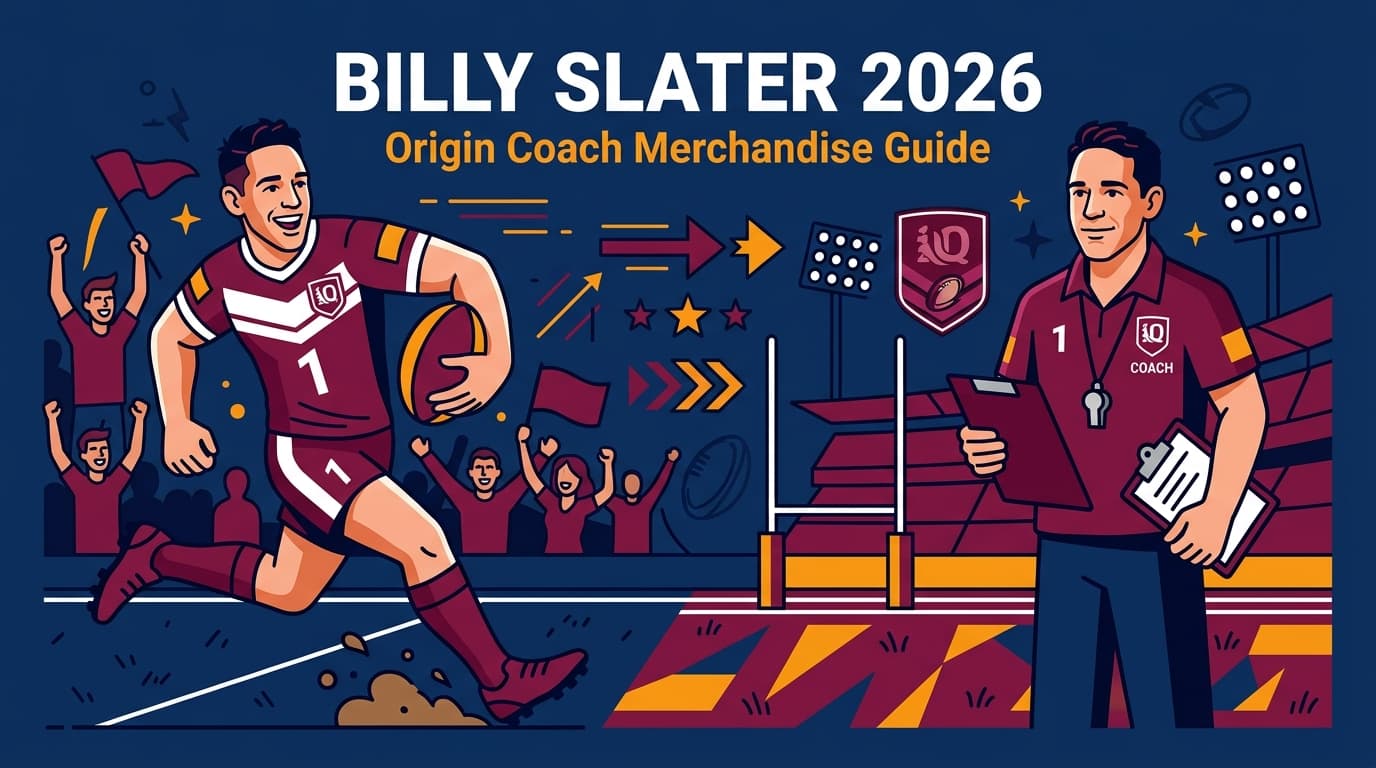
Billy Slater stands on the Suncorp Stadium sideline in a maroon polo shirt, arms folded, eyes scanning the field with the same intensity that made him the most dangerous fullback in rugby league history. The crowd does not just cheer the Queensland Maroons players running past him. They cheer Billy Slater himself — a player whose name is synonymous with State of Origin dominance, now standing as the coach tasked with extending that dominance into a new era.
The merchandise opportunity sitting in those stands is substantial and entirely uncaptured.
Walk through the Suncorp Stadium concourse on Origin night and you will see Maroons jerseys everywhere. Cameron Munster. Kalyn Ponga. Reece Walsh. But not a single piece of Billy Slater coach merchandise. No "Slater's Maroons" supporter scarf. No coach polo bearing the name of the man who has redefined Queensland's Origin identity from the sideline. No retro fullback tribute product referencing the 190 tries and 31 Origin appearances that made Slater untouchable.
The NRL official merchandise system is built for players, not coaches. The league licenses clubs and representative teams, but the coach — even a coach who happens to be one of the greatest players in the sport's history — falls outside every product line. Billy Slater playing merchandise would have sold by the truckload during his career, and it did. Billy Slater coaching merchandise sells nothing, because nobody makes it.
That gap is where Australian importers and sports retailers can build a product category that official channels are structurally incapable of serving, as we have previously documented in the State of Origin game 2 sourcing analysis. The same manufacturing economics that make player merchandise viable — established demand, zero supply, small-batch production from Chinese factories — apply with even greater force to a coach whose on-field legacy guarantees a fan base that spans generations.
Who Is Billy Slater and Why His Merchandise Demand Is Dual-Layered
Understanding why Billy Slater generates merchandise demand that no one is capturing requires understanding the specific structure of his public profile. Most athletes retire and their commercial relevance fades. Slater retired and his commercial relevance reorganised itself around a new role. He is rare among NRL figures: a playing legend who became a successful coach, maintaining two active fan bases simultaneously.
The Playing Career: An Immortal-Calibre Fullback
Billy Slater was born in Nambour, Queensland, on 18 June 1983 — a date that makes today his 43rd birthday. His journey from Sunshine Coast junior football to Melbourne Storm legend is one of the NRL's defining career arcs. Debuting for the Storm in 2003, Slater played 319 NRL games across 16 seasons, scoring 190 tries — the most by any fullback in the competition's history and the second-most by any player at the time of his retirement.
The statistical record is remarkable, but the playing style is what created the fan base that now generates merchandise demand. Slater did not just score tries. He scored tries that other fullbacks would not have attempted. His support play — the art of following the ball carrier through the defensive line in anticipation of an offload — was so instinctive that commentators coined the phrase "Billy Slater support play" as its own tactical category. Melbourne Storm halfback Cooper Cronk and hooker Cameron Smith, Slater's partners in the club's legendary "Big Three," have both described his try-scoring instincts as impossible to coach and impossible to defend.
The honours list establishes the commercial foundation:
- 2 NRL Premierships with Melbourne Storm (2012, 2017)
- Clive Churchill Medal (2009) for best player in a Grand Final
- Dally M Fullback of the Year (2008, 2011, 2017)
- Golden Boot Award (2008, 2011) for world's best international player
- 31 State of Origin appearances for Queensland (2004-2018)
- 30 Test matches for Australia
- Rugby League World Cup winner (2013, 2017)
- Inducted into the NRL Hall of Fame (2023)
Every one of those achievements represents a merchandise moment that fans remember. The 2009 Grand Final. The 2013 World Cup. The 2017 Premiership in his final season. Those memories translate into purchasing intent — but only if a product exists for fans to buy.
The Coaching Era: A New Audience Layer
Slater retired from playing at the end of 2018 and transitioned into media commentary, but his return to the Queensland Maroons as head coach in 2022 created an entirely new dimension to his public profile. The appointment was not ceremonial. Slater inherited a team that had lost the 2020 and 2021 Origin series, and he immediately delivered — winning the 2022 series in his rookie coaching season and backing it up with a second consecutive series victory in 2023.
The coaching success generated a new category of fan interest. The playing-era Slater fans — people who remember his Melbourne Storm tries — were joined by a younger demographic who know Slater primarily as the coach who restored Queensland's Origin dominance. These two audiences want different products. The playing-era fans want retro fullback merchandise: number-one jerseys, highlight-reel tribute designs, Storm-adjacent throwback products. The coaching-era fans want coach-branded Maroons gear: sideline polo shirts, coach caps, Origin campaign commemorative products.
No official product line serves either of these audiences. The NRL does not produce coach merchandise at all. The Melbourne Storm produces club-branded products, not individual player tribute items — especially for retired players whose rights are no longer managed through the club. The Queensland Rugby League produces Maroons team merchandise, not coach-specific products.
The gap is structural. The demand is measurable. The manufacturing pathway exists, as we documented for player merchandise in our Herbie Farnworth NRL merchandise sourcing guide. The only missing variable is a business willing to manufacture the product.
Why Coach Merchandise Is the Untapped NRL Product Category
The NRL merchandise landscape has spent decades focused on two product archetypes: club team wear and representative team wear. Every product that appears in an official store, a Rebel Sport rack, or a stadium vendor kiosk fits one of these two categories. Coach merchandise fits neither.
The Licensing Blind Spot
The NRL's licensing framework assigns commercial rights to clubs and representative bodies. Melbourne Storm controls Storm-branded products. The Queensland Rugby League controls QLD Maroons-branded products. Individual players are represented through their clubs and the RLPA, but coaches exist in a licensing void. The NRL does not license coach imagery or coach-branded products because no one has ever asked for a coach merchandise licence.
This creates an unusual legal situation for Australian importers. Coach-branded products that reference a coach by name, in team-adjacent colours, without reproducing official logos or protected marks, occupy the same legally safe territory as player-branded fan merchandise. A maroon polo shirt with "SLATER" embroidered on the chest and a subtle Queensland reference in the design is not infringing on the QRL's registered marks any more than a "Farnworth 4" Dolphins-adjacent training singlet infringes on the Dolphins' registered marks. The legal principle is identical: generic name, generic colours, original design — no protected intellectual property involved.
The Fan Demand Signals
Coach merchandise demand expresses differently from player merchandise demand, but the underlying signals are equally strong:
-
Social media sentiment: Billy Slater's Instagram posts during the Origin series generate comments from fans asking where to buy the maroon polo shirt he wears on the sideline. The QRL does not sell it. No retailer stocks it. The demand is posted publicly, repeatedly, and left unanswered every season.
-
Origin broadcast visibility: Slater appears on screen for approximately 60-80 minutes during an Origin broadcast — more screen time than any individual player. Every camera cut to the coach's box is a free advertisement for a product that does not exist.
-
Coaching achievement memorabilia: The 2022 and 2023 Origin series victories under Slater's coaching already have commemorative value. Queensland fans who want to mark those achievements have no product to buy beyond generic Maroons team merchandise.
-
Cross-generational appeal: Slater's dual playing-coaching identity means a 45-year-old who watched him play fullback and a 25-year-old who watches him coach the Maroons both want Billy Slater products — but for different reasons and likely different product types.
The Supply-Side Vacuum
The major NRL licensees — the manufacturers who produce official team jerseys, training wear, and supporter merchandise — have no economic incentive to develop coach product lines. Their production model requires minimum order quantities of 500-5,000 units per SKU to justify the development cost. A coach polo shirt that might sell 200 units is not commercially viable under their cost structure.
But for a Chinese sportswear factory in Fujian province accepting 50-unit minimum orders, that same product is perfectly viable. The economics that exclude coach merchandise from the official supply chain are the same economics that make it profitable through direct sourcing — a structural advantage that applies to every niche within the NRL merchandise ecosystem.
5 Sourcing Plays for Billy Slater NRL Coach and Legend Merchandise
The following five strategies outline how Australian retailers and importers can source Billy Slater-themed merchandise from China profitably, using his dual playing-coaching identity to maximise product range and market coverage.
Play 1: Design Within the Maroons Identity Without Licensing Exposure
The single most important design principle for Billy Slater merchandise is the boundary between generic team-adjacent products and trademark-infringing products. The boundary is well-established and Chinese manufacturers with experience in Australian sports products understand it.
Design the product around these safe elements:
-
Name and iconography: "Slater" in custom typography, the number one in a generic typeface (referencing his fullback position without replicating official jersey numbering), and original graphic elements that evoke his playing style — a fullback silhouette in a distinctive running pose, support-play movement lines, or try-scoring action graphics.
-
Colour strategy: Maroon, gold, and white — the Queensland Maroons' traditional colours — are not trademarked in isolation. A shirt in maroon with gold trim is a colour combination, not a trademark. What must be avoided is the specific arrangement of colours that constitutes the official QRL jersey design, and any reproduction of the QRL shield, Maroons logo, or NRL Origin branding.
-
Coach-specific design language: Products aimed at the coaching-era audience should use design elements that reference the coaching box rather than the playing field. A sideline silhouette, a coach's whistle motif, a tactical whiteboard graphic — these communicate the coaching identity without trespassing on player-image rights or club trademarks.
-
Retro playing-era design language: Products aimed at the playing-era audience can reference Melbourne Storm purple, navy, and gold in colour combinations that do not replicate official Storm designs, and can use "Slater 1" or "Billy 1" numbering that fans immediately associate with his fullback position.
Chinese manufacturers in Fujian province — particularly in the cities of Quanzhou and Shishi — have extensive experience with exactly these design constraints. They produce NRL-adjacent fan merchandise for Australian importers regularly and understand which design elements are legally safe and which cross into trademark territory. A properly briefed factory will flag risky design elements before production begins.
Play 2: Structure a Dual-Audience Product Mix That Covers Both Eras
Billy Slater's unique value proposition for merchandise sourcing is the dual audience. A Mitchell Moses product line targets Eels fans and NSW Blues supporters. A Billy Slater product line targets Queensland Maroons fans across two distinct eras — the playing era and the coaching era — plus Melbourne Storm heritage fans. The addressable market is larger, and the product mix should reflect that breadth.
The following product matrix illustrates a starter product line:
| Audience Segment | Product Type | Design Direction | Retail Price (AUD) |
|---|---|---|---|
| Playing-era Queensland fans | Retro fullback tribute t-shirt | Maroon base, "Slater 1" design, try-scoring silhouette | $39.95 |
| Coaching-era Queensland fans | Coach sideline polo | Maroon polo, "Slater" embroidery, subtle coach motif | $59.95 |
| Melbourne Storm heritage fans | Storm-adjacent throwback tee | Purple/navy/gold palette, fullback number design | $39.95 |
| General Origin memorabilia buyers | Commemorative coach cap | Maroon cap, "Slater's Maroons" text, 2022-23 series dates | $29.95 |
| Premium collectors | Limited edition coach jacket | Softshell coach-style jacket, premium embroidery | $89.95 |
This five-SKU starter line, at 50 units per SKU, represents a total production investment of approximately AUD 2,400-3,800 at Fujian factory FOB pricing. At full sell-through, gross revenue exceeds AUD 10,000. The product mix diversifies audience risk — if the coaching-era polo outperforms expectations but the Storm throwback underperforms, the line as a whole remains profitable.
Play 3: Exploit the Small-Batch Economics That Official Licensees Cannot Match
The structural advantage of direct China sourcing for Billy Slater merchandise is most visible in the per-unit economics. Official NRL licensees need to amortise licensing fees, warehousing costs, and retail distribution across large production volumes. A 500-unit order of coach polos is the minimum that makes sense under their business model. A 50-unit order, which is the realistic market size for a first-run Billy Slater coach product, is not on their radar.
Chinese sportswear factories in Fujian province have eliminated the economic barrier that historically prevented small-batch sports merchandise. Digital sublimation printing requires no screen setup, no plate creation, and effectively no minimum beyond the fabric and labour cost. A factory can switch from printing Broncos jerseys to printing Billy Slater coach polos without reconfiguring the production line. The result is that a 50-unit order costs only 20-30 per cent more per unit than a 500-unit order, rather than the 200-300 per cent premium that screen-printed orders carried a decade ago.
The current minimum order quantities and unit costs from verified Fujian manufacturers as of mid-2026:
| Product | Minimum Order | FOB Unit Cost (AUD) | Production Lead Time |
|---|---|---|---|
| Sublimated t-shirt (retro design) | 50 units | $6-9 | 15-20 days |
| Embroidered coach polo | 50 units | $9-14 | 18-25 days |
| Embroidered cap | 30 units | $4-7 | 12-18 days |
| Softshell coach jacket | 30 units | $15-22 | 20-28 days |
| Supporter scarf (sublimated) | 50 units | $3-5 | 10-15 days |
FOB prices exclude shipping, duty, and GST. Fujian province manufacturers, June 2026.
At these minimums, an Australian retailer can launch a Billy Slater merchandise line for less than AUD 5,000 in total investment. The financial exposure is limited. The upside, if the product connects with the Slater fan base, is a product category that no competitor stocks and no official channel will ever produce.
Play 4: Align Production and Marketing with the Origin Series Calendar
Billy Slater merchandise demand follows the State of Origin calendar with near-total concentration in the May-July window. This is both a constraint and an advantage. It is a constraint because the selling window is narrow — roughly eight weeks from series build-up through post-series analysis. It is an advantage because the demand during that window is intense, predictable, and fuelled by the most concentrated media coverage in Australian sport.
The production timeline should work backwards from the Origin calendar:
-
February-March: Product design finalisation, sample approval, factory engagement. This is the development phase. Design files, colour specifications, and embroidery digitisation should be completed and approved before the end of March.
-
April: Production order placed. Samples approved in March translate to a production order placed in early April. At 15-25 day production lead time, goods are completed by late April.
-
Early May: Sea freight to Australian ports. At 15-20 days transit time, goods clear customs and arrive at the retailer's location by mid-May — approximately two weeks before the Origin series opener.
-
Late May-July: Active selling window. Products are live on e-commerce platforms and in any physical retail location throughout the Origin series. Demand peaks in the 48 hours after each match.
-
August: Post-series inventory management. Remaining stock is either held for the following season, discounted as retro product, or redirected to the next Origin-related marketing cycle.
The lead time discipline is essential. A production order placed in May will not arrive until June at the earliest, missing the critical pre-series demand window. Chinese factory communication should begin no later than February for a product line targeting the May-July Origin season.
Play 5: Build a Pre-Order Validation System Before Committing to Production
The lowest-risk method for entering the Billy Slater merchandise market is the pre-order model. Instead of producing inventory on speculation, a business announces a limited-edition Billy Slater product, collects confirmed orders and payment over a defined window, then commissions production based on verified demand.
This approach eliminates inventory risk entirely. A Facebook or Instagram post with product mockups, pricing, and a payment link circulated in QLD Maroons fan groups can generate sufficient demand signals in 48-72 hours to confirm whether a production run is commercially justified. A group with 3,000-5,000 members where fans regularly discuss Origin and Billy Slater's coaching record is an ideal pre-order distribution channel.
The pre-order economics are compelling. A campaign that generates 40 confirmed orders at AUD 59.95 for a coach polo collects AUD 2,398 before any production cost is incurred. A factory order for 50 polos at AUD 12 per unit FOB costs AUD 600. Add freight and import costs of approximately AUD 250 for a small parcel shipment. Total landed cost: approximately AUD 850. The pre-order revenue covers all production costs with AUD 1,548 in surplus — and the 10 unsold units represent free inventory for future sales. The risk is zero. The pre-order customers have effectively funded the production run.
Queensland Maroons fan groups on Facebook, Billy Slater fan pages on Instagram, and Origin discussion forums on platforms like Reddit and LeagueUnlimited are the primary pre-order distribution channels. These communities already know who Billy Slater is and already want products that reference him. The business simply needs to make the product available and collect orders.
Cost Analysis: Billy Slater Coach Merchandise Production Run
For retailers and importers evaluating the financial case for a Billy Slater merchandise line, the following representative cost breakdown illustrates the economics of a first production run:
| Cost Item | Amount (AUD) |
|---|---|
| 50x coach polo shirts (maroon, embroidered "Slater") | $600 |
| 50x retro fullback t-shirts (sublimated, "Slater 1" design) | $375 |
| 50x commemorative coach caps (embroidered) | $275 |
| Artwork and embroidery digitisation (one-time) | $120 |
| Pre-production samples (3 designs, including courier) | $150 |
| Sea freight (LCL, to Port of Brisbane) | $220 |
| Customs clearance and duty (5% ChAFTA rate) | $79 |
| GST on landed value | $182 |
| Total landed cost | $2,001 |
| Cost per unit landed (average across 150 units) | $13.34 |
| Blended retail price (across three products) | $43.28 |
| Gross revenue (150 units at blended price) | $6,492 |
| Gross margin (before platform or payment fees) | $4,491 (69%) |
The 69 per cent blended gross margin compares favourably to the 35-45 per cent margin typical of Australian wholesale team merchandise. The margin differential is entirely attributable to the elimination of the Australian wholesale intermediary — a structural advantage that persists regardless of the specific player or coach brand being sourced.
For an Australian print-on-demand comparison, the same three products produced domestically would cost approximately AUD 28-45 per unit for a polo and AUD 25-35 for a t-shirt, yielding a blended landed cost of roughly AUD 28-35 per unit and a gross margin of only 19-35 per cent at the same retail prices. The China direct sourcing advantage in this product category is not marginal. It is the difference between a viable business and an unprofitable one.
Frequently Asked Questions
Is Billy Slater still coaching the QLD Maroons in 2026?
Billy Slater has been the head coach of the Queensland Maroons State of Origin team since 2022. He won the Origin series in his first two seasons as coach (2022 and 2023), restoring Queensland's dominance after series losses in 2020 and 2021. His coaching contract and ongoing role with the Maroons continue to drive fan engagement and merchandise interest, particularly during the Origin series window between May and July each year.
Is it legal to sell Billy Slater merchandise without an NRL or QRL licence?
Yes, provided the merchandise does not reproduce official club logos, the NRL shield, the QRL emblem, or any registered trademarks belonging to the league, state bodies, or clubs. Products that feature a player or coach surname, a generic playing number, and team-adjacent colour combinations without specific trademark reproduction are generally legally safe in Australia. Designs that incorporate the words "State of Origin," "Queensland Maroons" in their official typeface, or any protected league marks require licensing. Chinese manufacturers with experience in Australian sports merchandise understand these boundaries and will flag designs that carry legal risk before production begins.
What is the minimum order quantity for Billy Slater coach merchandise from China?
Chinese sportswear factories in Fujian province accept minimum orders of 50 units for sublimated t-shirts and embroidered polo shirts, and 30 units for simpler products like caps and scarves. The minimum order quantities for coach-specific merchandise are identical to those for player-specific merchandise — the manufacturing economics do not differentiate between the two categories. At these minimums, a starter product line of three to five SKUs can be produced for a total landed investment of approximately AUD 2,000-4,000.
How long does it take to source Billy Slater merchandise from China for the Origin season?
The typical timeline from factory engagement to goods landed in Australia is 40-55 days for a first-time order. This breaks down to approximately 5-7 days for design finalisation and quoting, 15-25 days for production, and 15-20 days for sea freight and customs clearance. Businesses targeting the May-July Origin selling window should begin factory engagement no later than February to allow for sample rounds, revisions, and unbuffered freight transit time. Air freight reduces shipping to 5-7 days but adds approximately AUD 4-6 per unit, which may not be viable for products retailing below AUD 50.
Can I sell Billy Slater merchandise that references both his playing and coaching career?
Yes, and the dual-era product strategy is one of the strongest commercial arguments for a Billy Slater merchandise line. Products referencing his playing career at the Melbourne Storm should use team-adjacent colours (purple, navy, gold) without reproducing official Storm logos or jersey designs. Products referencing his coaching career should use Maroons-adjacent colours (maroon, gold, white) without reproducing the QRL emblem or official Origin branding. The two product categories appeal to different segments of the Slater fan base and can be sold simultaneously without legal conflict, as neither infringes on protected intellectual property.
Which Chinese manufacturing regions are best for sports coach merchandise?
Fujian province — and specifically the cities of Quanzhou, Shishi, and Jinjiang — is the centre of Chinese sportswear manufacturing and the primary manufacturing base for NRL-adjacent products imported into Australia. Fujian factories specialise in sublimation printing, embroidery, and moisture-wicking performance fabrics — the three production capabilities most relevant to coach merchandise (embroidered polos, sublimated tribute t-shirts, and performance caps). Guangdong province offers broader manufacturing diversity but at slightly higher per-unit costs. Zhejiang province has strong general apparel capability but fewer factories with specific sportswear specialisation.
The Window Is Open
Billy Slater's public profile is currently experiencing a structural expansion that no NRL figure has previously occupied. He is an Immortal-calibre player whose playing legacy continues to attract new fans through highlight reels, documentary content, and the institutional memory of the Melbourne Storm dynasty. He is simultaneously an active, successful Origin coach whose sideline presence during the NRL's most-watched annual series generates free media exposure for a product category that does not exist.
Every Origin series that passes without Billy Slater merchandise on the market is a series where Queensland fans walk through the Suncorp Stadium gates wanting to buy something that commemorates the man who restored their state's rugby league identity — and walk out with nothing. That demand will eventually be met, either by a retailer who recognises the opportunity and moves first, or by an official channel that restructures its product development approach to include coach properties.
The five sourcing plays outlined in this guide provide a practical, legally sound, and financially validated pathway for Australian businesses of any size to manufacture Billy Slater merchandise from Chinese factories. The supply chain is proven. The production economics work at small batch quantities that were unimaginable a decade ago. The fan base is self-identified, self-organised, and reachable through distribution channels that cost nothing to access. The only missing element is someone to commission the first production run.
Winning Adventure Global connects Australian retailers and importers with verified Chinese sportswear factories that produce NRL-quality merchandise at low minimum order quantities. Our services include factory identification and verification from our pre-inspected Fujian and Guangdong manufacturer network, design compliance review to ensure products operate within safe legal boundaries, pre-production sample coordination and quality evaluation, third-party inspection arrangement, and shipping logistics management from factory floor to Australian port. The first step is a free supplier shortlist matched to your specific product brief.
Sports Merchandise Sourcing
See how a Brisbane retailer captured Billy Slater's Origin-era fanbase
One Brisbane sports store added Billy Slater QLD Maroons merchandise and sold out during Origin week. Our verified China factories produce coach and legend fan gear with no minimum order. Free supplier shortlist.
Get Your Free Supplier ShortlistFree initial consultation · We respond within 4 business hours
Verified Factories for This Industry
Manufacturers from our factory directory — each verified with on-site assessment.