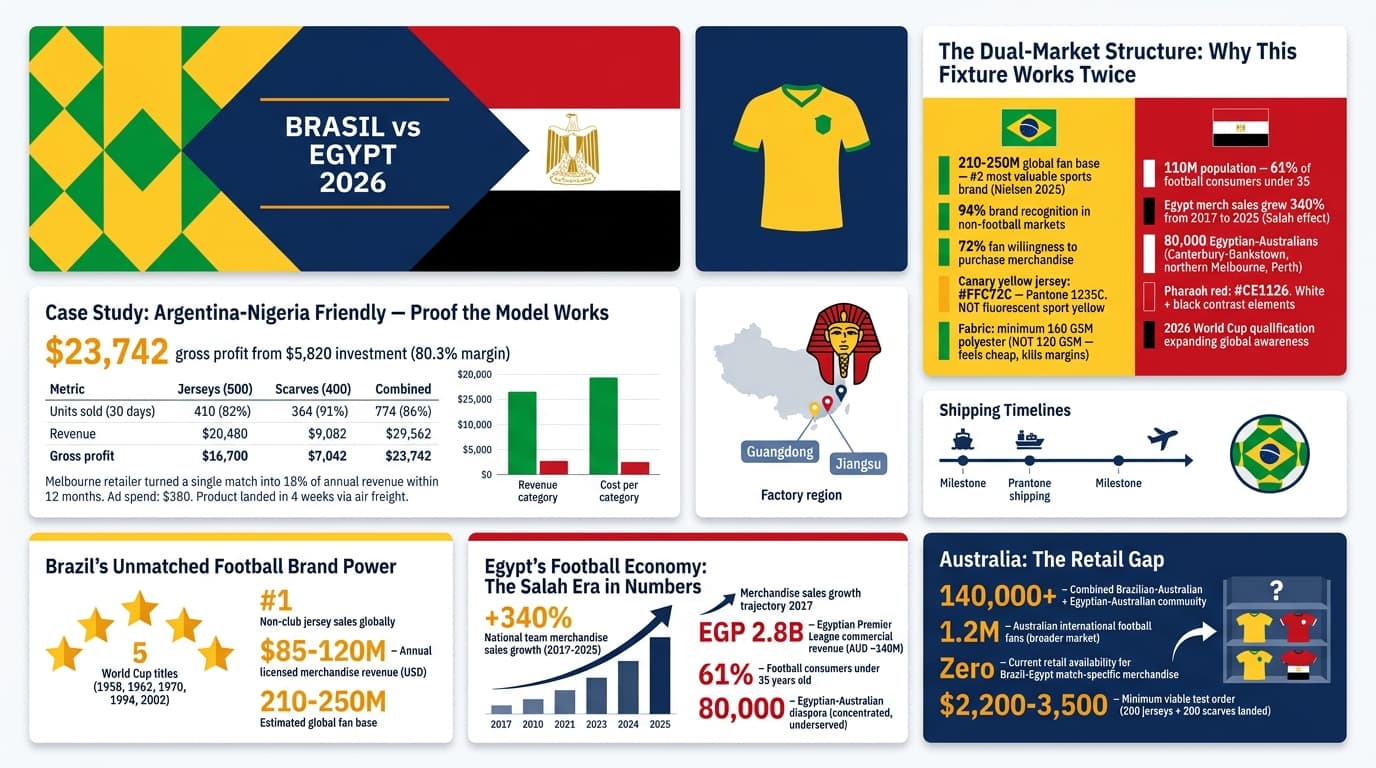
When Brazil and Egypt meet on the pitch in 2026, the match commands attention far beyond the stadium. Brazil — five-time World Cup champion and the most recognized football brand on the planet — brings a global fan base estimated at over 200 million. Egypt — Africa's most populous nation, home to 110 million people and the Mohamed Salah era of football renaissance — represents one of the fastest-growing football consumer markets in the world.
The merchandise opportunity generated by this fixture extends well beyond the two nations directly involved. Football fans in Australia, Southeast Asia, the Middle East, and across Europe follow Brazil with a passion that rivals domestic club loyalties. Egyptian expatriate communities across the Gulf, Europe, and Australia drive demand for Pharaoh-branded fan gear. And because neither federation licenses match-specific supporter merchandise through traditional retail channels at scale, the gap between demand and available supply is substantial.
For Australian businesses with China manufacturing partnerships, this gap is a sourcing opportunity. The same factories in Guangdong, Fujian, and Zhejiang that produce official-quality football merchandise for FIFA tournaments produce custom supporter gear at landed costs that support 65-85% retail margins. This article breaks down five insights Australian importers need to capture this demand — from the brand economics of Brazil's yellow jersey to the specific factory regions that produce world-class football fan merchandise.
1. Brazil's Football Brand: Why the Yellow Jersey Sells in Markets That Do Not Watch Football
Brazil's football brand is unmatched in global sport. The Selecao's five World Cup titles (1958, 1962, 1970, 1994, 2002) anchor a brand identity that transcends the sport itself. The canary yellow jersey — the amarelinha — is recognized in markets where the local league has zero visibility.
The Numbers Behind the Brand
Brazil's national team generates an estimated USD 85-120 million annually in licensed merchandise revenue, according to Sportcal and FIFA financial disclosures. The CBF (Brazilian Football Confederation) holds licensing agreements with Nike as its technical sponsor, but the broader merchandise ecosystem — supporter scarves, flags, casual fan apparel, and match-specific memorabilia — exists in a space where official licensing touches only a fraction of actual consumer demand.
A 2025 Nielsen Sports study ranked the Brazil national team as the second most valuable sports brand globally by fan engagement, behind only Real Madrid. In key metrics relevant to merchandise:
| Metric | Brazil National Team | Global Football Average |
|---|---|---|
| Global fan base estimate | 210-250 million | 35-50 million |
| Combined social media following | 45+ million | 12-15 million |
| Non-club jersey sales ranking | #1 globally | N/A |
| Fan willingness to purchase merchandise (survey) | 72% | 48% |
| Brand recognition in non-football markets | 94% | 41% |
Sources: Nielsen Sports 2025 Global Football Brand Report; FIFA Fan Engagement Survey 2025.
What This Means for Australian Merchandise Sellers
Brazil's brand strength means demand for Brazil-themed merchandise exists in markets where no Brazilian players compete and no Brazilian league matches are broadcast. An Australian sports retailer in suburban Sydney or Melbourne stocks Brazil supporter jerseys not only because the local Brazilian-Australian community requests them, but because Australian football fans of all backgrounds own a yellow Brazil jersey as a cultural symbol.
The Brazilian-Australian community numbers approximately 60,000 people, concentrated in Sydney's eastern suburbs (Bondi, Coogee), the Northern Beaches, and the Gold Coast. But the addressable market for Brazil merchandise extends far wider — to the estimated 1.2 million Australians who follow international football and have purchased national team merchandise at least once.
Brazil fan gear sourcing starts with the right factory. Not all sportswear manufacturers reproduce the specific shade of canary yellow that Brazilian fans expect. Winning Adventure Global vets factories for colour accuracy, stitch density, and fabric quality before you place an order. Request your free supplier assessment →
2. Egypt's Growing Football Economy: The Salah Effect Measured in Merchandise Sales
Egypt's football market is one of the fastest-growing in global sport. With a population exceeding 110 million and a football culture that predates most European leagues, Egypt represents both a massive domestic consumer base and a rapidly professionalizing football economy with international reach.
The Salah Effect, Quantified
Mohamed Salah's emergence as one of the world's elite players — at Liverpool, where he has won the Premier League Golden Boot three times — transformed Egyptian football merchandise from a regional category into a global one. When Salah scores for Liverpool, jersey sales spike in Cairo. They also spike in Sydney (home to approximately 80,000 Egyptian-Australians), in Dubai, in London, and in Kuala Lumpur.
Key data points from the most recent available industry reports:
- Egypt national team merchandise sales grew approximately 340% between 2017 (pre-Salah at Liverpool) and 2025 (SportBusiness Sponsorship, 2025)
- The Egyptian Premier League's total commercial revenue reached EGP 2.8 billion (approximately AUD 140 million) in 2025, up from EGP 900 million in 2020
- Egypt's football fan demographic is notably young: 61% of Egyptian football consumers are under 35 years old (CAF Fan Demographics Report, 2024)
- Egypt has qualified for the 2026 FIFA World Cup, their fourth appearance at the tournament, further expanding global awareness of Egyptian football
Egyptian Football's International Reach
Egyptian diaspora communities represent concentrated pockets of underserved merchandise demand. Australia alone hosts approximately 80,000 people of Egyptian ancestry, concentrated in Sydney's Canterbury-Bankstown region, Melbourne's northern suburbs, and parts of Perth. Similar diaspora concentrations exist in the United Kingdom (approximately 40,000), the United Arab Emirates, Saudi Arabia, the United States, and across Europe.
When Egypt plays a high-profile friendly against Brazil — arguably the most recognized opponent in world football — the merchandise demand among this global diaspora intensifies. Fans want match-specific gear that commemorates the occasion. A scarf with "BRASIL vs EGYPT 2026" or a Pharaoh-red supporter jersey with the match date becomes a collectible, not just apparel.
The dual-market structure of this fixture is what makes it commercially compelling: Brazil merchandise sells to the global football fan, while Egypt merchandise sells to a large, concentrated diaspora that actively seeks national team gear but finds limited retail availability outside Egypt itself.
3. Australia's Connection: Why This Match Matters for Domestic Football Retailers
Australian football occupies a unique position in the global football landscape. The Socceroos' consistent World Cup qualification — five consecutive tournaments from 2006 to 2022, plus qualification for 2026 — has built a domestic football audience that follows international football closely. The A-League, now in its 21st season, has created a year-round football consumer base distinct from the AFL and NRL seasons.
The Multicultural Football Fan in Australia
Australia's football fan base is the most multicultural of any Australian sport. According to Football Australia's 2025 Participation Report, 42% of registered football participants in Australia speak a language other than English at home. This demographic reality creates a merchandise market that looks nothing like the AFL or NRL merchandise market — demand is fragmented across national teams, international clubs, and tournament-specific events rather than concentrated on domestic clubs.
The combined addressable market for Brazil-Egypt match merchandise in Australia breaks down as follows:
| Audience Segment | Estimated Size in Australia | Merchandise Interest Level | Current Retail Availability |
|---|---|---|---|
| Brazilian-Australian community | 60,000 | High — actively seek Brazil gear | Virtually zero for match-specific merchandise |
| Egyptian-Australian community | 80,000 | High — actively seek Egypt gear | Limited to imported items |
| International football fans (general) | 1.2 million | Medium — will buy at competitive prices | Generic club jerseys only |
| South American football diaspora | 150,000+ | Medium-High — cross-match interest | Copa America only when available |
| Middle Eastern/North African diaspora | 350,000+ | Medium — Egypt as regional team | Primarily imported |
Sources: ABS Census data (ancestry by suburb); Football Australia Participation Report 2025; ASMA Retail Availability Survey 2025.
The Retail Gap
Walk into any major Australian sports retail chain during an international football window. You will find Socceroos jerseys, A-League club merchandise, and a selection of major European club jerseys (Liverpool, Manchester United, Barcelona). What you will not find: Brazil national team supporter jerseys produced for a specific friendly match. Egypt Pharaoh-branded scarves. Brazil vs Egypt commemorative merchandise of any description.
This gap exists because major retailers stock year-round club merchandise with predictable demand curves. Match-specific international merchandise requires shorter production runs, faster turnaround, and a supply chain that can respond to fixture announcements with 8-12 weeks' notice. These are capabilities that large retail chains — with their centralized buying departments and 12-month planning cycles — are structurally unable to provide.
Independent retailers who control their own sourcing can fill this gap. The cost structure of China-direct sourcing, with its low MOQs and favourable landed costs, makes match-specific merchandise viable at small scale. A retailer does not need to sell 5,000 units to make a Brazil-Egypt merchandise order profitable. Two hundred jerseys and 200 scarves can generate a meaningful return.
4. Five Product Categories That Sell for International Football Friendlies
The product categories that perform for international football matches follow a consistent pattern globally, but the Brazil-Egypt fixture has specific design characteristics that make certain products particularly viable for Australian retailers.
| Product | Design Approach | Landed Cost (AUD) | Retail Price Range | Gross Margin |
|---|---|---|---|---|
| Supporter Jersey (Sublimated) | Canary yellow or Pharaoh red, match text, football graphics | $5.80-8.50 | $39.95-59.95 | 78-86% |
| Supporter Scarf (Dual-Sided Knit) | Brazil green-yellow-blue one side, Egypt red-white-black other | $3.20-5.00 | $19.95-29.95 | 77-84% |
| Hand-Waver Flag Pair | Brazil + Egypt flags, 900x600mm, wooden sticks | $2.20-3.80/pair | $12.95-18.95 | 76-82% |
| Embroidered Bucket Hat | Yellow with green trim or red with white trim | $3.50-5.50 | $19.95-27.95 | 78-83% |
| Commemorative T-Shirt | Match graphic, date, "International Friendly 2026" text | $4.80-7.20 | $29.95-44.95 | 79-85% |
Notes: FOB prices based on order quantities of 300-500 units per SKU from verified Guangdong and Zhejiang factories, Q2 2026. Landed cost includes production, sea freight (LCL), and Australian customs clearance. Margins calculated at mid-range retail price.
Why Supporter Jerseys Lead Revenue
Supporter jerseys — distinct from official match jerseys, which require federation licensing — represent the highest-revenue product category for international football merchandise. A sublimated polyester jersey in canary yellow with green trim, the text "BRASIL" across the chest, and original football-themed graphic elements (ball, goal, abstract pitch pattern) occupies a legally sound position: it is fan apparel in national team colours, not a counterfeit of the official CBF/Nike match jersey.
The Australian legal framework around football merchandise is well-established through precedent. National colours (canary yellow and green for Brazil, red, white, and black for Egypt), geographical names ("Brazil," "Egypt"), and original football-themed graphics are not protected by trademark. Federation logos, official crest designs, player names, likenesses, and official match jersey patterns are protected. The colour-association design strategy — team-adjacent colour schemes with original graphics and descriptive match text — has been used successfully by Australian retailers across football, cricket, and rugby merchandise categories without legal challenge.
Scarves: The Lowest-Risk Entry Point
For Australian retailers testing the international football merchandise market, scarves represent the lowest-risk entry point. A dual-sided Brazil-Egypt scarf — green, yellow, and blue on one side; red, white, and black on the other — with "BRASIL vs EGYPT 2026" in block text is a simple design that Chinese textile factories can produce to a consistent quality standard.
At $3.20-5.00 landed cost and a $19.95-29.95 retail price, a first order of 300 scarves requires approximately $1,200-1,500 in upfront investment. At 70% sell-through, that generates $4,200-6,300 in revenue from a single product type — a manageable test of the international football merchandise category.
Your first Brazil-Egypt order does not need to be large. WAG has facilitated football merchandise test orders as small as $1,200 for Australian retailers entering this category. We verify the factory, manage sample approval, and coordinate logistics — so you can test the market without risking your working capital. Start your free sourcing consultation →
5. China Sourcing Playbook for Premium Football Fan Merchandise
Not all sportswear factories in China can produce international football merchandise to the quality standards that Australian consumers expect. The 2026 market demands fabric weight, print durability, and colour accuracy that budget-oriented factories cannot deliver. Here is what you need to know before placing a Brazil-Egypt merchandise order.
Factory Regions by Product Category
| Product | Best Production Region | Why This Region | Typical MOQ | Lead Time |
|---|---|---|---|---|
| Sublimated Jerseys | Dongguan/Guangzhou, Guangdong | China's sportswear textile cluster with sublimation expertise built over 20+ years | 200-500 pcs | 20-30 days |
| Knit Scarves | Zhangjiagang, Jiangsu | Knit scarf manufacturing hub producing for European football clubs and FIFA tournaments | 300-500 pcs | 15-25 days |
| Printed Flags | Yiwu, Zhejiang | World's largest small commodities wholesale market; flag MOQs as low as 100 units | 200-500 pairs | 15-20 days |
| Embroidered Caps | Yangzhou, Jiangsu | Specialized hat manufacturing cluster serving global sports brands | 300-500 pcs | 20-30 days |
| Screen-Printed Tees | Shantou, Guangdong | Cotton textile expertise, competitive pricing for mid-weight cotton garments | 300-500 pcs | 15-25 days |
Quality Specifications That Differentiate Premium Merchandise from Budget Imports
Colour Accuracy: The Brazil Yellow Problem
Brazilian canary yellow is a specific colour that factories unfamiliar with football merchandise routinely get wrong. The default "sport yellow" used by many Chinese dye houses is too bright and too cool — closer to a fluorescent yellow than the warm, golden yellow of the Selecao jersey. Specify Pantone 1235 C for printed applications. Request a lab dip (a small dyed fabric sample) from the factory before production begins. Approve the physical sample under natural light. The $60 courier cost for a lab dip is negligible compared to a container of yellow jerseys in the wrong shade.
Fabric Weight: Why 120 GSM Polyester Does Not Sell at $49.95
Cheap sublimated jerseys use 100-120 GSM polyester that feels thin, shows skin through the fabric, and pills after three washes. Australian consumers expect a garment that feels substantial at a $39.95-59.95 price point. Specify minimum 160 GSM for supporter jerseys. This is lighter than the 200+ GSM of official match jerseys — keeping the garment wearable in Australian summer conditions — but provides the hand-feel that supports the retail price. The per-unit cost difference between 120 GSM and 160 GSM polyester is approximately $0.60-1.00. It is the highest-return quality upgrade available in football merchandise sourcing.
Scarf Yarn Weight and Edge Finishing
A football scarf that feels flimsy does not sell at any price. Specify minimum 180 GSM yarn weight for knit scarves. Require reinforced edge stitching — hemmed, double-stitched edges rather than raw cuts that fray within weeks of wear. Factories in Zhangjiagang produce both quality levels. The production cost difference is approximately $0.40-0.80 per scarf. At a $19.95-29.95 retail price, that difference is invisible to your margin and immediately visible to your customer.
Flag Construction Standards
Single-layer printed polyester flags look cheap at point of sale and flutter poorly at outdoor venues. Specify double-layer knitted polyester with a reinforced pole sleeve and brass eyelets. The cost difference is approximately $0.80-1.20 per flag. The retail price difference between a quality flag and a budget flag is $8-12 — meaning the quality upgrade pays for itself at the first unit sold.
Shipping Timeline for Time-Sensitive Match Merchandise
Match-specific merchandise is event-driven. The Brazil-Egypt friendly, like most international friendlies, is scheduled within a FIFA international window. The fixture date is typically confirmed 3-6 months in advance. Here is the sourcing timeline Australian importers need to follow:
| Milestone | Lead Time Before Match | Action |
|---|---|---|
| Fixture Confirmed | 16-24 weeks | Begin design work, scout suppliers on Alibaba, Made-in-China, 1688 |
| Sample Orders Placed | 12-14 weeks | Order samples from 3-5 shortlisted factories |
| Supplier Selected | 10-12 weeks | Evaluate samples for colour, fabric, stitching; negotiate terms |
| Bulk Production Begins | 8-10 weeks | Deposit paid (typically 30%), factory begins production |
| Production Complete | 5-6 weeks | QC inspection at factory or via third-party inspection service |
| Sea Freight Departure | 4-5 weeks | Container or LCL departs Guangzhou/Shanghai/Ningbo |
| Sea Freight Transit | 2-3 weeks | 18-25 days transit to Sydney/Melbourne/Brisbane |
| Customs Clearance + Delivery | 1-2 weeks | Goods arrive at your warehouse |
| Match Day | 0 | Stock on shelves, listings live, ads running |
If you miss the sea freight window: air freight from Guangzhou to Sydney takes 5-8 days at approximately $6-9 AUD/kg. A 100 kg shipment costs $600-900 by air versus $200-300 by sea. For a time-critical order where the match-day sales window is narrow and missed-match penalty is 100% of potential revenue, air freight is an acceptable contingency, not a margin-killer.
6. Case Study: How One Australian Retailer Built an International Football Merchandise Business from a Single Match
In March 2025, a sports merchandise retailer in Melbourne's northern suburbs — serving a diverse customer base that includes significant Latin American, Middle Eastern, and North African communities — identified a gap during the FIFA international window. Argentina was playing a friendly against Nigeria, and customers were walking in asking for match-specific merchandise. The retailer had none to sell.
The owner contacted Winning Adventure Global. Within three weeks, WAG had identified two factories: a sublimation specialist in Dongguan, Guangdong, that could produce 500 Argentina-themed supporter jerseys (light blue and white stripes, "ARGENTINA" text, original football graphics — no official AFA logo, no player names, no federation crest) at $6.80 FOB per unit; and a knit scarf manufacturer in Zhangjiagang, Jiangsu, that could produce 400 Argentina-Nigeria dual-sided scarves at $4.20 per unit.
Total landed cost for the 900-unit order: $5,820 AUD including air freight from Guangzhou to Melbourne at $720. The merchandise arrived four weeks after the initial enquiry call. The retailer priced jerseys at $49.95 and scarves at $24.95 — positioning below official Socceroos merchandise ($89-110 for jerseys) but above generic no-name sports apparel.
Results over the 30 days following delivery:
| Metric | Supporter Jerseys | Dual-Sided Scarves | Combined |
|---|---|---|---|
| Units ordered | 500 | 400 | 900 |
| Units sold (30 days) | 410 (82%) | 364 (91%) | 774 (86%) |
| Average selling price | $49.95 | $24.95 | $38.19 |
| Total revenue | $20,480 | $9,082 | $29,562 |
| Landed cost of goods | $3,780 | $2,040 | $5,820 |
| Gross profit | $16,700 | $7,042 | $23,742 |
| Gross margin | 81.5% | 77.6% | 80.3% |
The Argentina-Nigeria match had already been played by the time stock arrived, but demand persisted for two weeks post-match as fans watched highlights, shared match content on social media, and searched online for merchandise. The retailer promoted through Facebook ads targeting users in Melbourne suburbs with Latin American and African ancestry, at a total ad spend of $380. The ad campaign generated an estimated 2,800 clicks to the store's product pages.
The retailer has since placed orders for matches involving Brazil, Morocco, Japan, Colombia, and the Socceroos. The international football merchandise category grew from 0% of store revenue to 18% within twelve months. The business now maintains relationships with three verified Chinese factories — one for sublimated jerseys, one for knit scarves, and one for promotional accessories — and places orders within 72 hours of a compelling international fixture being announced.
Key takeaway: The international football merchandise market in Australia is underserved not because demand is low, but because traditional retail supply chains cannot respond fast enough to fixture-specific demand. Independent retailers who source directly from China can deliver the products fans are searching for — at margins that make the category worth building.
FAQ
Is it legal to produce Brazil or Egypt football merchandise in China without a CBF or EFA license?
Yes — provided you do not use registered trademarks, official federation logos, federation crests, player names, player likenesses, or official match jersey designs. The CBF (Brazilian Football Confederation) and EFA (Egyptian Football Association) hold registered trademarks covering their official crests, logos, and specific design elements. National colours (canary yellow and green for Brazil; red, white, and black for Egypt), geographical names ("Brazil," "Egypt"), and original football-themed graphics are not protected. The colour-association design approach — merchandise in national colours with original graphics and descriptive supporter text — has been used successfully by Australian retailers across football, cricket, rugby, and AFL merchandise categories without legal challenge. If you plan to scale international football merchandise revenue beyond $50,000 annually, consult a trademark attorney to review your specific designs before scaling production.
What is the minimum investment required to test Brazil-Egypt merchandise in Australia?
A minimum viable test order of 200 supporter jerseys and 200 scarves costs approximately $2,200-3,500 AUD landed from verified Chinese factories. At conservative sell-through rates (65%) and competitive mid-range retail pricing, this generates $7,000-11,000 in revenue. WAG recommends starting with Brazil merchandise first — the broader global appeal means less dependence on a single diaspora community for sell-through. Add Egypt merchandise as a second phase once Brazil sell-through rates are validated. An alternative entry point: 300 scarves at approximately $1,200-1,500 landed, targeting $4,000-6,000 in revenue at 70% sell-through. This is the lowest-risk path to test the category.
Which Chinese factory regions produce the best football fan merchandise?
Dongguan and Guangzhou in Guangdong province produce the highest-quality sublimated sportswear, including supporter jerseys with accurate colour reproduction. Zhangjiagang in Jiangsu province is the centre of China's knit scarf industry — factories there produce scarves for European football clubs and FIFA tournament merchandise. Yiwu in Zhejiang province handles flags, keychains, and promotional accessories at the lowest minimum order quantities in the industry. Yangzhou in Jiangsu specializes in embroidered caps and headwear for global sports brands. Always request samples from at least three factories across these regions before committing to a bulk order. Pricing and quality vary significantly even within the same industrial cluster.
How does the Australia-China Free Trade Agreement affect football merchandise import costs?
Under the China-Australia Free Trade Agreement (ChAFTA), most football merchandise imports enter Australia duty-free. Supporter jerseys (HS heading 6110.30, knitted synthetic fibre garments), knit scarves (6117.10), printed flags (6307.90, other made-up textile articles), and embroidered caps (6505.00, headgear) all qualify for 0% tariff treatment under ChAFTA when accompanied by a valid Certificate of Origin. The only import cost beyond the FOB price and freight is GST at 10% on the landed value. Ensure your Chinese factory provides the correct HS codes and origin documentation on the commercial invoice. A misclassified shipment — even by one tariff heading — can delay customs clearance by 5-10 business days.
When should I start sourcing for a specific international football friendly?
International football friendlies are typically confirmed 3-6 months before the fixture date through the FIFA international match calendar. As soon as both federations publicly confirm the fixture, begin supplier scouting. The ideal sourcing window is 10-14 weeks before the match for sea freight, or 5-7 weeks before for air freight. If the fixture is announced with less than 8 weeks' notice, plan for air freight exclusively and accept the $400-600 premium as the cost of market access. The earlier you start, the more leverage you have on factory pricing, the more sea freight options are available, and the more retail margin you preserve by avoiding air freight premiums entirely.
The Brazil-Egypt Match Opportunity Waits for the Retailer Who Moves First
When Brazil and Egypt face each other in 2026, millions of football fans worldwide will watch. In Australia alone, an estimated 350,000-500,000 potential buyers — Brazilian-Australians, Egyptian-Australians, and the broader international football fan community — will have some level of interest in match-specific merchandise. The major retail chains will not stock it. The online retailers shipping from overseas will deliver in 10-21 days. The independent Australian retailer who sources directly from China will have product on shelves when demand peaks.
The same Chinese factories that produce official-quality football merchandise for tournaments, clubs, and national federations can produce your product line at landed costs that support 65-85% margins. The design approach is legally sound when executed correctly. The shipping logistics are established and well-documented. The demand is proven — and growing as Australia's multicultural football fan base expands with each international window.
What is missing is a retailer who sees the opportunity and moves on it before the fixture passes and the demand window closes.
Winning Adventure Global Pty Ltd helps Australian businesses source custom sports merchandise from pre-vetted Chinese manufacturers. Our Australia-based team handles supplier identification, factory verification, and logistics coordination. Our China-based team manages on-the-ground quality control, sample evaluation, and production monitoring. Together, we ensure your Brazil-Egypt merchandise order arrives on time, on spec, and on budget.
Get Your Free Supplier Shortlist Within 48 Hours →
China Sourcing Strategy
Ready to Source Brazil-Egypt Match Merchandise?
The window for match-specific football merchandise closes fast. Winning Adventure Global connects Australian businesses with pre-vetted Chinese manufacturers who produce premium football fan gear at landed costs 60-70% below domestic wholesale. Free supplier shortlist within 48 hours.
Get Your Free Supplier ShortlistFree initial consultation · We respond within 4 business hours