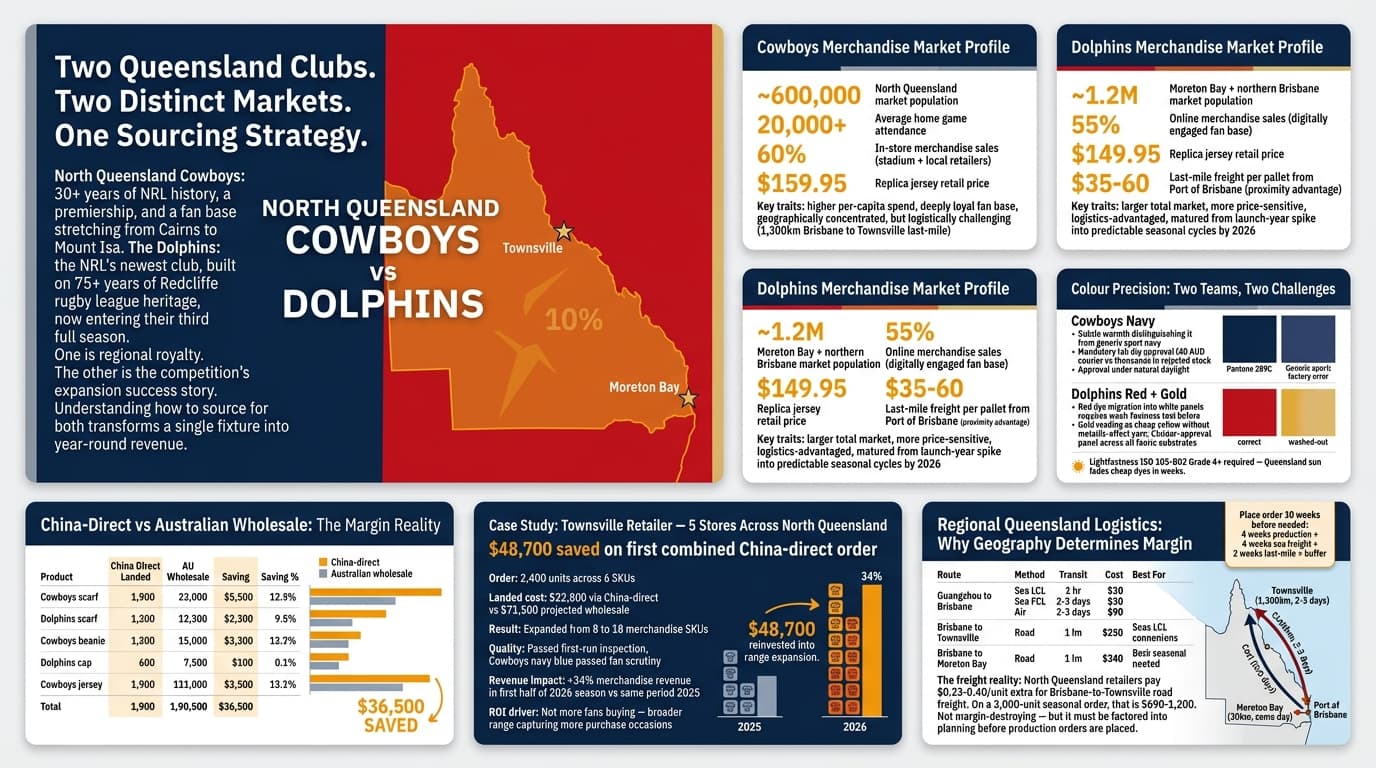
When the North Queensland Cowboys host the Dolphins at Queensland Country Bank Stadium in Townsville, the contrast between the two clubs could not be starker. On one side: the Cowboys, a regional powerhouse with over three decades of NRL history, a premiership in the cabinet, and a fan base that stretches from Cairns to Mount Isa. On the other: the Dolphins, the NRL's newest club, playing their third full season in 2026, drawing on a century of Redcliffe rugby league heritage but only beginning to write their top-flight story.
For Australian sports retailers, this fixture is more than a contest between two Queensland rugby league clubs. It is two distinct merchandise markets — the established, loyal Cowboys supporter base across North Queensland, and the rapidly growing Dolphins fan community concentrated in the Moreton Bay region and northern Brisbane — converging on a single match day. Understanding how to source and supply both markets, particularly through direct manufacturing relationships in China, transforms a single fixture into a year-round revenue opportunity.
1. The Cowboys-Dolphins Dynamic: Why This Fixture Matters for Australian Retailers
The Cowboys and Dolphins occupy opposite ends of the NRL establishment spectrum, and that dynamic creates distinct merchandise demand patterns that retailers can plan around.
The North Queensland Cowboys: Regional Rugby League Royalty
The Cowboys entered the NRL in 1995 as part of the competition's expansion beyond its Sydney heartland. Based in Townsville — a city of approximately 200,000 people, 1,300 kilometres north of Brisbane — the club built its identity around representing the entire North Queensland region. That regional identity translated into one of the NRL's most engaged supporter bases.
The club's breakthrough 2015 premiership, secured in a golden-point grand final against the Brisbane Broncos, remains one of the most celebrated moments in Queensland rugby league history. That victory, combined with consistent finals appearances and the iconic status of players like Johnathan Thurston, locked in a generation of North Queensland fans whose merchandise purchasing loyalty runs deep.
In the 2026 NRL season, the Cowboys continue to draw from this established base. Queensland Country Bank Stadium averages over 20,000 attendees for Cowboys home games, and the club's membership consistently ranks in the NRL's top half despite Townsville's smaller metropolitan population. For retailers, this means a geographically concentrated but deeply loyal customer base — North Queensland fans do not casually support the Cowboys. They belong to the club.
The Dolphins: NRL's Expansion Success Story
The Dolphins joined the NRL in 2023 as the competition's 17th team, but the club's identity runs far deeper than three seasons of top-flight football suggest. The Redcliffe Dolphins were founded in 1947 and spent decades as a powerhouse in the Queensland Cup — Brisbane's premier rugby league competition — before earning NRL admission. That history matters for merchandise because the Dolphins entered the NRL with an established supporter community, not a manufactured one.
Based at Redcliffe in the Moreton Bay region north of Brisbane, the Dolphins split their home games between Suncorp Stadium and Kayo Stadium (formerly Dolphin Stadium). The club's first season in 2023 exceeded all expectations, with the Dolphins reaching the finals — a feat no expansion club had achieved in their debut NRL campaign. That early success accelerated merchandise demand and established the Dolphins brand far faster than the club's commercial team had forecast.
By 2026, the Dolphins fan base has matured. Supporter merchandise purchasing patterns have stabilised from the initial launch-year spike into predictable seasonal cycles. For retailers, this maturation means the Dolphins market is now forecastable — a critical factor for sourcing planning.
Two Queensland Markets, Two Sourcing Strategies
The Cowboys and Dolphins serve fundamentally different geographic markets, and that difference shapes the logistics that determine landed merchandise costs.
| Factor | North Queensland Cowboys | Dolphins |
|---|---|---|
| Primary market | North Queensland (Townsville, Cairns, Mackay, Mount Isa) | Moreton Bay, northern Brisbane, Sunshine Coast |
| Market population | ~600,000 across North Queensland | ~1.2 million across Moreton Bay and northern Brisbane |
| Fan spending profile | Higher per-capita spend, lower total addressable market | Larger total market, more price-sensitive |
| Merchandise delivery challenge | Long freight distances from Brisbane or Sydney ports | Short last-mile from Port of Brisbane |
| Peak demand windows | March-August home games, regional tours | March-September home games, derby fixtures |
| Online vs in-store | 60% in-store (stadium and local retailers) | 45% in-store, 55% online |
The logistics implication is significant: Cowboys merchandise travels further and costs more to deliver to end customers, while Dolphins merchandise benefits from proximity to the Port of Brisbane. Smart sourcing strategies account for these regional cost differences before production orders are placed.
2. NRL Merchandise Economics: What Cowboys and Dolphins Fans Buy
Understanding what NRL fans purchase — and at what price points — determines whether a sourcing strategy generates margin or erodes it.
Product Categories with Highest Margin Potential
NRL supporters consistently purchase across five merchandise categories. The margin profile of each category varies significantly depending on whether products are sourced through domestic wholesale or direct from Chinese manufacturers.
Scarves and beanies deliver the highest margins in NRL fan merchandise because they combine low production complexity with high perceived value. A Cowboys navy scarf or a Dolphins red-and-gold beanie costs between $3.50 and $5.80 to produce in Guangdong — and retails for $30 to $40 in Australian sports stores. That margin gap, typically 82-87%, funds everything else in a retailer's seasonal inventory.
Jerseys command the highest dollar value per unit but thinner percentage margins. A replica Cowboys jersey produced in China at $14-$18 per unit sells for $140-$170 in Australian retail. The absolute dollar return is strong, but the inventory risk is proportionally higher — a slow-selling size or a discontinued design leaves a retailer holding expensive stock.
Real Production and Retail Data
| Product | China Production Cost (AUD) | Freight + Customs (AUD) | Landed Cost (AUD) | Australian Retail (AUD) | Gross Margin |
|---|---|---|---|---|---|
| Cowboys navy knitted scarf | $4.50 | $1.30 | $5.80 | $34.95 | 83% |
| Dolphins red-and-gold scarf | $4.80 | $1.30 | $6.10 | $34.95 | 83% |
| Cowboys beanie (navy/grey) | $3.80 | $1.10 | $4.90 | $24.95 | 80% |
| Dolphins beanie (red/white) | $4.00 | $1.10 | $5.10 | $24.95 | 80% |
| Cowboys replica jersey | $15.00 | $2.50 | $17.50 | $159.95 | 89% |
| Dolphins replica jersey | $14.50 | $2.50 | $17.00 | $149.95 | 89% |
| Supporter flag (900x600mm) | $3.20 | $0.90 | $4.10 | $22.95 | 82% |
| Team cap (embroidered) | $4.90 | $1.40 | $6.30 | $39.95 | 84% |
Prices based on order quantities of 500-800 units per SKU. Sea freight LCL via Port of Brisbane. Duty at 5% under ChAFTA. All figures Q2 2026.
A Townsville sports store ordering 600 Cowboys scarves and 400 Dolphins rivalry tees from a verified Guangdong factory at these rates would land product for approximately $6,800 AUD. The same order through an Australian wholesale distributor would cost $18,000-$22,000. That $11,200-$15,200 difference is not margin optimisation — it is the difference between a merchandise program that funds itself and one that drains cash flow.
3. Sourcing Cowboys and Dolphins Merchandise from China
The Chinese factories that produce for global sportswear brands are the same facilities capable of manufacturing NRL-quality fan merchandise. The challenge is not finding capable manufacturers. It is specifying product requirements with enough precision that the factory produces exactly what your North Queensland or Moreton Bay customers expect.
Cowboys Navy Blue: The Colour-Matching Challenge
North Queensland Cowboys navy blue appears straightforward — it is navy, after all — but Chinese textile factories routinely misjudge this specific shade. The Cowboys blue has a subtle warmth that distinguishes it from the cooler, more common sportswear navy used by dozens of clubs globally. Factories defaulting to their standard "sport navy" dye formulation will produce merchandise that looks slightly off to any Cowboys supporter who has spent years staring at the real thing.
The solution is specific: provide Pantone 289 C as the reference for Cowboys navy on all purchase orders, request a lab dip before production begins, and approve the physical fabric sample under natural daylight — not under factory fluorescent lighting or via a phone photograph. The $60 courier fee for a physical sample to Queensland is negligible compared to the cost of a container of scarves in the wrong shade of blue.
Dolphins Red and Gold: Avoiding the Washed-Out Problem
The Dolphins colour palette — red, white, and gold — presents a different challenge. Red dyes in polyester-based sportswear fabrics are susceptible to colour migration during washing, where the red bleeds into adjacent white panels. Gold tones, meanwhile, tend to read as yellow when factories use cheaper reactive dyes rather than the pigment blends that produce the metallic warmth the Dolphins brand requires.
Specify Pantone 186 C for Dolphins red and Pantone 1235 C for Dolphins gold. Require the factory to conduct a wash-fastness test on the red-to-white colour boundary before production begins. For gold elements — including the Dolphins logo gold trim — request a metallic-effect yarn sample rather than assuming a standard dye can replicate the brand's intended appearance.
Key Manufacturing Regions for NRL Products
Guangdong province (Guangzhou, Dongguan, Shenzhen) is the primary source for knitted NRL accessories and cut-and-sew jerseys. Factories here produce for European football clubs, NBA teams, and Australian sporting codes. They understand the seasonality of sports merchandise and the colour-accuracy demands of passionate fan bases.
Zhejiang province (Yiwu) excels at supporter flags, banners, and novelty items at very low minimum order quantities. For small retailers testing a new product line — say, a Cowboys-Dolphins rivalry commemorative flag — Yiwu's 50-unit MOQ allows experimentation without committing to volumes that strain cash flow.
Minimum Order Quantities for Australian SMEs
| Product | Standard MOQ | Negotiable To | Surcharge Below MOQ |
|---|---|---|---|
| Knitted scarves | 200-300 pcs | 100 pcs | 15-20% |
| Beanies | 200-500 pcs | 100 pcs | 15-20% |
| Sublimated jerseys | 50-100 pcs | 30 pcs | 20-25% |
| Supporter flags | 100-200 pcs | 50 pcs | 10-15% |
| Embroidered caps | 200-300 pcs | 100 pcs | 15-20% |
For North Queensland retailers serving a smaller but higher-value market, lower-quantity orders with the surcharge are often more profitable than large orders that tie up working capital in inventory. The surcharge adds $0.70-$1.20 per unit — easily absorbed by NRL merchandise retail pricing.
4. Regional Logistics: Getting Merchandise to Townsville and Moreton Bay
The geographic reality of Queensland creates two distinct logistics profiles that retailers must account for before placing production orders.
The Townsville Freight Challenge
Merchandise bound for North Queensland retailers typically arrives in Australia through the Port of Brisbane. From Brisbane, the journey to Townsville covers approximately 1,300 kilometres by road. This last-mile leg adds $180-$320 per pallet to the landed cost, depending on freight carrier and volume.
For a Townsville retailer ordering 800 scarves — approximately one pallet — the Brisbane-to-Townsville freight adds roughly $0.23-$0.40 per unit. This is modest on a per-unit basis, but it accumulates across SKUs. A full-season order of 3,000 units across six product types adds $690-$1,200 in regional freight that Melbourne or Sydney retailers do not pay.
The strategic response is not to absorb this cost but to factor it into margin planning from the start. A Cowboys scarf that lands in Brisbane at $5.80 per unit and delivers to Townsville at $6.15 per unit still retails at $34.95 with an 82% margin. The freight premium is real but not margin-destroying.
Moreton Bay Advantage
Dolphins merchandise benefits from geographic proximity to the Port of Brisbane. Moreton Bay retailers and the Dolphins' own merchandise operations at Kayo Stadium are within 30 kilometres of the port — a last-mile cost of $35-$60 per pallet, or approximately $0.04-$0.08 per unit.
This logistics advantage means Dolphins merchandise in Moreton Bay can carry slightly lower retail pricing while maintaining equivalent margins, or maintain standard NRL pricing while delivering higher per-unit profit. Either approach works — the key is that retailers know the numbers before setting prices, not after.
Shipping Options and Lead Times
| Method | Transit Time | Cost (AUD) | Best For |
|---|---|---|---|
| Sea freight LCL to Brisbane | 20-28 days | $150-$250/m3 | Standard orders, 2-10 m3 |
| Sea freight FCL to Brisbane | 15-20 days | $1,800-$3,200 (20ft) | Large orders over 15 m3 |
| Air freight to Brisbane | 3-7 days | $4.50-$8.00/kg | Urgent restock, test orders |
| Brisbane to Townsville road | 2-3 days | $180-$320/pallet | All North Queensland orders |
| Brisbane to Moreton Bay road | Same day | $35-$60/pallet | All Moreton Bay orders |
For the typical seasonal planning cycle: place production orders 10 weeks before merchandise is needed. Allow 4 weeks for production, 4 weeks for sea freight and customs, and 2 weeks for last-mile delivery and buffer.
5. The Licensing Landscape for NRL Fan Merchandise
NRL club logos, names, mascots, and jersey designs are registered trademarks controlled by the NRL and individual clubs. Producing merchandise bearing these protected marks without a licence or authorised wholesale arrangement is illegal.
Official Merchandise Path
The primary path to selling official NRL merchandise is wholesale purchasing from the NRL's authorised licensees and distributors. This ensures compliance but compresses retailer margins, as the wholesale price includes the licensee's margin, the NRL royalty, and the distributor's markup.
The Fan-Inspired Alternative
A growing segment of the NRL merchandise market operates outside official licensing through original designs that reference club culture without using protected trademarks. This includes colour-block scarves in team combinations, apparel featuring original artwork inspired by regional identity, and lifestyle products in team colours with non-trademarked designs.
Colours and regional references are not trademarkable. A navy-and-grey textile with a North Queensland geographic motif does not infringe Cowboys intellectual property if it avoids the club's registered logo, wordmark, and horn design. A red-and-gold product referencing Moreton Bay rather than using the Dolphins crest operates in the same legally permissible space.
For independent retailers and community organisations, the fan-inspired approach eliminates licensing fees, removes approval delays from rights holders, and allows the creation of merchandise that reflects local identity rather than mass-market templates. The commercial reality is that many successful NRL fan merchandise businesses generate the majority of their revenue from fan-inspired rather than officially licensed product lines.
6. Quality Control for NRL Team Colours
NRL supporters notice colour inaccuracies immediately. The fan who has worn the same shade of Cowboys blue since 1995 will spot a variant within seconds. The Dolphins supporter who bought a jersey in 2023 and returns for a scarf in 2026 expects the red to match. Meeting these expectations requires specification discipline before production begins.
Pre-Production Colour Protocol
- Provide Pantone codes for every colour in the design — not descriptions like "navy" or "gold"
- Request lab dips (small dyed fabric samples) for approval before bulk production
- Approve physical samples under natural daylight — not via photograph
- For multi-colour products with white panels (Dolphins red and white being particularly sensitive), require a colour-fastness test at the red-white boundary
- Specify lightfastness of ISO 105-B02 Grade 4+ for all colours — Queensland stadium sun fades cheap dyes within weeks
Pre-Shipment Inspection Essentials
Before accepting delivery of any NRL merchandise order from China, verify:
- Colour accuracy against approved Pantone references under natural daylight
- Stitch density and evenness across the production run (minimum 10% sample check)
- Logo or design placement consistency — centred, level, correctly positioned
- Size conformity against approved specification chart
- Fibre content labelling compliant with Australian Consumer Law
- Care instruction labels present and legible
- Packaging free of moisture damage, loose threads, and soiling
A third-party inspection in China costs $250-$400 AUD per inspection day. For first orders with a new supplier, this cost is negligible compared to the financial and reputational damage of receiving substandard product after six weeks of sea freight.
7. Production Cost Comparison: Direct China Sourcing vs Australian Wholesale
The gap between Chinese factory-direct sourcing and Australian wholesale purchasing is not marginal — it is structural.
| Product | China Direct Landed (AUD) | Australian Wholesale (AUD) | Saving | Saving % |
|---|---|---|---|---|
| Cowboys scarf (500 units) | $5.80/unit | $18.00/unit | $12.20/unit | 68% |
| Dolphins scarf (500 units) | $6.10/unit | $18.50/unit | $12.40/unit | 67% |
| Cowboys beanie (400 units) | $4.90/unit | $16.00/unit | $11.10/unit | 69% |
| Dolphins cap (300 units) | $6.30/unit | $19.00/unit | $12.70/unit | 67% |
| Cowboys replica jersey (200 units) | $17.50/unit | $55.00/unit | $37.50/unit | 68% |
On a combined order of 1,900 units across these five product lines, direct China sourcing delivers landed cost of approximately $17,200 AUD versus $53,700 AUD through Australian wholesale — a saving of $36,500 on a single seasonal order. For a regional Queensland sports retailer operating on standard retail margins, that difference determines whether the merchandise program is the business's profit centre or a break-even volume driver.
Case study: A Townsville sports retailer supplying Cowboys merchandise to five stores across North Queensland transitioned from Australian wholesale to direct China sourcing for the 2026 NRL season. Their first combined order — 2,400 units across six SKUs — landed at $22,800 AUD versus a projected $71,500 through their previous wholesale supplier. The $48,700 saving allowed them to expand from 8 to 18 merchandise SKUs while reducing per-unit inventory risk. All products cleared quality inspection on the first production run, and colour matching for Cowboys navy blue passed fan scrutiny. The retailer reports that the expanded range has driven a 34% increase in merchandise revenue through the first half of the 2026 season compared to the same period in 2025 — not because fans are buying more, but because the broader range captures more purchase occasions.
FAQ
Can I sell NRL Cowboys and Dolphins merchandise without an official licence?
You cannot sell products bearing official NRL club logos, names, or protected jersey designs without a licence or authorised wholesale arrangement. However, you can legally sell original merchandise in team colours — navy and grey for the Cowboys, red, white, and gold for the Dolphins — using non-trademarked designs. Fan-inspired merchandise referencing regional identity rather than protected marks operates in a legally permissible category that many successful Australian sports retailers have built businesses around.
Where in China should I source NRL-quality scarves and jerseys?
Guangdong province — specifically the Guangzhou-Dongguan-Shenzhen manufacturing corridor — is the primary source for knitted sports accessories and cut-and-sew jerseys. Factories in this region produce for global sportswear brands and Australian sporting codes, and they understand the colour-matching precision, seasonal production cycles, and quality standards that NRL merchandise demands. Zhejiang province (Yiwu) is the preferred source for supporter flags, banners, and lower-MOQ novelty items.
What is the minimum budget to start sourcing NRL merchandise from China?
A realistic starting budget is $2,000-$3,500 AUD for a test order of 300-500 pieces across two product types. This covers production, air freight or LCL sea freight to Brisbane, customs clearance, and last-mile delivery to your Queensland location. For North Queensland retailers, add approximately $200-$300 for the Brisbane-to-Townsville road freight leg. WAG has facilitated test orders starting at $1,800 for retailers entering the NRL merchandise category for the first time.
How long before a Cowboys vs Dolphins match should I place my China production order?
For sea freight, place your order 10-12 weeks before the match date — 4-5 weeks for production, 4 weeks for shipping and customs, and 2 weeks for last-mile delivery and buffer. For air freight, order 5-6 weeks before the match. The NRL fixture for the 2026 season was released in November 2025, giving retailers a full 4-5 month planning window for the entire home-and-away season. The most profitable retailers place seasonal orders covering multiple fixtures rather than rushing individual match-specific orders.
How do I ensure Cowboys navy blue and Dolphins red match across different product types?
Colour inconsistency across product categories — where a scarf, beanie, and cap in the "same" team colour look visibly different — is the most common quality complaint in NRL fan merchandise. The solution is to specify the same Pantone code across all products (Pantone 289 C for Cowboys navy, Pantone 186 C for Dolphins red) and require the factory to produce a unified colour-approval panel showing each colour on every fabric substrate before production begins. Different materials take dye differently — a colour that looks correct on acrylic knit may shift on cotton twill — and seeing them side by side is the only reliable way to catch the discrepancy.
What customs documentation do I need for importing NRL merchandise from China?
You need a commercial invoice from your Chinese supplier, a packing list detailing item quantities and carton dimensions, a bill of lading (sea freight) or air waybill (air freight), and an import declaration lodged through the Integrated Cargo System. Textile products typically fall under HS Code Chapter 61 (knitted apparel and accessories) or Chapter 65 (headwear). A licensed customs broker can handle classification and declaration lodgement — fees run $150-$250 AUD per entry, which is modest compared to the cost of an audit triggered by a self-lodged classification error.
Your Cowboys vs Dolphins Merchandise Supply Chain Starts Here
The North Queensland Cowboys and the Dolphins represent two distinct Queensland rugby league markets — one regional, established, and deeply loyal; the other coastal, growing, and digitally engaged. For Australian retailers, the opportunity is not choosing between these markets but serving both with merchandise sourced at margins that make regional Queensland retailing viable.
Direct sourcing from verified Chinese manufacturers turns NRL fan merchandise from a thin-margin volume play into a genuine profit centre. The same factories that produce for global sportswear brands can manufacture Cowboys navy scarves and Dolphins red-and-gold beanies at 65-70% below Australian wholesale — and the logistics to deliver those products to Townsville or Moreton Bay are well-established, predictable, and cost-effective when planned in advance.
Winning Adventure Global works exclusively with Australian businesses to connect them with pre-vetted Chinese factories that understand NRL-specific production requirements. We verify colour-matching capability, assess factory quality control systems, and coordinate logistics from factory floor to your Queensland retail location. Whether you stock shelves in Townsville, sell online from the Sunshine Coast, or operate a multi-store retail presence across regional Queensland, our team can provide a verified supplier shortlist matched to your specific product requirements.
Get Your Free Supplier Shortlist Within 48 Hours →
China Sourcing Strategy
Sourcing Cowboys or Dolphins merchandise? Get a free supplier shortlist within 48 hours.
Whether you stock shelves in Townsville or sell online from Moreton Bay, NRL merchandise margins make or break your season. Winning Adventure Global pre-vets Chinese factories that understand NRL production specs, colour accuracy, and regional Queensland logistics. Send us your product brief and receive a verified supplier shortlist — free, no commitment.
Get Your Free Supplier ShortlistFree initial consultation · We respond within 4 business hours