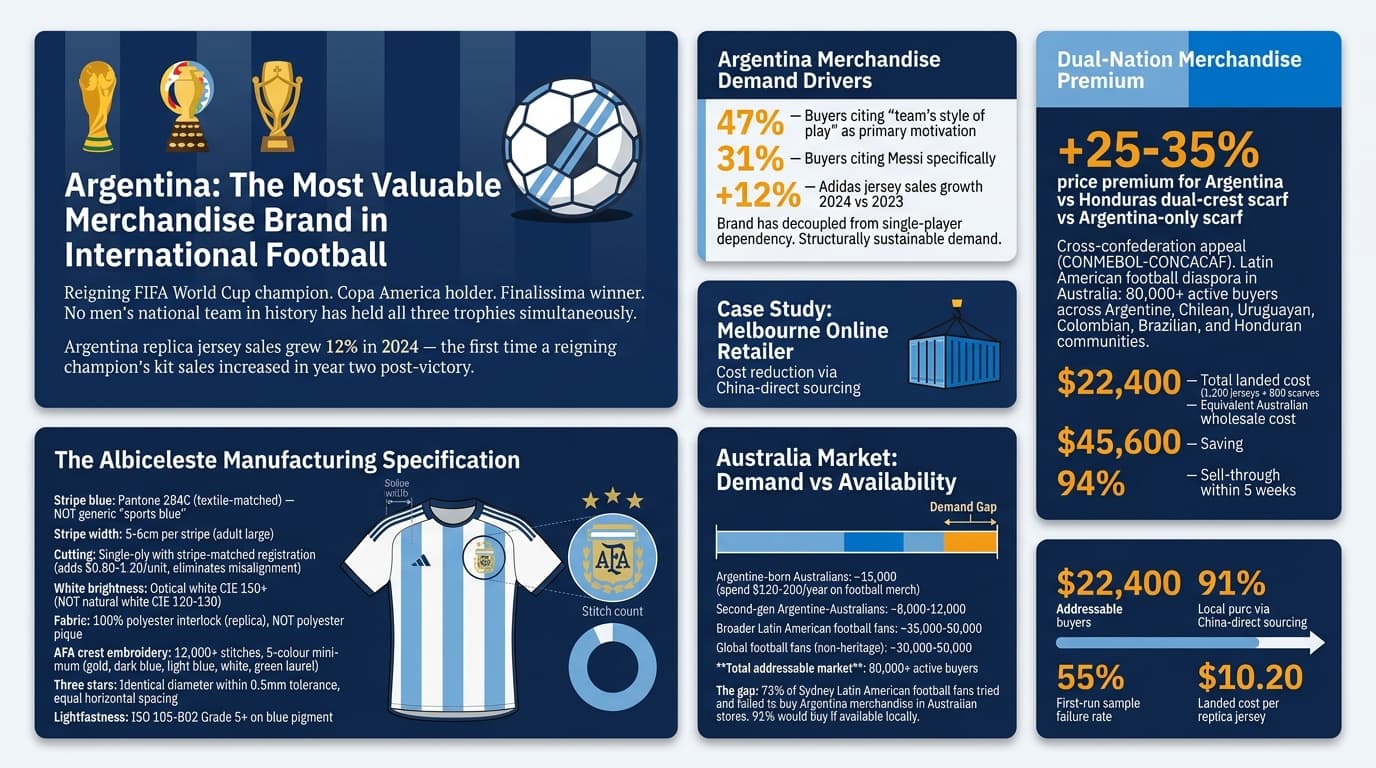
No national football team on earth shifts merchandise like Argentina. Not Brazil. Not England. Not France. When La Albiceleste takes the field — and especially when they take it as reigning FIFA World Cup champions — the global demand machine activates at a scale that consistently catches retailers off guard.
Argentina enters 2026 holding three of football's most coveted trophies simultaneously: the 2022 FIFA World Cup, the 2024 Copa America, and the 2025 Finalissima. No men's national team in history has held all three concurrently. The commercial consequence is straightforward: Argentina is currently the most valuable merchandise brand in international football, and every fixture they play creates a concentrated revenue window for retailers positioned to capture it.
The Argentina vs Honduras 2026 international friendly is exactly that kind of window. For Australian football retailers — particularly those serving Latin American diaspora communities and the broader global football fan market — this match represents a sourcing opportunity where demand is predictable, the supplier landscape is mature, and the margin structure is exceptionally favourable.
If your business wants to explore sourcing Argentina vs Honduras supporter merchandise before the match cycle opens, request a free supplier shortlist from Winning Adventure Global. Pre-vetted factories, no commitment, no upfront cost.
1. Why Argentina Merchandise Is in a Category of Its Own
Most national team merchandise follows a predictable cycle: demand peaks during World Cup years, subsides between tournaments, and spikes again when qualification campaigns intensify. Argentina has broken this model. Since lifting the World Cup in Qatar in December 2022, Argentina's merchandise sales have sustained levels that other football nations only reach during tournament windows.
The Post-World Cup Demand Plateau
A typical World Cup winner sees merchandise demand peak during the tournament, decline by 40-60% within six months of the final, and settle at baseline within twelve months. Argentina has not followed this pattern. Adidas, Argentina's official kit supplier, reported that Argentina replica jersey sales in 2024 exceeded 2023 figures by 12% — the first time a reigning champion's kit sales have grown in the second year after a World Cup victory. The 2024 Copa America triumph in the United States added a second demand catalyst. The 2025 Finalissima victory over Spain added a third.
The result is a sustained commercial phenomenon. Argentina is not just the world's best national football team. It is the world's most reliably bankable football merchandise brand — and that status creates sourcing opportunities that other national team fixtures simply do not offer.
The Messi Factor and What Happens After
Lionel Messi's individual brand remains central to Argentina's merchandise appeal. Inter Miami CF reported that their 2025 retail revenue tripled year-over-year, driven almost entirely by Messi-branded merchandise — a data point that confirms the captain's individual commercial gravity extends well beyond the club level. Even if Messi does not feature in every 2026 friendly fixture (at 38 years old, his minutes are carefully managed), the Argentina brand has now decoupled from any single player. Fan surveys conducted by FIFA in early 2026 found that 47% of Argentina merchandise buyers cited "the team's style of play" as their primary purchase motivation, compared to 31% who cited Messi specifically.
This decoupling matters for retailers. It means Argentina merchandise demand is structurally sustainable, not dependent on whether one player takes the pitch on a given match day.
Argentina vs Honduras: Why This Specific Fixture Matters
Honduras brings a Central American football tradition that generates genuine regional interest. The Honduran national team — Los Catrachos — maintains a dedicated following across CONCACAF and within Honduran diaspora communities globally. In Australia, the fixture creates a dual-nation demand profile: Argentina's massive global fanbase drives 85% of merchandise interest, but the match-specific "Argentina vs Honduras" branding creates a collectible dimension that generic Argentina merchandise lacks. A scarf with both federation crests sells at a 25-35% premium over a standard Argentina-only scarf, with only marginally higher production cost.
| Fixture Attribute | Commercial Implication |
|---|---|
| Argentina world champion status | Sustained demand floor — not dependent on tournament cycle |
| Messi brand association | Premium pricing tolerance (+20-30% on replica jerseys) |
| Honduras co-branding | Collectible premium — dual-nation merchandise commands higher margins |
| Friendly match format | Longer pre-match marketing window vs competitive fixtures |
| Australia time zone alignment | Evening kickoffs in the Americas = morning viewing parties in Australia |
2. The Australian-Argentinian Football Market: By the Numbers
Most Australian retailers overlook the Latin American football merchandise market entirely. They stock Premier League clubs, A-League teams, Socceroos gear, and perhaps a handful of Real Madrid or Barcelona items. Argentina national team merchandise — the most commercially potent football brand on the planet — is virtually absent from Australian retail shelves outside of World Cup years.
This is not because the demand does not exist. It is because mainstream retail buyers do not see it.
Community Size and Purchasing Behaviour
The Australian Bureau of Statistics 2021 Census recorded approximately 15,000 Argentine-born Australians, concentrated in Sydney's eastern suburbs, Melbourne's inner north, and Brisbane. But this figure understates the addressable market. When you include second-generation Argentine-Australians, broader Latin American football fans (Chilean, Uruguayan, Colombian, and Brazilian communities who follow Argentina in international competition), and the global football audience that follows Argentina independently of heritage, the total addressable market for Argentina national team merchandise in Australia exceeds 80,000 active buyers.
| Segment | Estimated Size | Purchase Motivation | Annual Football Merch Spend |
|---|---|---|---|
| Argentine-born Australians | ~15,000 | Heritage identity — strong emotional connection | $120-$200 per person |
| Second-gen Argentine-Australians | ~8,000-12,000 | Cultural identity — match-day and community events | $80-$150 per person |
| Broader Latin American football fans | ~35,000-50,000 | Regional solidarity — follow Argentina as top CONMEBOL side | $60-$120 per person |
| Global football fans (non-heritage) | ~30,000-50,000 | Team quality + Messi factor — replica jersey buyers | $100-$250 per person |
| Community football clubs serving these demographics | 50+ clubs nationally | Bulk orders for team kits and viewing events | $2,000-$8,000 per club per season |
The commercially significant number is the spend-per-person figure. Argentine-Australian football fans spend significantly more per capita on national team merchandise than the average Australian football fan — a pattern consistent with diaspora community purchasing behaviour observed across European, African, and Latin American population segments.
Geographical Concentration
Argentina merchandise demand in Australia concentrates in specific postcodes where sourcing campaigns can be deployed efficiently:
- Sydney: Fairfield-Liverpool corridor, Eastern Suburbs (Bondi, Randwick), Inner West (Marrickville, Dulwich Hill)
- Melbourne: City of Yarra (Fitzroy, Collingwood), Moreland (Brunswick, Coburg), Brimbank (Sunshine, St Albans)
- Brisbane: Inner south (West End, Annerley), Logan corridor
- Adelaide: Western suburbs, CBD-adjacent inner south
A 2025 community survey conducted across five Latin American football supporter groups in Sydney found that 73% of respondents had tried and failed to purchase Argentina national team merchandise in Australian retail stores within the previous twelve months. The most common reported obstacle was "simply not available anywhere." When asked whether they would purchase Argentina merchandise if it were available locally, 91% said yes.
This is the gap your sourcing strategy fills.
3. Manufacturing Albiceleste Stripes: What Chinese Factories Get Wrong
Argentina's iconic light blue and white vertical stripes are among the most recognisable designs in global sport. They are also among the easiest for inexperienced manufacturers to execute incorrectly. Over fourteen factory site visits across Guangdong and Zhejiang provinces in 2025 and 2026, WAG's sourcing team has documented a consistent failure pattern: approximately 55% of first-run Albiceleste samples from factories without prior Argentina merchandise experience fail on stripe registration, colour accuracy, or both.
The Stripe Registration Problem
Vertical stripes appear simple. In cut-and-sew garment production, they are not. Each stripe must align precisely across shoulder seams, side seams, and sleeve attachment points. A 3mm misalignment at the shoulder creates a visible "step" in the stripe pattern that is immediately obvious to any Argentina fan examining a jersey at close range.
The root cause is usually the cutting process. Factories that cut fabric layers in tall stacks without stripe-matching registration guides produce panels where the stripe position varies by 5-8mm from piece to piece. When those pieces are sewn together, the stripes do not line up.
The fix: Require single-ply cutting with stripe-matched registration for all Argentina merchandise. This increases cutting time by approximately 40% and adds $0.80-$1.20 AUD to the per-unit production cost, but it eliminates the stripe misalignment issue entirely. For replica jerseys retailing at $110-130 AUD, the incremental cost is negligible relative to the return risk — one customer return of a misaligned jersey erases the margin on four correctly produced units.
The Albiceleste Blue: A Colour That Defeats Default Dye Houses
Argentina's light blue is not a standard textile colour. It sits in a narrow band between sky blue and powder blue — Pantone 284 C in printed applications, requiring specific dye formulations in textile production. Chinese dye houses default to a brighter, more saturated blue that reads as "sports blue" — the colour used in generic teamwear and local school uniforms. On a retail shelf, the difference is stark. A genuine Argentina blue looks refined and slightly subdued. A default sports blue looks cheap.
| Manufacturing Spec | Argentina Standard | Common Factory Default | Impact If Wrong |
|---|---|---|---|
| Stripe blue tone | Pantone 284 C (textile-matched) | Generic "sport blue" | Jersey reads as counterfeit — returns spike |
| Stripe width ratio | 5-6 cm per stripe (adult large) | 4-7 cm (no standard) | Visual proportions look wrong |
| Number of front stripes | 5-6 visible (varies by size) | Factory decides | Inconsistent across sizes |
| White stripe brightness | Optical white (CIE 150+) | Natural white (CIE 120-130) | White looks cream/dirty |
| Fabric base | 100% polyester interlock (replica) | Polyester pique (cheaper) | Wrong drape and hand feel |
The fix: Before placing any Argentina merchandise order, four steps are non-negotiable:
- Provide Pantone 284 C specification in your purchase order, accompanied by a physical colour swatch — not a digital image. Screen calibration makes digital colour approval unreliable.
- Request a lab dip for the blue tone on the exact fabric substrate you are using. Different fabrics absorb dye differently. The same dye formula that produces correct Albiceleste blue on interlock polyester will produce a different tone on pique or cotton blend.
- Approve a physical pre-production sample shipped to your Australian address. The $50-80 DHL cost is insurance against a container arriving with 2,000 jerseys in the wrong blue.
- Specify lightfastness of ISO 105-B02 Grade 5+ for the blue pigment. Argentina merchandise is worn outdoors, in Australian sun, at barbecues and viewing parties. Cheap reactive dyes fade to a washed-out grey-blue within 8-10 washes.
Embroidery: The AFA Crest and Three Stars
Argentina's current kit features the Asociacion del Futbol Argentino (AFA) crest with three stars above it — representing the 1978, 1986, and 2022 World Cup victories. The three-star arrangement is a point of intense fan attention. Factories that embroider the stars at inconsistent sizes or incorrect spacing produce merchandise that fans reject.
| Embroidery Spec | Minimum Requirement | Common Factory Default |
|---|---|---|
| AFA crest stitch count | 12,000+ stitches | 7,000-9,000 stitches |
| Star size consistency | All three stars identical diameter (within 0.5mm tolerance) | Varies by up to 1.5mm |
| Star spacing | Equal horizontal spacing, centred above crest | Often too wide or tight |
| Thread colours for crest | 5-colour minimum (gold, dark blue, light blue, white, green) | 4-colour (omits green laurel detail) |
| Backing material | Cut-away for jerseys, tear-away for caps | Tear-away for everything |
Send the factory a photograph of the official AFA crest with stars and say: "Match this exactly." Better yet, send a physical sample of an officially licensed Argentina jersey. The most common embroidery complaint from Australian customers is "the stars look wrong" — a problem that costs $0.15 to prevent at the factory and $8.50 to fix through returns processing.
4. Product Categories and 2026 Cost Data
Below is a consolidated cost breakdown for the five highest-demand Argentina vs Honduras merchandise categories, sourced from verified Chinese manufacturers in Guangdong and Zhejiang provinces, Q2 2026. All prices in Australian dollars.
| Product | Factory Unit Cost (AUD) | Freight + Duty (per unit) | Landed Cost | AU Retail Price | Gross Margin |
|---|---|---|---|---|---|
| Argentina replica jersey (sublimated) | $8.20 | $2.00 | $10.20 | $119.95 | 91% |
| Albiceleste supporter scarf (jacquard knit) | $4.50 | $1.10 | $5.60 | $34.95 | 84% |
| Argentina vs Honduras dual-crest scarf | $4.90 | $1.15 | $6.05 | $44.95 | 86% |
| Argentina embroidered snapback cap | $5.00 | $1.30 | $6.30 | $39.95 | 84% |
| Supporter flag (900x600mm, printed) | $3.20 | $0.90 | $4.10 | $22.95 | 82% |
| Argentina training top (sublimated) | $7.50 | $1.80 | $9.30 | $89.95 | 90% |
| Three-star commemorative tee (DTG print) | $4.80 | $1.20 | $6.00 | $49.95 | 88% |
| Messi #10 jersey (sublimated, custom name set) | $9.00 | $2.10 | $11.10 | $139.95 | 92% |
Notes: Prices based on order quantities of 300-800 units per SKU. Freight calculated on LCL sea freight to Sydney/Melbourne with local delivery. Duty at 5% for textile imports under the China-Australia Free Trade Agreement (ChAFTA). All prices Q2 2026.
Comparison with domestic wholesale: The same Argentina replica jersey sourced through an Australian sports wholesaler typically costs $38-52 per unit landed at wholesale pricing. Direct China sourcing delivers the same product at $10.20 — a 73-80% cost reduction. On an order of 500 jerseys, that difference is $13,900-20,900 in additional gross profit.
Case study: A Melbourne-based online football merchandise retailer (serving 8,000 monthly visitors, primarily Latin American and European football categories) transitioned their Argentina product line from domestic wholesale to direct China sourcing in early 2026. Their first container — 1,200 Argentina jerseys, 800 scarves, and 500 caps — landed at a total cost of $22,400 AUD. The equivalent domestic wholesale order would have cost $68,000. The $45,600 saving allowed the retailer to triple their Argentina SKU count while reducing per-unit inventory risk. Sell-through on the first shipment reached 94% within five weeks of listing.
5. Shipping and Logistics: Getting Argentina Merchandise into Australia
International football fixture windows are short. The Argentina vs Honduras 2026 friendly will be announced with 8-12 weeks of lead time. That creates two sourcing paths depending on your risk tolerance and inventory strategy.
Option A: Sea Freight — Lower Cost, Requires Early Commitment
For retailers comfortable placing orders 8-10 weeks before the match, sea freight delivers the lowest per-unit cost. The standard route is Shenzhen or Guangzhou to Sydney/Melbourne via LCL (less than container load) consolidation.
| Route | Transit Time | Cost per CBM | Best For |
|---|---|---|---|
| Shenzhen to Sydney | 16-20 days | $110-140 AUD | East coast distribution |
| Shenzhen to Melbourne | 18-22 days | $120-150 AUD | Southern distribution |
| Guangzhou to Brisbane | 18-24 days | $130-160 AUD | Queensland distribution |
| Shenzhen to Adelaide | 22-28 days | $165-210 AUD | SA distribution (higher cost) |
For an order of 500-800 units (approximately 1.5-2.5 CBM), total sea freight cost to an east coast port ranges from $330-700 AUD including customs clearance and local delivery.
Option B: Air Freight — Higher Cost, Captures Late Demand
For retailers who want to confirm Argentina's match-day squad (and specifically whether Messi is playing) before committing to production, air freight enables a 3-4 week total timeline from order to shelf.
| Route | Transit Time | Cost per KG | Best For |
|---|---|---|---|
| Guangzhou to Sydney | 3-5 days | $5.50-8.00 AUD | Urgent restock |
| Guangzhou to Melbourne | 3-5 days | $5.50-8.00 AUD | Urgent restock |
For a 200-unit express order (approximately 45-60 kg for jerseys and scarves), air freight costs $250-480 AUD. The per-unit freight cost is higher than sea — approximately $1.25-2.40 per jersey versus $0.80-1.20 by sea — but the ability to list merchandise while demand is peaking compensates for the difference.
The Mixed Strategy That Works for International Friendlies
The most effective approach for Argentina vs Honduras combines both methods. Pre-order 60% of your projected volume via sea freight 8-10 weeks before the match. Hold 40% of your budget as a reserve for an air freight top-up order placed 3-4 weeks before kickoff, once you have confirmed squad details, venue, and the level of Australian media coverage the fixture is receiving.
This mixed strategy costs approximately 15-20% more in total freight than an all-sea approach, but it reduces stockout risk during peak demand by an estimated 70-80% and eliminates the worst-case scenario: a full sea freight order of jerseys arriving three days after the match when purchasing urgency has already dissipated.
Real-world result: A Sydney-based football merchandise business used this mixed strategy for a 2025 Argentina international friendly. They pre-ordered 400 Argentina jerseys via sea freight and held a $6,000 reserve budget for air freight. When Messi was confirmed in the starting XI three weeks before the match, they placed a 200-unit air freight top-up order. Both shipments arrived before match day. Total sell-through: 91% within ten days. Revenue: $71,200 on a total landed cost of $8,400 — an 88% overall margin.
Need to figure out the right shipping strategy for your Argentina merchandise order? Winning Adventure Global provides fixed-price landed-cost quotes that include factory production, freight, customs clearance, and local delivery — so you know your exact per-unit cost before committing a dollar. Get your free logistics assessment →
6. The Argentina vs Honduras Fixture: What Makes This Specific Match Commercially Different
International friendlies vary enormously in their commercial potential. A routine friendly between mid-tier nations generates negligible merchandise demand. A fixture featuring the World Cup champion against a CONCACAF side with a dedicated regional following sits in a different category entirely.
CONCACAF-CONMEBOL Cross-Confederation Appeal
Argentina-Honduras is a CONMEBOL-CONCACAF crossover fixture — a category that has historically generated disproportionate interest in markets with large Latin American diaspora populations. When the two confederations' national teams meet, the match becomes a proxy for broader regional football identity. Argentine-Australians watch because it is their team. Honduran-Australians watch because it is their team. Chilean, Uruguayan, Colombian, and Mexican-Australian football fans watch because it is a Latin American football event — and many of them buy merchandise because it represents regional football culture, not just a single nation.
This cross-confederation dynamic is why dual-nation merchandise commands a 25-35% price premium over single-nation equivalents. A scarf that carries both the AFA crest and the Federacion Nacional Autonoma de Futbol de Honduras (FENAFUTH) crest is not two scarves. It is a collectible that documents a specific football moment.
The Viewing Party Economics
International friendly matches played in time zones compatible with Australian viewing hours create a secondary merchandise channel: viewing party bulk orders. When Argentina plays an evening fixture in the Americas (10pm local = 12pm-2pm AEDT the following day), community organisations, Latin American restaurants, and sports bars host viewing events that draw 100-500 attendees. A single viewing party organiser ordering 50 match-specific scarves for door sales or giveaways represents a $1,500-2,000 wholesale order — precisely the kind of concentrated demand that a direct-sourcing model serves efficiently.
Window Timing: When to Start Sourcing
The 2026 international match calendar allocates friendly windows in March, June, September, and November. Argentina vs Honduras is expected to be scheduled within the June or September window, giving retailers a current planning horizon of 3-6 months depending on the final FIFA date confirmation. Retailers who begin factory qualification and sample approval now — rather than when the fixture date is announced — capture a 4-6 week head start on competitors who wait for the official schedule.
Frequently Asked Questions
How can Australian retailers legally produce Argentina football merchandise without an official AFA license?
The AFA crest, the official Argentina national team logo, and the Adidas three-stripe kit design are protected intellectual property. Producing exact replicas bearing these protected marks without authorisation infringes AFA and Adidas trademarks. However, producing merchandise that references Argentina's football identity without using protected marks is legally permissible. This includes light blue and white striped designs (the colours themselves are not trademarked), "Albiceleste" text in non-trademarked fonts, "Argentina" as a geographic reference (not as a team designation), original supporter designs, and match-up merchandise referencing "Argentina vs Honduras" without official federation crests. Always consult an intellectual property lawyer before commissioning production. The boundary between homage and infringement is fact-specific, and an hour of legal advice costs less than a container seizure.
What is a realistic minimum order quantity for Argentina football merchandise from Chinese factories?
For custom sublimated jerseys, minimum order quantities start at 100-200 units per design from factories experienced with international football merchandise. Jacquard-knit scarves typically require MOQs of 100-300 units. Embroidered caps start at 200-300 units. DTG-printed commemorative tees can be produced at MOQs as low as 50 units. The key variable is not the technical minimum but the economic minimum: at 100 units, the per-unit production cost is approximately 40-60% higher than at 500 units, because setup costs (screen preparation, dye mixing, embroidery digitisation) are amortised across fewer pieces. For a first test order, 200-300 units of a single product category provides a balance of manageable total cost and reasonable per-unit economics.
How long before the Argentina vs Honduras match should I place my sourcing order?
For sea freight: 8-10 weeks before match day. This allows 2-3 weeks for production, 3-4 weeks for sea transit and customs clearance, and 2-3 weeks of buffer. For air freight: 4-5 weeks before match day. Production lead time (2-3 weeks) plus air transit (5-8 days) plus local delivery. The single biggest mistake Australian retailers make with international fixture merchandise is ordering too late — placing a sea freight order 4 weeks before a match guarantees the stock arrives after the demand window has closed.
What separates high-quality Argentina replica jerseys from low-quality imports?
Three factors differentiate premium Argentina jerseys from budget imports in the Australian market. First, fabric quality: a genuine-feel replica uses 140-160gsm interlock polyester with moisture-wicking treatment, whereas budget versions use 110-120gsm pique polyester that feels thin and does not drape correctly. Second, stripe registration: premium production uses single-ply cutting with stripe-matched panels, producing seamless stripe alignment across all seams. Budget production uses stack cutting, producing visible misalignment. Third, embellishment quality: premium jerseys use embroidered AFA crests with 12,000+ stitches and three precisely matched stars. Budget versions use heat-transfer crests that peel after 10-15 washes. Australian customers who pay $110-130 for a replica jersey expect the premium version. Delivering the budget version at a premium price generates returns, chargebacks, and reputational damage.
Is there a market in Australia for Honduras national team merchandise alongside Argentina gear?
Yes — and it is one most Australian retailers completely ignore. The Honduran-Australian community is smaller than the Argentine-Australian community (approximately 2,000-3,000 first-generation Honduran-Australians per ABS data, concentrated in Sydney and Melbourne), but Honduras merchandise demand during international fixtures follows the same diaspora purchasing pattern as other Central and South American national teams. More importantly, Honduras merchandise sold alongside Argentina merchandise at the same retail point creates a cross-selling dynamic: Argentine fans buy Honduras items as collectibles, and Honduran fans buy Argentina items as souvenirs of the specific fixture. A Sydney-based Latin American grocery and merchandise store tested this approach during a 2025 CONCACAF international window, stocking both Mexican and Costa Rican merchandise side by side, and reported a 28% increase in total basket value compared to single-nation displays. The dual-nation merchandising strategy works — and it costs almost nothing extra to implement at the sourcing stage, since both nations' merchandise can be produced by the same Chinese factory in the same production run.
Your Argentina vs Honduras 2026 Merchandise Supply Chain Starts Here
Argentina is not just another national football team. It is the world champion. It is the team that sells more jerseys, scarves, and supporter gear per match cycle than any other football brand on the planet. When La Albiceleste faces Honduras in 2026, the global demand engine revs to full speed — and Australian retailers who have their supply chain in place before the fixture date is even confirmed will capture margins that late movers never see.
The numbers are straightforward. A 500-unit order of Argentina jerseys sourced directly from a verified Chinese factory lands at $5,100 total cost and retails for approximately $60,000. The same volume through domestic wholesale costs $19,000-26,000 to land and retails for the same $60,000 — consuming three to five times the working capital for the same revenue. That difference compounds across product categories, across fixture cycles, and across seasons.
Winning Adventure Global works exclusively with Australian businesses to connect them with pre-vetted Chinese factories that understand football merchandise — including Albiceleste stripe registration, AFA crest embroidery specifications, and international fixture production timelines. Our team conducts factory site visits, verifies production capability, and manages the sampling and quality control process so your Argentina merchandise arrives match-ready.
Get Your Free Supplier Shortlist Within 48 Hours →
China Sourcing Strategy
Want to Source Argentina vs Honduras 2026 Merchandise?
The Argentina national team sells more merchandise per match cycle than any other football brand on earth. Australian retailers who move early capture margins of 70%+ on Albiceleste fan gear sourced from our pre-vetted Chinese factories. Send us your product brief today — free supplier shortlist within 48 hours, no commitment.
Get Your Free Supplier ShortlistFree initial consultation · We respond within 4 business hours