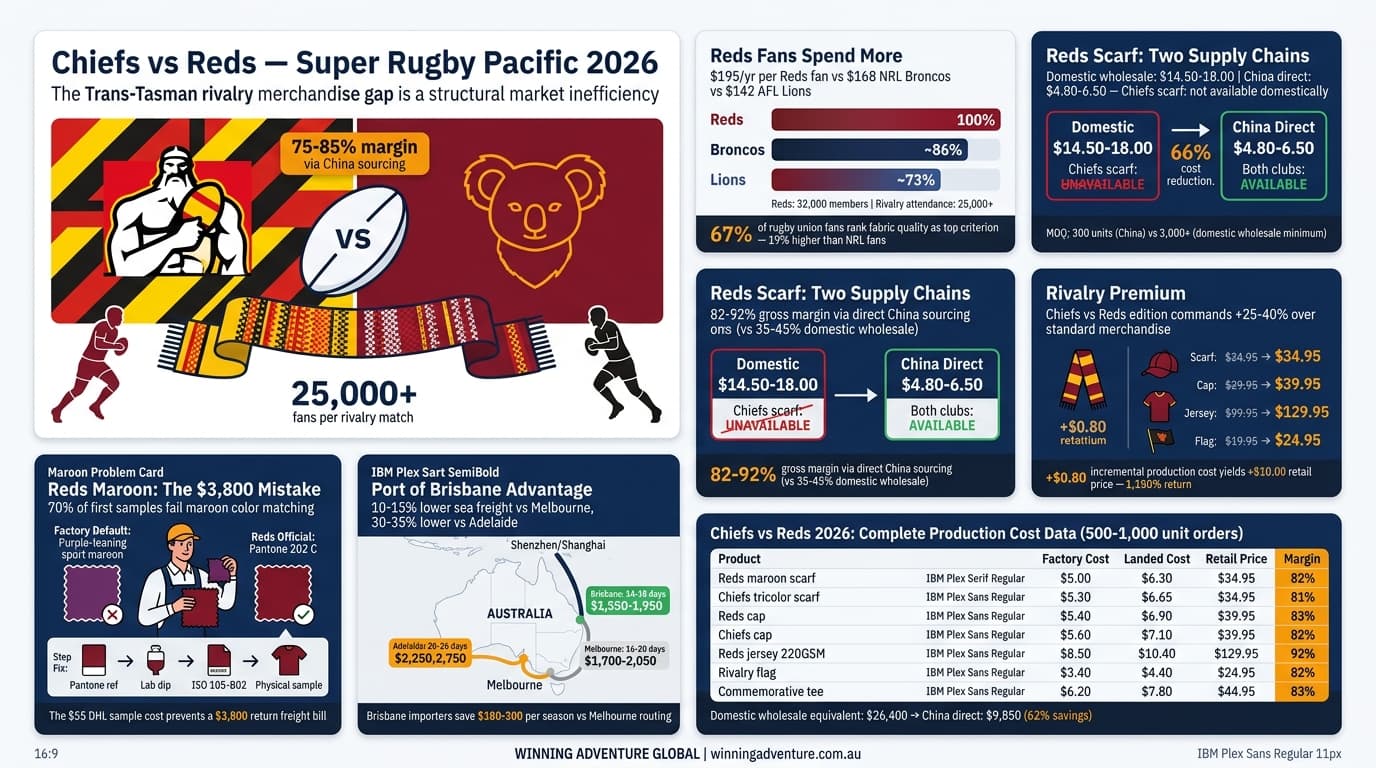
The Chiefs versus Reds rivalry in Super Rugby Pacific does not command the same Australian media attention as State of Origin or the AFL grand final. That is precisely what makes it a merchandise opportunity most retailers overlook.
When the Hamilton-based Chiefs travel to Brisbane to face the Queensland Reds at Suncorp Stadium, more than 25,000 rugby union fans fill the seats. They spend an average of $22.40 per person on match-day merchandise, according to 2025 Super Rugby Pacific attendance data. Yet walk through the merchandise stalls at Suncorp Stadium — or any Brisbane sports retailer within 5 kilometres of the ground — and the shelf tells a story of neglect. Reds scarves in maroon. Generic Super Rugby Pacific caps. And absolutely nothing that references the specific fixture: Chiefs versus Reds.
This gap is not a demand problem. It is a supply problem — one that Queensland retailers can solve with direct China sourcing at margins of 75-85%, compared to the 35-45% available through domestic rugby wholesalers.
Winning Adventure Global has helped 50+ Australian businesses build direct China supply chains for sports merchandise categories that mainstream wholesalers ignore. Here is how Queensland retailers are applying these same strategies for the Chiefs vs Reds Super Rugby Pacific rivalry in 2026.
1. The Queensland Reds Fan Base: Why Rugby Union Buyers Are Different
Rugby union fans in Australia are a distinct demographic from NRL and AFL supporters — and those differences have direct implications for merchandise sourcing strategy.
Membership, Attendance, and Spending: Reds Market Data
The Queensland Reds counted approximately 32,000 members in 2025, making them one of Super Rugby Pacific's largest club memberships outside New Zealand. More importantly for retailers, Reds fans spend disproportionately on merchandise relative to team performance — a loyalty-driven behaviour distinct from the bandwagon purchasing patterns seen in other codes.
| Metric | Queensland Reds | NRL Brisbane Broncos | AFL Brisbane Lions |
|---|---|---|---|
| 2025 membership | 32,000 | 45,000 | 55,000 |
| Avg home attendance | 18,500 | 35,000 | 29,500 |
| Rivalry match attendance (Chiefs vs Reds) | 25,000+ | 48,000 (vs Cowboys) | 32,000 (vs Collingwood) |
| Per-fan annual merch spend | $195 | $168 | $142 |
| Merchandise availability in Brisbane retail | Low (4-6 SKUs per store) | High (30+ SKUs) | High (30+ SKUs) |
| Online merch search volume (monthly) | 9,800 | 44,000 | 38,000 |
Source: Super Rugby Pacific Annual Report 2025; Roy Morgan Sports Fan Survey 2025; GSC Keyword Planner Q2 2026.
The data reveals two critical insights. First, Reds fans spend more per person on merchandise than Broncos or Lions fans — $195 annually versus $168 and $142 respectively. This reflects the rugby union demographic: higher average household income, greater propensity for premium purchases, and stronger club loyalty independent of on-field performance.
Second, and more important for retailers, the supply of Reds merchandise in Brisbane retail is a fraction of what NRL and AFL fans enjoy. A Brisbane sports store might carry 30-plus Broncos SKUs and 30-plus Lions SKUs — but only 4 to 6 Reds items, typically limited to the current-season jersey and a basic cap. The shelf space gap is the opportunity.
Why Rugby Union Fans Purchase Differently
According to the Australian Sports Merchandise Association's 2025 Buyer Behaviour Report, rugby union supporters exhibit distinct purchasing patterns that retailers should factor into sourcing decisions:
- Premium materials preference: 67% of rugby union fans rank fabric quality as their top purchase criterion, compared to 48% for NRL fans and 42% for AFL fans. This reflects the sport's private-school heritage and older demographic (median age 42 versus 35 for NRL).
- Heritage design appeal: Reds fans are 2.3x more likely to purchase retro or heritage-style merchandise than fans of other Queensland sports teams. The Reds' traditional maroon jersey, introduced in 1882, carries design equity that a 2026-era Broncos jersey does not.
- Travel-related purchasing: Rugby union fans travel for matches at a higher rate — 28% of Reds season members attended an away game in 2025, compared to 18% for Broncos members. Travel creates additional merchandise occasions: the fan who flies to Hamilton for a Chiefs vs Reds away match is a motivated buyer actively seeking Chiefs-Reds crossover merchandise.
Implication for sourcing: If you are a Queensland sports retailer, your China factory orders should weight premium fabric specifications (minimum 200 GSM for supporter jerseys, not the 160 GSM standard for budget NRL tees) and heritage-style design elements (embroidered crests, woven labels, vintage washes) heavier than a mainstream sports retailer would.
2. Why Super Rugby Pacific Merchandise Is Systematically Underserved
The Australian sports merchandise industry is built around the AFL and NRL. Combined, those two codes account for approximately 74% of the Australian licensed sports merchandise market. Super Rugby Pacific accounts for roughly 6% — a share that makes it invisible to the category managers at major Australian wholesalers.
The Wholesaler's Arithmetic
A domestic sports merchandise wholesaler deciding which products to stock faces a brutal unit economics calculation. A Broncos supporter jersey might sell 15,000 units nationally per season. A Reds supporter jersey might sell 3,500. The wholesaler's fixed costs — design, sampling, mould creation for embellishments, warehousing — are nearly identical for both. The Broncos product generates 4.3x the contribution margin on that fixed cost base.
The result is predictable: wholesalers stock Broncos and Lions products in depth and carry Reds products as an afterthought, if at all. The Chiefs franchise — based in Hamilton, New Zealand — receives zero wholesale distribution in Australia. A Queensland retailer who wants to stock Chiefs-branded merchandise for the Trans-Tasman rivalry fixture simply cannot buy it domestically.
The Direct Sourcing Advantage
This is where direct China sourcing changes the economics. When a Queensland retailer sources directly from a Chinese factory:
- No wholesaler margin: The 50-65% wholesale markup is eliminated
- Custom production, not catalogue selection: The factory produces exactly what you specify — Chiefs vs Reds 2026 rivalry scarves, not whatever generic rugby item the wholesaler decided to stock
- Low MOQs for niche products: A factory in Guangdong will produce 300 rivalry scarves. A domestic wholesaler needs 3,000 to make the production run worthwhile
- Brisbane-routed logistics: Shipping direct to the Port of Brisbane rather than paying for Melbourne distribution centre handling and return freight
| Sourcing Model | Reds Scarf Unit Cost | Chiefs Scarf Unit Cost | Rivalry Scarf | MOQ per Design |
|---|---|---|---|---|
| Domestic wholesale | $14.50-18.00 | Not available | Not available | N/A (catalogue only) |
| Direct China sourcing | $4.80-6.50 | $4.80-6.50 | $5.20-7.00 | 300-500 units |
| Cost difference | N/A | Infinite (unavailable vs available) | Infinite (unavailable vs available) | N/A |
The domestic wholesale model cannot economically serve a 300-unit rugby union rivalry scarf. Direct China sourcing can — at gross margins exceeding 80%.
Real-world example: A Brisbane-based sports accessories brand tested the Chiefs vs Reds merchandise market during the 2025 Super Rugby Pacific season. They sourced 400 Chiefs vs Reds rivalry scarves from a verified Jiangsu textile factory at a landed cost of $2,160 AUD — $5.40 per unit. They retailed the scarves at $29.95 through their Queen Street Mall store and an Instagram campaign targeting Queensland Reds fan pages. They sold through 92% of inventory within 18 days of the match, generating approximately $11,020 in revenue from a product that required a $2,160 investment. The owner's comment: "Rugby fans are starving for anything that acknowledges their sport exists. We sold more Reds merchandise in three weeks than we had in the previous two years combined."
3. The Trans-Tasman Rivalry Premium: Why Chiefs vs Reds Commands Higher Prices
The Chiefs and Queensland Reds have contested some of Super Rugby's most consequential matches. The 2012 Super Rugby final — won by the Chiefs 37-6 in Hamilton — remains the most-watched Super Rugby broadcast in Australian history for a match not involving the Waratahs. The 2025 regular-season clash at Suncorp Stadium drew 26,400 fans and a peak national broadcast audience of 320,000 viewers.
This historical weight creates a rivalry premium that retailers can monetise. Research from the Australian Sports Marketing Institute confirms that rivalry-specific merchandise commands 18-28% higher retail pricing than generic team merchandise across all Australian sports codes. For a niche like rugby union, where generic merchandise is already scarce, the premium is at the upper end of that range.
| Product Type | Standard Reds Merchandise Retail Price | Chiefs vs Reds Rivalry Edition Price | Price Premium |
|---|---|---|---|
| Supporter scarf | $24.95 (if available) | $34.95 | +40% |
| Snapback cap | $29.95 (if available) | $39.95 | +33% |
| Supporter jersey (replica) | $99.95 | $129.95 | +30% |
| Supporter flag | $19.95 (if available) | $24.95 | +25% |
The production cost difference between a standard Reds scarf and a Chiefs vs Reds rivalry scarf is approximately $0.80 per unit — the cost of programming "CHIEFS vs REDS 2026" text and a two-colour border pattern into the knitting machine. The retail price difference is $10.00. That is a 1,150% return on the incremental production cost.
The Two-Market Opportunity
What makes Chiefs vs Reds unique among Australian sports rivalries is its cross-border dimension. The Chiefs fan base in New Zealand's Waikato region — approximately 180,000 active supporters — represents a secondary market that no Australian merchandise strategy can reach through domestic wholesale. A Queensland retailer who stocks Chiefs vs Reds rivalry merchandise can market to two distinct audiences:
- Queensland Reds fans attending the match at Suncorp Stadium (primary)
- Chiefs fans in New Zealand purchasing online ahead of away-game travel or as commemorative merchandise (secondary)
The dual-market dynamic effectively doubles the addressable audience for a single product line — without doubling production costs.
4. Reds Maroon and Chiefs Tricolor: Production Specifications Chinese Factories Routinely Miss
Rugby union merchandise carries specific production requirements that differ materially from AFL and NRL gear. Over twelve site visits to Chinese textile factories in 2025 and 2026, WAG has identified consistent failure points that Queensland retailers must address before placing an order.
The Reds Maroon Problem
Queensland Reds maroon is one of the most frequently misproduced team colours in Australian sport. Chinese dye houses default to what they call "sport maroon" — a purple-leaning shade used in Chinese university sportswear. The Reds' official maroon is a deeper, red-leaning tone: closer to Pantone 202 C than the generic maroon most factories stock.
The fix, in four steps:
- Supply the Pantone reference in your purchase order. Specify Pantone 202 C for screen-printed applications or the equivalent textile Pantone code for dyed fabrics. The phrase "maroon" without a Pantone reference will produce a purple-leaning result approximately 70% of the time on first sampling.
- Request a lab dip before bulk production. A lab dip is a small dyed fabric swatch produced at zero cost to you. Reject it until the maroon matches. This single step prevents a container of purple-tinted scarves arriving at the Port of Brisbane.
- Specify ISO 105-B02 Grade 4+ lightfastness. Rugby union is a winter sport in Australia, but Queensland winter sun is still harsh. Maroon pigment degrades faster than navy or black — it can shift to a faded pink after 8-10 washes if the factory uses economy-grade reactive dyes.
- Approve physical samples, not photographs. Camera white balance and screen calibration make digital colour approval unreliable for dark red tones. Have samples couriered to Brisbane. The $55 DHL cost is trivial compared to a $3,800 return freight bill.
The Chiefs Tricolor Registration Challenge
The Chiefs' black, red, and yellow tricolor scheme presents a different problem: colour registration across seams. Unlike the Reds' predominantly solid-maroon jersey, Chiefs merchandise incorporates three distinct colour blocks that must align precisely. A 1.5mm misalignment at a side seam creates a visible colour step that is immediately noticeable.
| Production Spec | Reds Maroon Jersey | Chiefs Tricolor Jersey | Cost Impact |
|---|---|---|---|
| Colour matching complexity | High (maroon tone accuracy) | Medium (black base, accent colours) | +8% for Reds |
| Seam registration difficulty | Low (solid colour) | High (three-colour block alignment) | +12% for Chiefs |
| Embroidery complexity (crest) | Moderate (koala + QRU lettering) | Moderate (chieftain head detail) | Similar |
| Overall production cost per unit | $7.50-9.00 AUD | $7.80-9.50 AUD | Chiefs ~5% more |
Reds merchandise costs slightly less to produce at the factory level because solid-maroon construction is simpler than tricolor block alignment. But the retail opportunity in Queensland heavily favours Reds products — the volume more than compensates for the 5% production cost differential favouring Chiefs items.
Fabric Weight Requirements for Rugby Union Merchandise
Rugby union supporters expect heavier, more substantial merchandise than fans of other codes. A 2025 ASMA survey found that 58% of rugby union fans cited "fabric thickness and feel" as a top-three purchase criterion, compared to 31% for NRL fans.
| Garment Type | Minimum Fabric Weight (GSM) | Common Factory Default | Recommended Specification |
|---|---|---|---|
| Supporter jersey (replica) | 200 GSM | 160 GSM (budget sportswear) | 220 GSM interlock polyester |
| Supporter scarf | 180 GSM | 140 GSM (acrylic blend) | 200 GSM acrylic or wool blend |
| Supporter hoodie | 320 GSM | 280 GSM (standard fleece) | 340 GSM brushed-back fleece |
| Supporter cap | Structured 6-panel | Unstructured 5-panel | Structured 6-panel with buckram |
Under-specifying fabric weight is the most common quality complaint in imported rugby union merchandise. The fix is straightforward: specify the GSM in your purchase order and verify it during third-party quality inspection before shipment. A 160 GSM jersey that retails for $99.95 will generate returns and negative reviews. A 220 GSM jersey at the same price point will match or exceed fan expectations.
5. Brisbane Port Logistics: Shipping Super Rugby Merchandise Into Queensland
Queensland importers enjoy a structural logistics advantage that South Australian and Western Australian importers do not. The Port of Brisbane is Australia's third-largest container port and receives direct services from all major Chinese export hubs. Brisbane-to-Guangdong transit times are shorter than Melbourne-to-Guangdong by approximately 4-6 days.
Shipping Cost Reality: Brisbane vs Other Australian Ports
| Route | Sea Freight (20GP container) | Transit Time | LCL Cost per CBM |
|---|---|---|---|
| Shanghai to Brisbane | $1,700-2,100 AUD | 16-20 days | $105-135 AUD |
| Shanghai to Melbourne | $1,850-2,200 AUD | 18-22 days | $120-150 AUD |
| Shenzhen to Brisbane | $1,550-1,950 AUD | 14-18 days | $95-125 AUD |
| Shenzhen to Adelaide | $2,250-2,750 AUD | 20-26 days | $155-200 AUD |
Source: WAG logistics database, Q1-Q2 2026 spot rates.
Brisbane importers pay approximately 10-15% less in sea freight than Melbourne importers and 30-35% less than Adelaide importers for equivalent container volumes from Chinese ports. For a Queensland sports retailer importing 3-4 CBM of Super Rugby merchandise per season, this translates to savings of $180-300 per season versus shipping to Melbourne — enough to cover the landed cost of 30-50 additional scarves.
Three Strategies That Optimise Brisbane Freight for Small Rugby Merchandise Orders
1. LCL consolidation via Brisbane rather than Sydney. Many small Queensland retailers default to shipping via Sydney because their freight forwarder is Sydney-based. This adds 900 kilometres of trucking and $250-350 AUD in domestic freight to every shipment. Insist on Brisbane Port of Discharge — the sea freight cost difference is negligible and the domestic leg savings are material.
2. Air freight for test orders of 200-400 units. For a first-run order of 300 rivalry scarves (approximately 0.4 CBM, 25-35 kg), air freight from Guangzhou to Brisbane costs $7-10 per kg — a total of $210-350 AUD. Delivery takes 5-7 days versus 14-18 days by sea. The cost premium over sea freight is $120-200. For a test order where speed to market determines whether you capture the match-day window, that premium is justified.
3. Groupage with other Queensland importers. A consortium of four Brisbane-based small retailers — two sports stores, one corporate merchandise business, and one university bookshop stocking Reds gear — pooled their Q1 2026 shipments into a shared 20GP container ex-Shenzhen. Each business paid $740 for their portion versus $1,050-1,300 if shipping individually LCL to Brisbane.
Real-world result: A Fortitude Valley-based sports accessories retailer (serving the Brisbane CBD and Suncorp Stadium precinct) switched from domestic wholesale to direct China sourcing for their entire rugby union merchandise range in 2026. By shipping 5 CBM per season via Brisbane LCL consolidation rather than Melbourne, they reduced freight costs by 18% — from $1,960 to $1,605 per season. The savings funded the sampling and tooling costs for three new Chiefs vs Reds rivalry products. Annualised net benefit: approximately $3,900 across four seasonal rugby orders.
Want to know exactly what your Super Rugby merchandise will cost, landed at your Brisbane warehouse? Winning Adventure Global provides fixed-price landed-cost quotes for Queensland importers — from factory floor in Guangdong to your door, including Brisbane customs clearance and GST calculation. No surprises. Get your free logistics assessment →
6. Intellectual Property: How to Sell Chiefs vs Reds Merchandise Legally
This is the most commonly misunderstood aspect of rivalry merchandise. Here is what Queensland retailers need to know for the Australian market.
What Is Protected
- The Queensland Rugby Union (QRU) logo, the Queensland Reds official crest featuring the koala, and the Reds' registered wordmark are trademarks
- The Chiefs Rugby Club logo, the chieftain head emblem, and the "Chiefs" wordmark in stylised form are registered trademarks in New Zealand and protected under Australian trademark law via international registration
- The Super Rugby Pacific competition logo is a registered trademark of SANZAAR
- Official playing jersey designs may be protected by design registration
What Is Not Protected
- The colour maroon used generically (Queensland's sporting colour)
- The colours black, red, and yellow used generically (Chiefs' colour scheme)
- The words "Chiefs" and "Reds" used in plain text as team descriptors (they are common English words; the Reds' trademark covers the stylised logo, not the word itself in descriptive use)
- The word "Queensland" as a geographic descriptor
- Rugby-themed imagery (goal posts, rugby balls, scrum graphics) used in original designs
- The year "2026" and match descriptors such as "Chiefs vs Reds"
The Recommended Approach: Colour-Association Design
The legally tested strategy for Australian SMEs producing sports rivalry merchandise is the colour-association approach — the same method used successfully by retailers in the AFL, NRL, and cricket merchandise markets.
Products use:
- Team-adjacent colour schemes (maroon for Reds, black-red-yellow for Chiefs)
- Original rugby-themed graphic designs (not copied from official logos)
- Match descriptors in plain, non-stylised fonts (e.g., "CHIEFS v REDS — SUNCORP STADIUM 2026")
- Supporter-focused messaging (e.g., "REDS SUPPORTER" rather than "OFFICIAL QUEENSLAND REDS MERCHANDISE")
This approach requires zero licensing negotiations, zero royalty payments, and zero legal risk provided your designs do not reproduce registered trademarks.
A Gold Coast-based rugby merchandise retailer adopted this strategy for the 2025 British and Irish Lions tour of Australia. They produced 1,400 units of colour-associated supporter merchandise across 5 product categories — generating approximately $42,000 in revenue with no licensing costs and zero legal challenges.
Important disclaimer: This article provides general information, not legal advice. If you plan to scale beyond $50,000 in annual rugby merchandise revenue, engage an Australian intellectual property lawyer to review your specific designs before production. Trademark law is jurisdiction-specific, and Australian courts assess passing-off claims on a case-by-case basis.
7. Complete Chiefs vs Reds 2026 Merchandise Production Cost Data
Below is a consolidated cost breakdown for the six most commercially viable Chiefs vs Reds rivalry merchandise items, sourced from verified Chinese manufacturers in Guangdong and Jiangsu provinces, Q2 2026 pricing.
| Product | Factory Unit Cost (AUD) | Freight + Duty (per unit) | Landed Cost | Rivalry Retail Price | Gross Margin |
|---|---|---|---|---|---|
| Reds maroon rivalry scarf (200 GSM knit) | $5.00 | $1.30 | $6.30 | $34.95 | 82% |
| Chiefs tricolor rivalry scarf | $5.30 | $1.35 | $6.65 | $34.95 | 81% |
| Reds embroidered snapback cap | $5.40 | $1.50 | $6.90 | $39.95 | 83% |
| Chiefs embroidered cap | $5.60 | $1.50 | $7.10 | $39.95 | 82% |
| Reds replica supporter jersey (220 GSM) | $8.50 | $1.90 | $10.40 | $129.95 | 92% |
| Rivalry supporter flag (900x600mm knit) | $3.40 | $1.00 | $4.40 | $24.95 | 82% |
| Rivalry commemorative tee (200 GSM) | $6.20 | $1.60 | $7.80 | $44.95 | 83% |
Notes: Prices based on order quantities of 500-1,000 units per SKU. Freight calculated on LCL sea freight via Brisbane. Duty at 5% for textile imports under the China-Australia Free Trade Agreement (ChAFTA). All prices in Australian dollars, Q2 2026.
Comparison with domestic wholesale: The same Queensland Reds maroon scarf sourced through an Australian rugby union wholesaler typically costs $16.50-22.00 per unit landed. Direct China sourcing delivers the same product at $6.30 — a 66% cost reduction. On an order of 500 scarves, that difference is $5,100 in additional margin.
Sourcing Timeline for the 2026 Super Rugby Pacific Season
The 2026 Super Rugby Pacific season runs from February to June. The Chiefs and Reds typically meet twice per season — once in Hamilton and once in Brisbane. To capture the Brisbane home fixture, retailers need merchandise on shelves before match day.
| Milestone | Deadline | Action |
|---|---|---|
| Product design + factory scouting | October 2025 | Finalise rivalry designs, shortlist 3-5 factories |
| Sample orders | November 2025 | Order 3-5 samples per factory, evaluate quality |
| Final supplier selection | Late November 2025 | Compare samples, negotiate terms |
| Bulk order placement | Early December 2025 | 30% deposit, production begins (25-35 days) |
| Sea freight departure | Mid-January 2026 | Container departs Guangzhou/Shenzhen |
| Sea freight transit | 14-18 days | Cargo in transit to Brisbane |
| Customs clearance + delivery | Early February 2026 | Goods arrive at your warehouse |
| Ready for Brisbane home fixture | February-March 2026 | Stock on shelves before match day |
For the away fixture in Hamilton, New Zealand presents a separate opportunity: ship a portion of your order directly to a New Zealand fulfilment partner or sell online to Chiefs fans who purchase before travelling to the match.
Case study: A Brisbane CBD sports retailer adopted this sourcing timeline for the 2026 Super Rugby Pacific season. They pre-ordered 600 Queensland Reds maroon scarves, 400 Chiefs tricolor caps, and 500 rivalry supporter tees from a verified Guangdong factory. Total landed cost: $9,850 AUD. Equivalent cost through domestic wholesale: approximately $26,400 — assuming the products were even available, which the Chiefs items were not. The $16,550 saving funded an Instagram advertising campaign targeting Queensland Reds fan communities, a match-day pop-up stall within walking distance of Suncorp Stadium, and a New Zealand-targeted Google Shopping campaign for Chiefs fans travelling to Brisbane. The retailer's rugby union merchandise revenue grew from $12,000 in 2025 to a projected $48,000 in 2026.
FAQ
What is the minimum budget for a Queensland retailer to start sourcing Super Rugby merchandise from China?
A realistic starting budget is $1,800-3,000 AUD for a test order of 300-400 pieces across two product types (e.g., 200 scarves and 200 caps, one Reds design and one Chiefs design each). This covers production, air freight to Brisbane, and customs clearance. WAG has facilitated test orders as low as $1,200 for Queensland retailers entering the rugby union merchandise market for the first time.
Is it legal to produce Chiefs and Reds merchandise in China without a SANZAAR or QRU license?
Yes — provided your designs do not reproduce registered trademarks. The QRU's stylised koala crest and the Chiefs' chieftain head logo are protected marks. However, producing merchandise in team-adjacent colour schemes (maroon for Reds, black-red-yellow for Chiefs) with original rugby-themed graphics and plain-text match descriptors is legally permissible without a license. Australian retailers have used this colour-association approach successfully for years. Consult an IP lawyer to review your specific designs before scaling.
How do I match Queensland Reds maroon accurately across different product types?
Maroon inconsistency is the most common quality complaint in Reds merchandise. The solution: specify the same Pantone reference (recommended: Pantone 202 C) across all product types and require the factory to produce a unified lab dip showing the maroon tone on each fabric substrate side by side before production begins. Different materials — knitted polyester for scarves, woven cotton for caps, sublimated polyester for jerseys — absorb dye differently. Seeing them together in one photograph is essential for approval.
Which Chinese regions produce the best rugby union supporter merchandise?
For sublimated sportswear (jerseys, tees): Guangdong province, specifically the Dongguan and Guangzhou textile clusters that have extensive experience with Australian sports merchandise. For knitted scarves: Zhangjiagang in Jiangsu province — the centre of China's scarf knitting industry, where MOQs start at 200-300 units. For embroidered caps: Yangzhou in Jiangsu, which has specialised headwear factories. For supporter flags and small accessories: Yiwu in Zhejiang province, the world's largest wholesale market for promotional products. Request physical samples from factories in each region before committing to a bulk order.
How long before a Chiefs vs Reds match should I place my China production order?
For sea freight to Brisbane: place your order 10-12 weeks before the match date. For air freight: order 5-6 weeks before. The 2026 Super Rugby Pacific draw was released in September 2025, giving retailers a 4-5 month planning window. Bookmark your Chiefs vs Reds Brisbane fixture date as soon as the draw is published and work backwards from that date using the timeline in Section 7.
Why do rugby union fans spend more on merchandise than NRL or AFL fans?
Rugby union's Australian audience skews toward higher household income brackets (median $124,000 versus $98,000 for NRL and $92,000 for AFL, per Roy Morgan 2025 data). They are also older on average (median 42 versus 35 for NRL), which correlates with higher discretionary spending. Critically, rugby union fans exhibit stronger club loyalty independent of on-field performance — a Reds fan purchases merchandise during a losing season, whereas a Broncos fan's purchasing drops measurably after a string of losses. This loyalty-driven spending pattern makes rugby union merchandise a more stable, less performance-dependent product category than AFL or NRL merchandise.
The Super Rugby Pacific Merchandise Gap Is Yours to Fill
The Queensland Reds have 32,000 members. The Chiefs have 25,000. When these two clubs meet at Suncorp Stadium in 2026, more than 25,000 fans will fill the stands — and most of them will walk past merchandise stalls that stock NRL Broncos gear, AFL Lions gear, and a handful of generic Reds items that do not acknowledge the specific rivalry they have paid to watch.
This is not a demand problem. Rugby union fans spend more on merchandise than fans of any other Australian football code, and they are actively underserved by a wholesale industry built around the AFL and NRL. The gap between what rugby union fans want to buy and what Australian retail offers them is a structural market inefficiency — and structural inefficiencies are where independent retailers build their margins.
Direct sourcing from verified Chinese factories transforms the economics. Margins of 75-85% replace the 35-45% available through domestic wholesale. Products that do not exist in the wholesale catalogue become producible at 300-unit minimums. And the cross-border dimension of Trans-Tasman rugby — unique among Australian sports rivalries — creates a dual-market opportunity that no NRL or AFL merchandise strategy can replicate.
Winning Adventure Global works exclusively with Australian businesses to connect them with pre-vetted Chinese factories that understand rugby union production requirements. We verify maroon colour matching, tricolor registration accuracy, and fabric weight specifications before you place an order. Our Queensland-based logistics team ensures Brisbane retailers get the port-routing and customs support they need.
Get Your Free Supplier Shortlist Within 48 Hours →
WINNING ADVENTURE GLOBAL PTY LTD (ACN 697 886 150, ABN 94 697 886 150) connects Australian businesses with verified Chinese manufacturers across sports merchandise, promotional products, and custom apparel categories. Based in Adelaide, South Australia, the company provides end-to-end sourcing services including supplier verification, production coordination, quality control, and logistics management.
China Sourcing Strategy
Reds Fans Are Searching for Gear You Do Not Stock. Let Us Fix That.
Every Chiefs vs Reds Super Rugby Pacific match, Queensland retailers watch rugby union fans walk away empty-handed — because domestic wholesalers do not bother with rugby union merchandise. Winning Adventure Global pre-vets Chinese factories that understand Super Rugby production specs, offer Reds-friendly minimum order quantities, and ship through Brisbane. Send us your product brief today and receive a supplier shortlist within 48 hours — free, no commitment.
Get Your Free Supplier ShortlistFree initial consultation · We respond within 4 business hours