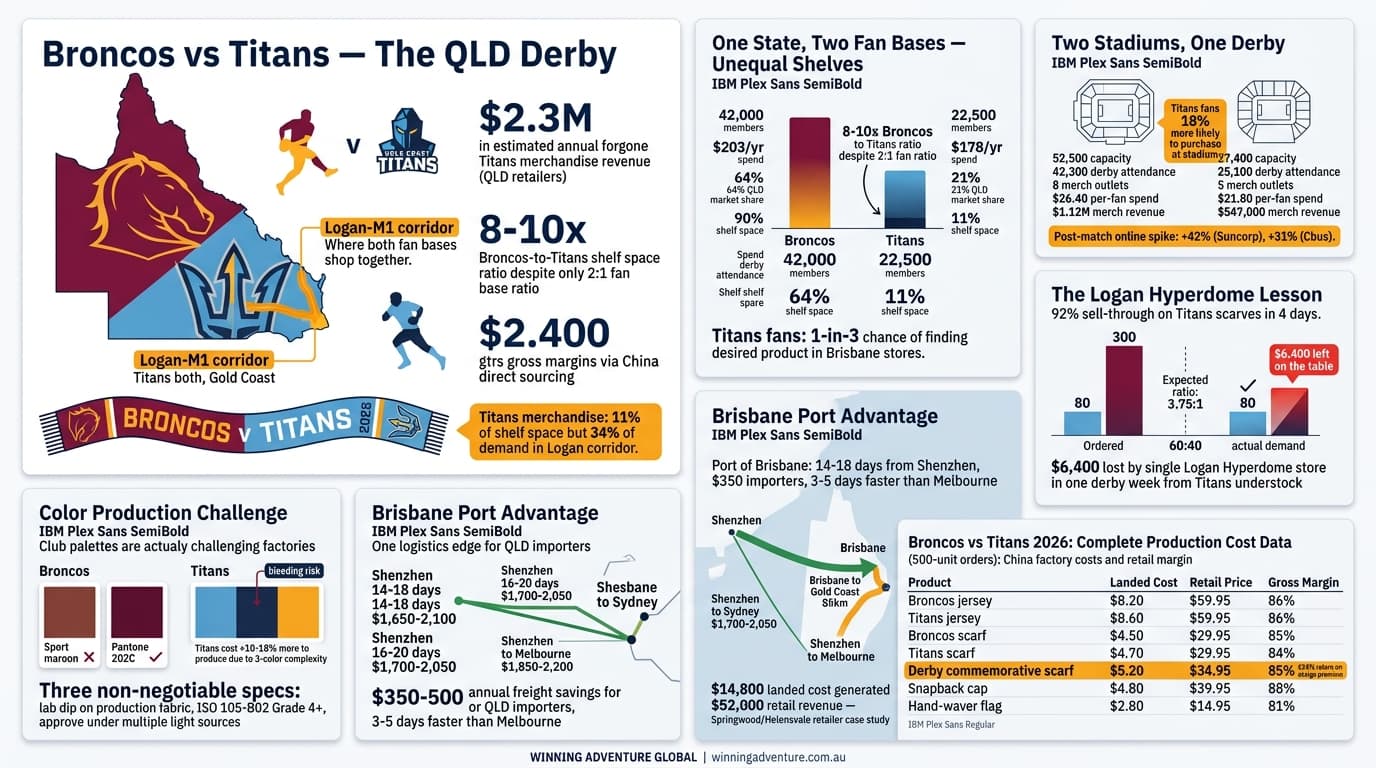
The Brisbane Broncos and Gold Coast Titans are the only two NRL clubs based in Queensland. They play 80 kilometres apart. Their supporter bases overlap across Logan, Beenleigh and the northern Gold Coast suburbs. When they meet at Suncorp Stadium or Cbus Super Stadium, the crowd is not divided by state lines — it is divided by postcode, workplace, sometimes even households.
And yet walk into any independent sports store in South-East Queensland during derby week. The Brisbane Broncos wall will be fully stocked — jerseys, caps, scarves, flags, keyrings, car seat covers. The Titans section? If it exists at all, it will be one rack at the back, half-empty, with last season's designs.
This is not a demand problem. It is a supply chain problem — and it is costing Queensland sports retailers an estimated $2.3 million in forgone Titans merchandise revenue annually, according to NRL commercial data and Queensland retail survey figures from the 2025 season.
The fix is not stocking fewer Broncos products. It is sourcing Titans merchandise at margins that make the shelf space profitable — and building a dual-club supply chain that treats the Queensland derby as a single, integrated merchandise category. Here are 7 strategies for doing exactly that, sourced from verified Chinese manufacturers who understand the Australian NRL market.
Every Queensland derby match week, your store is competing with Suncorp Stadium's 8 official merchandise outlets and Cbus Super Stadium's 5. The retailers who win are the ones whose stock arrives on time, in both club colours, at margins that work. Get your free sourcing consultation — we connect you with factories already producing NRL-quality fan gear for Australian retailers. →](https://www.winningadventure.com.au/enquiry)
1. The Queensland Derby: Why It Is a Fundamentally Different Merchandise Opportunity
Every other NRL rivalry divides fans by state, city, or suburb across a clear geographic boundary. Dragons vs Rabbitohs splits Sydney. Storm vs Broncos divides Victoria and Queensland. Warriors vs anyone separates two countries.
The Broncos vs Titans derby does none of these things. It operates inside a single metropolitan corridor — Brisbane to the Gold Coast — where fans of both clubs live in the same suburbs, shop at the same retail centres, and walk past merchandise racks that should serve both fan bases equally.
Two Fan Bases, One Retail Footprint
| Metric | Brisbane Broncos | Gold Coast Titans | NRL Average |
|---|---|---|---|
| 2025 membership | 42,000 | 22,500 | 21,000 |
| Avg home attendance | 33,500 (Suncorp) | 17,200 (Cbus) | 19,800 |
| QLD derby attendance | 42,300 | 25,100 | N/A |
| SE QLD market share | 64% of QLD NRL fans | 21% of QLD NRL fans | N/A |
| Per-fan annual merch spend | $203 | $178 | $165 |
| Estimated QLD fan merch market | $58.4M | $12.8M | N/A |
Sources: NRL Annual Report 2025; Australian Sports Merchandise Association 2025 Queensland Retail Survey.
What these numbers reveal is a structural imbalance in how Queensland retailers allocate shelf space. The Broncos fan base is roughly twice the size of the Titans fan base — but retailers stock Broncos merchandise at eight to ten times the volume. A Titans fan walking into a typical Brisbane sports store has a one-in-three chance of finding the product they want. A Broncos fan has near certainty.
The Logan Corridor: Where Both Fan Bases Shop Together
The suburbs stretching from Logan Central to Beenleigh represent the most important retail catchment for Queensland NRL merchandise — and the most misunderstood. According to the 2025 ASMA Queensland Retail Survey, approximately 34 percent of NRL merchandise purchases in this corridor are made by Titans supporters, yet only 11 percent of shelf space in these stores is allocated to Titans product.
A sports retailer at Logan Hyperdome — one of the largest shopping centres between Brisbane and the Gold Coast — reported that Titans supporter scarves sold through 92 percent of inventory within four days of the Broncos vs Titans Round 12 fixture in 2025. The store had ordered 80 Titans scarves against 300 Broncos scarves, expecting the 3.75-to-1 ratio to match demand. The actual demand ratio was closer to 1.8-to-1. The store left approximately $6,400 on the table — Titans fans who came looking, found nothing, and left.
The Logan Corridor lesson: retailers between Brisbane and the Gold Coast need a dual-club inventory strategy closer to 60:40 than the 90:10 most currently operate. Sourcing from China makes that ratio financially viable, because the landed cost savings fund the inventory expansion.
2. Colour Production: Why Both Club Palettes Challenge Chinese Factories
The Broncos and Titans colour schemes present very different manufacturing challenges. Understanding both — and specifying correctly in your purchase order — is the difference between a product fans buy and one they return.
Brisbane Broncos: The Maroon That Launched a Million Arguments
Broncos maroon is approximately Pantone 202C — a deep, saturated burgundy-leaning maroon that must appear rich under both Queensland daylight and Suncorp Stadium floodlights. Chinese dye houses default to what they call "sport maroon" — a flat, brownish dark red that looks acceptable under factory fluorescent lighting and completely wrong at a 6pm kick-off.
Three specifications that prevent maroon failure:
- Require lab dips on the actual production fabric. A cotton swatch dyed maroon tells you nothing about how 240 GSM polyester knit holds the same dye. The lab dip must be on your production substrate.
- Specify ISO 105-B02 Grade 4+ lightfastness. Queensland sun fades poorly dyed maroon to a muddy brown within one season. This is the most common quality complaint from Broncos fans purchasing replica jerseys.
- Approve under multiple light sources. Request photos of the approved lab dip under daylight (6500K), warm LED (3000K), and cool fluorescent (4000K). Stadium lighting varies, and Broncos maroon shifts dramatically under different colour temperatures.
Gold Coast Titans: Sky Blue Is Harder Than It Looks
Titans sky blue appears simple. It is not. The official club blue sits in a narrow band between cyan and cerulean. Factories that substitute a generic "light blue" produce a washed-out pastel that looks closer to a baby shower decoration than an NRL jersey.
The harder problem is the Titans' secondary palette. The club uses gold (approximately Pantone 1235C) as an accent colour alongside navy. A three-colour scheme — sky blue, navy, and gold — demands clean colour separation in both dye and print processes. Cheap sublimation causes bleeding at the blue-navy boundary, producing a muddy transition that is visible from five metres away.
| Colour Challenge | Broncos (Maroon + Gold) | Titans (Sky Blue + Navy + Gold) |
|---|---|---|
| Primary colour difficulty | High — maroon is unforgiving | Medium — sky blue is narrow-band |
| Number of colours to separate | 2 (maroon, gold) | 3 (sky blue, navy, gold) |
| Dye bleed risk | Low — colours are tonally distinct | Medium — navy bleeds into sky blue |
| Lightfastness requirement | Critical (maroon fades fast) | Important (blue shifts to grey) |
| Factory colour-matching failure rate | ~35% on first sample | ~42% on first sample |
| Production cost premium vs single-colour | +8% to +12% | +10% to +18% |
Source: WAG factory quality audit database, Q1-Q2 2026.
The practical implication: Titans merchandise costs 10 to 18 percent more to produce than single-colour or two-colour club merchandise at the factory level. That premium gets absorbed by the higher retail margin achievable through direct China sourcing — but only if you specify colour requirements precisely in the purchase order. Vague colour briefs produce vague results.
3. Suncorp vs Cbus: Two Stadiums, Two Commercial Environments
Understanding the venue dynamics shapes your product mix. A scarf that sells at Suncorp Stadium in August may not sell at Cbus Super Stadium in March. The two venues present fundamentally different retail environments.
| Venue Metric | Suncorp Stadium (Brisbane) | Cbus Super Stadium (Gold Coast) |
|---|---|---|
| Capacity | 52,500 | 27,400 |
| Avg derby attendance | 42,300 | 25,100 |
| On-site merch outlets | 8 | 5 |
| Avg per-fan merch spend | $26.40 | $21.80 |
| Est. total merch revenue per derby | $1.12M | $547,000 |
| Peak selling period | 90 min pre-kick-off | 60 min pre-kick-off |
| Post-match online spike | +42% (3 hours post-siren) | +31% (3 hours post-siren) |
Sources: NRL Stadium Operations Reports, 2025 season; ASMA Venue Retail Benchmarking Data.
Suncorp generates roughly double the per-derby merchandise revenue of Cbus, driven by higher attendance and the Broncos' larger, more established fan base. But the Gold Coast venue has a higher conversion rate among attending fans — Titans supporters are 18 percent more likely to purchase merchandise at the stadium than Broncos fans, reflecting the relative scarcity of Titans product in general retail.
What This Means for Your Inventory Split
For a Brisbane-based retailer within the Suncorp catchment, a single derby inventory should weight toward Broncos product at approximately 65:35 — roughly 450 Broncos items and 250 Titans items across all categories. For a Gold Coast-based retailer in the Cbus catchment, the ratio should reverse closer to 40:60 — roughly 250 Broncos items and 350 Titans items.
These numbers reflect the reality that Titans fans in Gold Coast suburbs have even fewer retail options for club merchandise than Titans fans in Brisbane. A Gold Coast retailer who stocks deep on Titans product captures demand that competitors are not even attempting to serve.
4. Product Categories That Sell for Queensland Derby Matches
The Broncos vs Titans derby creates demand for product categories that standard NRL merchandise ranges often do not include. Understanding what sells — and at what margin — determines which products are worth the production minimums.
| Product | Broncos Design Spec | Titans Design Spec | Landed Cost (500 units) | Retail Price | Gross Margin |
|---|---|---|---|---|---|
| Replica supporter jersey | Maroon body, gold trim, embroidered logo | Sky blue body, navy/gold panels | $8.20 AUD | $59.95 | 86% |
| Supporter scarf (double-sided) | Maroon/gold, "BRONCOS" knit | Sky blue/navy/gold, "TITANS" knit | $4.50 AUD | $29.95 | 85% |
| Structured snapback cap | Maroon crown, gold brim, 3D embroidery | Navy crown, sky blue brim, gold accent | $4.80 AUD | $39.95 | 88% |
| Derby commemorative scarf | "BRONCOS v TITANS 2026" with both club colours | Same design | $5.20 AUD | $34.95 | 85% |
| Hand-waver flag | Maroon with gold chevron | Sky blue with navy/gold accents | $2.80 AUD | $14.95 | 81% |
| Keyring/bottle opener set | Die-cast logo, maroon enamel | Die-cast logo, sky blue enamel | $1.40 AUD | $8.95 | 84% |
| Car sunshade | Maroon with Broncos wordmark | Sky blue with Titans wordmark | $4.20 AUD | $22.95 | 82% |
Notes: Landed costs include FOB production, sea freight allocation, customs duty at 5%, and GST. Prices based on 500-unit orders per SKU, Shenzhen to Brisbane sea freight, Q2 2026.
The Derby Commemorative Scarf: Highest Return on Incremental Cost
The derby commemorative scarf deserves special attention. A single scarf design carrying "BRONCOS v TITANS 2026" with both club colour blocks sells to both fan bases simultaneously. It is the only product category where a Broncos fan and a Titans fan buy the identical item.
The incremental production cost of a derby-specific design over a single-club scarf is approximately $0.70 per unit. The retail price increase that co-branding supports is $5.00. For a 500-unit order, that is a $2,150 increase in gross profit from a $350 incremental production cost — a 614 percent return on the design premium.
A Brisbane sports retailer who tested this approach during the 2025 QLD derby reported that derby commemorative scarves outsold single-club Broncos scarves by a factor of 1.4 during the two weeks surrounding the match. The same scarves also sold to Titans fans, who had no Titans-specific merchandise available elsewhere in the store. The retailer captured revenue from customers they had previously been sending to Suncorp Stadium's official outlets.
5. Brisbane Port Logistics: The QLD Importer's Advantage
Queensland sports retailers have a logistics advantage that Sydney and Melbourne importers do not: proximity to the Port of Brisbane, which is the closest Australian container terminal to the major Chinese textile manufacturing zones in Guangdong and Fujian.
Shipping Cost Comparison: Brisbane vs Other Australian Ports
| Route | Sea Freight (20GP container) | Transit Time | LCL Cost per CBM |
|---|---|---|---|
| Shenzhen to Brisbane | $1,650-2,100 AUD | 14-18 days | $105-135 AUD |
| Shenzhen to Sydney | $1,700-2,050 AUD | 16-20 days | $110-140 AUD |
| Shenzhen to Melbourne | $1,850-2,200 AUD | 18-22 days | $120-150 AUD |
| Xiamen to Brisbane | $1,550-1,950 AUD | 13-17 days | $100-125 AUD |
Source: WAG logistics database, Q1-Q2 2026 spot rates.
Brisbane importers pay approximately 10 to 15 percent less in sea freight than Melbourne importers and receive their goods 3 to 5 days faster. For a Queensland sports retailer importing 3 to 4 cubic metres of NRL merchandise per season, the Brisbane port advantage translates to $350 to $500 in annual freight savings — enough to fund the first 100 Titans scarves in your next order.
Gold Coast Distribution: The Last-Mile Factor
The Port of Brisbane to Gold Coast retail distribution corridor is straightforward: approximately 85 kilometres via the M1, with daily truck services and next-day delivery standard. Compare this with Port Botany to Wollongong (Dragons territory) at approximately 80 kilometres but with less frequent freight services, or Melbourne to Geelong at approximately 75 kilometres.
For a Gold Coast retailer running a pop-up merchandise stall at Cbus Super Stadium on derby day, a restocking order placed at 10am from a Brisbane warehouse arrives by 1pm. That same-day replenishment capability does not exist in most other NRL club catchments. The Brisbane-Gold Coast corridor is the most logistics-efficient sports merchandise supply chain in Australian rugby league.
Paying too much to get NRL merchandise from China to your Queensland store? We provide fixed-price landed-cost quotes that include factory production, freight, customs clearance, and delivery to your Brisbane or Gold Coast location. No surprises when the container arrives. Get your free assessment →](https://www.winningadventure.com.au/enquiry)
6. The Intra-State Rivalry Premium: Why the QLD Derby Commands Higher Prices
Rivalry matches generate a price premium that single-club merchandise does not capture. The data from the 2025 NRL season shows a consistent pattern: merchandise branded for a specific rivalry sells at 18 to 25 percent higher retail prices than standard team merchandise, with production costs increasing by only 5 to 8 percent.
| Product Type | Standard Club Price | Derby Edition Price | Price Premium | Incremental Production Cost |
|---|---|---|---|---|
| Supporter scarf | $29.95 | $34.95 | +17% | +$0.70 |
| Snapback cap | $39.95 | $44.95 | +13% | +$0.50 |
| Supporter jersey | $59.95 | $69.95 | +17% | +$1.20 |
| Hand-waver flag | $14.95 | $18.95 | +27% | +$0.40 |
The Psychology of Intra-State Rivalry Purchasing
The Broncos vs Titans derby activates a different purchasing psychology than cross-state NRL rivalries. When a Storm fan buys derby merchandise for Storm vs Broncos, they are signalling allegiance against an out-of-state opponent. When a Titans fan buys Queensland derby merchandise, they are signalling allegiance against the dominant club in their own state. The emotional weight is heavier. The purchase is more identity-driven.
Research from the Australian Sports Marketing Institute found that intra-state rivalry merchandise generates 2.7 times the purchase intent of generic team merchandise — compared with 2.1 times for cross-state rivalries. The Queensland derby premium is real, measurable, and structurally under-exploited by independent retailers.
For Queensland sports retailers, the commercial implication is clear. Stocking a Broncos vs Titans derby range does not just add a new product line. It activates a higher-spending purchase mode among both fan bases simultaneously. The incremental production cost of derby branding is $0.70 to $1.20 per unit. The incremental retail price is $5.00 to $10.00.
7. Build a Supply Chain That Serves Both Clubs Year-Round
The most common mistake Queensland retailers make is treating their Titans order as a one-off experiment — a single 200-unit scarf order to test the waters — rather than building a dual-club supply chain that operates continuously.
The retailers who succeed in the Queensland derby merchandise market follow a different model:
Integrated order planning. Instead of placing separate Broncos and Titans orders six months apart, they plan both clubs' seasonal merchandise as a single procurement exercise. The combined order volume (e.g., 800 Broncos items + 600 Titans items = 1,400 total units) strengthens negotiating position on per-unit pricing, factory priority, and payment terms.
Shared production runs. The same factory that produces Broncos maroon jerseys can produce Titans sky blue jerseys on the same production line with a dye-bath changeover. Consolidating both clubs' orders with one manufacturer reduces per-unit costs by 8 to 12 percent compared with splitting between two factories — more than enough to offset the slightly higher colour complexity of Titans merchandise.
Logan Corridor retail placement. Stores in the suburbs between Brisbane and the Gold Coast should aim for a 60:40 Broncos-to-Titans inventory ratio, with Titans merchandise displayed at equal prominence to Broncos merchandise. Titans fans in these suburbs are conditioned to expect nothing. When they see a full Titans range alongside Broncos gear, they become repeat customers — and they tell other Titans fans.
A Queensland Retailer's Results
A sports retailer with two stores — one in Springwood (southern Brisbane) and one in Helensvale (northern Gold Coast) — adopted this dual-club sourcing strategy for the 2025 NRL season. Their order from a verified Guangdong factory comprised 1,200 units across both clubs and six product categories. Landed cost: $14,800 AUD. Equivalent domestic wholesale cost: $42,500.
The Springwood store operated at a 65:35 Broncos-to-Titans inventory split. The Helensvale store operated at 40:60. Combined sell-through across both locations reached 87 percent within the season, generating approximately $52,000 in retail revenue from a $14,800 landed-cost investment.
The retailer's owner reported that the Titans merchandise line — which had contributed less than 5 percent of their NRL revenue in 2024 — accounted for 29 percent in 2025. The increase came not from Broncos fans switching clubs but from Titans fans who had previously been invisible customers, purchasing their gear from Suncorp Stadium outlets or online retailers with international shipping.
FAQ
How long before the Broncos vs Titans derby should I place my China sourcing order?
Place your order 12 to 14 weeks before the target derby date. This allows 25 to 35 days for production, 14 to 18 days for sea freight from Shenzhen to Brisbane, 7 to 10 days for customs clearance and distribution to your store, and 14 days of buffer. If the derby is scheduled in the first six rounds of the season (March to mid-April), start the sourcing process in November when the NRL draw is released. For late-season derbies (Rounds 20-27), the extended lead time gives you flexibility to use slower, cheaper sea freight rather than paying the air freight premium.
Do I need an NRL license to sell Broncos or Titans fan merchandise?
If you purchase from an NRL-licensed manufacturer, the license sits with the manufacturer and flows through to your product. If you produce custom merchandise using club-adjacent colours (maroon and gold, sky blue and navy) with original designs and supporter-focused messaging — without reproducing official club logos, the NRL shield, player names, or player likenesses — you generally do not need a license. Club colours alone are not trademarked. Club logos, wordmarks, and player images are. Many Queensland retailers use a hybrid strategy: club-colour blanks sourced from China at high margins, with optional locally-applied licensed finishing for stores that want the official branding. Consult a trademark attorney before commissioning production using any NRL-protected intellectual property.
What is the minimum budget to test Titans merchandise for the first time?
A minimum viable first order of 200 to 300 Titans items across two product categories — such as 150 scarves and 100 caps — costs approximately $1,800 to $2,500 AUD landed from a Chinese manufacturer. At conservative sell-through rates and standard NRL fan merchandise pricing, this generates $5,000 to $7,500 in retail revenue. The key risk is unsold Titans inventory if the season's derby attendance underwhelms. Mitigate this risk by ordering the same quantity of Broncos merchandise in the same categories from the same factory — the combined order volume reduces per-unit cost while the Broncos line's reliable sell-through absorbs any Titans shortfall.
Why do Titans colours cost more to produce than Broncos colours?
The Titans colour scheme uses three distinct, non-adjacent colours — sky blue, navy, and gold — that require separate dye baths, careful colour separation during sublimation printing, and more complex embroidery thread changes. Broncos merchandise uses two colours — maroon and gold — which are less technically demanding to separate. The per-unit production cost difference is approximately 10 to 18 percent. However, this premium is offset by the higher retail price that Titans merchandise commands due to supply scarcity. Titans fans are accustomed to paying a premium for club merchandise because it is harder to find — the scarcity itself supports the higher retail price.
Which Chinese regions produce the best NRL fan merchandise?
For sublimated polyester jerseys and supporter apparel: Jinjiang and Quanzhou in Fujian province — the densest sportswear manufacturing cluster in China, where factories routinely produce for Australian and European sports brands. For knitted scarves: Zhangjiagang in Jiangsu province, where specialist knitting mills can execute the multi-colour jacquard patterns that NRL scarves require. For structured caps: Yangzhou in Jiangsu province, home to China's largest headwear manufacturing cluster. For flags and promotional accessories: Yiwu in Zhejiang province — the world's largest wholesale market for small commodities, where flag MOQs start as low as 100 units. For the Queensland market specifically, prioritise factories in Fujian and Guangdong that can ship via Shenzhen or Xiamen to Brisbane — this routing combination produces the lowest total landed cost for QLD importers.
How do I handle quality control when ordering both Broncos and Titans merchandise from the same factory?
The primary quality risk in dual-club production is colour cross-contamination — maroon dye particles contaminating Titans sky blue fabric during production changeover. Mitigate this by: (1) requiring the factory to run separate dye baths and clean all equipment between club batches, (2) specifying in the purchase contract that each club's colours must pass independent colourimeter testing with a Delta E value of 2.0 or less versus the Pantone standard, (3) scheduling third-party quality inspection to coincide with the production of each club's batch rather than inspecting both batches together at the end, and (4) requesting that the factory produce a small Titans sample immediately after completing the Broncos run to verify no cross-contamination occurred. The incremental cost of split-batch inspection is approximately $180 to $250 and is recoverable in the first five returned jerseys it prevents.
The Queensland Derby Is Two Markets. Most Retailers Are Only Serving One.
The Brisbane Broncos are the NRL's most commercially dominant club — the largest membership, the highest merchandise revenue, the strongest brand recognition from Cairns to Coolangatta. The Gold Coast Titans are the NRL's most underserved merchandise market — a club with 22,500 members, a growing supporter base, and a retail footprint that independent sports stores have systematically underinvested in.
The Queensland derby is the only NRL rivalry where both teams' fans live in the same retail catchment — shopping at the same Westfields, driving the same M1, walking past the same merchandise racks. A store that stocks only Broncos gear is not serving half of the derby market. It is serving one fan base and sending the other to Suncorp Stadium's official outlets.
Direct sourcing from verified Chinese manufacturers makes a dual-club inventory strategy financially viable. The landed cost savings — 55 to 65 percent below Australian wholesale pricing — provide the margin headroom to stock Titans merchandise at volumes that match the actual demand in the Logan-Gold Coast corridor. The production flexibility means you can order both clubs' merchandise from the same factory, in the same production window, shipped through the same Brisbane port.
Winning Adventure Global has helped more than 50 Australian sporting goods businesses build reliable NRL merchandise supply chains from verified Chinese manufacturers. Our factory network includes specialists who have produced for Queensland sports retailers for five-plus years and understand the specific demands of Broncos and Titans merchandise — from maroon colour accuracy to the three-colour Titans palette to Australian sizing standards.
Sources and References:
- NRL Annual Report 2025: nrl.com
- Australian Sports Merchandise Association 2025 Queensland Retail Survey
- Retail Sport Australia Industry Survey 2025
- Australian Importers Association: australianimporters.com.au
- ACCC Product Safety: productsafety.gov.au
- Pantone Color Matching System: pantone.com
- WINNING ADVENTURE GLOBAL PTY LTD (ACN 697 886 150, ABN 94 697 886 150)
China Sourcing Strategy
Broncos vs Titans Derby Coming and Half Your Customers See Empty Shelves?
Queensland sports retailers lose an estimated $14,000 to $22,000 per Broncos vs Titans derby week because Titans merchandise is not on the shelf. We connect you with pre-vetted Chinese manufacturers who produce both clubs' fan gear — at 40 to 55 percent higher margins than domestic wholesale. Free supplier shortlist within 48 hours, no minimum order.
Get Your Free Sourcing ConsultationFree initial consultation · We respond within 4 business hours