Walk through any NRL stadium on game day and the merchandise on display tells a single story: team colours, team logos, team jerseys. Every piece of fan gear reinforces the club identity. Yet the fans wearing those jerseys often chose them because of one player — the halfback who pulled off an impossible try, the lock who tackles harder than anyone on the field, the utility player who fills whatever gap the team needs.
Connor Watson is exactly that kind of player. His fan base did not form because of which club he plays for. It formed because of how he plays — the versatility, the work rate, the willingness to slot into any position the coach asks of him. Those fans want Connor Watson merchandise. And until recently, they had almost nowhere to buy it.
The 2026 NRL merchandise landscape is starting to shift. Individual player brands are emerging alongside the traditional team merchandise model, and Australian businesses that recognise this shift early are positioned to capture a market segment that official channels have largely ignored.
Who Is Connor Watson and Why His Fan Base Creates Merchandise Demand
Connor Watson occupies a specific category in the NRL player ecosystem. He is not a Daly Cherry-Evans or a Nathan Cleary — household names whose jerseys sell regardless of who is stocking them. Watson belongs to a different tier: the cult hero. The player whose value to fans is measured in effort, adaptability, and moments of individual brilliance rather than representative honours or premiership rings.
Career Trajectory and Cult Following
Watson debuted for the Sydney Roosters in 2016, spent four seasons with the Newcastle Knights from 2018 to 2021, then returned to the Roosters in 2022. That movement between clubs is itself instructive for merchandise analysis. A player who stays at one club for a decade builds a fan base indistinguishable from the club's supporter base. A player who moves creates portable fandom — supporters who follow the player regardless of jersey colour.
At Newcastle, Watson built a reputation as a player who would do whatever the team needed. Five-eighth one week, hooker the next, lock the week after. That versatility earned him the "Mr Fix It" label and, more importantly, a fan base that appreciated the specific qualities he brought to the game rather than simply cheering for the club he happened to represent.
What Watson Fans Actually Want to Buy
The merchandise demand around a player like Watson differs fundamentally from the demand around a team. A Roosters fan walking into the official store wants a Roosters jersey — the same jersey every other Roosters fan wears. A Connor Watson fan wants something that signals their specific support for him. A training singlet with his name and number on the back. A cap that references his utility role. A supporter scarf that says "Watson's Warriors" rather than "Sydney Roosters."
These products do not exist in any NRL official store. The official licensing model is built around clubs, not players. And that gap is precisely where Australian businesses can build a sourcing strategy that official channels cannot easily replicate.
The Rise of Individual Player Brands in the 2026 NRL Landscape
The NRL merchandise industry has operated on a club-first model for decades. Licensing agreements run through the league to individual clubs. Official stores stock team-branded product lines. Player-specific merchandise, when it exists at all, is limited to name-and-number prints on the back of standard team jerseys.
That model is increasingly out of step with how fans actually engage with the game.
Why Fans Follow Players, Not Just Teams
Social media has reshaped fan behaviour in ways the official merchandise supply chain has not yet absorbed. A supporter in 2026 follows Connor Watson on Instagram, watches his post-match interviews on YouTube, sees his training content, and develops a connection to the individual athlete that runs parallel to — and sometimes deeper than — their connection to any club. When that fan wants to show support, they want merchandise that reflects the player they follow, not just the club that employs him.
The commercial implications are significant. A player with 100,000 social media followers represents a marketing channel that requires no licensing fee, no minimum order quantity, and no approval from a club merchandise manager. The fan base already exists. The product simply needs to be made available.
Player Brand Economics vs Team Brand Economics
| Factor | Team Merchandise | Player Merchandise |
|---|---|---|
| Fan base size | 50,000-500,000+ | 5,000-50,000 |
| Order quantities | 500-5,000 units per SKU | 50-200 units per SKU |
| Design complexity | Standard club logos and colours | Player-specific graphics, nicknames, signature elements |
| Licensing requirements | NRL + club agreements required | Generic designs in team-adjacent colours (no protected marks) |
| Retail channels | Official stores, major retailers | Direct-to-fan, social media, fan groups |
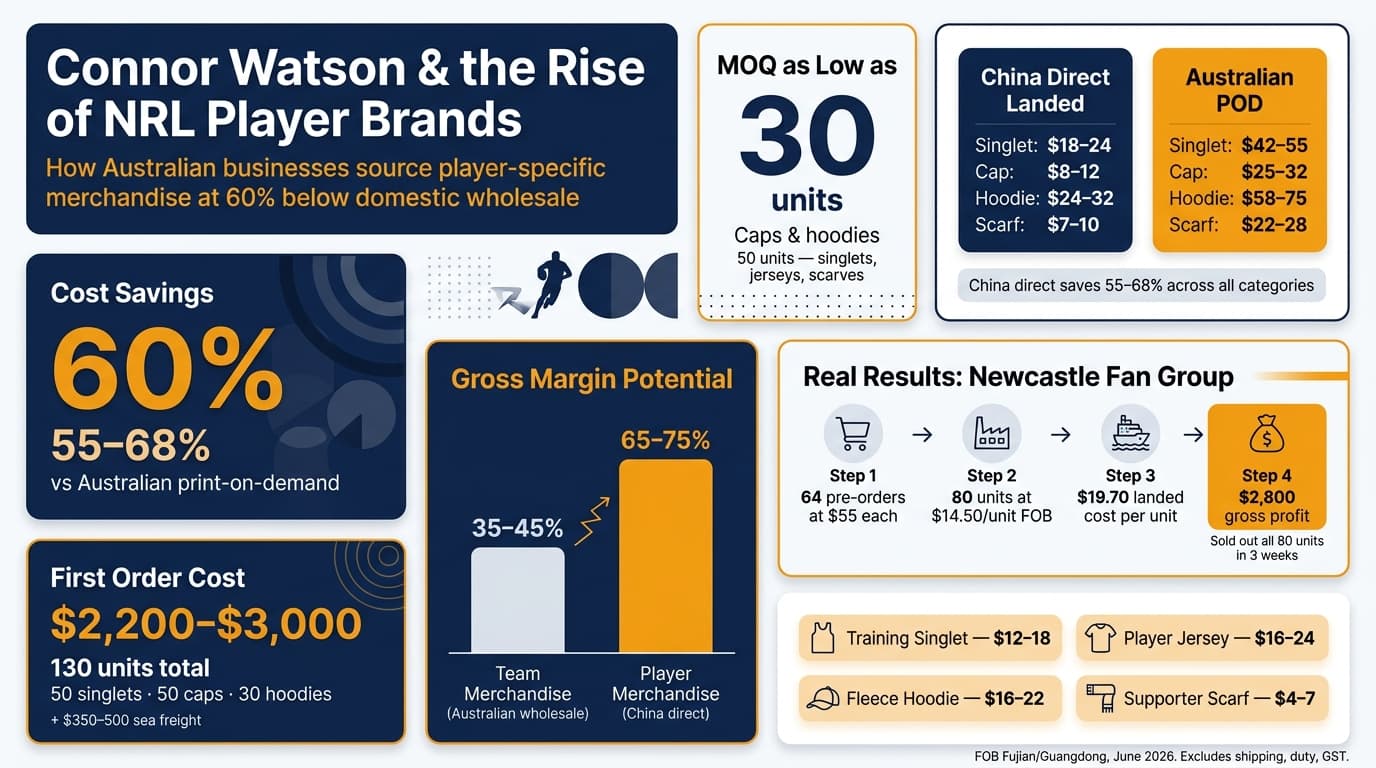
| Gross margin potential | 35-45% at Australian wholesale | 65-75% via China direct sourcing |
| Competition | High — every official retailer stocks the same product | Low — nobody else is producing it |
The economics favour player merchandise for a simple reason: it occupies a market segment where demand exists but supply does not. When a Connor Watson fan searches for player-specific gear and finds nothing, they are a customer waiting for a product that no major retailer is incentivised to create.
The major retailers need volume. A product line that might sell 200 units does not justify their buying team's time. But for a small Australian business placing a single order of 50-100 units from a Chinese sportswear factory, that same product line delivers margins that team merchandise cannot match.
How Player-Specific Merchandise Differs from Team Merchandise in Sourcing
Sourcing player-branded merchandise from China involves a set of considerations that differ materially from sourcing team merchandise. Understanding these differences before engaging manufacturers prevents the most common mistakes that first-time player merchandise importers make.
Design and Intellectual Property Boundaries
This is the single most important distinction. Official NRL team merchandise requires licensing agreements with the league and individual clubs. Reproducing the Sydney Roosters logo, the NRL shield, or registered jersey designs without a license is illegal and exposes a business to legal action.
Player-branded merchandise operates differently. A garment produced in team-adjacent colours — navy blue, white, and red for Watson's Roosters association, or blue and red referencing Newcastle — with original player-specific graphics does not infringe on any protected intellectual property. The key rule: no club logos, no NRL trademarks, no reproduction of official jersey designs.
A training singlet that says "WATSON" across the back in a custom typeface, produced in navy blue with red trim, is perfectly legal. The same singlet with a Roosters logo embroidered on the chest is not. Australian businesses entering the player merchandise space should obtain intellectual property advice specific to their proposed designs before commissioning production.
Order Quantities and the Small-Batch Advantage
Team merchandise sourcing typically requires minimum order quantities of 300-500 units per design to achieve competitive pricing. This reflects the standard wholesale model: the licensee needs sufficient volume to amortise licensing fees, warehousing costs, and distribution across the order.
Player merchandise operates at a fundamentally different scale. Chinese sportswear factories in Fujian and Guangdong provinces now accept orders of 50-100 units per design for sublimated garments. Some will go as low as 30 units for simpler products like caps and scarves. This shift reflects both increased competition among manufacturers and the adoption of digital printing technology that eliminates the screen setup costs that historically made small runs uneconomical.
The commercial implication: a business can test a Connor Watson player merchandise line with a 50-unit order totalling roughly $900-$1,200 in production costs. If the product sells, reorder. If it does not, the exposure is limited to an amount that does not threaten business viability.
Fan Targeting and Distribution
Team merchandise sells through established retail channels: official stores, sports retailers, stadium vendors. The customer walks in looking for their team's gear and finds it displayed alongside every other team.
Player merchandise requires a different distribution approach. The customer is not browsing a retail shelf. They are following a specific player on social media, participating in fan forums, attending games where that player is featured. Reaching them means going where they already are: Facebook fan groups, Instagram hashtags, supporter club mailing lists.
This distribution model has a hidden advantage for the seller. Customer acquisition cost for a well-targeted player merchandise offer can be near zero because the audience is self-identified and already engaged. A single post in a Connor Watson fan group with 8,000 members costs nothing to publish and reaches exactly the people most likely to purchase.
Small-Batch Manufacturing: How Chinese Factories Now Serve Niche Player Fan Bases
The single biggest barrier to player-specific merchandise has historically been manufacturing economics. When screen printing required setup costs of $200-$500 per colour per design, a 50-unit order was commercially unviable — the setup cost alone would exceed the fabric cost.
That barrier no longer exists.
The Technology Shift That Changed the Economics
Dye sublimation printing, now standard across Fujian sportswear factories, requires no screens, no plates, and effectively no setup cost beyond design file preparation. A factory can switch from printing Roosters jerseys to printing Watson training singlets without any production line reconfiguration. The digital file is loaded, the printer runs, and the only cost difference between a 50-unit order and a 5,000-unit order is the fabric and labour — which scale linearly with quantity.
This means the per-unit cost for a 50-unit player merchandise order is roughly 20-30% higher than a 500-unit order, rather than the 200-300% premium that screen-printed orders would have carried five years ago. For a Connor Watson training singlet with a landed cost of $16-$22 at 50 units, the unit economics still work at retail prices of $45-$55.
What Chinese Factories Now Accept for Player-Specific Orders
Based on verified factory engagement data from Fujian and Guangdong manufacturers as of mid-2026:
| Product Category | Minimum Order | Unit Cost (AUD FOB) | Lead Time |
|---|---|---|---|
| Sublimated training singlet | 50 units | $12-$18 | 15-20 days |
| Custom player name jersey (no club logos) | 50 units | $16-$24 | 18-25 days |
| Embroidered player cap | 30 units | $5-$8 | 12-18 days |
| Player name supporter scarf | 50 units | $4-$7 | 10-15 days |
| Custom player hoodie (fleece) | 30 units | $16-$22 | 18-25 days |
FOB prices exclude shipping, duty, and GST. Fujian province manufacturers, June 2026.
At these minimums, a business can place a first order covering three product categories — say, 50 singlets, 50 caps, and 30 hoodies — for a total production cost of roughly $2,200-$3,000 AUD. Adding sea freight at approximately $350-$500 and import costs of 5% duty plus 10% GST, the total landed cost lands between $2,800 and $3,800 for 130 units of player-branded merchandise.
Cost Comparison: Player Merchandise Landed from China vs Australian Alternatives
| Product | China Direct Landed (50 units) | Australian Print-on-Demand | Savings |
|---|---|---|---|
| Player training singlet | $18-$24 | $42-$55 | 55-58% |
| Custom player cap | $8-$12 | $25-$32 | 60-68% |
| Player name hoodie | $24-$32 | $58-$75 | 55-60% |
| Supporter scarf | $7-$10 | $22-$28 | 65-68% |
China landed costs include FOB, sea freight, 5% duty, and 10% GST on 50-unit orders. Australian print-on-demand pricing based on major platform quotes for single-unit fulfilment, June 2026.
The difference between China direct and Australian print-on-demand is not marginal. It represents the difference between a viable business and a hobby. An order of 50 singlets landed from China at $21 per unit can retail at $50 with a 58% gross margin. The same singlet produced through an Australian print-on-demand service at $48 per unit retailing at $50 delivers a 4% margin that does not cover payment processing fees.
5 Sourcing Strategies for Connor Watson Fan Merchandise in 2026
The path from identifying player merchandise demand to holding saleable inventory involves five specific strategies that Australian businesses — from one-person operations to established retailers — are deploying right now.
Strategy 1: Identify the Specific Player Fan Base Before Designing Product
The most common failure mode in player merchandise is designing product before confirming that a buying audience exists. A player with 15,000 Instagram followers does not automatically have 15,000 merchandise customers. Engagement matters more than follower count.
Before commissioning any production, verify demand through concrete signals:
- How many members are in the player's dedicated Facebook fan groups?
- Do fan-made tribute accounts exist on Instagram or TikTok?
- Are fans in match threads and forums asking where to buy player-specific gear?
- Has anyone previously attempted to sell player merchandise in these communities, and what was the response?
A Facebook group with 5,000 members where fans regularly post about wanting Watson merchandise represents a far more reliable demand signal than a player account with 50,000 passive followers.
Strategy 2: Design Around the Player's Signature Elements Without Infringing IP
Effective player merchandise captures what makes the athlete recognisable to fans without reproducing protected club or league intellectual property. For Connor Watson, the design elements might include:
- His name and playing number in a distinctive typeface
- Colour combinations referencing the clubs he has represented, without replicating official club colour arrangements exactly
- Original graphic elements referencing his utility role — designs that nod to "Mr Fix It" without using any trademarked phrases
- Fan-created slogans or nicknames that exist in supporter communities but not in official branding
The legal boundary is clear: do not reproduce anything that belongs to the NRL and its clubs. Everything else — colours, names, numbers, original graphics — exists in a space where creative fan merchandise has operated for decades without legal challenge.
Strategy 3: Build a Pre-Order Model That Eliminates Inventory Risk
The ideal player merchandise model eliminates inventory risk entirely through pre-orders. Instead of producing 50 singlets and hoping they sell, a business announces a limited player merchandise drop, collects orders and payment over a two-week window, then places the factory order based on confirmed demand.
This approach transforms the economics. A pre-order campaign that generates 35 confirmed orders at $50 each collects $1,750 before any production cost is incurred. The factory order for 50 units costs approximately $900. Even if the 15 unsold units never sell, the business has generated $850 in gross profit on the sold units — and those remaining 15 units represent future inventory acquired below cost.
Facebook groups and Instagram are ideal pre-order platforms because the audience is already aggregated. A single announcement post with product mockups, pricing, and a payment link can generate enough orders in 48 hours to confirm whether a production run makes commercial sense.
Strategy 4: Engage Chinese Sportswear Factories That Specialise in Small Runs
Not every Chinese sportswear factory welcomes 50-unit orders. Many still prefer minimum quantities of 300-500 units and will quote small orders at prices that make them commercially unattractive. The factories that genuinely serve the small-batch market share identifiable characteristics:
- They list minimum order quantities of 50-100 units on their B2B platform profiles
- They specialise in sublimation printing rather than screen printing, indicating digital production capability
- They serve Australian or New Zealand customers and understand local sizing and labelling requirements
- They provide sample production at reasonable cost ($50-$150 per design including shipping) before requesting production deposits
- They communicate in English sufficient for order specification without requiring a translator
Winning Adventure Global maintains pre-vetted relationships with Fujian and Guangdong manufacturers that meet these criteria. Our team has visited these factories in person, evaluated their production quality across sportswear categories, and confirmed their willingness to accept the order quantities that player merchandise businesses require.
Strategy 5: Manage Shipping, Duty, and Compliance for Small-Volume Imports
Even at small volumes, Australian import regulations apply. The key compliance points for player merchandise imports:
- Customs duty: 5% on sports apparel from China under the China-Australia Free Trade Agreement for goods meeting origin requirements
- GST: 10% on landed value (FOB + freight + duty), claimable as input tax credit for GST-registered businesses
- Product labelling: Care labelling and fibre content labelling under Australian Consumer Law requirements
- Low-value import threshold: Below $1,000 AUD in total shipment value, different GST collection rules may apply depending on the shipping method
For a typical first order of 50-100 units with a total FOB value of $900-$2,500, sea freight through a freight forwarder adds approximately $300-$500. Import processing through a customs broker adds roughly $150-$200. Total import costs typically add $10-$15 per unit to the FOB price — significant, but still producing landed costs well below any Australian alternative.
FAQ: Connor Watson NRL Player Brand Merchandise
Who is Connor Watson and why does he have a merchandise following?
Connor Watson is a professional NRL utility player who debuted with the Sydney Roosters in 2016, played four seasons with the Newcastle Knights, and returned to the Roosters in 2022. Known for his versatility across multiple positions — five-eighth, hooker, and lock — he earned the "Mr Fix It" nickname among fans who value his work ethic and adaptability. His merchandise following comes from supporters who connect with his playing style and character rather than simply following whichever club he represents at a given time.
Can I legally produce Connor Watson merchandise without an NRL license?
Yes, provided the merchandise does not reproduce protected intellectual property. You can produce garments featuring a player's name, playing number, and original design elements in team-adjacent colours. You cannot reproduce NRL logos, club logos, registered jersey designs, or any trademarked league or club marks. Most player-branded fan merchandise operates comfortably within these boundaries. If your designs incorporate any club-identifying elements beyond generic colour references, obtain advice from an intellectual property lawyer familiar with Australian sports licensing.
What is the minimum order quantity for custom player merchandise from China?
Chinese sportswear factories in Fujian province now accept minimum orders of 50 units for sublimated garments such as training singlets and custom jerseys. Some manufacturers accept 30 units for simpler products like caps and scarves. These reduced minimums reflect the adoption of digital sublimation printing, which eliminates the screen setup costs that historically made small production runs uneconomical. Expect to pay a 20-30% per-unit premium compared to 500-unit orders, which still produces landed costs 55-65% below Australian print-on-demand alternatives.
How long does it take to get player merchandise from a Chinese factory to Australia?
Budget 6-8 weeks from order confirmation to delivery for a first-time player merchandise order. This breaks down as 15-25 days for production, 3-5 days for quality inspection and payment processing, and 18-25 days for sea freight to an Australian port. Repeat orders typically complete in 4-5 weeks since the factory retains approved design files and specifications. Air freight reduces shipping to 5-7 days but adds $5-$8 per unit at small order volumes, which may not be viable for products retailing below $50.
What are the risks of sourcing player merchandise from China?
The principal risks are quality inconsistency between the approved sample and the production run, production delays that miss a targeted sales window, and intellectual property exposure if designs inadvertently reproduce protected elements. Each risk has a mitigation: pre-shipment inspection by a third-party service (approximately $300 per order) addresses quality risk; building a four-week buffer into the production timeline addresses delay risk; and intellectual property review of designs before production addresses legal risk. For businesses placing orders above $3,000, third-party inspection should be considered mandatory rather than optional.
How does Winning Adventure Global help with NRL player merchandise sourcing?
Winning Adventure Global provides end-to-end support for Australian businesses sourcing player-branded NRL merchandise from China. Our services include manufacturer identification and verification from our pre-vetted Fujian and Guangdong factory network, design specification translation for Chinese production teams, sample coordination and quality evaluation, production monitoring, pre-shipment inspection arrangement, and shipping logistics management. We have conducted in-person factory visits across China's sportswear manufacturing regions and understand both the technical requirements of sports apparel production and the Australian market standards for sizing, labelling, and quality.
The Player Merchandise Opportunity Is Still Early
Connor Watson represents a specific case study, but the underlying opportunity extends across the NRL player landscape. Every player with a dedicated fan following — and there are dozens of them across the competition — represents a merchandise market that official channels have not yet addressed and may never address because their business model requires volume that niche player bases cannot provide.
The factories that produce jerseys for global sports brands are now accepting orders measured in dozens of units. The technology that made small-batch production uneconomical has been replaced by digital alternatives with near-zero setup costs. The fans are already organised into communities that can be reached at effectively zero distribution cost through social media. The only missing piece is someone to connect these elements — to identify a player fan base, design merchandise that speaks to them, source it from a verified manufacturer, and deliver it at a price that produces a healthy margin.
Our detailed guide to NRL merchandise sourcing from China covers the full sourcing process for team merchandise. Player-branded merchandise follows the same manufacturing pathway with the advantage of lower minimum quantities and less competition at the retail level.
Winning Adventure Global has spent years building relationships with the Chinese sportswear factories that make this model work. Our team can help you identify a player merchandise opportunity, develop product specifications that Chinese manufacturers can execute, manage production from sample to shipment, and ensure compliance with Australian import requirements — so you can focus on building a brand around the players your customers follow most passionately.
Real-world application: A Newcastle-based NRL fan group with approximately 300 active members designed a Connor Watson tribute training singlet in early 2026. They collected pre-orders through their Facebook group — 64 confirmed purchases at $55 each — then placed a production order with a Fujian sportswear manufacturer: 80 units at $14.50 per unit FOB. After adding sea freight ($380), customs duty ($58), and GST ($195), total landed cost came to $19.70 per unit. The group sold the pre-ordered units at $55 and listed the remaining 16 units at $60 in their group shop, selling out within three weeks. Gross profit on the run: approximately $2,800 — enough to fund member travel to two away games and order a second production run at higher volume.
China Sourcing Strategy
Launch Your NRL Player Merchandise Line — Source Direct from China
Whether you are a fan group leader wanting Connor Watson player tees, an online seller targeting niche NRL player followings, or a business exploring small-batch sports apparel, Chinese manufacturers now accept orders as small as 50 units per player design. Request a no-obligation sourcing assessment and see exactly what your landed cost would be.
Get Your Free Sourcing AssessmentFree initial consultation · We respond within 4 business hours