Key Takeaways
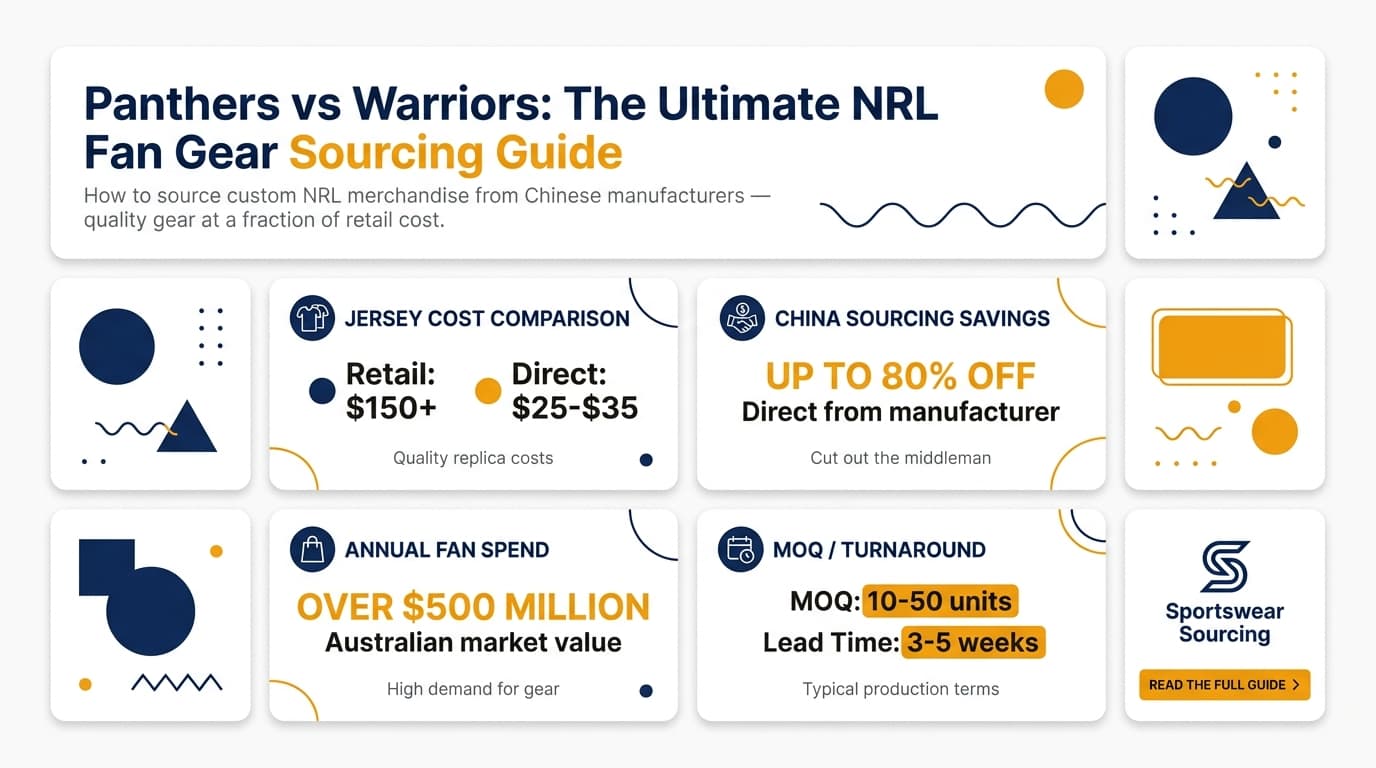
- 1Official NRL merchandise sells at 3-4x the manufacturing cost — direct sourcing from China captures this margin for Australian businesses
- 2Chinese sportswear factories in Fujian and Guangdong now accept orders as low as 50 units per design, eliminating the old MOQ barrier
- 3The Panthers vs Warriors rivalry drives consistent merchandise demand across Western Sydney and Auckland fan bases year-round
- 4Australian customs duty on sports apparel from China is just 5% under the China-Australia Free Trade Agreement
- 5Factory verification and sample approval before payment eliminates the number one risk in overseas merchandise sourcing
When the Penrith Panthers face the New Zealand Warriors at BlueBet Stadium, 22,000 fans pack the stands — most wearing team colours purchased at retail prices carrying a 300-400% markup over manufacturing cost. The Panthers vs Warriors fixture consistently ranks among the NRL's top-attended regular season matches, and each game day generates six-figure merchandise sales across official outlets, stadium vendors, and online stores. For the Australian businesses supplying this demand — independent retailers, fan club coordinators, online sellers — the wholesale prices they pay represent a margin opportunity they are leaving on the table.
The math is straightforward. A sublimated Panthers jersey retails for $160 at the official NRL store. The Australian wholesale price sits around $65 to $85. The landed cost from a verified Chinese sportswear manufacturer, including shipping and duty? Eighteen to twenty-eight dollars per unit. That gap — roughly 60% below Australian wholesale — is not a trade secret. It is the reality of global sportswear manufacturing, and Australian businesses of every size are now accessing it.
This article explains exactly how Australian sports retailers, supporter clubs, and online sellers can source NRL fan merchandise directly from Chinese manufacturers — cutting per-unit costs by 60% or more while maintaining quality that matches or exceeds what fans buy at the stadium.
Why NRL Fans Overpay for Panthers and Warriors Merchandise
The official NRL merchandise supply chain contains multiple markup layers that inflate the final retail price far beyond what manufacturing actually costs. Understanding these layers reveals where the margin lives — and who is currently capturing it.
The Official Merchandise Markup Explained
Every piece of officially licensed NRL merchandise passes through at least four hands before reaching a fan. The Chinese factory produces the jersey at a unit cost of $15 to $25. An intermediary trading company, often based in Hong Kong or Singapore, adds a 30-50% margin for quality control and logistics coordination. The Australian licensee — the company holding NRL branding rights — applies its own markup, typically 80-120%, to cover licensing fees, warehousing, and distribution. Finally, the official NRL store or stadium retailer adds a retail margin of 50-80%.
By the time a fan hands over $160 for a Panthers jersey, the original $18 manufacturing cost has multiplied nearly nine times. The factory in Guangdong received $18. Everyone else in the chain added their slice.
What Australian Retailers Actually Pay at Wholesale
Independent Australian sports retailers do not buy from the official NRL store. They purchase from licensed wholesalers at prices reflecting the first three layers of markup — factory cost plus trading company margin plus licensee markup. For a sublimated NRL team jersey, Australian wholesale typically ranges from $65 to $85 depending on order volume.
For a small business ordering 100 jerseys at $75 each, that is $7,500 in cost of goods before the first sale. At a retail price of $120 — undercutting the official store — the gross margin is $45 per jersey, roughly 37%. Respectable. But the business carrying inventory, managing returns, and paying rent on a shopfront in Penrith is capturing $45 while the supply chain captured $57.
5 Steps to Source NRL Fan Gear from Chinese Manufacturers
The alternative is not complicated. It requires diligence, not scale. Here is how Australian businesses — from one-person online stores to established retailers — source custom fan merchandise directly from China.
Step 1: Define Your Merchandise Line-Up
Chinese sportswear factories manufacture virtually every category of fan merchandise. The key decision is not what is technically possible — almost everything is — but what your specific customers will actually buy.
For NRL fan merchandise, the highest-volume categories are:
- Sublimated team jerseys (replica and custom designs)
- Embroidered scarves and beanies
- Fan polo shirts with embroidered logos
- Snapback caps with 3D embroidery
- Training shorts and compression gear
- Stadium cushions and seat covers
- Car flags and window decals
Start with three to five SKUs. A first order that tries to cover every product category diffuses attention, complicates quality control, and increases the risk of errors. One Sydney-based online seller who sources exclusively from Fujian factories reports that his best-performing SKU — a custom Panthers-themed training singlet — outsells his next four products combined. Narrow focus wins.
Step 2: Find Verified Chinese Sportswear Manufacturers
The sportswear manufacturing industry concentrates in two Chinese provinces: Fujian (centred on Jinjiang and Quanzhou) and Guangdong (centred on Guangzhou and Dongguan). Fujian specialises in performance fabrics and sublimation printing. Guangdong excels at cut-and-sew garments and embroidery.
Finding reliable manufacturers requires going beyond the first page of Alibaba. The factories with the best quality and most flexible terms typically do not rank at the top of B2B marketplaces — those positions belong to trading companies paying for promotion. Instead, look for:
- Factories with BSCI or WRAP social compliance certification — signals professional management, not just ethics
- Manufacturers that specialise in a narrow product category — a jersey factory, not a "we make everything" supplier
- Companies with verified export history to Australia or New Zealand — familiarity with Australian sizing, labelling, and quality expectations
- Suppliers willing to provide video tours of their production floor before any payment
Winning Adventure Global maintains a pre-vetted network of Fujian and Guangdong sportswear manufacturers, each verified through in-person factory visits and production sample evaluation. This eliminates the most dangerous stage of sourcing — the period between finding a supplier and knowing whether they are legitimate.
Step 3: Request and Evaluate Samples
Never place a production order without receiving and approving physical samples. This is the single most important rule in Chinese manufacturing, and the rule most frequently broken by first-time importers under time pressure.
Sample evaluation for NRL fan merchandise should cover:
- Fabric weight and hand feel compared to a reference garment — bring an official NRL jersey for side-by-side comparison
- Sublimation print sharpness — check fine details, colour gradients, and edge definition under good light
- Stitching quality — 12 stitches per inch minimum on main seams, no skipped stitches, no loose threads
- Embroidery density for logos — 3D puff embroidery should stand at least 3mm from the fabric surface
- Sizing accuracy against Australian standards — Chinese sizing typically runs one size smaller; specify Australian size charts in your order documentation
Sample rounds typically cost $50-$150 per design including express shipping to Australia. Budget for two rounds: first to evaluate baseline quality, second to confirm any adjustments. The $300-$500 invested in samples is the cheapest insurance you will buy against a container of unsellable merchandise.
Step 4: Negotiate Pricing, MOQ, and Payment Terms
Chinese sportswear factories have shifted dramatically on minimum order quantities over the past three years. Where 500 units per design was once standard, many Fujian factories now accept 50-100 units for sublimated garments. This change reflects both increased competition among manufacturers and improved digital printing technology that reduces setup costs.
Payment terms follow a standard structure:
| Order Stage | Typical Payment | Risk Level |
|---|---|---|
| Sample production | 100% upfront ($50-$150) | Low — small amount |
| Production deposit | 30% of order value | Medium — verify factory first |
| Balance payment | 70% before shipment | High — inspect goods before paying |
The critical protection: never pay the 70% balance without receiving photo or video confirmation of your completed order, including close-ups of logos, stitching, and packaging. For orders above $5,000, third-party inspection in China costs roughly $300 and is worth every dollar.
Step 5: Manage Production and Shipping to Australia
Production lead times for custom sportswear average 15-25 days, depending on order complexity and factory workload. Shipping to Australia offers three options at different speed-cost trade-offs:
- Sea freight: 18-25 days, approximately $1.50-$2.50 per jersey for a typical order
- Air freight: 5-7 days, approximately $5-$8 per jersey
- Express courier (DHL/FedEx): 3-5 days, approximately $10-$15 per jersey
For most Australian businesses, sea freight makes commercial sense. A 100-jersey order shipped by sea lands at Sydney or Brisbane port for roughly $200 in freight costs. Adding 5% customs duty under the China-Australia Free Trade Agreement and 10% GST on the landed value, total import costs add roughly $5-$7 per jersey — still leaving a landed cost 60% below Australian wholesale.
Cost Comparison: China Direct vs Australian Wholesale
The numbers speak for themselves. The table below compares per-unit costs across three sourcing channels for common NRL fan merchandise items, based on order quantities of 100 units per SKU.
| Merchandise Item | Official NRL Store Retail (AUD) | Australian Wholesale (AUD) | China Direct Landed (AUD) | Savings vs Wholesale |
|---|---|---|---|---|
| Sublimated team jersey | $160-$180 | $65-$85 | $25-$35 | 58-62% |
| Embroidered supporter scarf | $35-$45 | $15-$22 | $6-$10 | 55-60% |
| Fan polo with logo embroidery | $75-$90 | $28-$40 | $12-$18 | 55-57% |
| 3D embroidered snapback cap | $40-$50 | $15-$22 | $6-$10 | 55-63% |
| Training shorts | $55-$70 | $20-$30 | $8-$14 | 53-60% |
Landed costs include FOB unit price, sea freight, 5% customs duty, and 10% GST. Prices current as of June 2026 based on 100-unit orders from Fujian province manufacturers.
A business importing all five product categories at 100 units each (500 total units) would pay approximately $7,000-$10,000 landed from China. The same order through Australian wholesale channels would cost $18,000-$26,000. The $10,000-$16,000 difference is not theoretical — it represents the margin pool that Australian businesses are currently surrendering to the existing supply chain.
Real Results: How Australian Fan Clubs Already Save on Sourcing
The China sourcing model for sports merchandise is not speculative. Australian businesses across multiple codes are already executing it.
A Western Sydney-based NRL supporters group with approximately 400 members previously purchased custom fan gear through a local print-on-demand service. Their custom Panthers training singlets cost $52 per unit landed. In 2025, they placed their first direct order with a Fujian sportswear manufacturer: 200 singlets at $14 per unit FOB, plus $420 sea freight and import costs, for a total landed cost of $18.10 per singlet. The group now sells these singlets to members at $40 — undercutting their previous supplier by 23% while tripling their per-unit margin.
A similar pattern is emerging across the Tasman. A Warriors fan merchandise group in Auckland, frustrated by the limited range and high prices of officially licensed gear available in New Zealand, sourced custom Warriors-themed hoodies from a Guangdong manufacturer in early 2026. Their landed cost of $22 per hoodie compares against $75-$90 for equivalent products in New Zealand retail. They now sell exclusively through their members-only Facebook group and have funded two supporter trips to away games from the margin generated.
These are not large businesses. They are fan communities that recognised the sourcing opportunity and acted on it.
Common Mistakes When Sourcing NRL Merchandise from China
Direct sourcing delivers significant savings, but it also introduces risks that Australian wholesale relationships manage on your behalf. Understanding these risks before placing an order prevents expensive mistakes.
Copyright and Licensing Considerations
This is the most important legal distinction in sports merchandise sourcing. Officially licensed NRL merchandise requires a licensing agreement with the NRL and individual clubs to use protected logos, team names, colours in specific arrangements, and trademarked designs.
However, many fan merchandise categories operate outside the licensing framework. Generic fan gear — garments in team colours without protected logos, custom-designed supporter graphics that do not replicate official club marks, and original fan art applied to apparel — falls into a space where manufacturing is legal without an NRL license. The key is avoiding replication of protected intellectual property: no official club logos, no NRL trademarks, no reproduction of registered jersey designs.
Consult an intellectual property lawyer familiar with Australian sports licensing before commissioning merchandise that uses any team-adjacent branding. Winning Adventure Global can connect Australian businesses with legal advisors who specialise in this area.
Australian Import Duties and GST Compliance
Under the China-Australia Free Trade Agreement, most sports apparel imports from China attract a 5% customs duty, reduced from the standard 10% for non-FTA countries. GST at 10% applies to the landed value (FOB cost plus freight plus duty) for imports above $1,000 AUD in total value.
For imports below $1,000, GST is typically collected by the seller or platform under Australia's low-value import GST rules, but this regime applies primarily to B2C transactions. For B2B imports arranged directly with factories, standard import procedures apply regardless of shipment value.
Australian businesses importing merchandise for resale should register for an Australian Business Number (ABN) and, if annual turnover exceeds $75,000, GST registration. GST paid on imports is claimable as an input tax credit on your business activity statement, so the net GST cost for registered businesses is zero — it is a cash flow timing item, not a permanent expense.
Quality Control Before Shipment
The most common complaint from first-time importers is not about price or delivery time. It is about quality — specifically, quality that looked acceptable in a carefully selected sample but degraded across the production run. This problem has a straightforward solution: third-party pre-shipment inspection.
Professional inspection companies in China charge approximately $300 for a standard inspection covering quantity verification, workmanship assessment, functionality testing, and packaging conformity. The inspector visits the factory, examines a statistically significant sample of your production run, and delivers a detailed report with photographs within 24 hours.
For an order of 100 jerseys at $18 each ($1,800 total), a $300 inspection might feel expensive — it represents 17% of the order value. But compared against the cost of receiving 100 jerseys with misaligned logos, wrong sizing, or substandard fabric, the inspection is essentially free. For orders above $3,000, the inspection cost drops below 10% of order value and should be considered mandatory.
Frequently Asked Questions
Can I order small quantities of custom NRL fan gear from China?
Yes. Chinese sportswear manufacturers have significantly reduced minimum order quantities over the past three years. Many Fujian-based factories now accept orders of 50-100 units per design for sublimated garments, and some will go as low as 30 units for simpler products like scarves and caps. The trade-off is unit price — a 50-unit order carries a 15-25% price premium compared to a 500-unit order. The MOQ barrier that once restricted China sourcing to large retailers has effectively disappeared for the Australian market.
How long does it take to receive custom fan merchandise from Chinese factories?
From order confirmation to delivery at an Australian address, budget 5-7 weeks for a typical first order. This breaks down as: 15-25 days for production, 3-5 days for pre-shipment inspection and payment processing, and 18-25 days for sea freight to an Australian port plus local delivery. Repeat orders typically move faster as the factory already has your approved designs, colour specifications, and packaging requirements on file.
Is it legal to manufacture NRL team merchandise in China?
Manufacturing garments in team colours with original designs is legal. Reproducing official NRL club logos, registered trademarks, or protected jersey designs without a licensing agreement is not. The distinction is important: a navy blue and white striped polo shirt manufactured in China is perfectly legal. That same polo shirt with the Penrith Panthers logo embroidered on it requires NRL licensing. Most Australian fan groups and small retailers operate in the first category — producing custom supporter gear in team colours that fans recognise without infringing on protected intellectual property.
What quality standards should I specify when ordering from Chinese sportswear factories?
Specify fabric composition (e.g., 100% polyester 140gsm interlock for jerseys), stitching standard (12 stitches per inch minimum, flatlock seams for sportswear), print method (dye sublimation for polyester, screen print for cotton blends), and colour matching (Pantone codes for team colours). Provide physical reference samples wherever possible — sending a sample jersey with "match this quality" notes in Chinese eliminates the ambiguity of written specifications alone.
How do I pay a Chinese manufacturer safely?
Use a payment method that provides recourse if goods are not delivered. Telegraphic transfer (T/T) with the standard 30/70 split — 30% deposit to start production, 70% before shipment after inspection approval — is the industry norm. For first orders with an unfamiliar factory, Alibaba Trade Assurance adds a layer of buyer protection, and some manufacturers accept payment through the platform for initial transactions. Letter of credit (L/C) is available for orders above $20,000 but involves bank fees that erode the cost advantage of China sourcing for smaller orders.
Your NRL Merchandise Sourcing Starts Here
The Panthers vs Warriors rivalry fills stadiums and drives millions in merchandise sales every season. The businesses that capture the largest share of that spending will be the ones that go direct to manufacturing — not the ones that pay three or four layers of middleman markup and hope to make margin on what remains.
China sourcing for sports merchandise is no longer reserved for major retailers with container-sized orders. The factories that produce jerseys, scarves, caps, and fan gear for global sports brands now accept orders measured in dozens of units, not thousands. The quality gap between "official" and "direct" has narrowed to the point of invisibility — because in many cases, the same factory serves both channels.
What remains is the decision to act. Every month spent paying Australian wholesale prices for merchandise that could be landed from China at 60% less is a month of margin you will never recover.
Winning Adventure Global has conducted in-person factory visits across Fujian and Guangdong provinces, verified production quality across sportswear categories, and built relationships with manufacturers who understand Australian market requirements for sizing, labelling, and quality standards. Our sourcing team handles supplier identification, sample coordination, production management, and shipping logistics — so you focus on selling to your fans, not managing a supply chain in a time zone three hours behind.
China Sourcing Strategy
Stop Overpaying for NRL Fan Gear — Source Direct from China
Whether you run a Penrith fan shop, a Warriors supporters club in Auckland, or an online NRL merchandise store, Chinese manufacturers now accept orders as small as 50 units per design. Request a no-obligation sourcing quote and discover exactly how much margin you are leaving on the table.
Get Your Free Sourcing QuoteFree initial consultation · We respond within 4 business hours