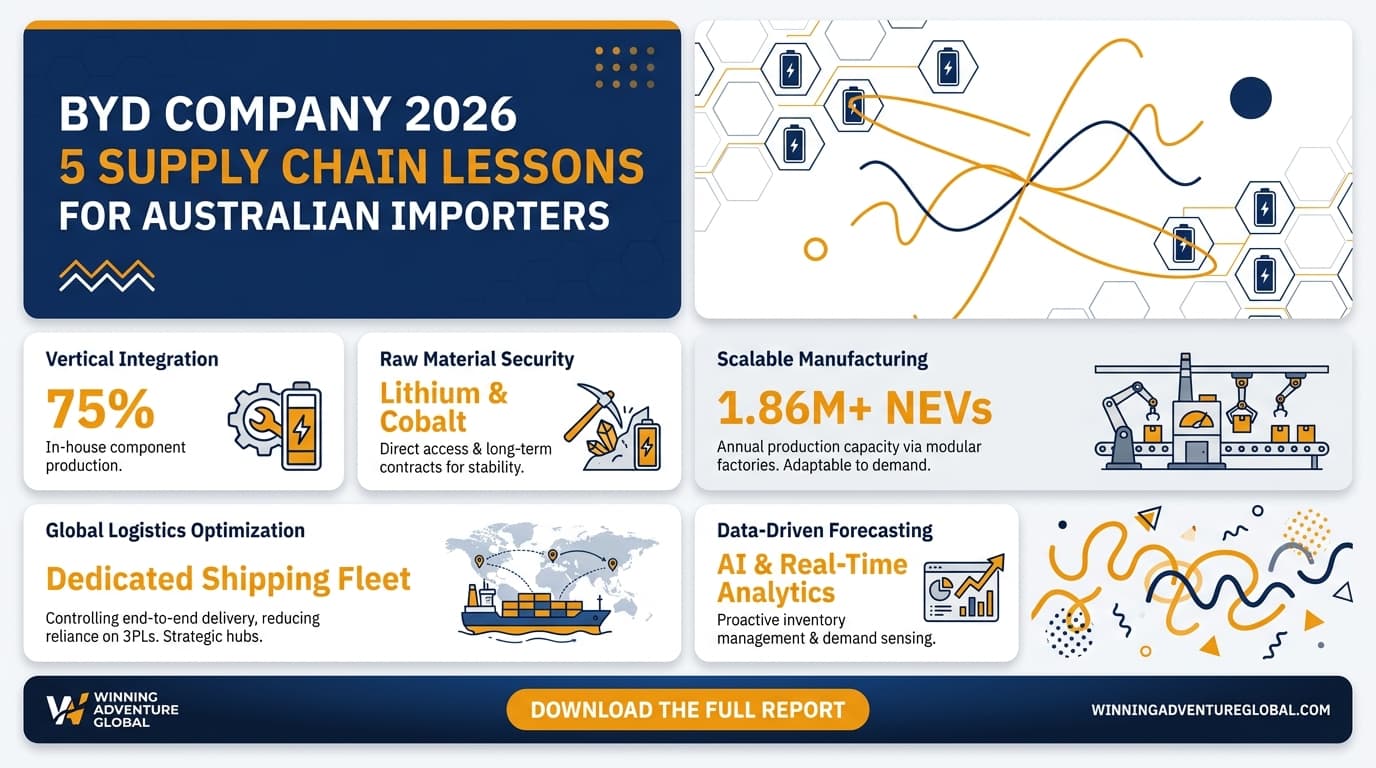
When an Australian business owner starts searching for "byd company" in 2026, they are rarely curious about electric vehicles alone. They are looking for proof that Chinese manufacturing can deliver world-class quality at scale — and whether the model that took BYD from a Shenzhen startup to the world's largest new energy vehicle manufacturer can be replicated by Australian importers.
The short answer is yes. The longer answer involves understanding exactly what BYD did differently from thousands of other Chinese manufacturers that tried and failed to go global, and which of those strategies translate to Australian SME supply chains.
This article is not about electric vehicles. It is about supply chain strategy — specifically, the five lessons every Australian importer can extract from BYD's manufacturing playbook and apply to their own China sourcing operations in 2026.
Why BYD Matters to Australian Importers
BYD — Build Your Dreams — was founded in 1995 by Wang Chuanfu, a former government researcher who started the company in a Shenzhen workshop with 20 employees and a focus on rechargeable batteries. By 2003, BYD had become the world's largest manufacturer of mobile phone batteries, supplying Nokia, Motorola, and Samsung.
That same year, BYD made a decision that defines its relevance to Australian importers today: it entered automotive manufacturing by acquiring a struggling state-owned carmaker in Xi'an. The company had no automotive experience. Industry analysts called it a mistake. Wang Chuanfu saw it differently — he believed that if BYD could master battery chemistry at scale, it could master any manufacturing process.
Twenty-three years later, BYD sold 4.25 million new energy vehicles in 2024, surpassing Tesla in global unit sales. Its market capitalisation exceeded $100 billion. It operates factories in Thailand, Brazil, Hungary, and Indonesia. Its Blade Battery technology powers vehicles from Toyota, Tesla, and Mercedes-Benz.
For an Australian SME importing from China, the significance is not the cars. It is the supply chain underneath them.
BYD did not succeed because it had better access to capital or government connections — although both played a role. It succeeded because it built a supply chain model that controlled quality at every link, from raw materials to finished products, while thousands of competitors outsourced production to the lowest bidder and lost control of their output.
The same dynamic plays out every day in Australian-China trade. Importers who understand how to structure supplier relationships, verify production capability, and build quality into their sourcing process see dramatically different outcomes from those who treat Chinese suppliers as interchangeable vendors.
How BYD Built a World-Class Supply Chain from Shenzhen
The core of BYD's supply chain strategy is vertical integration — a term that gets used loosely but means something specific in practice.
BYD manufactures its own batteries, electric motors, power semiconductors, and electronic control units. It owns lithium mines in Chile and Africa. It operates its own shipping fleet. At a time when most automakers were outsourcing electric powertrain components to specialist suppliers, BYD was building factories to produce them internally.
This approach was expensive and slow in the short term. It required enormous capital investment in factories, equipment, and engineering talent with no immediate return. But it gave BYD three advantages that are directly relevant to Australian importers:
Quality control from source to shipment. When you manufacture critical components yourself, you do not discover quality problems at the assembly line — you catch them at the component level. BYD's defect rate is among the lowest in the automotive industry because it controls the materials that go into its products, not just the finished assembly.
Cost stability through scale. BYD's battery costs per kilowatt-hour are roughly 30% lower than competitors who purchase batteries from third-party suppliers. Vertical integration eliminated the supplier margin on critical components, and the scale of BYD's production drove unit costs down further.
Supply continuity during disruption. During the 2021-2023 global semiconductor shortage, when Ford, GM, and Toyota were shutting down production lines, BYD was still building cars. It manufactured its own chips through a subsidiary. Every Australian importer who had orders delayed during COVID-era factory closures in China understands the value of this kind of resilience.
The Australian lesson is not that every SME should buy a lithium mine. It is that the sourcing decisions that feel expensive and slow in the short term — verifying suppliers before paying deposits, building direct relationships with factory management, auditing production processes rather than accepting samples — are the same decisions that determine whether your supply chain survives or fails when conditions change.
Five Supply Chain Lessons Australian SMEs Can Apply Today
The following five lessons are extracted from BYD's supply chain strategy and reframed for Australian importers who are sourcing products from China — not building electric vehicles, but needing the same discipline in supplier selection and management.
| BYD Practice | What It Means for Australian Importers | Practical Action |
|---|---|---|
| Vertical integration of critical components | Identify which parts of your supply chain are too important to outsource blindly | Visit your supplier's factory or commission a pre-shipment audit before placing the first order |
| Multi-source strategy for non-critical inputs | Never depend on a single supplier for any component that would stop your business if it failed | Qualify at least two Chinese suppliers for every product line, even if you only order from one |
| In-house quality testing at every stage | Do not accept the supplier's own QC report as your only quality check | Engage a third-party inspection agent to check your order before shipment |
| Long-term supplier partnerships with shared R&D | Invest in supplier relationships beyond price negotiations | Visit your factory at least once per year, share your product roadmap, negotiate multi-season contracts |
| Localised production near end markets | Understand your supplier's full production chain, not just the final assembly point | Map your supplier's raw material sources — a factory in Guangdong may depend on components from Jiangsu |
Lesson 1: Own the Relationship, Not Just the Transaction
BYD's supplier agreements are not structured as arm's-length purchase orders. They are multi-year partnerships that include shared technology development, joint production planning, and reciprocal investment. Wang Chuanfu personally visits key supplier factories.
Australian importers frequently make the opposite mistake: they negotiate entirely through Alibaba messaging or WeChat, place orders based on catalog photos, and never meet the people who will manufacture their products. When the supplier relationship is purely transactional, the supplier treats it as transactional — and the Australian buyer has no leverage when something goes wrong.
The fix is straightforward: build direct relationships with factory management. Visit the production floor. Understand how the factory operates, who makes the key decisions, and what their constraints are. This is not about being friendly — it is about having enough information to manage risk.
Lesson 2: Verify Before You Commit
BYD does not onboard a new supplier without an on-site audit. Its supplier qualification process includes inspection of production equipment, review of quality management systems, verification of raw material sourcing, and testing of sample output against specifications.
For Australian importers, the equivalent is supplier verification before paying a deposit. The minimum checklist includes:
- Business license verification through China's National Enterprise Credit Information Publicity System
- Factory address confirmation — does the registered address match an actual industrial facility
- Production line walkthrough — in person or via live video
- Reference check with at least two existing international buyers
- Third-party sample testing against Australian standards where applicable
A single factory visit costs less than the deposit on most import orders. A deposit lost to a trading company posing as a manufacturer costs the entire order value plus the opportunity cost of missed sales.
Lesson 3: Build Redundancy Into Your Supplier Base
BYD's supply chain includes backup suppliers for every critical component. When a primary supplier in one province was shut down during China's 2022 COVID lockdowns, BYD shifted production to backup suppliers in other provinces within 48 hours. The company had pre-qualified those backups before it needed them.
Most Australian importers operate with a single Chinese supplier per product line. When that supplier has a problem — factory shutdown, raw material shortage, quality failure, regulatory issue — the Australian business has no fallback. Orders are delayed. Customers are lost. Revenue stops.
Qualifying a backup supplier costs time but not much money. It means conducting the same verification process for a second factory, placing a small trial order, and maintaining the relationship with occasional communication. The backup may never be used, but the cost of not having one is measured in months of lost sales.
Lesson 4: Audit Quality at Source, Not at Delivery
BYD tests components at the supplier's factory before they ship, not when they arrive at BYD's assembly line. This means quality problems are caught within hours of production, not weeks later when the components have already been shipped across the country.
Australian importers typically discover quality problems when the container arrives in Sydney or Melbourne — weeks after production, with shipping costs already paid and no practical recourse other than negotiating a discount on the next order.
Third-party inspection in China before shipment changes this entirely. An inspection agent visits the factory, checks the goods against the agreed specification, tests samples, and issues a report before the container is loaded. Problems caught at this stage can be fixed. Problems caught after arrival in Australia cannot.
Inspection costs range from $200 to $400 per order depending on product complexity and factory location. Compare that to the cost of importing an entire container of unsellable product.
Lesson 5: Invest in Long-Term Supplier Development
BYD does not switch suppliers based on price alone. When a supplier delivers quality and reliability, BYD invests in that relationship — sharing technology, providing production equipment, and offering multi-year volume commitments that help the supplier plan capacity.
Australian importers often take the opposite approach: switching suppliers every season to chase marginal price reductions. This signals to Chinese factories that the relationship is temporary, and they respond by cutting corners on materials, reducing quality control investment, and deprioritising the Australian buyer's orders when capacity is tight.
A stable, long-term supplier relationship gives you priority when production slots are limited, better pricing over time as the supplier's efficiency improves with your volume, and a partner who has invested in understanding your quality requirements.
How to Vet Chinese Suppliers Using BYD's Standards
The most common question from Australian businesses sourcing from China for the first time is: "How do I know if a supplier is legitimate?"
BYD's supplier qualification framework provides a template, scaled down for SME use. The following process mirrors what BYD's procurement team does before approving a new supplier, adapted for the resources available to a typical Australian importing business.
Step 1: Document Verification
Before any conversation about pricing or samples, verify the supplier's legal identity. Request a copy of their business license (yingye zhizhao) and check it against the National Enterprise Credit Information Publicity System. Confirm the registered business scope includes the type of products you are sourcing. A company registered as a trading company cannot legally manufacture — its scope will say "wholesale and retail" rather than "manufacturing."
Step 2: Factory Location Verification
The business license includes a registered address. Compare this to the address the supplier uses in communication. Use satellite imagery to confirm the location is an industrial facility, not a commercial office building. A supplier claiming to be a manufacturer but registered at an office tower address is almost certainly a trading company.
Step 3: Production Capability Audit
This step requires being on the ground — either yourself, a trusted partner, or a third-party inspection agent. Walk the production line. Count the machines. Observe the workers. Ask about current orders — a factory at 60% capacity versus 95% capacity tells you very different things about their reliability and lead times.
Step 4: Reference Verification
Request contact details for at least two international buyers the supplier has worked with in the past 12 months. Contact those buyers directly. Ask about quality consistency, delivery reliability, and how the supplier handled problems when they occurred. Every supplier has problems — the relevant question is how they respond.
Winning Adventure Global has applied this framework across more than 200 factory visits in Guangdong, Zhejiang, Jiangsu, and Fujian provinces. The results are consistent: suppliers that pass all four steps deliver reliable quality and on-time shipments. Suppliers that fail even one step almost always cause problems within the first three orders.
Building a Resilient Australia-China Supply Chain in 2026
The Australia-China trade environment in 2026 is more complex than at any point in the past decade. Tariff adjustments, compliance requirements, shipping volatility, and geopolitical uncertainty have made supply chain management a strategic priority rather than a procurement afterthought.
Australian businesses that treat China sourcing as a tactical purchasing exercise — find the cheapest supplier, place orders, hope for the best — will continue to experience the same problems: delayed shipments, quality failures, deposit losses, and compliance surprises.
Businesses that adopt a structured approach — verify suppliers before paying deposits, build direct relationships with factory management, audit quality at source, maintain backup suppliers, and invest in long-term partnerships — will have supply chains that perform predictably regardless of external conditions.
BYD proved that Chinese manufacturing can compete at the highest level of global industry. The same principles that built the world's largest EV supply chain are available to Australian importers sourcing products from China. The question is whether you apply them.
Frequently Asked Questions
How did BYD build such a strong global supply chain?
BYD's supply chain strength comes from vertical integration — manufacturing its own batteries, motors, semiconductors, and electronic control systems rather than buying them from external suppliers. The company also invested heavily in supplier development, building long-term partnerships with factories that meet its quality standards and providing them with technology, equipment, and multi-year volume commitments. This combination of internal capability and deep supplier relationships created a supply chain that proved resilient during global disruptions including the semiconductor shortage and COVID-era factory shutdowns.
What can Australian SMEs realistically learn from a $100 billion Chinese company?
The scale differs but the principles transfer directly. BYD's approach to supplier verification (on-site audits before onboarding), quality control (testing at source not at delivery), supplier redundancy (pre-qualified backups for critical inputs), and long-term partnerships (multi-year commitments over price shopping) are all achievable for Australian importers sourcing from China. A $300 third-party inspection before shipment applies the same logic as BYD's in-house quality team — catch problems before they become expensive. Qualifying a backup supplier costs time, not capital. Visiting your supplier's factory costs less than a lost deposit.
How do I verify a Chinese supplier before paying a deposit?
Supplier verification follows four steps: (1) Check the supplier's business license against China's National Enterprise Credit Information Publicity System to confirm legal registration and business scope; (2) Verify the factory address using satellite imagery to distinguish industrial facilities from office buildings; (3) Conduct a production capability audit — walk the production line, count machines, observe workers, check current order volume; (4) Contact at least two existing international buyers for reference checks on quality, reliability, and problem resolution. A supplier that passes all four steps is statistically likely to deliver reliable quality and on-time shipments.
Which industries benefit most from BYD-style supply chain strategies?
Any Australian business importing physical products from China benefits from structured supplier management, but the impact is highest in industries where product quality directly affects customer satisfaction and brand reputation. Apparel and textiles, furniture and homewares, electronics and accessories, sporting goods and merchandise, building materials, and industrial components all see significant improvement in consistency and reliability when importers move from transactional purchasing to structured supplier management. The common factor is not the industry but the sourcing approach — importers who treat Chinese suppliers as partners rather than vendors consistently outperform those who chase the lowest unit price.
Take the Next Step
The difference between Australian importers who thrive in the China-Australia trade and those who lose money to supplier problems is not luck, industry knowledge, or volume. It is process. The importers who verify suppliers before paying deposits, audit quality before shipment, and invest in long-term factory relationships build supply chains that deliver predictable results. The ones who treat Chinese suppliers as interchangeable vendors spend their time managing crises.
Winning Adventure Global has conducted over 200 factory visits across China's manufacturing provinces. We know which suppliers are legitimate, which factories are reliable, and which processes protect Australian businesses from the most common sourcing failures. Before you pay another deposit, before you place another order, before you spend another week chasing a supplier who has gone quiet — let us help you build a supply chain that works.
Every day you operate without verified suppliers is a day your business carries unnecessary risk. Your competitors who source with a structured process are not paying more for their products — they are paying less for their problems.
China Sourcing Strategy
Tired of losing deposits to unverified Chinese suppliers?
Winning Adventure Global has vetted 200+ factories across China. We help Australian SMEs identify, verify, and connect with reliable manufacturers — so you can build a supply chain with the resilience of a global leader.
Get Free Supplier ShortlistFree initial consultation · We respond within 4 business hours