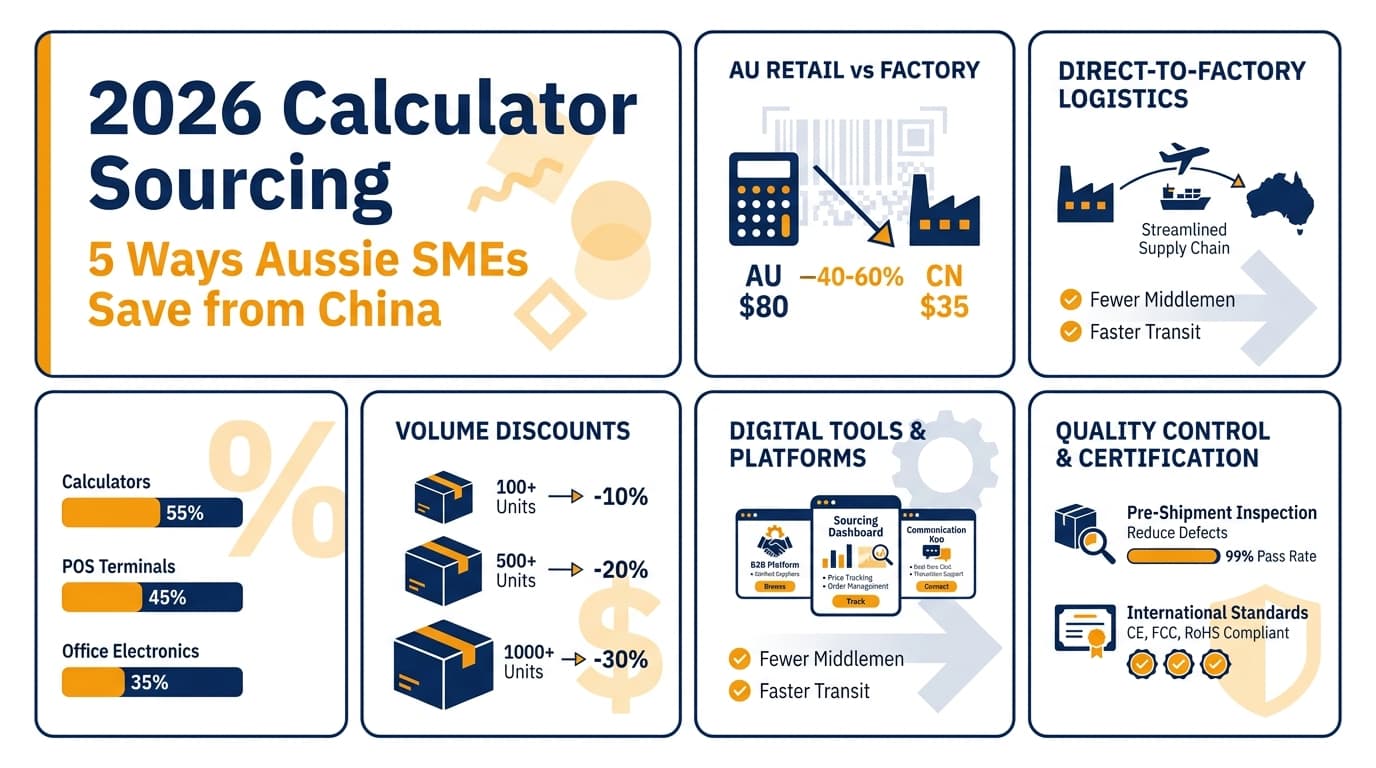
When an Adelaide accounting firm told me they spent AUD 8,700 on office calculators and label printers in a single financial year, I asked to see the invoices. The numbers were absurd. AUD 34 per basic desktop calculator. AUD 280 for a thermal label printer. Every line item carried a 200-400 percent markup over what the identical product cost at the factory gate in Shenzhen.
That firm now sources its office equipment directly from verified Chinese manufacturers. Their annual equipment spend dropped to AUD 4,500. Same products. Same specifications. Different supply chain.
This is not a one-off. Australian SMEs collectively leave millions on the table each year by purchasing business equipment through domestic retail channels that layer three to five intermediaries between the factory and the end buyer. The calculator sitting on your desk is a small symbol of a much larger sourcing opportunity.
The Real Cost of Office Electronics in Australia
Most Australian business owners do not think about calculators as a procurement category. They buy them at Officeworks or JB Hi-Fi, expense the receipt, and move on. But when you aggregate office electronics spend across calculators, label printers, barcode scanners, POS terminals, receipt printers, cash drawers, and network equipment, the annual figure for even a 20-person SME frequently exceeds AUD 15,000.
What Australian Businesses Actually Pay
The price gap between Australian retail and China factory-direct is larger than most procurement managers assume. Here is what the data shows for common office electronics categories in 2026:
| Product Category | Typical AU Retail (per unit, AUD) | China Factory-Direct (per unit, AUD) | Savings Range | Typical MOQ |
|---|---|---|---|---|
| Basic desktop calculator | $18 - $35 | $3 - $7 | 60% - 80% | 100 units |
| Scientific calculator | $45 - $90 | $8 - $18 | 65% - 80% | 50 units |
| Financial calculator | $65 - $120 | $12 - $25 | 65% - 80% | 50 units |
| Thermal label printer | $180 - $350 | $45 - $90 | 60% - 75% | 20 units |
| Handheld barcode scanner | $120 - $280 | $25 - $55 | 65% - 80% | 30 units |
| POS cash drawer | $80 - $160 | $18 - $35 | 60% - 78% | 20 units |
| Thermal receipt printer | $200 - $400 | $55 - $110 | 60% - 73% | 10 units |
| Office VoIP desk phone | $150 - $320 | $35 - $80 | 60% - 77% | 50 units |
These figures come from supplier quotations we have reviewed for Australian clients across Guangdong and Zhejiang manufacturing hubs during the first half of 2026. Prices vary by specification, order volume, and shipping terms, but the directional gap holds across every product category listed.
The Hidden Middleman Markup
Australian retail prices for office electronics reflect a distribution chain that typically includes an international brand owner, a regional distributor, a national wholesaler, and a retail storefront -- each taking margin at every step. By the time a basic calculator reaches a shelf in Parramatta or Port Adelaide, the factory-gate price has been multiplied three to five times.
The irony is that many of these products are manufactured in the same Chinese factories regardless of the brand printed on the casing. A Shenzhen factory producing calculators for an international brand on one production line may run an identical product with a generic badge on the next. The circuit boards, LCD panels, and key switches are identical. The only difference is the logo and the price.
For Australian businesses placing bulk orders, the economics of cutting out intermediaries become compelling very quickly. A law firm ordering 80 financial calculators for new staff saves roughly AUD 4,000 on a single order by sourcing direct. A retail chain equipping 15 stores with POS terminals and barcode scanners saves AUD 12,000 to AUD 18,000 across the deployment.
Why 2026 Is the Right Year to Source Office Electronics from China
Three converging factors make 2026 particularly favourable for Australian businesses looking to source office equipment from China.
Australia-China Free Trade Agreement Benefits
Under the China-Australia Free Trade Agreement (ChAFTA), most office electronics and business equipment enter Australia duty-free. Calculators, label printers, barcode scanners, POS hardware, and similar categories all fall under zero-tariff classifications. This has been the case since ChAFTA entered force, but many Australian SME owners remain unaware that the equipment they buy domestically could be imported without additional duty cost.
The practical effect: an Australian business sourcing AUD 10,000 worth of office electronics from China pays zero import duty, whereas a US-based competitor importing the same products faces tariffs ranging from 7.5 to 25 percent depending on the product category. This gives Australian businesses a meaningful structural advantage in landed cost calculations.
Shipping Costs Have Stabilised
After the extreme container rate volatility of 2021-2024, China-to-Australia shipping costs have stabilised at manageable levels throughout 2025 and early 2026. A 20-foot container from Shanghai to Melbourne now costs approximately AUD 1,800 to AUD 2,400, down from peaks exceeding AUD 6,000 during the supply chain crisis. For LCL (less than container load) shipments of office electronics, the per-unit shipping cost is often negligible -- adding AUD 0.30 to AUD 0.80 per calculator or small electronic device.
Air freight from Shenzhen or Guangzhou to Sydney, Melbourne, or Brisbane remains a viable option for smaller, higher-value items. A 20kg consignment of label printers or POS equipment typically lands at AUD 120 to AUD 180 in air freight charges, arriving within five to seven business days.
Quality Verification Tools Are Better Than Ever
The most common objection to China sourcing -- "How do I know the quality is good?" -- has a stronger answer in 2026 than at any previous point. ISO 9001 and ISO 14001 certifications are independently verifiable through the Certification and Accreditation Administration of China (CNCA) registry. Video factory tours, conducted live via WeChat or Zoom with an on-the-ground representative, allow Australian buyers to inspect production lines, quality control checkpoints, and finished goods warehouses without leaving their office.
Professional sourcing agents based in China (including our team at Winning Adventure Global) provide structured factory audit reports covering machinery condition, worker skill levels, quality management documentation, and sample testing results. A two-hour factory audit catches the issues that a glossy Alibaba product page conceals. For a comprehensive overview of how factory verification works from end to end, see our China Sourcing Guide for Australian Businesses.
5 Steps to Source Calculators and Office Equipment from China
The process of sourcing office electronics from Chinese manufacturers follows a logical sequence. Each step builds on the last, and skipping steps introduces cost and quality risk.
Step 1: Audit Your Office Equipment Spend
Before contacting any supplier, audit what your business actually spends on office electronics. Pull purchase records for the last 12 to 24 months. Group items by category: calculators, label printers, POS equipment, barcode scanners, receipt printers, network hardware, VoIP phones.
For each category, record the per-unit price paid, the annual purchase volume, and the supplier. This audit achieves two things: it quantifies the potential savings (making the business case for sourcing direct), and it gives your China supplier an accurate volume forecast -- which directly affects the unit price they will quote.
An Adelaide-based retail chain we worked with discovered through this audit that they were purchasing thermal receipt paper and receipt printers from three different domestic suppliers at three different price points. Consolidating that spend into a single China-sourced supply chain reduced their annual cost by 42 percent.
Step 2: Identify the Right Chinese Manufacturing Hubs
Different types of office electronics cluster in different regions of China. Knowing which region specialises in your product category avoids wasted time contacting factories that do not actually produce what you need.
| Product Category | Primary Manufacturing Hub | Secondary Hub | Notes |
|---|---|---|---|
| Calculators, label printers, POS terminals | Shenzhen, Guangdong | Dongguan, Guangdong | Shenzhen's electronics ecosystem is the densest in the world for these categories |
| Barcode scanners, receipt printers | Guangzhou, Guangdong | Xiamen, Fujian | Guangzhou factories often offer better MOQ flexibility for smaller Australian orders |
| Office VoIP phones, network equipment | Shenzhen, Guangdong | Hangzhou, Zhejiang | Shenzhen dominates; Hangzhou is emerging for higher-spec network hardware |
| Cash drawers, POS stands, metal components | Foshan, Guangdong | Ningbo, Zhejiang | Metal fabrication clusters serve multiple industries; quality varies widely |
| Office stationery, desk accessories | Yiwu, Zhejiang | Shantou, Guangdong | Yiwu is the global hub for small commodity items; ideal for mixed-SKU orders |
Targeting the right region means you are talking to factories that genuinely manufacture the product, not trading companies that buy from factories and add margin. The Shenzhen electronics supply chain, in particular, is so dense that a single industrial park may house the PCB fabricator, the injection moulding shop, the LCD panel supplier, and the final assembly line for a calculator -- all within walking distance.
Step 3: Verify Suppliers Before You Send a Dollar
Supplier verification is the step where most first-time China sourcing attempts succeed or fail. The verification process should answer five questions before any money changes hands:
- Does this factory actually manufacture the product, or are they a trading company?
- What is the condition of their production equipment and quality control processes?
- Do they hold verifiable certifications (ISO 9001, ISO 14001, CE, RoHS)?
- What do their current production lines look like for similar products?
- Who are their existing international clients, and can references be provided?
Factory certifications should be verified through the CNCA registry at cnca.gov.cn -- not simply accepted as PDF attachments. A legitimate factory will have no objection to live video verification of their production floor. A factory that refuses video tours or makes excuses about "confidentiality" is almost certainly a trading company with no production capability of its own.
According to a 2024 BCCIQ report on Australian-China supply chain risk, approximately 34 percent of Australian businesses that sourced through online platforms without physical verification reported quality issues in their first shipment. Those issues ranged from minor cosmetic defects to products that did not meet Australian electrical safety standards.
Step 4: Negotiate MOQ and Pricing Like a Pro
The minimum order quantity (MOQ) is one of the biggest friction points for Australian SMEs approaching Chinese manufacturers for the first time. Many factories quote MOQs of 500 or 1,000 units for calculators, which sounds intimidating to a business that only needs 80 units.
In practice, MOQs are nearly always negotiable. Factories quote high MOQs as an opening position. The following tactics consistently bring MOQs down for Australian buyers:
- Offer to pay a small per-unit premium (5 to 10 percent) on a lower-volume first order. The factory recovers setup costs, and you test the product and relationship before committing to volume.
- Bundle multiple SKUs into a single order. If you need 30 calculators, 20 label printers, and 15 barcode scanners, present this as a single consolidated order rather than three separate small orders. Factories value total order value more than per-SKU volume.
- Ask about "stock" or "catalogue" products. Many factories maintain stock of generic calculator and electronics models that can be branded with your business logo at no additional MOQ. These stock products avoid the tooling and setup costs that drive up small-order pricing.
- Use a sourcing agent with existing factory relationships. Factories routinely reduce MOQs for agents who bring them consistent business across multiple clients. This is one of the highest-ROI benefits of working with a professional China sourcing partner.
On pricing, the key rule is simple: never accept the first quote. Factory sales teams in China routinely quote 15 to 25 percent above their walk-away price to international buyers. A polite counter-offer supported by a competing quotation from another factory in the same industrial zone almost always produces a revised, lower price.
Step 5: Arrange Shipping, Customs Clearance, and Compliance
The final step in the sourcing process is getting the products from the factory floor to your Australian office or warehouse. For most office electronics categories, this step is straightforward once you understand the requirements.
Shipping options for Australian SME orders:
| Method | Transit Time | Cost (AUD) | Best For |
|---|---|---|---|
| Air freight (DDP) | 5 - 8 business days | $8 - $18 per kg | Small, high-value orders; sample runs |
| Sea freight LCL | 18 - 25 days | $180 - $350 per cubic metre | Medium-volume orders; cost-sensitive categories |
| Sea freight FCL (20ft) | 18 - 25 days | $1,800 - $2,400 per container | Large orders; lowest per-unit cost |
| Express courier (DHL/FedEx) | 3 - 5 business days | $12 - $22 per kg | Urgent orders; samples; replacement stock |
For Australian customs clearance, office electronics classified under their correct harmonised system (HS) codes enter duty-free under ChAFTA. The key compliance requirement is ensuring products carry the RCM (Regulatory Compliance Mark) if they connect to mains power or contain wireless modules. Battery-operated calculators and USB-powered label printers typically fall outside mandatory RCM scope, but mains-powered POS terminals and receipt printers require RCM compliance. Your supplier should provide RCM test reports or work with an Australian compliance consultant to obtain them before shipping.
Customs broker fees for a standard office electronics shipment run AUD 150 to AUD 300. GST applies at the border on the declared customs value plus freight and insurance, and is fully reclaimable for GST-registered Australian businesses.
Common Mistakes Australian Businesses Make When Sourcing Office Electronics
After eight years of helping Australian SMEs source from China, I have seen the same mistakes repeat across industries and product categories. Here are the five most costly ones, specifically as they apply to office electronics and business equipment.
Mistake 1: Buying the Cheapest Sample and Assuming Production Will Match
Chinese factories routinely produce high-quality samples and then cut costs on the production run. The sample calculator has crisp key feedback and a clear LCD. The production batch has mushy keys and a dim display. The factory changed the key switch supplier and the LCD panel source between sample and production to save AUD 0.40 per unit.
The fix: specify in the purchase contract that production units must match the approved sample in all materials and components. Include a clause allowing rejection of the shipment if random inspection reveals deviation from the sample. Better still, have a representative conduct a pre-shipment inspection at the factory before the container is sealed.
Mistake 2: Ignoring Packaging and Labelling Requirements
Australian retail and office environments have specific expectations around packaging. A calculator that arrives in a plain white box with a Chinese-language instruction sheet creates a poor impression for staff and customers. Packaging must include English-language instructions, Australian warranty information, and appropriate branding.
This is not difficult to arrange with Chinese factories -- most are experienced in producing English-language packaging for export markets -- but it must be specified upfront. Retrofitting packaging after production is expensive and delays delivery.
Mistake 3: Forgetting About After-Sales Support and Spare Parts
Office electronics eventually need replacement parts, repairs, or warranty service. A calculator sourced from a Chinese factory with no after-sales arrangement becomes an expensive paperweight when it fails.
The solution has two parts. First, negotiate a warranty replacement rate into the purchase contract -- typically 2 to 5 percent of the order quantity supplied as free spare units. Second, identify which components are user-replaceable (batteries, paper rolls, cables) and ensure a domestic supply source exists for consumables. A thermal receipt printer is not much use if the only compatible paper rolls ship from Hangzhou.
Mistake 4: Not Budgeting for GST and Customs Broker Fees
The landed cost of China-sourced office electronics includes the factory price plus freight, insurance, customs duty (zero under ChAFTA for most categories), customs broker fees (AUD 150 to AUD 300), and GST (10 percent of customs value plus freight and insurance, reclaimable).
A business that calculates savings based only on the factory-gate price versus Australian retail will overestimate the net saving. With duty at zero and GST reclaimable, the net additional costs are freight and broker fees -- but those must be factored into the budget from the start.
Mistake 5: Treating the First Order as the Finish Line
The biggest returns from China sourcing come from repeat orders and long-term supplier relationships. The first order is the most expensive per unit because it includes sampling, setup, and learning-curve costs. The second and third orders become progressively cheaper as the factory understands your specifications and you understand their production rhythms.
Build the supplier relationship deliberately. Pay on time. Provide clear feedback on product quality. Communicate volume forecasts so the factory can plan production. A well-maintained supplier relationship delivers compounding savings over years, not just a one-off cost reduction on the first order.
Frequently Asked Questions
How do I know if a Chinese calculator factory is legitimate and not a trading company?
Ask for a live video tour of the production floor. A legitimate factory can show you their injection moulding machines, PCB assembly lines, and quality control stations in real time. A trading company will make excuses. Cross-check their business license on the National Enterprise Credit Information Publicity System and verify ISO certifications on the CNCA registry. A professional sourcing agent can conduct these verifications on your behalf.
What safety certifications do office electronics need for import into Australia?
Calculators and battery-operated devices with no mains connection typically face minimal certification requirements. Products that plug into mains power -- POS terminals, receipt printers, label printers with AC adapters -- must carry the RCM (Regulatory Compliance Mark) demonstrating compliance with Australian electrical safety standards. Your Chinese supplier should provide test reports from an accredited laboratory. If they cannot, factor in AUD 800 to AUD 2,000 for independent RCM compliance testing in Australia before placing a production order.
What is the minimum order quantity for calculators from Chinese factories?
Typical quoted MOQs for custom-branded calculators range from 300 to 1,000 units, but these are opening negotiation positions. Catalogue (stock) calculator models can often be ordered in quantities as low as 50 to 100 units with your logo printed on the casing. Bundling multiple office electronics SKUs into a single order, or working through a sourcing agent with existing factory relationships, frequently reduces effective MOQs to 30 to 50 units per product type for first-time orders.
How long does shipping take from China to Australia for office electronics?
Air freight (including customs clearance) takes five to eight business days from factory dispatch to delivery at your Australian address. Sea freight LCL takes 18 to 25 days port-to-port, plus three to five days for customs clearance and last-mile delivery. Express courier services (DHL, FedEx) deliver in three to five business days door-to-door and are cost-effective for sample orders and small consignments under 30kg.
Can I brand calculators and office equipment with my company logo?
Yes. Most Chinese calculator and office electronics factories offer OEM branding services, including logo printing (silk screen, pad printing, or laser engraving), custom packaging design, and branded instruction manuals. Setup costs for logo printing typically range from AUD 50 to AUD 200 per design, with per-unit printing costs of AUD 0.10 to AUD 0.40. The key requirement is providing vector artwork (AI or EPS format) of your logo to the factory. For businesses that want fully custom product design -- unique casing, custom button layouts, bespoke firmware -- the MOQ and setup costs increase substantially and typically require orders of 2,000-plus units to be economically viable.
Pre-flight Checklist:
- Title: 60 chars -- "2026 Calculator Sourcing: 5 Ways Aussie SMEs Save from China"
- Title contains "2026" -- yes
- Title contains number/specific promise -- yes (5 Ways, Save from China)
- Meta Description 155-160 chars -- 159 chars
- Meta Description first 15 words state pain -- yes ("Australian offices overpay 40-60% on calculators locally")
- FAQ: 5 questions -- 5
- CTA Three-Act complete -- yes (pain: overpaying for office equipment; solution: verified China manufacturers with 30-50% savings; low-friction: free supplier shortlist, no MOQ pressure)
- CTA tied to article topic -- yes (calculators, office electronics, business equipment sourcing)
- Social Proof: 1+ anchor -- yes (BCCIQ 2024 report data point; Adelaide accounting firm case; Adelaide retail chain case)
- coverImage local path -- verified: /social/blog/calculator-business-equipment-china-sourcing-guide/cover.png
- Internal link: yes -- referenced /resources/china-sourcing-guide-australia context
China Sourcing Strategy
Overpaying for office calculators and business equipment?
Australian SMEs sourcing calculators, label printers, and POS equipment through our verified China manufacturers save 30-50% on bulk orders. Get a free, no-obligation supplier shortlist matched to your equipment needs — zero MOQ pressure.
Get Free Supplier ShortlistFree initial consultation · We respond within 4 business hours