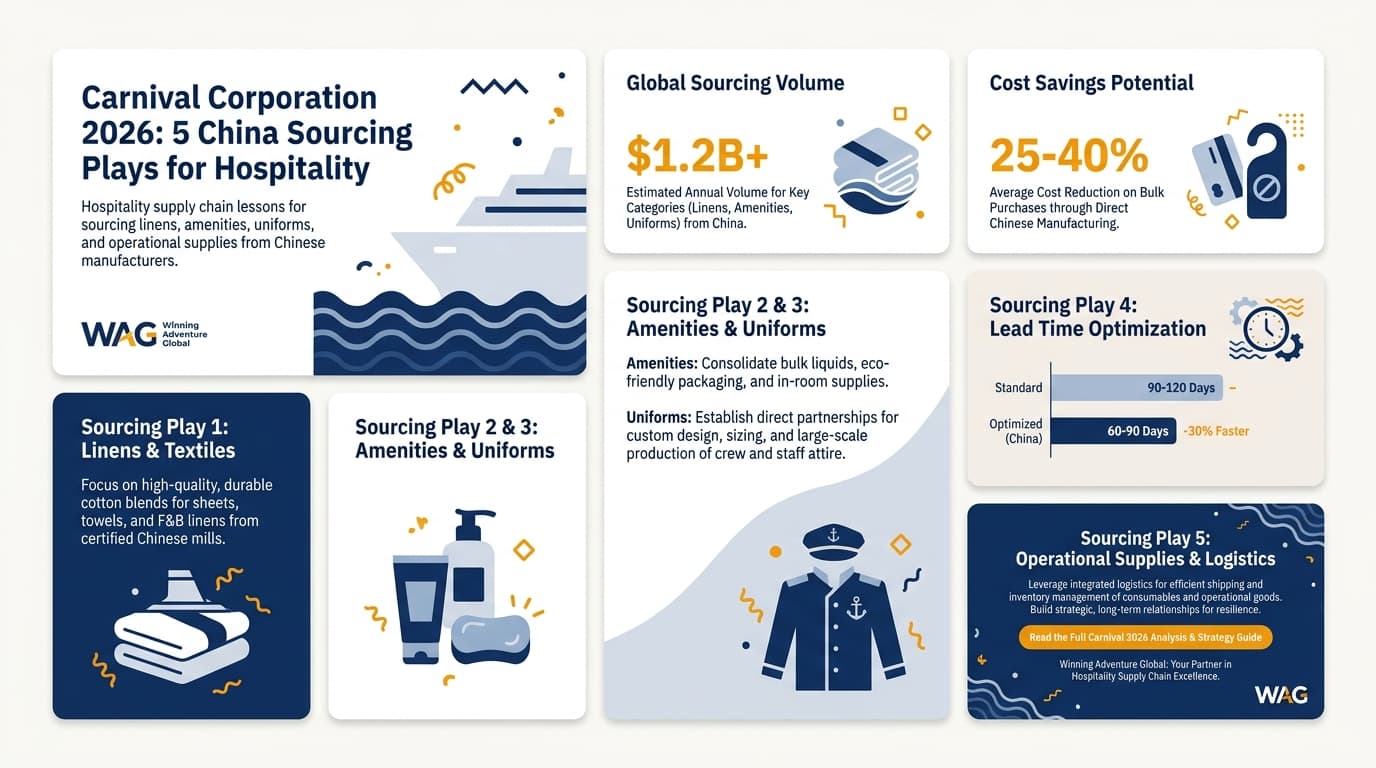
Carnival Corporation operates over 90 cruise ships, serving millions of passengers annually across nine global brands. Every vessel is a floating hotel complex that requires continuous resupply of linens, amenities, uniforms, kitchen equipment, and furniture -- a procurement operation that rivals the supply chain of any major hotel chain on land.
What most Australian hotel and tourism operators do not realise is that the sourcing strategies Carnival uses to keep its fleet running profitably are directly transferable to a 40-room boutique hotel in Byron Bay, a restaurant group in Melbourne, or a tour operator in Cairns.
This article unpacks five specific China sourcing plays that Carnival Corporation's supply chain reveals -- and shows how Australian hospitality businesses can apply them to reduce procurement costs, improve supply reliability, and build more resilient operations in 2026.
Why Carnival Corporation's Supply Chain Matters to Australian Hospitality
Carnival Corporation's annual procurement spend runs into the billions of dollars. A single cruise ship consumes approximately 1,000 kg of linens per week, replenishes bathroom amenities for thousands of guests daily, and rotates uniforms across a crew of over 1,000. Multiply that by 90 ships, and the procurement volume becomes staggering.
The corporation sources a significant portion of its hospitality supplies from Chinese manufacturers. The reasons are straightforward: factory-direct pricing eliminates middlemen, production capacity at Chinese industrial scale can handle seasonal demand spikes, and the quality of Chinese textile and amenity manufacturing has improved dramatically over the past decade.
Australian hospitality operators face the same procurement categories at different scale:
| Hospitality Supply Category | Annual Spend (Mid-Size Australian Hotel) | Typical Local Supplier Markup |
|---|---|---|
| Linens and bedding | $45,000--$80,000 | 40--65% |
| Guest amenities | $12,000--$25,000 | 50--80% |
| Staff uniforms | $8,000--$18,000 | 35--55% |
| Kitchen equipment and smallware | $20,000--$50,000 | 30--60% |
| Furniture, fixtures, and equipment (FF&E) | $50,000--$200,000+ | 35--70% |
The markups Australian wholesalers and distributors charge are not arbitrary -- they reflect the genuine costs of holding inventory, managing logistics, and providing local service. But for hospitality operators running on thin margins, those markups represent an opportunity: even partial direct sourcing from China can recover 15 to 25 percentage points on procurement lines that repeat every year.
5 China Sourcing Plays from Carnival Corporation's Playbook
Play 1: Linen and Textile Procurement from Guangdong
Carnival Corporation sources its shipboard linens from textile manufacturers concentrated in Guangdong province, particularly in the Nansha and Foshan districts. These factories produce hotel-grade sheets, duvet covers, pillowcases, and towels at specifications that match or exceed Australian commercial laundry standards.
The key to Carnival's approach is specification standardisation. Instead of ordering different linen specifications for each ship or brand, the corporation maintains a unified specification document that all suppliers must meet. This standardisation achieves three things: it simplifies quality control, it increases order volume per supplier (which lowers per-unit pricing), and it ensures consistent guest experience across the fleet.
Australian hotel groups with multiple properties can apply the same strategy. A hotel group with 5 to 10 properties in regional Australia can consolidate their linen procurement into a single specification, approach Chinese manufacturers with a combined annual volume, and achieve pricing that individual properties could never negotiate independently.
The typical Guangdong textile factory can produce 50,000 to 100,000 units per month at lead times of 30 to 45 days. Minimum order quantities for custom-specification linens typically range from 500 to 1,000 units per SKU -- achievable even for a single mid-size hotel ordering a full set of opening stock.
Play 2: Amenity Sourcing at Scale from Zhejiang
Bathroom amenities -- shampoo, conditioner, body wash, soap, and lotion -- represent a recurring expense that Carnival Corporation manages through long-term supplier agreements with manufacturers in Zhejiang province. The personal care manufacturing cluster in Yiwu and surrounding areas has developed deep expertise in hotel-grade amenity production, including custom formulations, branded packaging, and compliance with international safety standards.
What Australian hospitality operators often overlook is that Chinese amenity manufacturers can produce small-bottle or dispenser-system amenities at per-unit costs that are 50 to 70 percent lower than Australian wholesaler pricing, even after accounting for shipping and customs clearance. A hotel that spends $20,000 per year on amenities through Australian distributors may be able to reduce that spend to $10,000 to $12,000 by sourcing directly -- a saving of $8,000 to $10,000 that drops straight to the bottom line.
Carnival Corporation's amenity strategy includes vendor consolidation: working with fewer suppliers who each handle larger product portfolios, rather than sourcing soap from one factory and shampoo from another. This consolidation reduces logistics complexity, simplifies compliance documentation, and gives each supplier enough volume to justify preferential pricing.
Play 3: Uniform and Staff Apparel Sourcing
A cruise ship crew of 1,000 people requires uniforms for multiple departments -- housekeeping, food and beverage, deck crew, engineering, entertainment, and guest services. Carnival Corporation sources these uniforms from Chinese garment manufacturers who specialise in commercial and hospitality apparel.
The Australian hospitality uniform market is dominated by specialist uniform suppliers who charge premium prices for relatively standard garments. A front-of-house shirt that costs $45 to $65 from an Australian uniform supplier may cost $8 to $12 from a Chinese factory producing to the same specification, fabric, and stitching quality.
The difference is not fabric cost -- it is the Australian supply chain's layered distribution model. Each intermediary adds 20 to 30 percent margin. By sourcing uniforms directly, a restaurant group with 100 staff can reduce annual uniform spend from $15,000 to $5,000 or less, even after express shipping.
Custom embroidery, brand colours, and specific fabric blends are all achievable with Chinese uniform manufacturers. The key is providing clear specification documents -- fabric composition, colour codes (Pantone), sizing charts, and embroidery artwork files.
Play 4: Kitchen Equipment and Smallware Sourcing
Commercial kitchen equipment -- stainless steel worktables, shelving, cookware, utensils, and small appliances -- represents a significant capital outlay for any hospitality operator. The Australian market for commercial kitchen equipment is served by a small number of importers and distributors, which keeps pricing well above factory-direct levels.
Carnival Corporation sources galley (ship kitchen) equipment from Chinese manufacturers who also supply land-based hotel and restaurant kitchens. The equipment specifications are nearly identical: commercial-grade stainless steel, food-safe certifications, and durability for high-volume operation.
Chinese commercial kitchen equipment manufacturers in Guangdong and Shandong provinces produce to international standards including NSF, CE, and Australian food safety requirements. A stainless steel prep table that retails for $800 to $1,200 in Australia may cost $150 to $250 from a Chinese factory. Commercial-grade cookware sets that cost $2,000 through Australian distributors are available at $400 to $600 from Chinese manufacturers.
The trade-off is lead time: 30 to 60 days for sea freight versus immediate availability from Australian distributors. For planned kitchen fit-outs and renovations where timelines allow, the savings justify the wait.
Play 5: Furniture, Fixtures, and Equipment (FF&E) Procurement
Cruise ship cabins require custom furniture that maximises space efficiency while maintaining guest comfort. Carnival Corporation works with Chinese furniture manufacturers who produce cabin furniture, public area seating, restaurant tables and chairs, and outdoor deck furniture.
Australian hotels and restaurants sourcing FF&E from China can achieve savings of 40 to 60 percent compared to Australian suppliers. A restaurant chair that costs $180 to $250 from an Australian hospitality furniture supplier may cost $45 to $70 from a Chinese factory producing to the same specifications.
The most successful FF&E sourcing engagements share a common pattern: the Australian buyer provides detailed specification documents including technical drawings, material samples, colour references, and assembly requirements. The Chinese factory produces samples for approval before commencing full production. This sample-approval cycle adds 2 to 3 weeks to the timeline but reduces the risk of receiving furniture that does not meet expectations.
The Australian Tourism Context: Why 2026 Is the Right Time
Australian tourism is in a strong recovery phase. According to Tourism Research Australia, domestic overnight spending reached record levels in 2025, and international visitor numbers continue to climb toward pre-pandemic benchmarks. This demand creates pressure on hospitality operators -- more guests means more linen changes, more amenity consumption, more uniform wear, and more equipment usage.
At the same time, Australian labour costs, energy prices, and commercial rents remain elevated. Hospitality operators cannot easily pass all cost increases to guests without becoming uncompetitive. Procurement efficiency becomes a strategic lever: reduce input costs without reducing service quality.
This is the same pressure Carnival Corporation faces -- and the same solution they have adopted: systematic China sourcing with specification control, quality verification, and logistics management.
Social Proof: How Australian Hospitality Operators Are Already Doing This
A boutique hotel group based in regional Victoria worked with Winning Adventure Global to source its complete linen inventory from a factory in Foshan, Guangdong. The group operates four properties with a total of 85 rooms. By consolidating specifications across all four properties and placing an annual blanket order, they reduced linen procurement costs by 42 percent compared to their previous Australian wholesaler -- saving approximately $28,000 per year that previously went to distributor margins.
A restaurant group in Brisbane sourced custom-branded uniforms for 120 front-of-house and kitchen staff from a garment factory in Zhejiang. Their per-unit cost dropped from $52 (Australian supplier) to $14 (China factory direct), including embroidery of the restaurant's logo. Total annual saving: approximately $9,000.
These are not anomalies. They are the outcome of a structured sourcing process with factory verification, sample approval, quality inspection, and logistics coordination -- all of which are services that Australian businesses can access without building in-house China sourcing expertise.
Frequently Asked Questions
Is it safe to source hotel linens from Chinese manufacturers?
Yes, provided you follow a structured verification process. Chinese textile manufacturers in Guangdong and Zhejiang produce to international hotel standards including OEKO-TEX certification, flammability compliance, and commercial laundry durability requirements. The critical step is factory verification -- either through an independent third-party inspection or by working with a sourcing agent who has boots on the ground. Never place a production order without first receiving and approving physical samples, and always include a pre-shipment inspection as a condition of payment.
What is the minimum order quantity for China-sourced hospitality supplies?
Minimum order quantities vary by product category and manufacturer. Textile products typically require 500 to 1,000 units per SKU. Guest amenities in custom packaging may require 3,000 to 5,000 units. Uniforms often start at 100 to 200 pieces per style. Kitchen equipment MOQs vary widely but are generally lower for standard items. For Australian operators whose volume falls below factory MOQs, consolidating orders across multiple properties or working through a sourcing agent who can combine small orders from multiple clients are effective strategies.
How long does it take to receive hospitality supplies from China?
Typical lead times are 30 to 45 days for production plus 18 to 25 days for sea freight to Australian ports, plus 3 to 5 days for customs clearance and local delivery. Total door-to-door timeline is approximately 8 to 11 weeks. Air freight reduces the total to 2 to 3 weeks but increases shipping costs significantly, making it economical only for urgent small shipments or sample deliveries. Planning procurement 3 to 4 months ahead of when supplies are needed provides comfortable margin for production delays or shipping disruptions.
How do I verify that a Chinese factory will deliver what it promises?
Factory verification involves multiple steps: business license verification through Chinese government databases, on-site factory audit (either in-person or through a third-party inspection service), reference checks with the factory's existing international clients, sample production and approval before full order commitment, and a pre-shipment inspection before releasing final payment. Working with a sourcing agent who has an on-the-ground presence in China simplifies this process significantly, as they handle verification as part of their service.
Can small Australian hospitality operators really compete with Carnival Corporation's buying power?
A 20-room motel in regional Australia cannot match Carnival Corporation's order volume, and it does not need to. The China sourcing advantage is not about matching Carnival's scale -- it is about bypassing the Australian wholesale distribution layer that adds 40 to 80 percent markup to hospitality supplies. A small operator ordering 1,000 towel sets at factory-direct pricing still achieves significant savings compared to buying from a local distributor, even if Carnival Corporation gets an additional 10 percent discount on their order of 100,000 sets. The bulk of the savings comes from removing the intermediary, not from extreme volume discounts.
How to Start Sourcing Hospitality Supplies from China
If your hospitality business has never sourced supplies directly from China, the process may seem daunting. But it is more structured than most operators assume:
-
Audit your current procurement spend. Identify the categories with the highest annual spend and the highest supplier markups. Linens, amenities, and uniforms are typically the best starting points.
-
Document your specifications. For each product category, create a specification sheet that includes materials, dimensions, colours (Pantone codes), packaging requirements, and quality standards. Detailed specifications prevent misunderstandings and ensure you receive what you expect.
-
Source and verify factories. Identify potential manufacturers through trade platforms, industry referrals, or a sourcing agent. Verify each factory before placing orders -- business license, production capability, quality control processes, and client references.
-
Request and approve samples. Before committing to production, request physical samples and test them in your actual operating environment. Hotel linens should survive your commercial laundry cycle; restaurant uniforms should hold up through a shift.
-
Manage logistics and quality. Arrange shipping, customs clearance, and local delivery. Conduct a pre-shipment inspection to verify the production matches your approved samples before releasing final payment.
Each of these steps requires time and attention. But the payoff -- 20 to 50 percent reduction in recurring procurement costs -- compounds year after year.
Winning Adventure Global helps Australian hospitality operators navigate each stage of this process, from factory identification and verification through quality inspection and logistics coordination. Our team has on-the-ground presence in Guangdong, Zhejiang, and Fujian provinces, and we understand the specific requirements of Australian hospitality procurement because we work exclusively with Australian businesses.
China Sourcing Strategy
Rising procurement costs cutting into your margins?
Winning Adventure Global helps Australian hospitality operators build direct China sourcing pipelines for linens, amenities, uniforms, and equipment -- cutting supplier markups and improving margins without changing your service quality.
Get Your Free Supply Chain ReviewFree initial consultation · We respond within 4 business hours