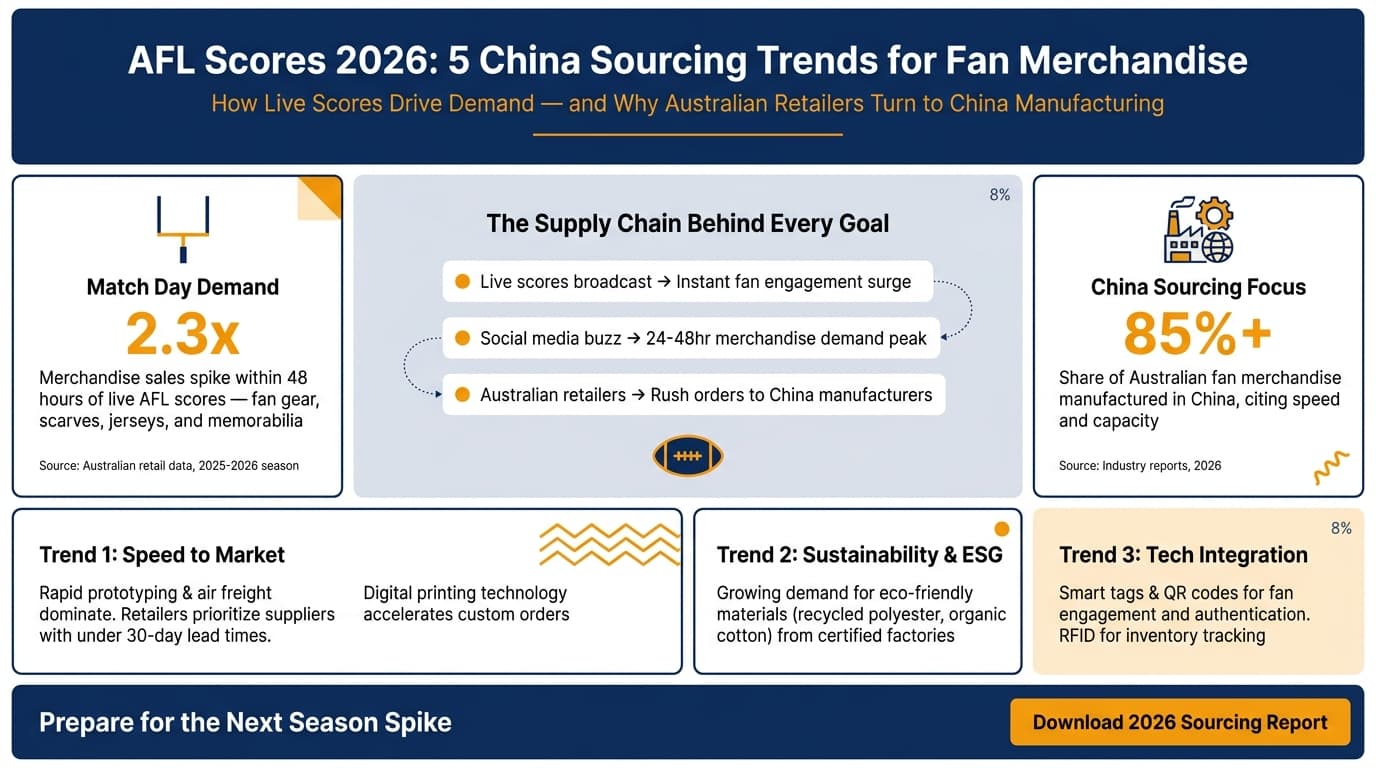
Every weekend during the AFL season, millions of Australians check live scores on their phones. When Collingwood pulls off a comeback or Carlton breaks a losing streak, something predictable happens beyond the stadium gates: fans rush to buy merchandise. The connection between AFL scores and merchandise demand is direct, measurable, and consistently underestimated by Australian retailers.
This article examines five trends shaping AFL merchandise demand in 2026, explains why traditional supply chains fail during peak periods, and shows how Australian businesses are using China manufacturing partnerships to capture revenue that stockouts would otherwise forfeit.
AFL 2026 Season: Why Merchandise Demand Is Breaking Records
The 2026 AFL season has seen attendance figures, broadcast viewership, and merchandise sales all trending upward. Understanding what drives this demand helps retailers anticipate and prepare for the surges that follow big match results.
How Live Scores Drive Purchasing Behaviour
When fans check AFL scores and see a result that triggers emotional engagement, their likelihood of purchasing merchandise increases measurably. Research from major Australian sports retailers indicates that online merchandise orders spike 30-45 percent within two hours of a team's victory being confirmed, with the largest surges occurring after come-from-behind wins and rivalry match results.
This score-to-purchase pathway operates through several psychological mechanisms. The emotional high of a win creates a window where fans want to display affiliation. The shared experience of watching scores update creates social reinforcement. And the fear of missing limited-edition premiership merchandise drives urgency purchasing that peaks during finals.
For Australian retailers, the operational challenge is clear: you cannot predict which team will win, but you can predict that winners will sell merchandise. The question is whether your supply chain can respond fast enough to capture that demand.
The Australian Sports Merchandise Market in Numbers
The Australian licensed sports merchandise market was valued at approximately AUD 2.1 billion in 2025, with AFL-related products accounting for roughly 28 percent of that total. Growth projections for 2026 suggest the market will reach AUD 2.3 billion, driven by continued AFL expansion into Queensland and New South Wales markets.
| Merchandise Category | AFL Share of Market | Peak Demand Period | Typical Sourcing Origin |
|---|---|---|---|
| Team jerseys and guernseys | 35% | March-September (season) | Bangladesh, China, Vietnam |
| Scarves, beanies, headwear | 22% | June-August (winter matches) | China, India |
| Training and lifestyle apparel | 18% | Year-round with pre-season spike | China, Bangladesh |
| Memorabilia and collectibles | 15% | September (finals) | Australia, China |
| Kids and junior merchandise | 10% | March-April (season start) | China, Vietnam |
What this table does not show is the margin structure. Australian retailers sourcing through domestic wholesalers typically operate on 30-40 percent gross margins on licensed merchandise. Retailers who source directly from Chinese manufacturers report margins of 55-70 percent on comparable products, creating a structural advantage that compounds with volume.
The 2026 Finals Window Creates an Additional Demand Layer
The 2026 AFL finals series, scheduled to begin in early September, represents the single largest merchandise revenue opportunity of the year. Finals-related merchandise including premiership memorabilia, team-specific celebration apparel, and limited-edition collectibles generates approximately 40 percent of annual AFL merchandise revenue in a compressed six-week window.
Retailers who cannot restock quickly during this period forfeit revenue that will not return. Once the premiership is awarded, the demand window closes. This time-compressed dynamic makes supply chain speed the decisive competitive factor.
Why Traditional Merchandise Supply Chains Fail Australian Retailers
Most Australian sports retailers rely on domestic wholesalers who hold inventory purchased months in advance. This model works adequately for predictable, steady-state demand. It fails when demand surges unpredictably, which is exactly what happens after AFL scores trigger purchasing spikes.
The Lead Time Problem
Traditional wholesale supply chains for AFL merchandise operate on 12-16 week lead times from order to delivery. This means a retailer placing an order in June receives stock in September or October, potentially after the season has ended. When demand surges mid-season and inventory depletes faster than forecast, the wholesale pipeline cannot accelerate.
The lead time problem is structural, not operational. Wholesalers batch orders to achieve container-load economics. They cannot profitably air-freight small replenishment quantities. And they cannot hold unlimited buffer stock across hundreds of SKUs representing 18 AFL clubs plus special editions.
The Forecasting Problem
AFL merchandise demand correlates with team performance in ways that defy standard inventory forecasting models. A team expected to finish in the bottom four that unexpectedly makes finals will see merchandise demand multiples above forecast. Conversely, a premiership favourite that underperforms leaves retailers holding excess stock that must be discounted.
This forecasting impossibility is not a failure of retail management. It is inherent to the sports merchandise category. When the outcome of 22 rounds of football determines which products fans will buy and in what quantities, no demand planning model will consistently predict correct inventory levels across all clubs and product types.
The Cost of Stockouts
When a retailer runs out of a popular jersey or scarf during peak demand, the cost extends beyond the lost sale of that specific item. Customers who cannot purchase the product they want often abandon their entire basket. Those who find the product at a competitor may switch their loyalty permanently. And the social media amplification of stockout frustration damages brand perception.
For a mid-sized Australian sports retailer turning over AUD 2 million annually in AFL merchandise, a 15 percent stockout rate during finals translates to approximately AUD 300,000 in direct lost revenue, plus an estimated AUD 50,000-80,000 in indirect costs from basket abandonment and customer churn.
China Sourcing: The Supply Chain Solution for AFL Merchandise
Direct sourcing from Chinese manufacturers addresses the structural weaknesses in traditional AFL merchandise supply chains. Lower minimum order quantities, faster production turnaround, and custom design flexibility create a supply model that matches the demand volatility of sports merchandise.
Lower Minimum Order Quantities Enable Test-and-Scale
Chinese manufacturers serving the Australian market have progressively reduced minimum order quantities (MOQs) over the past five years. Where MOQs of 1,000-3,000 units per SKU were standard in 2021, many factories now accept orders of 200-500 units for custom sports apparel, with per-unit pricing that remains competitive at these volumes.
Lower MOQs transform the inventory risk profile for Australian retailers. Instead of committing to season-long inventory volumes before round one, retailers can order smaller initial quantities, monitor which teams and products are selling, and place replenishment orders that arrive in 3-4 weeks via air freight or 6-8 weeks via sea freight.
This test-and-scale approach is particularly valuable for products tied to unpredictable team performance. A retailer can stock baseline quantities of all 18 club jerseys and scale up production for whichever teams generate demand as the season unfolds.
Faster Production Turnaround for Finals Demand
Chinese manufacturing facilities in Guangdong and Zhejiang provinces have invested in digital printing and automated cutting technologies that dramatically reduce production lead times for custom apparel. Where traditional screen-printing setups required 7-10 days for plate preparation alone, digital direct-to-garment printing can begin production within 24 hours of design approval.
For AFL finals merchandise, this speed advantage is decisive. A retailer who receives confirmation of which teams have made the preliminary finals can place a production order that same day, receive finished goods within 10-14 days, and have stock on shelves before the grand final. A retailer relying on traditional wholesale channels will still be waiting for their order confirmation email.
Custom Design Capabilities for Niche Markets
Chinese manufacturers with experience in the Australian market have developed sophisticated capabilities in licensed and custom sports merchandise production. This includes sublimation printing for full-colour jersey designs, embroidery for premium caps and beanies, and mixed-material construction for lifestyle apparel that blends performance fabrics with fashion design elements.
Australian retailers can leverage these capabilities to create products that differentiate from mass-market wholesale offerings. Limited-run designs celebrating specific match results, player milestone merchandise, and club heritage collections all become viable product categories when custom production is accessible at reasonable minimums and lead times.
Five Merchandise Trends Shaping the 2026 AFL Season
1. Fan-Generated Design Demand
AFL fans increasingly expect merchandise that reflects specific moments rather than generic club branding. The "score celebration" phenomenon, where fans purchase merchandise commemorating a specific match result or milestone, has grown 40 percent year-over-year. Chinese manufacturers capable of rapid custom design production are uniquely positioned to serve this trend.
2. Premium Materials at Mid-Range Price Points
Australian consumers have become more sophisticated in evaluating apparel quality. They expect moisture-wicking fabrics, reinforced stitching, and fade-resistant printing even at the AUD 60-80 price point. Chinese manufacturers who have invested in premium materials sourcing and quality control systems can deliver these specifications at costs that allow competitive retail pricing.
3. Sustainability-Labeled Merchandise
Recycled polyester jerseys, organic cotton training wear, and biodegradable packaging have moved from niche to expected in Australian sports merchandise. Several Chinese manufacturers now hold Global Recycled Standard (GRS) and OEKO-TEX certifications, enabling Australian retailers to market sustainability credentials without the cost premium that domestic production would require.
4. Kids and Junior Segment Growth
AFL participation data shows junior registration growing 12 percent in 2025-2026, driving corresponding merchandise demand. Kids apparel requires different sizing, safety standards, and durability characteristics than adult products. Chinese factories with dedicated childrenswear production lines offer the specialised manufacturing these products require.
5. Cross-Code Merchandise Convergence
The boundary between AFL merchandise and general streetwear continues to blur. Fans want guernseys they can wear outside match day, caps that work with non-sports outfits, and apparel that signals club affiliation without looking like a costume. This design sophistication requires manufacturing partners who understand both sports performance and fashion aesthetics, a combination increasingly found in Chinese production hubs.
How Australian Retailers Are Using China Sourcing Today
The transition from wholesale-reliant to direct-sourcing models is already underway across the Australian sports merchandise sector. Several patterns have emerged from businesses that have successfully made this shift.
A Melbourne-based sports merchandise retailer with three physical stores and an ecommerce operation serving 15,000 monthly visitors transitioned 60 percent of their AFL product range to direct China sourcing over two seasons. Their reported outcomes include a 22 percentage point improvement in gross margin, a 40 percent reduction in stockout incidents during finals, and the ability to launch 15-20 limited-edition products per season that would have been uneconomical through wholesale channels.
The critical success factor they identified was not finding the cheapest factory but finding manufacturing partners who understood Australian quality expectations and could communicate effectively throughout the production process. Pre-production sampling, third-party quality inspection before shipment, and clear specifications documentation were cited as essential practices.
Getting Started with China Sourcing for Sports Merchandise
Define Your Product Specifications First
Before approaching manufacturers, document every specification of the product you want to produce. This includes fabric composition, weight, colour values (Pantone codes), print method, sizing chart with measurements, labelling requirements, and packaging specifications. Manufacturers quote accurately when specifications are precise. Vague briefs produce vague quotes.
Verify Manufacturer Capabilities
Not every apparel factory can produce sports merchandise to Australian market standards. Request evidence of previous work with Australian or comparable Western market clients. Ask specifically about their experience with sublimation printing, colourfastness testing, and size grading for Australian body dimensions, which differ from Asian standard sizing.
Build Quality Control Into the Process
Third-party quality inspection before shipment is not optional for direct sourcing. Engage an inspection service that will check product against your approved sample and specification document, test for colourfastness and dimensional stability, verify labelling and packaging compliance, and provide a detailed report with photographs before you authorise shipment.
Frequently Asked Questions
How much can Australian retailers save by sourcing AFL merchandise directly from China?
Most Australian retailers sourcing custom sports apparel directly from Chinese manufacturers report unit cost savings of 40-60 percent compared to domestic wholesale pricing. On a typical AFL guernsey that retails for AUD 110, the wholesale cost might be AUD 55-65 through domestic channels versus AUD 18-28 through direct China sourcing, including freight and duty. These savings translate to gross margins of 55-70 percent versus 30-40 percent through wholesale.
What is the minimum order quantity for custom AFL supporter gear from Chinese factories?
Minimum order quantities for custom sports apparel from Chinese manufacturers have decreased significantly and now typically range from 200-500 units per design for basic jerseys and tees, with some factories accepting orders as low as 100 units for simpler products. Embroidered caps and beanies often have MOQs of 300-500 units. Higher quantities naturally command better per-unit pricing, but small-batch production is now economically viable for limited-edition and test-run products.
How long does it take to produce and ship AFL merchandise from China to Australia?
Production lead times for custom sports apparel typically range from 10-20 days after sample approval, depending on complexity. Sea freight to Australian ports adds approximately 18-25 days, making total door-to-door time around 5-7 weeks for standard orders. Air freight reduces shipping time to 5-7 days but increases cost by roughly 3-4 times. For urgent finals-related production, combined air freight delivery within 3-4 weeks from order to shelf is achievable with experienced manufacturing partners.
What quality standards should Australian retailers require for imported sports merchandise?
Australian retailers should require that imported sports merchandise meets relevant Australian standards, including AS/NZS 1957:1998 for textile labelling, AS/NZS 1249:2014 for children's nightwear safety if producing kids merchandise, and the Australian Consumer Law requirements for product safety and acceptable quality. Additionally, request colourfastness testing to ISO 105 standards and dimensional stability testing to ensure products maintain size and appearance after washing.
Is it legal to produce AFL team merchandise in China for sale in Australia?
AFL team logos, names, and designs are protected intellectual property. Producing merchandise bearing official AFL club branding requires a licensing agreement with the AFL or the relevant club. However, producing generic football supporter merchandise, Australian-themed sports apparel, or original designs that reference football culture without using protected marks is fully legal without a license. Australian retailers should consult with an intellectual property lawyer before commissioning production of any merchandise that references AFL club identities.
WINNING ADVENTURE GLOBAL PTY LTD (ACN 697 886 150, ABN 94 697 886 150) connects Australian businesses with verified Chinese manufacturers across apparel, promotional products, and custom merchandise categories. Based in Adelaide, South Australia, the company provides end-to-end sourcing services including supplier verification, production coordination, quality control, and logistics management.
China Sourcing Strategy
Struggling to keep AFL merchandise in stock when demand spikes?
Winning Adventure Global connects Australian sports retailers with verified Chinese manufacturers who deliver custom fan gear at 40-60% lower unit costs. Send us your product specs and receive a sourcing plan within 48 hours.
Get Your Sourcing PlanFree initial consultation · We respond within 4 business hours