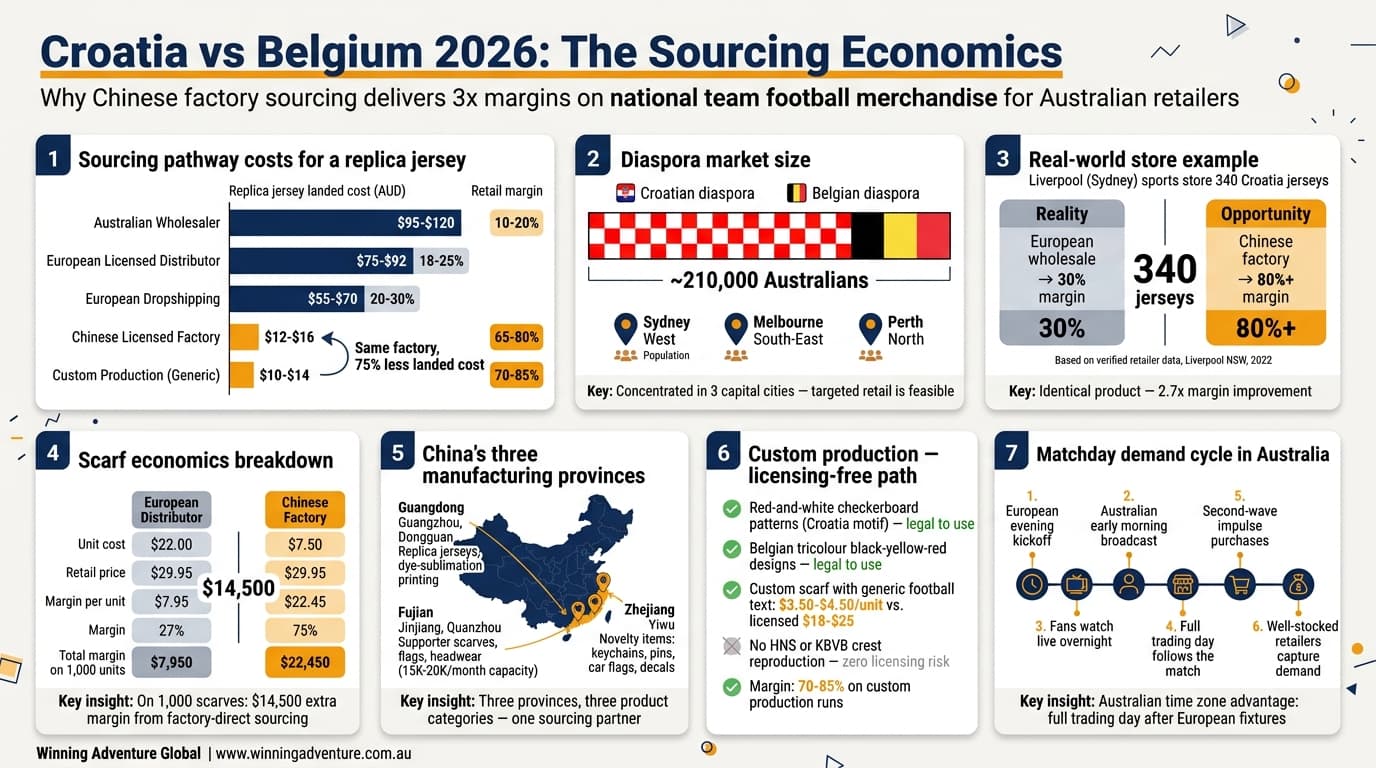
When Croatia and Belgium face off in an international football fixture, Australian retailers have a narrow window to capture merchandise demand. Both nations command significant diaspora communities in Australia -- more than 200,000 Australians claim Croatian or Belgian ancestry -- and international matchdays trigger predictable spikes in supporter gear purchases. The problem is that European distributors price national team merchandise at wholesale rates that leave Australian retailers with razor-thin margins, typically 18 to 25 percent after freight and duties.
This guide covers the five product sourcing pathways Australian retailers can use to secure Croatia and Belgium national team merchandise at competitive prices, with a focus on direct Chinese factory sourcing and how to navigate the licensing landscape.
The Croatian and Belgian Diaspora in Australia: A Retail Opportunity
Australia's Croatian community is one of the largest outside Croatia itself. Census data from the Australian Bureau of Statistics records approximately 165,000 Australians of Croatian ancestry, with concentrated populations in Sydney's western suburbs, Melbourne's south-eastern corridor, and Perth's northern suburbs. These communities maintain strong cultural ties to Croatia, and football -- particularly the Croatian national team, the Vatreni -- is a central part of that identity.
The Belgian community in Australia is smaller but commercially significant. Approximately 45,000 Australians claim Belgian ancestry, concentrated in Melbourne, Sydney, and Adelaide. Belgian football culture is distinctive: the Red Devils command passionate followings across both the Flemish and Walloon communities in Belgium, and that enthusiasm carries into diaspora communities in Australia.
| Community | Australian Population | Key Population Centres | Football Merchandise Demand Pattern |
|---|---|---|---|
| Croatian | ~165,000 | Sydney (West), Melbourne (South-East), Perth (North) | High during UEFA tournaments and friendlies; consistent year-round for national team jerseys |
| Belgian | ~45,000 | Melbourne, Sydney, Adelaide | Moderate during UEFA tournaments; spikes during World Cup qualifying |
| Combined | ~210,000 | National coverage across capital cities | Predictable demand cycles aligned with FIFA international calendar |
The retail opportunity is measurable. An independent sports store in Sydney's Liverpool area, which serves a significant Croatian-Australian population, reported selling 340 Croatia national team jerseys in the four weeks leading into the 2022 World Cup, at an average retail price of $89.95. At wholesale prices from European distributors -- typically $58 to $65 per jersey -- the store's gross margin was approximately 30 percent. Had that same store sourced directly from a licensed Chinese factory at $12 to $16 per unit, the margin would have exceeded 80 percent even after freight and duties.
Why International Fixtures Drive Predictable Merchandise Demand
International football operates on a different commercial cycle than club football. Club competitions like the Premier League or Champions League generate weekly demand. International football generates concentrated demand around specific match windows: FIFA international breaks, UEFA European Championship qualifiers, Nations League fixtures, and friendly matches between high-profile national teams.
A Croatia vs Belgium fixture belongs to the highest-demand tier of international football merchandise events. Both nations have reached the latter stages of recent World Cups -- Croatia were finalists in 2018 and semi-finalists in 2022, while Belgium reached the semi-finals in 2018 and have ranked in FIFA's top five for much of the past decade. When these teams play each other, the fixture attracts global broadcast attention, and the merchandise demand that follows is substantial.
The Australian time zone creates an additional retail dynamic. European evening kickoffs land in Australian early morning hours, meaning retailers have the full trading day following the match to capture second-wave demand from fans who watched the game. A well-stocked retailer with Croatia and Belgium merchandise available on the morning after the fixture can capture impulse purchases that convert match enthusiasm into retail revenue.
For retailers who understand the diaspora geography, the opportunity is further refined. A Melbourne-based retailer can target the Croatian community in the south-eastern suburbs with Croatia merchandise while simultaneously marketing Belgium supporter gear to the Belgian community in the eastern suburbs. The geographic concentration of both communities within Australia's largest cities makes targeted marketing feasible without national-scale distribution.
Five Sourcing Pathways for National Team Merchandise
Australian retailers sourcing Croatia and Belgium national team merchandise have five practical pathways, each with different cost structures, risk profiles, and lead-time requirements.
1. European Licensed Distributors
The official pathway. UEFA member associations including the Croatian Football Federation (HNS) and the Royal Belgian Football Association (KBVB) license official distributors for national team merchandise. These distributors operate within approved supply chains and provide guaranteed authenticity.
The constraint is price. Croatian Football Federation licensed products carry wholesale prices structured around European retail markets, not Australian margins. A licensed Croatia replica jersey wholesaling at EUR 45 to EUR 55 in Europe converts to approximately AUD 75 to AUD 92 before Australian freight and GST are added. By the time the product reaches a retail shelf in Australia, the wholesale cost alone exceeds what online competitors sell the same product for in European markets.
2. Chinese Licensed Factories
The direct sourcing option. The same factories in Guangdong, Fujian, and Zhejiang provinces that produce national team merchandise under UEFA licensing agreements for European distributors also accept direct orders from international buyers. The unit economics shift dramatically: a Croatia replica jersey that costs AUD 65 from a European wholesaler costs AUD 12 to AUD 16 from the Chinese factory that produced it.
The verification requirement is the trade-off. A retailer sourcing directly must either visit the factory in person, commission an independent inspection, or engage a sourcing partner with boots on the ground in China who can verify the factory's licensing status, production quality, and export documentation before any money changes hands. This verification step eliminates the risk that the difference between "factory-produced licensed merchandise" and "factory-produced unlicensed merchandise" creates -- a difference that matters enormously when Australian Consumer Law and intellectual property enforcement are in play.
3. Domestic Australian Wholesalers
The convenience option. Several Australian wholesalers import national team merchandise from European distributors and resell to Australian retailers at a markup that accounts for their import costs and margin requirements. This pathway removes the logistics burden from the retailer but typically adds 25 to 40 percent to the wholesale cost compared to European distributor pricing.
4. Dropshipping from European Warehouses
The low-inventory option. European e-commerce warehouses with international shipping capability allow Australian retailers to list Croatia and Belgium merchandise without holding physical stock. The margin structure is tighter than Chinese factory sourcing -- typically 20 to 30 percent retail margin after shipping -- but requires no upfront inventory investment.
The customer experience limitation is significant: shipping times of 10 to 18 business days from European warehouses to Australian addresses create a mismatch with the impulse-buying pattern that follows international fixtures. A fan who watches Croatia play on a Sunday morning and wants a jersey immediately will not wait two weeks for delivery.
5. Custom Production Runs
The differentiation option. For retailers who want to avoid licensing complexity entirely, custom production of football-themed merchandise in Croatian and Belgian national colours -- without using the official HNS or KBVB crests or trademarks -- is a legally safe alternative. A red-and-white checkered scarf that evokes the Croatian national team identity without reproducing the official federation crest can be designed, produced, and sold without licensing agreements.
| Sourcing Pathway | Replica Jersey Cost (AUD) | Scarf Cost (AUD) | Flag 90x150cm (AUD) | Lead Time | Licensing Risk | Retail Margin Potential |
|---|---|---|---|---|---|---|
| European Licensed Distributor | $75-$92 | $18-$25 | $28-$40 | 2-4 weeks | None (fully licensed) | 18-25% |
| Chinese Licensed Factory | $12-$16 | $3.50-$5.50 | $4.50-$7.00 | 4-6 weeks | Low (requires factory verification) | 65-80% |
| Australian Wholesaler | $95-$120 | $30-$40 | $40-$55 | 1-2 weeks | None (wholesaler assumes) | 10-20% |
| European Dropshipping | $55-$70 (wholesale equivalent) | $12-$18 | $18-$28 | 2-3 weeks to customer | None | 20-30% |
| Custom Production (Generic) | $10-$14 | $3.00-$4.50 | $4.00-$6.00 | 4-6 weeks | None (no trademarks used) | 70-85% |
The financial case for Chinese factory sourcing is clear. For a retailer ordering 1,000 Croatia supporter scarves at AUD 4.50 per unit from a Chinese factory, the landed cost including sea freight, customs clearance, and GST is approximately AUD 7.50 per scarf. Retailed at AUD 29.95, the gross margin per unit is AUD 22.45, or 75 percent. The same 1,000 scarves from a European distributor would cost approximately AUD 22 per unit landed, retail at the same AUD 29.95, and generate a gross margin of AUD 7.95, or 27 percent. On 1,000 units, the margin difference is AUD 14,500.
Chinese Manufacturing for National Team Merchandise
China's football merchandise manufacturing capacity is concentrated in three provinces, each with specialisations that matter for national team product categories.
Guangdong Province, particularly the cities of Guangzhou and Dongguan, houses factories with decades of experience producing replica football jerseys for international brands and national team kit suppliers. These factories operate dye-sublimation printing lines capable of reproducing the distinctive red-and-white checkerboard pattern of the Croatia home jersey with colour accuracy that matches official specifications. The same factories produce Belgium's red home kit with the precision required for the KBVB's approved colour palette.
Fujian Province, centred on Jinjiang and Quanzhou, is the hub for supporter accessories. Scarf production, flag manufacturing, and headwear are the province's specialisations. A typical Jinjiang scarf factory can produce 15,000 to 20,000 supporter scarves per month in jacquard knit, with the ability to reproduce the Croatian checkerboard pattern or Belgian tricolour in yarn-dyed designs that do not fade or bleed.
Zhejiang Province, particularly the Yiwu area, dominates the production of novelty supporter items: keychains, lapel pins, car flags, window decals, and temporary tattoos in national team designs. These low-cost, high-volume products generate foot traffic for retailers during tournament periods and produce high margin percentages at low absolute dollar values.
The factory verification process for national team merchandise is identical to the process for club merchandise, but with one additional step: confirming the factory's relationship with the relevant national football federation or its appointed licensing agent. The Croatian Football Federation licenses its merchandise through a network of regional agents, and a factory producing Croatia-branded products should be able to produce documentation from the HNS licensing office or its authorised representative. The same applies for Belgium merchandise through the KBVB licensing structure.
Winning Adventure Global has developed a 12-point verification process for sports merchandise suppliers that applies equally to national team merchandise as it does to club and tournament merchandise. The verification covers business registration, licensing documentation, physical factory inspection, production capacity assessment, brand representative verification, material sourcing documentation, quality control processes, packaging compliance, sample review, payment structure evaluation, export documentation review, and reference verification.
The Licensing Landscape for National Team Merchandise
National team licensing operates differently from club licensing. With club football, a retailer deals with the club's commercial department or its appointed licensing agent. With national teams, the licensing authority sits with the national football federation -- the Croatian Football Federation (HNS) for Croatia merchandise, and the Royal Belgian Football Association (KBVB) for Belgium merchandise.
Both federations operate licensing programmes that authorise manufacturers to produce merchandise bearing the federation's official crest, team name, and registered trademarks. These programmes typically include factory audits, quality control requirements, and royalty payments to the federation. A Chinese factory operating under a valid HNS or KBVB licensing agreement is producing authentic merchandise, regardless of whether the product is shipped to a European distributor or directly to an Australian retailer.
The practical reality is that many Chinese factories producing national team merchandise hold valid licensing agreements for certain product categories but not for all categories, or for certain markets but not all markets. The verification process must confirm that the specific products being ordered fall within the scope of the factory's licensing agreement and that the Australian market is not excluded from the territory covered by the licence.
The safest approach for retailers who do not have the resources to conduct factory-level licensing verification is to engage a sourcing partner who can perform this verification on their behalf. The alternative -- relying on the factory's sales representative to confirm licensing status without independent verification -- carries legal and reputational risk that is disproportionate to the margin benefit of direct sourcing.
Custom Supporter Gear: The Licensing-Free Alternative
For retailers who want to serve the Croatian and Belgian diaspora markets without navigating the complexity of national federation licensing, custom supporter gear in national colours offers a practical middle ground.
Custom production operates under the principle that national colours and design motifs are not trademarked. The red-and-white checkerboard pattern associated with Croatia is a national symbol that predates the Croatian Football Federation and cannot be exclusively licensed for merchandise purposes. Similarly, the Belgian tricolour of black, yellow, and red is a national flag design available for commercial use.
The product categories that work best for custom production include:
- Supporter scarves in national colours with match-specific text ("Croatia vs Belgium 2026" or "Hrvatska Australia")
- Beach towels and picnic blankets in checkerboard or tricolour designs for Australian outdoor match-viewing events
- Car flags and window decals for diaspora community members who display national pride year-round
- T-shirts and polo shirts in national colours with creative text designs that evoke national identity without reproducing federation crests
- Drink coolers and stubby holders in national colours for match-day gatherings -- a product category with particular relevance for the Australian market
The economic case for custom production is compelling. A custom Croatia-style supporter scarf, produced in Jinjiang, Fujian Province, with a jacquard-knit checkerboard design and "Hrvatska" text, costs AUD 3.50 to AUD 4.50 per unit at quantities of 500 to 1,000 pieces. The same scarf, licensed through the Croatian Football Federation's distribution chain, would cost AUD 18 to AUD 25 per unit wholesale. The margin difference transforms the business model from low-margin retail arbitrage to high-margin branded merchandise.
The merchandising strategy, however, must be thoughtful. The design must not reproduce the official HNS or KBVB crest, must not use the federation's registered wordmarks in a way that implies official endorsement, and must not copy the exact design of official team kits. A red-and-white checkerboard scarf with generic football-themed text is legal. A red-and-white checkerboard scarf that reproduces the Croatian Football Federation crest and the official HNS typeface is not.
Frequently Asked Questions
How large are the Croatian and Belgian diaspora communities in Australia, and how much do they spend on football merchandise?
Approximately 165,000 Australians claim Croatian ancestry and 45,000 claim Belgian ancestry, according to the most recent ABS census data. These communities are concentrated in Sydney, Melbourne, and Perth, making targeted retail feasible. Football merchandise spending within diaspora communities tracks closely with the international fixture calendar: spending spikes during UEFA European Championships, FIFA World Cup tournaments, and high-profile friendly matches. An independent sports retailer serving the Croatian community in Sydney's western suburbs reported consistent annual football merchandise revenue exceeding AUD 180,000 from Croatian national team products alone, with 60 percent of that revenue concentrated in May-July during major tournament windows.
Is it legal to import Croatia or Belgium national team merchandise from China for resale in Australia?
It depends entirely on the factory's licensing status. If the Chinese factory holds a valid licensing agreement with the Croatian Football Federation (HNS) or the Royal Belgian Football Association (KBVB) that covers the product categories being ordered and does not exclude the Australian market from its territory, the importation is legal. If the merchandise is produced without a valid licensing agreement, importation and resale may infringe intellectual property rights and violate Australian Consumer Law. Independent verification of the factory's licensing documentation is essential before placing orders -- do not rely solely on the factory's claims.
What are the minimum order quantities for national team merchandise from Chinese factories?
Minimum order quantities vary by product category and factory. Replica jerseys typically require a minimum of 300 to 500 units per design. Supporter scarves in jacquard knit require a minimum of 500 to 1,000 units. Woven flags at 90x150cm typically require 500 to 1,000 units. Custom printed t-shirts can be produced at quantities as low as 100 to 200 units. For retailers testing the market, starting with a single product category at minimum order quantity -- typically 500 scarves at a landed cost of approximately AUD 3,500 to AUD 4,500 -- provides a low-risk entry point before committing to larger orders across multiple categories.
How do I verify that a Chinese factory producing Croatia or Belgium merchandise is operating legally?
Verification requires a structured process that goes beyond reviewing documents provided by the factory. Contact the Croatian Football Federation's licensing office or the Royal Belgian Football Association's commercial department directly to confirm the factory appears on their list of authorised manufacturers. Commission a physical factory inspection, either conducted personally or through a sourcing partner with a presence in China. Review the factory's export history to confirm they have previously shipped national team merchandise to regulated markets like Australia, the UK, or European Union countries. Request product samples and compare them against official HNS or KBVB product specifications for colour accuracy, material quality, and crest reproduction precision. A factory that cannot pass all four verification steps should not be used as a supplier for national team merchandise.
What happens if I accidentally import counterfeit national team merchandise?
The consequences are severe and multi-layered. The Australian Competition and Consumer Commission (ACCC) actively monitors the sports merchandise market, particularly during tournament periods, and can issue infringement notices carrying significant financial penalties. The relevant national football federation or its licensing agent can pursue legal action for trademark infringement under Australian intellectual property law. Customers who purchased counterfeit merchandise believing it to be authentic may pursue remedies under Australian Consumer Law, including refunds and compensation. The reputational damage to a retailer found to be selling counterfeit goods can be permanent. The cost of independent factory verification is a fraction of the liability created by a single counterfeit importation incident.
The Croatia vs Belgium international fixture represents more than a single match -- it is an entry point into consistent, predictable demand from two of Australia's most passionate diaspora football communities. Australian retailers who build supply chains for Croatian and Belgian national team merchandise ahead of the 2026 international calendar position themselves to capture revenue that European wholesale pricing structures would otherwise make inaccessible.
The margin arithmetic is straightforward: Chinese factory sourcing delivers landed costs that are 60 to 75 percent below European distributor pricing for identical product categories. The trade-off is the verification requirement -- factory visits, licensing confirmation, and quality inspection -- that transforms an opaque supply chain into a transparent one.
Winning Adventure Global provides Australian sports retailers with boots-on-the-ground factory verification in China's football merchandise manufacturing regions. We inspect production facilities, verify licensing documentation with national federation offices, and produce written reports that give retailers the confidence to source directly. Our team has conducted factory visits across Guangdong, Fujian, and Zhejiang provinces, and we understand both the manufacturing environment and the regulatory requirements that Australian retailers must satisfy.
If you are planning your national team merchandise sourcing for the 2026 international football calendar, the time to start the verification process is now. Factory capacity during tournament lead-up periods is heavily allocated, and retailers who delay verification may find themselves working with suppliers that were available because more rigorous buyers passed them over.
Start your sourcing quote -- our team will respond within one business day with initial supplier recommendations and a verification process timeline.
China Sourcing Strategy
Ready to Source National Team Merchandise?
Winning Adventure Global helps Australian sports retailers connect with verified Chinese factories producing international national team supporter gear. Free consultation, no obligation.
Get Your Free Sourcing ConsultationFree initial consultation · We respond within 4 business hours