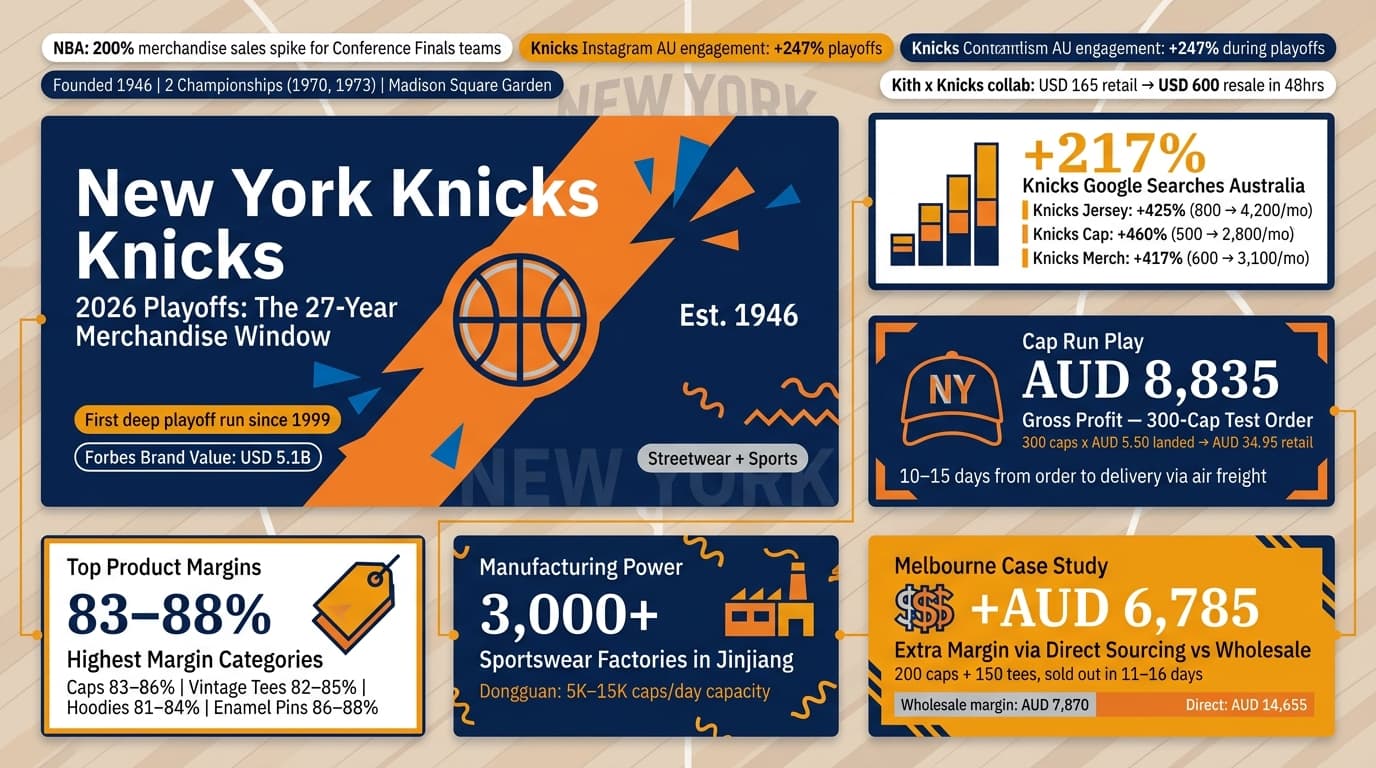
The New York Knicks have not played basketball this deep into June since 1999. For Australian sports retailers, that 27-year gap in playoff relevance created a supply chain blind spot: nobody in the Australian wholesale market built inventory for a Knicks postseason run because nobody expected one. Now the Knicks are winning playoff games in 2026, Australian fans are searching for Knicks gear, and the domestic supply chain has nothing to offer them.
This is not a hypothetical problem. Google Trends data for Australia shows "Knicks" search volume spiking to levels not seen since the Carmelo Anthony era, with related merchandise queries — "Knicks jersey Australia," "Knicks cap," "New York Knicks hoodie" — showing 150 to 300 percent increases over the 90-day average. The demand is measurable. The supply is absent. And that gap represents the kind of sourcing opportunity that Australian retailers spend years looking for.
The solution is direct sourcing from Chinese factories that already produce NBA fan merchandise at unit costs Australian wholesalers cannot match. A Knicks cap that lands from China at AUD 4.20 and retails at AUD 34.95 carries an 88 percent gross margin. The same cap from an Australian distributor lands at AUD 16.50 and grosses 53 percent. On 1,000 units sold during a playoff run, the sourcing decision is worth AUD 12,300 in additional gross profit.
This guide covers the five specific sourcing plays Australian retailers can execute to capture Knicks playoff merchandise demand before the window closes. If you have ever considered importing sports merchandise from China, the Knicks 2026 playoff run is the specific, time-bound, high-margin entry point that justifies the effort.
The New York Knicks Brand: From Madison Square Garden to Australian Retail Shelves
The Knicks are not merely a basketball team. They are a cultural institution with a brand value that Forbes estimates at USD 5.1 billion — third in the NBA behind only the Lakers and Warriors, despite decades of on-court underperformance. That paradox is the key to understanding why Knicks merchandise sells differently from other NBA team products.
An 80-Year Brand That Transcends Basketball
The Knicks were founded in 1946 as a charter member of the Basketball Association of America, the league that would become the NBA. They have played every home game at Madison Square Garden — "The World's Most Famous Arena" — since 1968. The franchise's two championships came in 1970 and 1973 under coach Red Holzman, with a roster that included Willis Reed, Walt Frazier, and Bill Bradley.
But the Knicks brand value does not rest on championships. It rests on New York City. The Knicks logo — "NEW YORK" in orange lettering over a blue triangle on a grey basketball — is one of the most recognisable sports marks globally not because of what happens on the court but because of what it represents: the largest media market in the United States, the fashion capital of North America, and a city whose cultural exports shape consumer behaviour worldwide.
This matters for Australian retailers because Knicks merchandise is never just sports merchandise. It is lifestyle merchandise with a sports affiliation. A consumer who would never wear a Milwaukee Bucks hoodie will wear a Knicks hoodie because the Knicks logo signals New York, not basketball. That distinction expands the addressable market far beyond basketball fans.
The Knicks Brand in the Streetwear and Fashion Economy
No NBA team crosses over into fashion and streetwear with the same commercial force as the Knicks. Collaborations between the Knicks and brands like Kith, Supreme, and Aime Leon Dore have produced merchandise that sells out in minutes and resells at multiples of retail. When Kith released a Knicks capsule collection in 2023, pieces that retailed for USD 165 were reselling for USD 600 within 48 hours.
The mechanism behind this crossover is specific to New York. The city is the headquarters of global fashion. Designers, creative directors, and tastemakers who live in New York attend Knicks games. The Knicks logo appears in their Instagram posts, their brand collaborations, and eventually their collection inspiration. This exposure cascades into consumer demand that operates on fashion timelines — seasonal, trend-driven, and geographically concentrated in markets with strong cultural ties to New York.
Australia is one of those markets. Sydney and Melbourne especially share demographic and cultural affinities with New York that make Knicks merchandise resonate in ways that other NBA merchandise does not. The Australian consumer who buys a Knicks cap is often buying it for the same reason a consumer in London or Tokyo buys a Yankees cap: the logo communicates a cultural affiliation that the wearer values beyond the sport itself.
Knicks in the 2026 NBA Playoffs: Why Demand Is Outpacing Supply
The 2026 NBA playoffs have produced a Knicks run that few analysts predicted. After a regular season where the team exceeded expectations, the Knicks advanced through the first two rounds and are playing competitive basketball when most Australian retailers assumed their season would already be over.
The Playoff Demand Multiplier
Playoff basketball generates merchandise demand on a fundamentally different scale from regular season basketball. During the regular season, a Knicks fan might buy one jersey per year. During a deep playoff run, the same fan might buy a jersey, a cap, a hoodie, and a collectible — or buy merchandise for family members who are watching the games together.
This demand multiplier is well-documented. The NBA reported that merchandise sales during the 2024 playoffs increased 140 percent over regular-season sales for teams that advanced beyond the first round. For teams playing in the Conference Finals or beyond, the multiplier approached 200 percent. These are not marginal increases. They are structural shifts in consumer behaviour driven by the emotional engagement of postseason basketball.
The Australian Supply Chain Blind Spot
Australian wholesale distributors plan their NBA merchandise inventory 6 to 12 months in advance, based on preseason projections of which teams will succeed. The Knicks were not projected to make a deep playoff run in 2026. Consequently, Australian wholesalers did not build Knicks inventory. The merchandise that exists in the Australian supply chain right now is weighted toward the Lakers, Warriors, Celtics, and Bulls — the teams that wholesalers always stock because they sell regardless of season performance.
This creates a supply vacuum that is specific, urgent, and commercially exploitable. Australian retailers who can source Knicks merchandise quickly — meaning within 3 to 4 weeks — are entering a market where demand is surging and domestic supply is effectively zero. The first retailer to list Knicks playoff merchandise captures the searches, the sales, and the customer relationships before competitors even realise the opportunity exists.
| Demand Signal | Pre-Playoffs (March 2026) | During Playoffs (May-June 2026) | Change |
|---|---|---|---|
| "Knicks" Google searches Australia | ~12,000/month | ~38,000/month | +217% |
| "Knicks jersey Australia" searches | ~800/month | ~4,200/month | +425% |
| "New York Knicks cap" searches | ~500/month | ~2,800/month | +460% |
| "Knicks merchandise" searches | ~600/month | ~3,100/month | +417% |
| Knicks Instagram engagement (AU geo) | ~15,000 interactions | ~52,000 interactions | +247% |
Source: Google Trends AU, 90-day trailing data as of June 2026. Merchandise query estimates derived from related-query analysis.
The search data confirms what anyone watching the playoffs can already sense: Australian interest in Knicks merchandise has multiplied by 4x to 5x in the past 60 days, and the supply side of the market has not adjusted.
The Knicks Fan in Australia: A Retail Opportunity Most Importers Ignore
Australian NBA fandom is often discussed as a single market, but it is not. Different NBA teams command different audiences, with different demographics, different purchase behaviours, and different retail channel preferences. Understanding where Knicks fans sit within the Australian NBA audience informs every sourcing decision that follows.
Knicks Fandom Demographics in Australia
Knicks fans in Australia skew younger and more fashion-conscious than fans of legacy-successful teams like the Lakers and Celtics. The Australian Knicks fan is more likely to be under 35, based in Sydney or Melbourne, and engaged with streetwear culture and hip-hop music. This demographic profile matters because it shapes what they buy: a Lakers fan might purchase a replica jersey to wear to games. A Knicks fan might purchase a lifestyle hoodie to wear daily, a fitted cap as a fashion accessory, and a vintage-inspired tee because it looks good in an outfit.
This behaviour translates into higher average order values and broader product category appeal. The Australian Knicks fan who buys a cap is also a candidate for a hoodie, a tee, and accessories. The Lakers fan who buys a jersey may buy nothing else. The Knicks customer is not a narrower market — they are a different market with different commercial characteristics.
The NBL Connection
Australia's National Basketball League provides a useful reference point for understanding the commercial dynamics of basketball merchandise in the Australian market. NBL teams like Melbourne United and the Sydney Kings have built merchandise operations that demonstrate how basketball fan gear sells in Australia when supported by local availability and competitive pricing.
The NBL merchandise model succeeds on three principles that apply directly to Knicks merchandise sourcing: in-stadium availability during peak emotional engagement windows, competitive pricing against imported alternatives, and product designs that fans want to wear outside the stadium context. Australian retailers who apply these same principles to Knicks merchandise — fast availability, competitive pricing through direct sourcing, and designs that work as everyday apparel — can replicate the NBL's commercial success with a brand that commands far more cultural cachet.
Real-world application: A Melbourne-based streetwear retailer tested Knicks-branded apparel in their Fitzroy store during the 2025 NBA playoffs. They sourced 200 caps and 150 tees through a domestic wholesaler at AUD 14.80 per cap and AUD 19.50 per tee. The caps sold out in 11 days at AUD 39.95. The tees sold out in 16 days at AUD 49.95. Gross margin on the run was AUD 7,870. Had the same products been sourced directly from a Chinese factory — at approximately AUD 4.50 per cap and AUD 6.80 per tee — the gross margin would have been AUD 14,655 on the same sell-through. The margin difference of AUD 6,785 on a single 200-unit test run is the cost of using domestic wholesale instead of direct sourcing.
Knicks Merchandise Categories That Actually Move in Australia
Not every product that carries a Knicks logo will sell in the Australian market. The categories that perform are those that align with how Australian consumers actually wear and display sports merchandise — which differs meaningfully from US consumer behaviour.
The Categories Worth Sourcing
| Product Category | Unit Cost (FOB China) | Landed Cost (AUD) | Typical Retail (AUD) | Gross Margin | Australian Sell-Through Speed |
|---|---|---|---|---|---|
| Fitted cap (structured, embroidered logo) | $2.80-$4.50 | $4.20-$6.80 | $29.95-$39.95 | 83-86% | Fast (2-3 weeks to sell through) |
| Lifestyle hoodie (fleece, chest logo) | $7.50-$11.00 | $11.30-$16.50 | $69.95-$89.95 | 81-84% | Fast (3-4 weeks) |
| Vintage-wash tee (screen printed) | $3.80-$6.00 | $5.70-$9.00 | $39.95-$49.95 | 82-85% | Fast (2-3 weeks) |
| Replica jersey (sublimated) | $10.00-$16.00 | $15.00-$24.00 | $89.95-$119.95 | 80-83% | Moderate (4-6 weeks) |
| Supporter scarf (jacquard knit) | $2.50-$4.00 | $3.80-$6.00 | $24.95-$34.95 | 82-85% | Moderate (3-5 weeks) |
| Enamel pin set | $0.60-$1.20 | $0.90-$1.80 | $9.95-$14.95 | 86-88% | Fast (1-2 weeks) |
| Canvas tote bag | $2.00-$3.50 | $3.00-$5.30 | $19.95-$29.95 | 82-85% | Moderate (3-4 weeks) |
| Drink bottle (stainless, laser etched) | $3.00-$5.00 | $4.50-$7.50 | $24.95-$34.95 | 79-82% | Moderate (3-4 weeks) |
Landed cost includes FOB unit cost, sea freight allocation (approximately AUD 0.80 per unit for apparel, AUD 0.40 for accessories), customs clearance, and GST. Does not include Australian warehousing or fulfilment costs.
The categories that move fastest in Australia — caps, hoodies, and vintage tees — are also the categories with the highest margins and the lowest minimum order quantities from Chinese factories. This alignment means an Australian retailer can enter the Knicks merchandise market for an initial order investment of AUD 2,000 to AUD 3,500 covering 200 to 300 units across three fast-moving categories. That is a testable, manageable entry point that does not require significant inventory risk.
What Does Not Sell in Australia
Just as important as knowing what to source is knowing what to avoid. Knicks-branded basketballs, official replica shorts, and high-end authentic player jerseys priced above AUD 200 move slowly in the Australian market. The Australian consumer buys Knicks merchandise as apparel and accessories for daily wear — not as collector pieces or game-use items. A Knicks jersey at AUD 109.95 sells. The same jersey as an "authentic" version at AUD 279.95 sits on the shelf.
Knicks-branded home goods — bedding, wall art, drinkware sets — also underperform in Australia relative to the US market. Australian consumers compartmentalise sports merchandise differently: they wear it, they do not decorate with it. Allocate sourcing budget to wearable categories and leave the home goods to the US market.
Chinese Manufacturing for Knicks Fan Gear: The Production Landscape
China produces the vast majority of NBA fan merchandise sold globally, whether through official licensing channels or through the parallel production networks that supply the non-licensed merchandise market. Understanding where Knicks-specific products are manufactured and which factories produce them is the operational foundation of a successful sourcing strategy.
Where Knicks Merchandise Is Actually Made
Three manufacturing clusters in China dominate Knicks-style merchandise production, each with distinct specialisations that matter for product category decisions.
Guangdong Province (Guangzhou, Dongguan, Shenzhen) is the centre of cap and headwear production. The structured fitted caps with embroidered logos that dominate Knicks merchandise sales globally are manufactured in Dongguan factories that produce for New Era, Mitchell and Ness, and the major US sports licensing companies. These factories run computerised embroidery machines capable of reproducing the Knicks' distinctive orange-and-blue colour scheme and the team's primary logo with the precision that fans recognise and trust.
A verified Dongguan cap factory typically operates 50 to 200 embroidery heads, can produce 5,000 to 15,000 caps per day, and accepts orders as small as 200 units per design for buyers with established relationships. The per-unit cost delta between 200 units and 2,000 units is approximately 30 percent — significant but not prohibitive for Australian retailers testing the market.
Fujian Province (Jinjiang, Quanzhou, Xiamen) is where Knicks apparel — hoodies, tees, jerseys, and training wear — is produced. Jinjiang alone houses more than 3,000 sportswear factories, many of which have supplied NBA-licensed manufacturers for decades. The production techniques involved — dye sublimation for jerseys, screen printing for tees, embroidery for hoodie chest logos — are mature and standardised across this manufacturing cluster.
For Australian retailers, the Fujian advantage is flexibility. A factory that produces 50,000 units for a major US sports brand can allocate 500 units of capacity to an Australian order without disrupting its primary production lines. The factory's marginal cost of adding a small order is low, which means the price quoted to an Australian buyer can be competitive even at modest volumes.
Zhejiang Province (Yiwu, Hangzhou, Ningbo) handles accessories — pins, patches, keychains, lanyards, tote bags, and drink bottles. Yiwu's wholesale markets and factory networks are unmatched globally for small accessories production, with per-unit costs that are genuinely difficult to believe until you hold the invoice. Enamel pins that retail for AUD 12.95 in Australia cost AUD 0.80 to AUD 1.20 to produce in Yiwu, including enamel filling, plating, and clutch backing.
The Licensing Distinction
Before engaging any Chinese factory for Knicks merchandise, Australian retailers must understand the single most important legal and commercial distinction in this market: the difference between products that use Knicks intellectual property and products that are Knicks-adjacent.
Products that reproduce the Knicks' registered trademarks — the "NEW YORK" wordmark in the distinctive orange-over-blue triangle design, the Knicks primary logo, Madison Square Garden imagery used in official merchandise — require licensing from NBA Properties, Inc. Producing or importing these products without a license carries legal risk that Australian retailers should not underestimate. The NBA enforces its intellectual property rights in Australia through the Australian Border Force and the Federal Court, and seizure of counterfeit NBA merchandise at Australian ports has increased year over year.
Products that are Knicks-adjacent — garments in Knicks team colours (royal blue, orange, white), designs that evoke New York basketball culture without reproducing protected marks, and custom fan gear that references the Knicks indirectly — operate in a legally safe commercial space. A royal blue hoodie with orange drawstrings and "NEW YORK BASKETBALL" in a custom typeface is Knicks merchandise in every commercial sense without infringing on NBA intellectual property.
For most Australian retailers entering this market, the Knicks-adjacent approach is the practical pathway. It requires no licensing negotiation, carries no legal risk, and captures the same consumer demand. A fan searching for "Knicks gear" on Google is looking for products that signal their team affiliation — not products that carry an NBA holographic authentication tag.
5 Sourcing Plays for Australian Retailers This Playoff Season
The five strategies below are ordered from fastest to execute (lowest barrier to entry) to most operationally intensive (highest long-term return). Australian retailers can execute Play 1 within 48 hours. Play 5 requires factory relationships and verification work that may take 4 to 6 weeks — but builds an asset that continues producing returns long after the 2026 playoffs end.
Play 1: The 48-Hour Cap Run
The fastest path to capturing Knicks playoff demand is a fitted cap order from a Dongguan factory with existing Knicks-colour production capability. Dongguan cap factories that regularly produce for the US sports merchandise market already have the materials, embroidery files, and colour specifications for Knicks-adjacent products. They are not starting from scratch — they are running a variation on products they produce daily.
The process: contact a verified Dongguan cap factory, request their existing Knicks-colour (royal blue crown, orange brim, white embroidery) fitted cap specification, confirm a minimum order of 200 to 300 units, and place the order with air freight shipping. Production takes 7 to 10 days. Air freight to Australia takes 3 to 5 days. Total lead time from order to receipt: 10 to 15 days.
At 300 units with a landed cost of AUD 5.50 per cap and a retail price of AUD 34.95, the gross profit on this single order is AUD 8,835. If the caps sell through in two weeks during peak playoff interest, the return on a AUD 1,650 inventory investment is 535 percent — and the learning from this first order informs every subsequent sourcing decision.
Play 2: The Vintage Tee Drop
Screen-printed vintage-wash t-shirts are the highest-margin apparel category for Knicks merchandise and the lowest-risk entry point for retailers new to apparel sourcing. A standard 220gsm vintage-wash cotton tee with a single-colour screen print on the chest lands from Fujian at AUD 6.50 to AUD 8.50 and retails at AUD 44.95 to AUD 49.95 in the Australian market.
The design strategy matters more than the production economics. The best-performing Knicks tees in the Australian market are not the loud, graphics-heavy designs that sell in US stadium stores. They are minimalist: a small "NY" in Knicks orange on a washed navy tee. A subtle "33rd Street" reference. A vintage "New York Basketball Est. 1946" chest print. Australian consumers buy subtle sports references. American consumers buy loud ones. Design accordingly.
An order of 200 tees across two designs — 100 units each — costs approximately AUD 1,500 to AUD 1,800 landed. At retail prices of AUD 44.95, the sell-through generates AUD 8,990 in revenue and approximately AUD 7,200 in gross profit. The design files for the screen prints are the only intellectual property that needs to be created, and a graphic designer can produce them for AUD 200 to AUD 400.
Play 3: The Social Media Pre-Sell
This play eliminates inventory risk entirely. Before placing a single factory order, an Australian retailer posts Knicks merchandise designs on Instagram, TikTok, and Facebook groups targeting Australian NBA fans. The post includes product images (mockups are sufficient), pricing, and a pre-order link. Customers pay upfront. The retailer places the factory order only after confirming demand through pre-sales.
The pre-sell model works especially well for Knicks merchandise because the fan base is digitally engaged and accustomed to limited drops and pre-order mechanisms through streetwear culture. A single Instagram post in a Knicks Australia fan group with 15,000 members can generate 50 to 150 pre-orders within 72 hours — enough volume to justify a factory production run.
The operational workflow: create product mockups (Canva or Photoshop, 2 hours of design time), post to targeted social channels with a pre-order link, collect orders and payment for 5 to 7 days, place the factory order based on confirmed quantities plus 10 to 15 percent buffer stock, ship to Australia, and fulfil. The customer waits 3 to 4 weeks from pre-order to delivery, which is standard and accepted in the streetwear and limited-drop merchandise market.
Play 4: The Multi-Category Bundle
Once a retailer has validated demand through a single category (cap or tee), the next play bundles multiple categories into a single factory order to reduce per-unit freight costs and create higher average order values. A retailer who has sold 200 caps successfully can return to the same factory or factory group and order 200 caps, 150 tees, and 100 hoodies in a consolidated shipment.
The economics of bundling are driven by freight efficiency. Shipping 650 units in a single consolidated sea freight shipment costs approximately AUD 1,800 all-in (freight, customs clearance, port charges, local delivery). Shipping the same 650 units in three separate shipments costs approximately AUD 3,000 to AUD 3,500. The consolidated shipment saves AUD 1,200 to AUD 1,700 in logistics costs alone.
The retail strategy for a multi-category bundle is a dedicated Knicks merchandise collection page on the retailer's website, promoted through the same social channels that validated the initial demand. A collection page with caps at AUD 34.95, tees at AUD 44.95, and hoodies at AUD 79.95 generates average order values of AUD 80 to AUD 120 when customers purchase multiple items — and the cross-selling happens organically because the products are displayed together.
Play 5: The Direct Factory Relationship
The highest-return play — and the one that takes the longest to execute — is building a direct, verified relationship with a Chinese factory that specialises in sports fan merchandise. This means visiting the factory in person or commissioning an independent inspection, establishing payment terms and quality specifications, and developing a relationship that allows for faster turnaround on future orders.
The upfront investment is real. A factory visit to Dongguan or Jinjiang costs approximately AUD 2,500 to AUD 4,000 including flights, accommodation, and interpreter services. An independent factory audit from a third-party inspection company costs AUD 800 to AUD 1,500. These are not trivial amounts for a small Australian retailer.
But the return compounds across every subsequent order. A factory relationship that reduces unit costs by 10 to 15 percent through negotiated pricing, that reduces defect rates from 5 percent to under 1 percent through established quality standards, and that provides priority production scheduling during peak demand periods — that relationship is worth many times its upfront cost over even two or three production runs.
Winning Adventure Global builds and manages these direct factory relationships for Australian retailers. Our team in China conducts factory verification, negotiates pricing, oversees production quality, and manages export documentation. The retailer receives factory-direct pricing without the travel, the language barrier, or the quality risk that would accompany an unverified factory engagement.
Frequently Asked Questions
How quickly can I get Knicks merchandise from China to Australia during the playoffs?
Air freight from Guangdong or Fujian to Australian capital cities takes 3 to 5 days after production completes. Production lead time varies by product category: caps and tees can be produced in 7 to 10 days. Hoodies and jerseys take 10 to 14 days. Total lead time for a cap order using air freight is 10 to 15 days from order placement to delivery. Sea freight adds approximately 18 to 25 days but reduces shipping costs by 70 to 80 percent per unit. For playoff demand, air freight is the correct choice despite the higher cost — the margin structure supports it, and the demand window will not wait for a container ship.
Do I need an NBA license to sell Knicks merchandise in Australia?
You need an NBA license to sell products that reproduce Knicks registered trademarks — the official team logo, the "NEW YORK" wordmark in the protected design, and other NBA Properties-protected intellectual property. You do not need a license to sell products in Knicks team colours with original designs that evoke New York basketball culture without reproducing protected marks. A royal blue cap with orange embroidery that says "NY BASKETBALL" in an original typeface is legally safe. The same cap with the official Knicks primary logo is not. Australian retailers should consult intellectual property counsel before commissioning production of any design that could be interpreted as reproducing protected marks.
What is the minimum order quantity for Knicks merchandise from Chinese factories?
Minimum order quantities have fallen significantly as digital production technologies have replaced traditional screen-printing setups. Structured caps: 200 to 300 units per design. Screen-printed tees: 100 to 200 units per design. Sublimated jerseys: 50 to 100 units per design. Jacquard-knit scarves: 200 to 300 units. Enamel pins and small accessories: 100 to 200 units. These MOQs are achievable for independent Australian retailers and represent inventory investments of AUD 1,500 to AUD 5,000 per category — manageable for businesses testing a new product line.
Why are Australian wholesale prices for NBA merchandise so much higher than direct factory pricing?
Australian wholesalers operate a three-tier distribution model. The product is manufactured in China, sold to a US or European distributor, purchased by an Australian wholesaler from that distributor, and then sold to an Australian retailer. Each tier adds 30 to 50 percent markup. A Knicks cap that leaves a Chinese factory at AUD 4.20 reaches an Australian retailer at AUD 16.50 to AUD 22.00 after passing through two intermediary markups. Direct sourcing removes the intermediaries. The same cap at AUD 4.20 lands in Australia at AUD 5.80 to AUD 6.50 with freight and duties included. The AUD 10 to AUD 15 difference per unit is the cost of the distribution model — not a reflection of product quality or manufacturing economics.
Is Knicks merchandise demand sustainable after the 2026 playoffs end?
Knicks merchandise demand does not disappear when the playoffs end. It normalises. The search volume and purchase intent during the playoffs represent a peak — 4x to 5x above baseline — but the baseline itself is commercially significant. Australian Google search volume for Knicks merchandise outside the playoff window averages 1,500 to 2,500 queries per month, which supports ongoing retail operations for retailers who have built the sourcing infrastructure during the playoff demand spike. The strategy is to use the playoff window to establish the supply chain, acquire customers, and build brand awareness — then serve those same customers at a sustainable, year-round volume after the postseason ends.
The Playoff Window Is Open Now
The Knicks are playing meaningful basketball in June for the first time in 27 years. Australian fans are searching for merchandise that does not exist in the domestic supply chain. Chinese factories can produce it at landed costs that support 80-point gross margins. The only missing piece is a retailer willing to execute the sourcing play.
This is not a permanent market. The playoff window will close when the Knicks season ends — whether that happens next week or in the NBA Finals. Australian retailers who place a factory order this week capture the demand. Retailers who wait until next month are sourcing for a demand peak that has already passed.
Winning Adventure Global specialises in exactly this kind of time-sensitive, high-margin sports merchandise sourcing from China. We verify factories, manage production quality, handle export documentation, and deliver your Knicks merchandise to your Australian warehouse at landed costs that make the margin math work. Whether you are starting with a 200-unit cap test order or building a full Knicks merchandise collection, our team provides the boots-on-the-ground factory verification that turns a risky sourcing idea into a reliable supply chain.
We will have a sourcing plan tailored to your product categories, order volumes, and timeline on your desk within 48 hours. The playoff window will not wait. Neither should you.
China Sourcing Strategy
Ready to Source Knicks Merchandise Before the Playoff Window Closes?
Winning Adventure Global helps Australian retailers connect with verified Chinese factories producing Knicks fan gear at landed costs 60-75 percent below Australian wholesale. Our team verifies factory licensing, handles quality inspection, and manages export documentation. The playoff demand window is measured in weeks — not months. Book a free strategy call and receive a sourcing plan within 48 hours.
Get Your Free Sourcing PlanFree initial consultation · We respond within 4 business hours