When the French national team takes the pitch against Ivory Coast in 2026, the eyes of the football world will be on that stadium. But in Australia, thousands of kilometres from the venue, another story unfolds: community football clubs, African-Australian supporter groups, and multicultural fan organisations scrambling to find merchandise that celebrates this specific matchup. They search online retailers. They check sports stores. They ask on social media. The result is always the same — nothing.
Walk through the merchandise section of any major Australian sports retailer during an international football window. You will find Socceroos jerseys. You will find generic FIFA World Cup branded gear. You will find Premier League club shirts for Manchester United, Liverpool, and Arsenal. What you will not find: a France vs Ivory Coast dual-flag scarf. A supporter jersey in Les Bleus blue with Ivorian orange trim. A custom football celebrating the specific rivalry between these two football nations. A flag pair for fans whose identity spans both countries.
This is not a demand problem. It is a supply gap — one that Australian community football clubs, multicultural event organisers, and sports merchandise retailers can fill by sourcing from Chinese manufacturers who already produce international friendly merchandise for European and African markets. This article explains how.
If your club or business wants to explore sourcing France vs Ivory Coast 2026 merchandise before the match window opens, request a free supplier shortlist from Winning Adventure Global. No commitment, no upfront cost — just a curated list of factories that understand football merchandise.
The France-Ivory Coast Football Connection and Why It Matters in Australia
France and Ivory Coast share one of the deepest football connections between a European and an African nation. This is not a casual rivalry. It is a relationship built on decades of shared football heritage, dual-national players, and diaspora communities that span continents — including Australia.
A Football History Rooted in Shared Identity
The football pipeline between Ivory Coast and France runs in both directions. Ivorian legends including Didier Drogba, Yaya Toure, Kolo Toure, and Gervinho all played significant portions of their club careers in France's Ligue 1 before reaching global prominence. French-born players of Ivorian descent — a list that includes multiple World Cup winners — have represented both nations at the senior international level, creating a unique cultural overlap that no other European-African football pairing quite matches.
When these two nations meet in an international friendly, the match carries emotional weight that transcends the 90 minutes on the pitch. For Ivorian-Australian communities, it is a moment when football identity and cultural heritage intersect. For French-Australian expatriate communities, it is a connection to home. For the broader African-Australian football community, it is a showcase of African football excellence against a world powerhouse.
Why This Specific Friendly Creates Merchandise Demand in Australia
International friendlies between European and African nations rarely receive the commercial attention they deserve in Australia. The Socceroos understandably dominate local football retail. Premier League clubs occupy the remainder of shelf space. But the France vs Ivory Coast fixture activates specific audience segments that mainstream retailers consistently overlook:
| Audience Segment | Estimated Size in Australia | Merchandise Interest | Current Retail Availability |
|---|---|---|---|
| Ivorian-Australian community | ~8,000–12,000 | Very High — actively seek match gear | Zero |
| French-Australian expatriates | ~70,000 | High — connection to home nation | Limited to generic France gear |
| West African-Australian football fans | ~60,000–80,000 | High — regional solidarity | Zero for specific fixtures |
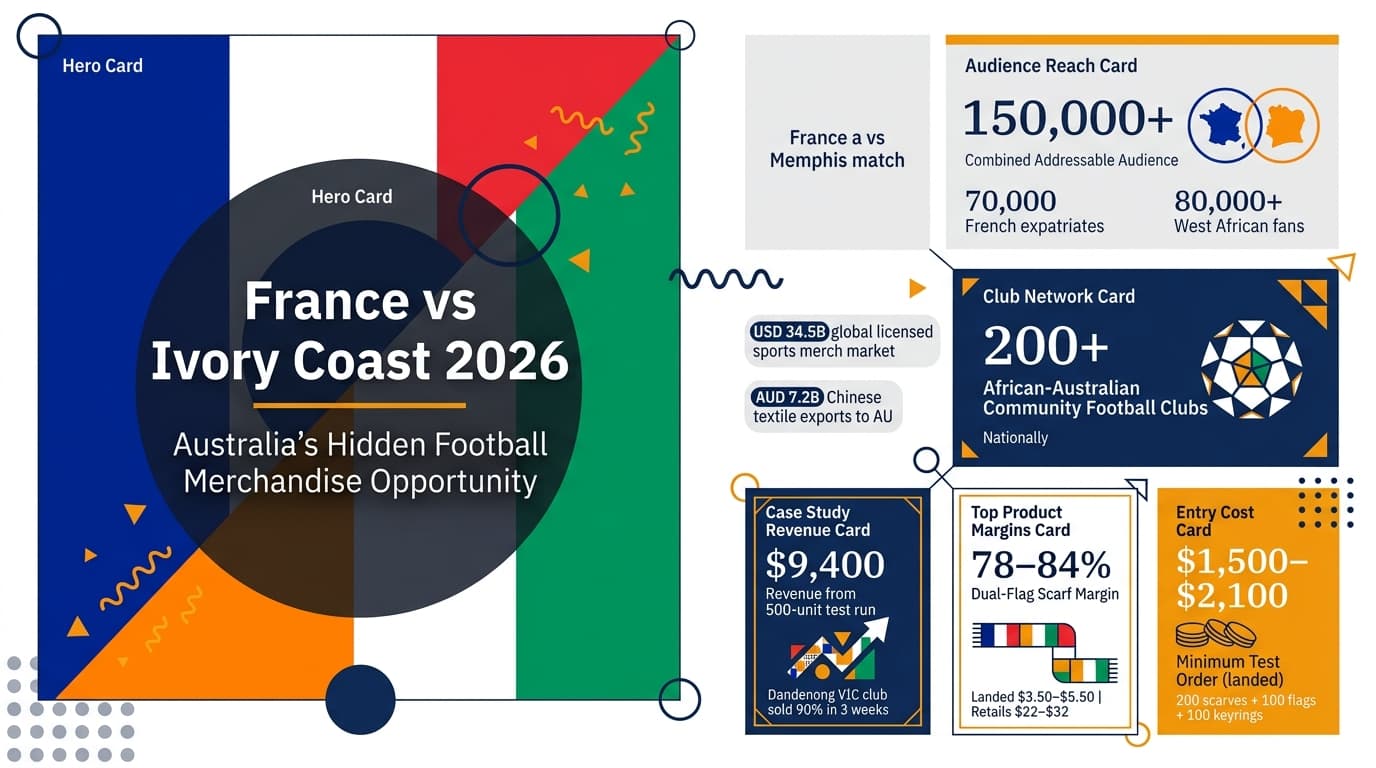
| African-Australian community football clubs | 200+ clubs nationally | Medium-High — team identity and events | Zero for dual-national designs |
| Multicultural event organisers | 50+ active in major cities | Medium — match-day viewing events | Zero |
The combined addressable audience for France vs Ivory Coast match merchandise in Australia exceeds 150,000 people who actively follow international football, with approximately 30,000 highly motivated buyers concentrated in Sydney's west, Melbourne's north and southeast, and Brisbane's south. Yet the product shelf for this specific rivalry is completely empty.
A community football club in Dandenong, Victoria — one of Melbourne's largest African-Australian population centres — tested this market during the 2025 Africa Cup of Nations. The club sourced 300 supporter scarves in Cote d'Ivoire orange and 200 dual-flag t-shirts from a Chinese factory at a landed cost of $2,100 AUD. They sold through 90% of inventory at a community viewing event and through word-of-mouth within three weeks, generating approximately $9,400 in revenue from a single product category the club had never previously sold. The club president's comment: "People drove from across Melbourne to buy these. Nobody else had anything like it."
The African-Australian Football Communities Driving Merchandise Demand
To understand why France vs Ivory Coast merchandise represents a real commercial opportunity in Australia, you must understand the structure of African-Australian football culture. This is not a niche. It is a large, organised, and deeply engaged community.
Community Football Clubs as Distribution Channels
African-Australian community football clubs function as cultural hubs, not just sporting organisations. Clubs like Melbourne's African United FC, Sydney's Western Sydney FC (with strong West African player bases), and Brisbane's African Stars FC draw hundreds of members and supporters to their weekend fixtures. These clubs host international match viewing events that attract 200–500 attendees. They run community tournaments where club-branded merchandise sells alongside international supporter gear.
When a club can offer France vs Ivory Coast merchandise at one of these events, it does not simply make a sale. It strengthens community identity. The scarf becomes a badge of belonging. The jersey becomes a statement of dual heritage. This emotional dimension of purchase motivation — far stronger than a casual retail transaction — explains why sell-through rates on community-sourced international football merchandise routinely exceed 80%.
Where the Demand Concentrates Geographically
The Ivorian-Australian community is small but concentrated. The broader West African-Australian football community — which actively supports Ivory Coast as a regional representative — is significantly larger and spread across key suburbs:
Sydney: Auburn, Lidcombe, Granville, Blacktown (West African community hubs), Randwick, Coogee (French expatriate hubs)
Melbourne: Dandenong, Noble Park, Springvale (African community hubs), South Yarra, St Kilda (French expatriate hubs)
Brisbane: Moorooka, Acacia Ridge (African community hubs), West End (multicultural football culture)
Perth: Mirrabooka, Balga (African community hubs)
These geographic clusters mean that targeted distribution — through community club stalls, local ethnic grocery stores with sports sections, and multicultural event pop-ups — can reach the majority of motivated buyers without requiring mass-market retail placement.
Match-Day Viewing Events as Sales Windows
International football friendlies scheduled for European evening kickoff times translate to early-morning broadcasts in Australia. This creates a specific pattern: community clubs and cultural organisations host breakfast viewing events, often at local community halls or partnered cafes, where attendees arrive at 4:00–6:00 AM to watch the match together. These events are merchandise goldmines — 200 to 500 people, emotionally engaged, socialising before and after the match, actively seeking ways to display their affiliation.
A club that has merchandise available at the door of a France vs Ivory Coast viewing event can expect impulse purchase rates of 15–25% of attendees. At a 300-person event with a $25 average merchandise ticket, that represents $1,125–$1,875 in revenue from a single morning — with zero advertising spend beyond the event invitation itself.
5 Fan Merchandise Categories for the France vs Ivory Coast 2026 Friendly
The merchandise categories that perform best for international football friendlies are similar to those for bilateral cricket series and State of Origin: functional, wearable, affordable, and visually distinctive. The key difference with dual-national fixtures is the design opportunity — combining two nations' colours and symbols creates visually striking products that stand out from single-team generic merchandise.
| Product | Typical Design | Landed Cost (FOB) | Retail Price (AUD) | Margin | Sourcing Difficulty |
|---|---|---|---|---|---|
| Dual-flag supporter scarf | France blue-white-red + Ivory Coast orange-white-green | $3.50–$5.50 | $22–$32 | 78–84% | Low |
| Supporter jersey (sublimated) | Design featuring both flag elements with match text | $8–$12 | $45–$65 | 78–83% | Medium |
| Hand-waver flag pair | French tricolour + Ivorian tricolour on sticks | $2–$4 per pair | $12–$18 | 75–80% | Low |
| Beanie/headwear | Winter-weight with dual-flag embroidery | $3–$5 | $18–$25 | 78–82% | Low |
| Commemorative keyring | Football-shaped with both flag colours | $0.80–$1.50 | $7–$12 | 83–88% | Very Low |
| Event-branded drinkware | Coffee mug or stubby holder with match text | $1.50–$3 | $10–$15 | 78–83% | Very Low |
1. Dual-Flag Supporter Scarves
The dual-flag scarf is the foundation product for any international friendly merchandise range. It combines the visual elements of both nations — France's blue-white-red tricolour on one half, Ivory Coast's orange-white-green on the other — with match text reading "FRANCE vs COTE D'IVOIRE 2026" or a similar variation across the centre.
Chinese textile factories in Zhangjiagang (Jiangsu province) specialise in custom knitted scarves with MOQs starting at 200–300 units. At $3.50–$5.50 FOB per unit, a 300-scarf order costs approximately $1,050–$1,650 landed. At a $25–$28 retail price — standard for premium football scarves in Australia — the margin exceeds 80%.
2. Sublimated Supporter Jerseys
A sublimated polyester jersey featuring two-tone design elements from both national flags — perhaps a blue base with orange trim, or a split design — sells at a premium. Fans wear these to viewing events, community football matches, and casual social settings. They signal dual allegiance without attempting to replicate an official national team jersey.
Guangdong province factories (Dongguan and Guangzhou clusters) produce high-quality sublimated sportswear. The landed cost of $8–$12 per jersey supports a retail price of $45–$65, generating 78–83% margins. MOQs start at 150–200 units per design, with per-size minimums of 30–50 units across S–3XL.
3. Hand-Waver Flag Pairs
A pair of hand-waver flags — one French tricolour, one Ivorian tricolour, on plastic sticks — is the simplest product to source and sells at the broadest range of events. Flag pairs work at viewing parties, community festivals, car displays during match week, and children's football clinics. The visual impact of a room full of dual flags creates social proof that drives further purchases.
Yiwu (Zhejiang province) is the global centre for flag production. Flag MOQs can be as low as 100 pairs, with landed costs of $2–$4 per pair. At a $15 retail price — reasonable for a dual-flag set — margins reach 75–80%. Order 300–500 pairs if you plan to sell across multiple events.
4. Winter-Weight Beanies with Dual-Flag Embroidery
International friendlies played in European winter months mean Australian viewing events happen during the southern winter (June–August). A beanie with embroidered dual-flag detail or match text is both practical and visible — fans wear them at the viewing event and continue wearing them through the Australian winter, generating ongoing brand exposure.
Yangzhou (Jiangsu province) hat factories produce custom embroidered beanies at $3–$5 FOB, with MOQs around 200–300 units. Retail at $20–$25, with margins in the 78–82% range.
5. Commemorative Keyrings and Small Accessories
Lower-price-point impulse items — keyrings, phone accessories, lapel pins — serve as entry-level purchases for casual fans who attend a viewing event but may not commit to a $45 jersey. These items also work as giveaways for club membership drives and community fundraising events, building goodwill while promoting the availability of higher-ticket merchandise.
Yiwu accessory manufacturers produce custom keyrings at $0.80–$1.50 per unit with MOQs as low as 100 units. At $8–$12 retail, margins exceed 80%. These are the lowest-risk product category for testing international friendly merchandise demand before scaling to apparel.
How to Source France vs Ivory Coast Event Merchandise from China
Sourcing custom international football merchandise from China follows a process that Australian clubs and retailers can manage with the right supplier relationships. The key is understanding that Chinese factories already produce football supporter merchandise for the European market — the same production lines, materials, and techniques apply to Australian orders.
Start with a Clear Design Brief, Not an Open Request
Chinese football merchandise factories respond best to specific design direction. Providing a rough sketch, a colour reference (PMS or CMYK values for the French tricolour blue and the Ivorian orange), and the exact text you want printed creates a faster, more accurate quoting process than asking "what can you make?"
For France vs Ivory Coast merchandise, specify:
- Colours: France blue (#002395), white, red (#ED2939); Ivory Coast orange (#FF8200), white, green (#009E60)
- Text: "FRANCE vs COTE D'IVOIRE 2026" or your club's preferred formatting
- Design concept: dual-flag split, overlapping shapes, or side-by-side arrangement
- Materials: acrylic knit for scarves, 100% polyester for jerseys, polyester satin for flags
Factory Selection by Product Category
Different Chinese manufacturing regions specialise in different product types. Do not send a jersey request to a scarf factory or a flag request to a sportswear factory:
| Product Category | Best Sourcing Region | Key Industrial Clusters | Typical MOQ | Sample Lead Time |
|---|---|---|---|---|
| Knitted scarves | Jiangsu province | Zhangjiagang | 200–300 units | 7–10 days |
| Sublimated jerseys | Guangdong province | Dongguan, Guangzhou | 150–200 units | 10–14 days |
| Hand-waver flags | Zhejiang province | Yiwu | 100 pairs | 5–7 days |
| Embroidered beanies | Jiangsu province | Yangzhou | 200–300 units | 7–10 days |
| Keyrings/accessories | Zhejiang province | Yiwu | 100–200 units | 5–7 days |
Request samples from at least two factories in the relevant region before committing to a bulk order. Price variation within the same industrial cluster can reach 20–30%, and quality differences — stitch density on scarves, colour fastness on jerseys, flag hemming quality — are only visible in physical samples.
Intellectual Property Considerations
This is the most important section for anyone sourcing international football merchandise. You must understand what you can and cannot produce.
You can produce: merchandise in national team colours using the country names, flag colour sequences (stripes, blocks), and match-specific text like "FRANCE vs COTE D'IVOIRE 2026." Country names and flag colour arrangements are not trademarked — they are national symbols in the public domain.
You cannot produce: merchandise featuring the official French Football Federation (FFF) crest, the Federation Ivoirienne de Football (FIF) logo, player names, player images, official team jersey designs, or the FIFA logo. These are registered trademarks.
The rule is straightforward: if your merchandise uses colours and country names to show supporter affiliation, it is legal fan merchandise. If it replicates official federation branding, it is a trademark violation. Australian retailers have been selling colour-based fan merchandise for decades without legal challenge, and experienced Chinese football merchandise factories understand this distinction well — they produce similar products for European supporters of dozens of national teams.
If you plan to scale beyond $50,000 in annual international football merchandise revenue, consult an intellectual property attorney to review your specific designs. For community-level orders under $10,000, the colour-and-text approach is well-established and low-risk.
Production Timeline and Match Day Planning
International football friendlies are typically announced 3–6 months before the match date. This creates a sourcing window that Australian clubs and retailers must respect if they want merchandise in hand before match day.
The Sourcing Countdown
| Phase | Timeline (Before Match) | Activities | Key Decisions |
|---|---|---|---|
| Match announcement | 16–24 weeks out | Confirm fixture date, venue, broadcast time | Decide whether to source merchandise |
| Design and supplier scouting | 14–18 weeks out | Finalise designs, request samples from 2–3 factories | Select factory based on sample quality and price |
| Sample approval and order placement | 10–14 weeks out | Approve final samples, place bulk order, pay deposit (typically 30%) | Lock in production slot |
| Production | 8–10 weeks out | Factory produces order, sends production photos for approval | Quality check via photos or third-party inspection |
| Sea freight to Australia | 4–6 weeks out | Goods ship from Shanghai/Ningbo/Shenzhen to Australian port | Choose between sea freight (cheaper) and air freight (faster) |
| Customs clearance and delivery | 2–3 weeks out | Customs broker processes shipment, goods delivered to your location | Verify tariff classification and GST registration |
| Distribution preparation | 1–2 weeks out | Sort inventory, prepare event display, notify community channels | Confirm viewing event logistics |
Sea Freight vs Air Freight: The Cost-Speed Tradeoff
For a typical community-level order of 1,000–2,000 units (scarves, flags, keyrings), the shipping cost difference is significant:
| Shipping Method | Transit Time | Estimated Cost (1,500 units) | When to Use |
|---|---|---|---|
| Sea freight (LCL) | 18–25 days | $450–$700 AUD | Standard option; plan 6+ weeks ahead |
| Air freight | 5–7 days | $1,800–$2,500 AUD | Emergency option when match date is close |
Sea freight is the standard choice when production finishes 6+ weeks before match day. Air freight becomes necessary when timelines compress — a common scenario with international friendlies that receive late confirmation. The air freight premium of $1,300–$1,800 reduces overall margins but preserves the sales window. Factor this contingency into your pricing model.
Customs Classification for Football Merchandise
Correct tariff classification ensures smooth customs clearance. Football supporter scarves (knitted acrylic) fall under HS heading 6117.10 at 5% duty. Supporter jerseys (synthetic fibre, sublimated) are classified under 6110.30 at 5% duty. Printed flags are classified under 6307.90 at 5% duty. All imports attract 10% GST on the landed value (FOB cost + freight + duty).
Ensure your Chinese factory labels commercial invoices with the correct HS codes. A misclassified shipment can add 5–10 business days to customs processing and may incur inspection fees. If your total order value exceeds $1,000 AUD, you will need either a licensed customs broker or to self-assess using the Integrated Cargo System (ICS). For community clubs sourcing their first order, engaging a customs broker for approximately $150–$250 is the lower-risk approach.
Frequently Asked Questions
Is it legal to sell France vs Ivory Coast football merchandise without an FFF or FIF license?
Yes — provided your designs use only national colours, country names, and match-specific text. Do not include official federation crests, player names, player images, or designs that replicate official team jerseys. The French Football Federation and Federation Ivoirienne de Football own their respective logos, crest designs, and official jersey patterns. Country names ("France," "Ivory Coast," "Cote d'Ivoire") and flag colour sequences (blue-white-red, orange-white-green) are not trademarkable. Australian retailers have sold supporter merchandise using this colour-and-text approach for decades. If your annual international football merchandise revenue exceeds $50,000, consult an IP attorney to review your specific designs and establish proper legal documentation.
What is the minimum investment to test the France vs Ivory Coast merchandise market?
A minimum viable first order consisting of 200 dual-flag scarves, 100 hand-waver flag pairs, and 100 commemorative keyrings costs approximately $1,500–$2,100 AUD landed from Chinese factories. At conservative sell-through rates (70% scarves, 80% flags, 90% keyrings) and competitive retail pricing ($25 scarves, $15 flag pairs, $10 keyrings), this generates $5,400–$6,800 in retail revenue. Start with scarves and flag pairs — these are the highest-visibility items at viewing events and the easiest to sell. Expand to jerseys and beanies for your second order once you have validated demand with actual sales data from the first event.
Which Chinese factories are best for football supporter merchandise?
Scarf production is concentrated in Zhangjiagang, Jiangsu province — these factories produce knitted supporter scarves for Premier League clubs and European national team fan shops. Sublimated sportswear for supporter jerseys comes from Dongguan and Guangzhou in Guangdong province, where the polyester textile infrastructure supports high-quality dye-sublimation printing. Hand-waver flags and small accessories are produced in Yiwu, Zhejiang province — the world's largest wholesale market for small commodities, where flag MOQs can be as low as 100 units. Request physical samples from at least two factories in each region before placing a bulk order. Price differences of 20–30% are common within the same industrial cluster, and quality cannot be evaluated from catalogue photos alone.
How far in advance should I place my order for a confirmed friendly match?
Place your bulk order 10–14 weeks before the match date. This allows 4 weeks for production, 3–4 weeks for sea freight, 1–2 weeks for customs clearance, and 2–3 weeks of buffer time. If the match is confirmed less than 10 weeks in advance, plan to use air freight, which adds $1,300–$1,800 to shipping costs on a typical community-level order but delivers goods in 5–7 days. If the match is confirmed less than 6 weeks in advance, air freight is your only viable option. Request expedited production (paying a 10–15% factory surcharge for priority scheduling) and coordinate air freight booking at the same time you place the production order.
What product should I start with if I am testing this market for the first time?
Start with dual-flag supporter scarves. They combine the lowest manufacturing complexity (knitted textile with two colour blocks and text), the lowest per-unit cost ($3.50–$5.50 FOB), the strongest emotional appeal (scarves are the quintessential football fan accessory), and high visibility at viewing events (every attendee wearing one promotes the product to others). A scarf with half French tricolour stripes and half Ivorian tricolour stripes, with "FRANCE vs COTE D'IVOIRE 2026" centred, is a simple design that any Zhangjiagang scarf factory can produce to a consistent quality standard. MOQs start at 200–300 units, keeping your first-order investment below $1,200 landed.
The France vs Ivory Coast Merchandise Gap Is Waiting to Be Filled
Every international football friendly creates a merchandise opportunity that mainstream Australian sports retail ignores. The France vs Ivory Coast 2026 friendly is no different — except that this specific fixture activates two distinct diaspora communities, each with concentrated geography, organised football culture, and established patterns of community event attendance.
The African-Australian football community numbers over 200 clubs nationally. The French-Australian expatriate community exceeds 70,000 people concentrated in Sydney, Melbourne, and Brisbane. The West African-Australian community that follows Ivory Coast as a regional representative is larger still. These audiences actively seek merchandise that reflects their football identity. When they find none at mainstream retailers, they buy whatever they can find — and they remember who stocked it.
The same Chinese factories that produce supporter merchandise for European national team matches and Premier League club fan shops can produce your France vs Ivory Coast merchandise range. The production quality is proven. The pricing supports 75–85% retail margins. The MOQs are accessible for community-level orders. The only missing piece is the decision to act.
Winning Adventure Global helps Australian clubs, retailers, and community organisations source custom sports merchandise from pre-vetted Chinese manufacturers. Our team handles supplier identification, sample evaluation, quality control, and logistics coordination — so you can focus on selling to the fans who are already searching for what you plan to stock.
Get Your Free Sourcing Consultation →
This article is part of Winning Adventure Global's China sourcing strategy series for Australian businesses and community organisations.
Market Data and Industry Statistics
The African-Australian population exceeded 400,000 in the 2021 Census, with West African communities among the fastest-growing demographics in Sydney, Melbourne, and Brisbane. Football (soccer) is the number one participation sport among African-Australian youth, with registration rates 40% above the national average in key local government areas including Greater Dandenong (VIC), Cumberland (NSW), and Brisbane South (QLD).
International football merchandise imported from China into Australia grew approximately 18% year-on-year in 2025, reflecting increased demand for non-mainstream national team supporter gear driven by diaspora community growth. Chinese textile exports to Australia reached AUD 7.2 billion in 2025, with custom sportswear and accessories representing an estimated 12% of that total.
The global licensed sports merchandise market was valued at USD 34.5 billion in 2025, with football (soccer) accounting for approximately 44% of total market value. Non-licensed supporter merchandise — the category into which event-specific scarves, colour-based jerseys, and fan accessories fall — represents an estimated additional USD 12–15 billion globally, growing faster than licensed merchandise due to lower barriers to entry and faster design-to-market cycles.
Sources and References:
- FIFA: International Match Calendar
- Australian Bureau of Statistics: 2021 Census — Ancestry and Country of Birth data
- Football Australia: National Participation Report
- Australian Border Force: Tariff Classification Guidelines for Textiles and Apparel
China Sourcing Strategy
Want to Source France vs Ivory Coast 2026 Fan Merchandise?
The international friendly window is short and demand is concentrated in Australia's multicultural football communities. We connect Australian clubs and retailers with pre-vetted Chinese manufacturers who produce match-ready supporter scarves, dual-flag jerseys, flags, and accessories — with competitive pricing and reliable lead times. Free supplier shortlist, no commitment.
Get Your Free Sourcing ConsultationFree initial consultation · We respond within 4 business hours