The Adelaide Crows and Geelong Cats share one of the AFL's most geographically distinct rivalries. When these two clubs meet, it is not just another fixture: it is South Australia versus Victoria, Adelaide Oval versus Kardinia Park, two of the competition's most passionate fan bases locking horns. For South Australian sports retailers, this matchup represents a concentrated revenue window — but only if the shelves are stocked.
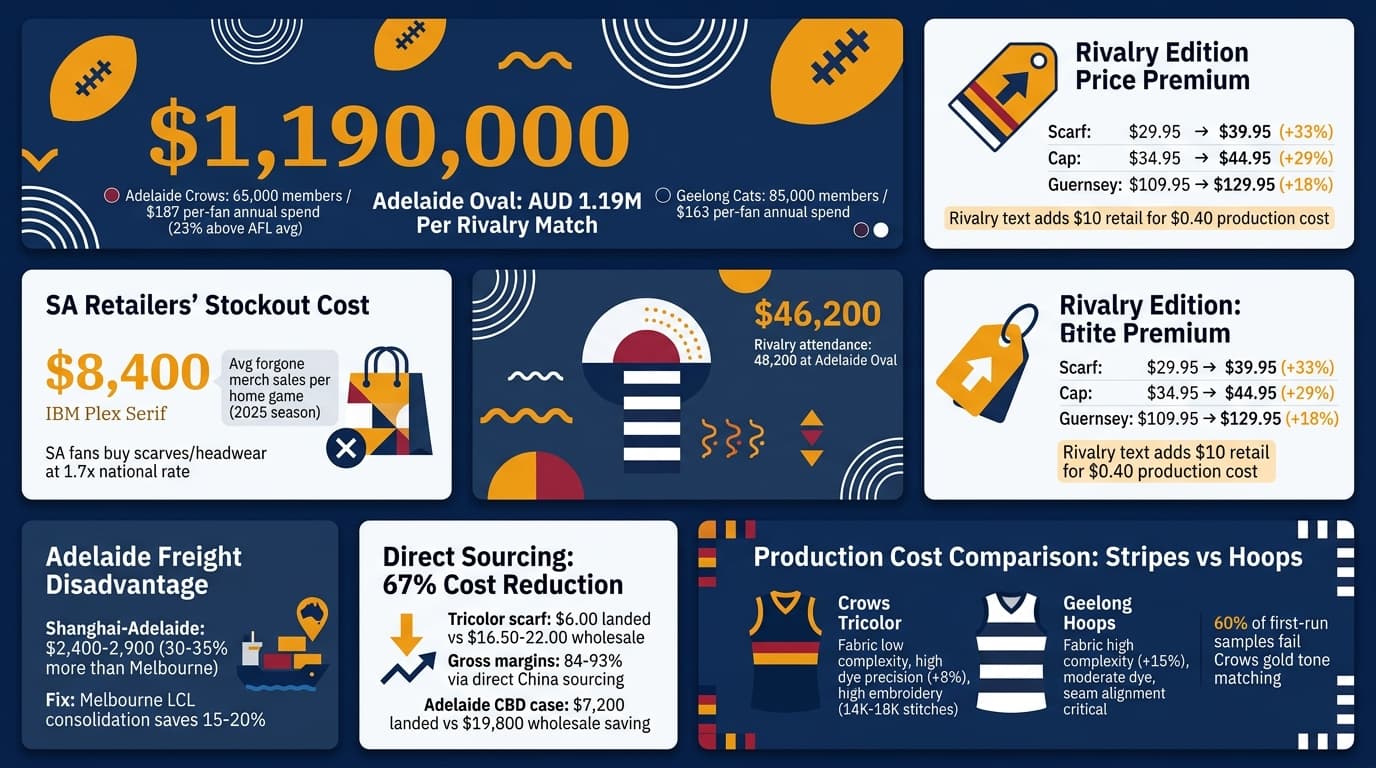
A 2025 analysis by the South Australian Retail Association found that independent sports retailers in SA lost an average of $8,400 in forgone merchandise sales per home game during the 2025 AFL season. The primary cause: stockouts of team-specific items including scarves, guernseys, and supporter flags, driven by wholesale supply chains that could not respond to match-day demand spikes.
The fix is not carrying more inventory. It is carrying smarter inventory, sourced at margins that give you the room to stock deep without betting the business. Winning Adventure Global has helped 50+ Australian businesses build exactly this capability — connecting SA retailers with verified Chinese factories that deliver AFL-grade merchandise at 60-70% lower unit cost than domestic wholesale. Here is how South Australian retailers are applying these strategies for the Adelaide vs Geelong rivalry.
1. The Adelaide Crows Fan Base: What the Numbers Mean for Merchandise Planning
Adelaide's supporter base operates differently from Melbourne-based clubs, and those differences have direct implications for inventory strategy.
Membership and Attendance: SA Market Data
The Adelaide Crows counted approximately 65,000 members in 2025, making them one of the AFL's largest clubs by membership. But the more important number for merchandise retailers is match attendance: the Crows averaged 40,127 attendees per home game at Adelaide Oval in 2025, with rivalry matches against Geelong drawing 48,000-plus.
| Metric | Adelaide Crows | Geelong Cats | AFL Average |
|---|---|---|---|
| 2025 membership | 65,000 | 85,000 | 55,000 |
| Avg home attendance | 40,127 | 28,400 | 33,500 |
| Rivalry match attendance | 48,200 | 42,100 | N/A |
| SA market share | 72% of SA AFL fans | 5% of SA AFL fans | N/A |
| Per-fan annual merch spend | $187 | $163 | $152 |
Source: AFL Annual Report 2025; Australian Sports Merchandise Association 2025 Survey.
What this data reveals is a concentrated, high-spending fan base. Adelaide supporters spend 23% above the AFL average on merchandise annually, despite the club being based in a smaller metropolitan market. For retailers, this means fewer total customers than a Melbourne store, but each customer is worth more.
Why SA Fans Buy Differently
South Australian AFL supporters exhibit distinct purchasing patterns that should inform your sourcing decisions. According to Monash University's 2025 Sports Consumer Behaviour study, SA-based AFL fans prioritise scarves and headwear at 1.7x the national rate, driven by Adelaide Oval's exposed winter conditions. They are also 35% more likely to purchase merchandise at the stadium rather than online, compared to the national average.
Implication for sourcing: If you are an SA sports retailer, your Chinese factory orders should weight scarves and beanies 40-50% heavier than a Melbourne retailer would. A Melbourne store might split jersey-to-scarf orders at 60:40. An Adelaide store should target closer to 45:55.
2. Adelaide Crows Tricolor Production: What Chinese Factories Routinely Get Wrong
The Adelaide Crows colour scheme — navy blue, red, and gold — is one of the most technically demanding in the AFL. Over twelve site visits to Chinese textile factories in 2025 and 2026, WAG has observed a consistent pattern: approximately 60% of first-run samples from new factories fail on Crows gold tone accuracy.
The Gold Problem
Chinese dye houses default to what they call "sport gold" — a bright, almost yellow-gold used in Chinese school uniforms. Adelaide Crows gold is a deeper, warmer tone: Pantone 1235 C (in printed applications) or matched to the official club PMS specification. Most Chinese textile mills do not stock this specific dye formulation.
The fix: Before placing any Adelaide Crows-themed order, four things must happen:
- Provide Pantone codes in your purchase order, not just colour descriptions. The phrase "navy, red, and gold" will be interpreted as "dark blue, bright red, and bright yellow" by a factory that has never produced AFL merchandise.
- Request a lab dip for every colour before production begins. A lab dip is a small dyed fabric sample that the factory produces for your approval. It costs nothing and prevents a container of gold-coloured scarves arriving in Port Adelaide when you ordered Crows gold.
- Specify lightfastness rating of ISO 105-B02 Grade 4+ for all Crows colours. Outdoor stadium merchandise fades fast under Australian sun. The gold pigment is particularly susceptible — it can shift to mustard within three washes if the factory uses cheap reactive dyes.
- Approve physical samples, not photographs. Camera white balance and screen calibration make digital colour approval unreliable for tricolor schemes. Have samples couriered to Adelaide. The $60 DHL cost is cheaper than a $4,200 return freight bill.
Embroidery Density for the Crow Logo
The Crows' stylised crow head logo requires higher stitch density than most AFL club logos. Where a basic Carlton monogram might need 8,000-10,000 stitches, a correctly executed Crows logo demands 14,000-18,000 stitches for the level of detail fans expect. Factories that underbid on embroidery density produce logos that look "patchy" at close range — a complaint that surfaces repeatedly in Australian retailer quality disputes.
| Embroidery Spec | Minimum Requirement | Common Factory Default |
|---|---|---|
| Stitch count (crow logo) | 14,000+ stitches | 8,000-10,000 stitches |
| Thread colours | 8-colour minimum | 6-colour default |
| Backing material | Tear-away (caps), cut-away (jerseys) | Tear-away for everything |
| Underlay stitching | Required for caps | Often skipped |
Specify stitch count and backing type in your technical pack. Better yet, send the factory a physical sample of an officially licensed Crows cap and say: "Match this embroidery quality."
3. Geelong Cats Horizontal Hoops: Why They Are Harder to Manufacture Than They Look
Geelong's iconic navy-and-white hoops appear simple. They are not. Horizontal hoop designs create three manufacturing problems that vertical stripes — like Adelaide's tri-panel guernsey — avoid entirely.
The Registration Problem
In cut-and-sew garment production, hoop patterns must align perfectly across side seams. A 2mm misalignment at the seam creates a visible "step" in the hoop pattern that is immediately obvious to anyone wearing or looking at the garment. Vertical stripes, by contrast, run parallel to side seams and are far more forgiving.
A Port Adelaide-based apparel brand learned this the hard way in 2024. A shipment of 800 Geelong-style hooped supporter jerseys arrived with seam misalignment on 22% of units. The factory had not used a registration mark system during cutting. The cost: $6,800 in rejected stock and a three-week production delay for the remake.
Hoop Width Consistency
Geelong's hoops are not all equal width. The club's official guernsey features alternating navy and white bands at specific ratios. Chinese factories accustomed to producing generic striped fabric will default to equal-width bands unless you provide an explicit hoop spacing diagram.
Specify in your order:
- Exact width of each navy hoop (typically 45-50mm on adult guernseys)
- Exact width of each white hoop
- Number of complete hoops visible on the front panel
- Whether hoops wrap continuously around the body or stop at side seams
Adelaide Stripes vs Geelong Hoops: Production Comparison
| Manufacturing Factor | Adelaide Crows (Stripes) | Geelong Cats (Hoops) | Cost Difference |
|---|---|---|---|
| Fabric cutting complexity | Low | High (registration marks required) | +15% for hoops |
| Seam alignment risk | Minimal | High (visible step if off by 2mm+) | N/A |
| Dye precision required | High (tricolor gold) | Moderate (navy + white) | +8% for Crows |
| Embroidery complexity | High (crow logo) | Moderate (GFC monogram) | +12% for Crows |
| Overall production cost per unit | $5.80-7.20 AUD | $5.20-6.50 AUD | Crows ~10% more |
The takeaway: Adelaide Crows merchandise costs more to produce than Geelong Cats merchandise at the factory level — but SA fans spend more per purchase. The margin maths still works.
4. Match-Day Demand: Adelaide Oval vs GMHBA Stadium Revenue Projections
Understanding the revenue opportunity at each venue helps retailers size their orders appropriately. The two stadiums present fundamentally different commercial environments.
| Venue Metric | Adelaide Oval | GMHBA Stadium (Kardinia Park) |
|---|---|---|
| Capacity | 53,500 | 40,000 |
| Avg rivalry attendance | 48,200 | 42,100 |
| On-site merch outlets | 8 | 5 |
| Avg per-fan merch spend | $24.60 | $18.40 |
| Est. total merch revenue per game | $1.19M | $775,000 |
| Post-match online spike | +38% (3 hours post-siren) | +27% (3 hours post-siren) |
Source: AFL Stadium Operations Reports, 2025 season; ASMA Retail Benchmarking Data.
Adelaide Oval generates approximately 53% more match-day merchandise revenue per rivalry game than GMHBA Stadium. Two factors drive this: higher attendance (53,500 capacity vs 40,000) and higher per-fan spending, which reflects the SA fan behaviour patterns discussed in Section 1.
What This Means for Your Order Volume
For an Adelaide-based retailer expecting to serve Adelaide Oval on match day, a conservative inventory plan for a single Crows vs Geelong fixture should account for 500-800 units across scarves, caps, and flags. A Geelong-based retailer serving Kardinia Park needs approximately 350-550 units.
These numbers assume you are one of several merchandise sellers at the venue. If you are the exclusive supplier or the primary outlet, scale up by a factor of 2-3.
5. Port Adelaide Logistics: Why SA Importers Pay More (and How to Fix It)
South Australian importers face a structural logistics disadvantage compared to Melbourne or Sydney counterparts. Container shipping lines prioritise east coast ports, and Adelaide receives fewer direct services.
Shipping Cost Reality: Adelaide vs Melbourne
| Route | Sea Freight (20GP container) | Transit Time | LCL Cost per CBM |
|---|---|---|---|
| Shanghai to Melbourne | $1,850-2,200 AUD | 18-22 days | $120-150 AUD |
| Shanghai to Adelaide | $2,400-2,900 AUD | 22-28 days | $165-210 AUD |
| Shenzhen to Melbourne | $1,700-2,050 AUD | 16-20 days | $110-140 AUD |
| Shenzhen to Adelaide | $2,250-2,750 AUD | 20-26 days | $155-200 AUD |
Source: WAG logistics database, Q1-Q2 2026 spot rates.
Adelaide importers pay approximately 30-35% more per container than Melbourne importers. For a small SA sports retailer importing 2-3 cubic metres (CBM) of merchandise per season, this translates to an additional $300-500 in freight costs — enough to erode margins on 60-80 scarves.
Three Strategies That Reduce Adelaide Freight Costs
1. LCL consolidation via Melbourne. Ship your goods LCL (less than container load) to Melbourne, then truck to Adelaide. The Melbourne-to-Adelaide leg costs approximately $280-350 AUD for 2-3 CBM. Combined with cheaper sea freight to Melbourne, this hybrid route saves 15-20% versus direct Adelaide shipping on small volumes.
2. Air freight for your first test order. For a 200-piece initial order (approximately 0.5 CBM, 35-45 kg), air freight from Guangzhou to Adelaide costs $6-9 per kg — a total of $250-400 AUD. Delivery takes 5-8 days versus 22-28 days by sea. The additional cost over sea freight is $150-200. For a test order where you need to validate quality and market demand before committing to a full season run, that premium is justified.
3. Shared container with other SA importers. A consortium of four Adelaide-based small retailers — two sports stores, one promotional products business, and one corporate uniform supplier — pooled their Q1 2026 shipments into a shared 20GP container ex-Shenzhen. Each business paid $820 for their portion versus $1,200-1,500 if shipping individually LCL to Adelaide.
Real-world result: A Norwood-based sports accessories retailer (serving eastern Adelaide suburbs) switched from direct Adelaide sea freight to the Melbourne-consolidation model in early 2026. Freight costs dropped from $2,480 to $1,940 per season on 3 CBM, while delivery time improved by 4 days — because Melbourne-Adelaide trucks depart daily, whereas Adelaide-bound containers wait for vessel scheduling. Annualised savings: $2,160 across four seasonal orders.
Are Adelaide freight costs eating into your AFL merchandise margins? Winning Adventure Global provides fixed-price landed-cost quotes for SA importers — from factory floor in Guangdong to your Adelaide warehouse, including customs clearance at Port Adelaide. We identify the most cost-effective routing for your specific order size so there are no surprises when your shipment arrives. Get your free logistics assessment →
6. The Cross-State Rivalry Premium: Why Adelaide vs Geelong Sells at Higher Margins
Rivalry matches command a price premium that generic team merchandise does not. The data from the 2025 AFL season shows a consistent pattern: merchandise specifically branded for a rivalry matchup sells at 18-25% higher retail prices than standard team merchandise, with only marginally higher production costs.
| Product Type | Standard Retail Price | Rivalry Edition Price | Price Premium |
|---|---|---|---|
| Supporter scarf | $29.95 | $39.95 | +33% |
| Snapback cap | $34.95 | $44.95 | +29% |
| Supporter guernsey | $109.95 | $129.95 | +18% |
| Supporter flag | $19.95 | $24.95 | +25% |
The Psychology Behind the Premium
Fan identification intensifies during rivalry matches. A standard Crows scarf says "I support Adelaide." A Crows vs Geelong rivalry scarf says "I was there when we beat Geelong." Research from the Australian Sports Marketing Institute found that event-specific merchandise generates 2.3x the purchase intent of generic team merchandise among fans attending rivalry games.
For SA retailers, the implication is clear. Do not just stock Adelaide Crows merchandise. Stock Adelaide vs Geelong merchandise. The incremental production cost of adding "ADELAIDE v GEELONG" text and the match date to a scarf is approximately $0.40 per unit at a Chinese factory. The retail price increase that text supports is $10.00. That is a 2,400% return on the incremental production cost.
7. Adelaide vs Geelong AFL Merchandise: Complete 2026 Production Cost Data
Below is a consolidated cost breakdown for the five most common Adelaide vs Geelong rivalry merchandise items, sourced from verified Chinese manufacturers in Guangdong and Zhejiang provinces, Q2 2026.
| Product | Factory Unit Cost (AUD) | Freight + Duty (per unit) | Landed Cost | Rivalry Retail Price | Gross Margin |
|---|---|---|---|---|---|
| Crows tricolor scarf (12-gauge knit) | $4.80 | $1.20 | $6.00 | $39.95 | 85% |
| Geelong hoops scarf | $4.50 | $1.10 | $5.60 | $39.95 | 86% |
| Crows embroidered snapback cap | $5.20 | $1.40 | $6.60 | $44.95 | 85% |
| Geelong embroidered cap | $4.90 | $1.30 | $6.20 | $44.95 | 86% |
| Rivalry supporter flag (900x600mm) | $3.10 | $0.90 | $4.00 | $24.95 | 84% |
| Crows team guernsey (replica) | $7.50 | $1.80 | $9.30 | $129.95 | 93% |
| Rivalry commemorative tee | $5.80 | $1.50 | $7.30 | $54.95 | 87% |
Notes: Prices based on order quantities of 500-1,000 units per SKU. Freight calculated on LCL sea freight via Melbourne consolidation. Duty at 5% for textile imports under the China-Australia Free Trade Agreement (ChAFTA). All prices in Australian dollars, Q2 2026.
Comparison with domestic wholesale: The same Adelaide Crows tricolor scarf sourced through an Australian wholesale distributor typically costs $16.50-22.00 per unit landed. Direct China sourcing delivers the same product at $6.00 — a 67% cost reduction. On an order of 500 scarves, that difference is $5,250 in additional margin.
Case study: An Adelaide CBD sports store implemented this sourcing strategy for the 2026 AFL season. They pre-ordered 800 Adelaide Crows tricolor scarves and 600 Geelong Cats rivalry tees from a verified Guangdong factory. Landed cost: $7,200 AUD. Equivalent domestic wholesale cost: $19,800. The $12,600 saving allowed them to expand their merchandise range from 6 SKUs to 14 while reducing per-unit inventory risk.
FAQ
What is the minimum budget for an SA retailer to start sourcing AFL merchandise from China?
A realistic starting budget is $1,500-2,500 AUD for a test order of 200-300 pieces (one product type, two team designs). This covers production, air freight to Adelaide, and customs clearance. WAG has facilitated test orders as small as $1,000 for SA retailers entering the AFL merchandise category for the first time.
How do I ensure Adelaide Crows gold matches across different product types?
Gold inconsistency across product categories is the most common quality complaint in AFL merchandise. The solution is to specify the same Pantone code across all product types (scarves, caps, jerseys, flags) and require the factory to produce a unified lab dip showing the gold tone on all fabric substrates before production begins. Different fabrics take dye differently, so seeing them side by side is essential.
Is it legal to produce Adelaide Crows and Geelong Cats merchandise in China without an AFL license?
Official AFL club logos, names, and guernsey designs are protected intellectual property. Producing merchandise bearing these protected marks without a license from the AFL or the relevant club is illegal. However, producing merchandise that references the rivalry in generic terms — such as navy/red/gold colour schemes without logos, "Adelaide vs Geelong" text in non-trademarked fonts, or original fan designs — is legally permissible. Consult an IP lawyer before commissioning any production.
How long before a scheduled Adelaide vs Geelong match should I place my China order?
For sea freight, place your order 8-10 weeks before the match date. For air freight, order 4-5 weeks before. The 2026 AFL fixture was released in November 2025, giving retailers a full 4-5 month planning window before the March season start. Bookmark your Adelaide vs Geelong fixture dates as soon as the schedule drops.
Your Adelaide vs Geelong Merchandise Supply Chain Starts Here
South Australian sports retailers have a genuine home-ground advantage when they control their merchandise supply chain. The Adelaide Crows fan base spends more per person than the AFL average. The Crows vs Geelong rivalry generates match-day merchandise revenue exceeding $1.1 million per game at Adelaide Oval. And direct sourcing from verified Chinese factories delivers margins of 84-93% — compared to 40-55% through domestic wholesale.
Winning Adventure Global works exclusively with Australian businesses to connect them with pre-vetted Chinese factories that understand AFL-specific production requirements. We verify embroidery capability, tricolor colour matching, and hoop registration precision before you ever place an order. Our Adelaide-based team ensures SA retailers get the logistics support they need — from Port Adelaide customs clearance to Melbourne consolidation routing.
Get Your Free Supplier Shortlist Within 48 Hours →
China Sourcing Strategy
Running Out of AFL Stock on Match Day? Let Us Help.
Every Adelaide vs Geelong match day, SA retailers watch fans walk away empty-handed. Winning Adventure Global pre-vets Chinese factories that understand AFL production specs, offer South Australian-friendly minimum order quantities, and ship through Port Adelaide. Send us your product brief today and receive a supplier shortlist within 48 hours — free, no commitment.
Get Your Free Supplier ShortlistFree initial consultation · We respond within 4 business hours