A Brisbane-based hospitality business with 12 full-time staff will pay roughly $23,000 more in wages this financial year compared to the last. A Melbourne manufacturer employing 25 production workers faces an additional $48,000 in direct labour costs. A Perth retailer with 8 casual staff on award rates is looking at $15,000 in extra wage outlays. None of these businesses did anything wrong. The Fair Work Commission made its decision, and on 1 July 2026, the new minimum wage took effect.
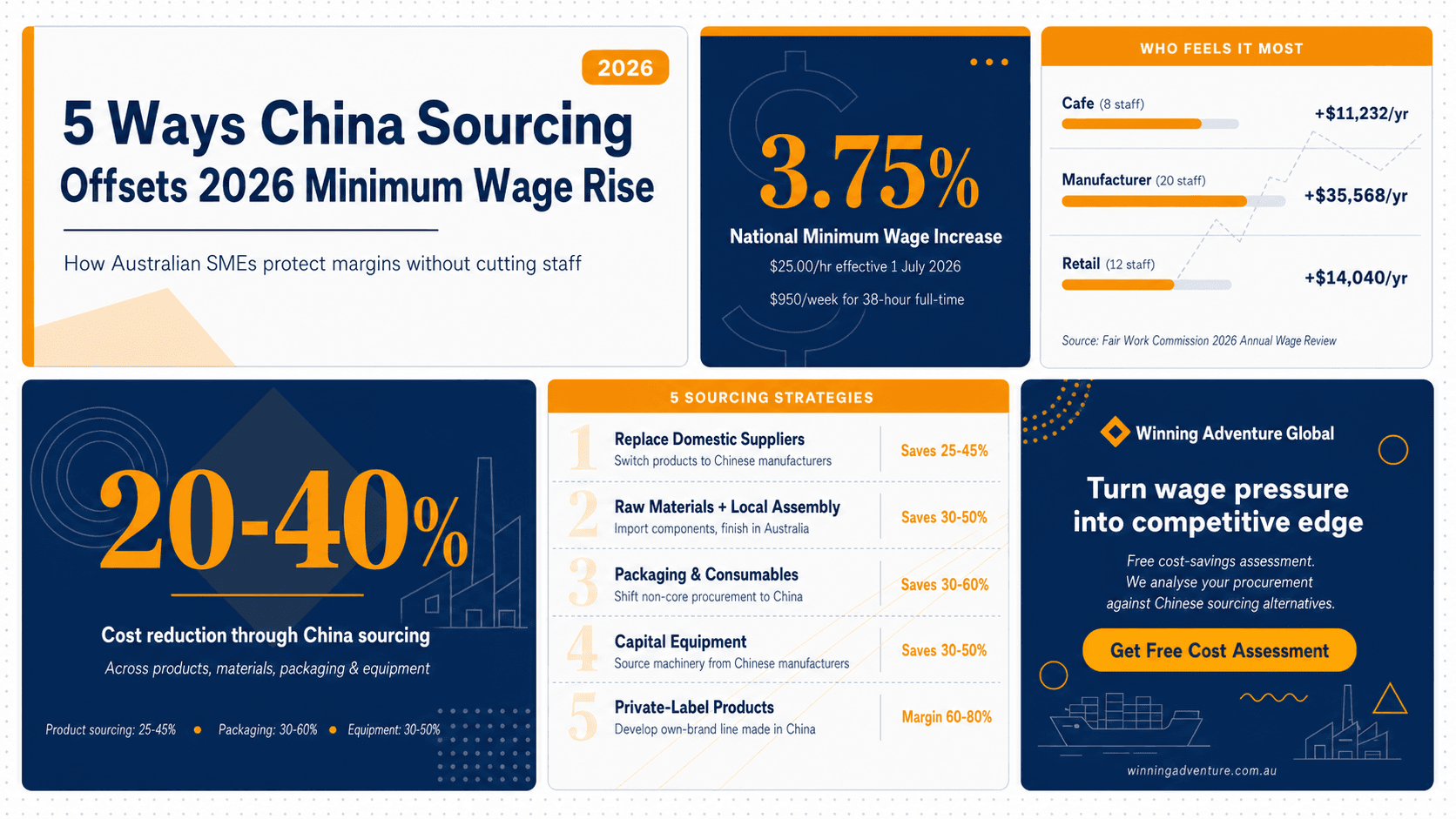
These numbers are not hypothetical. They are the direct arithmetic of the Fair Work Commission's 2026 Annual Wage Review, which increased the national minimum wage and all modern award rates by 3.75 per cent. For the typical Australian SME, wage costs represent 30 to 45 per cent of total operating expenditure. When that base moves up by nearly four per cent, the margin impact is immediate and material.
The question most business owners are asking is not whether the increase is justified. It is whether their business can absorb it without cutting staff, raising prices, or shrinking margins.
There is a third option. Australian SMEs that source products, materials, packaging, and equipment from Chinese manufacturers routinely reduce their cost of goods sold by 20 to 40 per cent compared to domestic or established-market alternatives. That cost differential, applied strategically, can offset the entire impact of the minimum wage increase — and then some.
This article examines exactly how that arithmetic works, which sourcing strategies produce the fastest cost relief, and what a practical implementation plan looks like for a business that has never imported from China before.
What the 2026 Minimum Wage Rise Means for Australian SMEs
The Fair Work Commission's 2026 Annual Wage Review decision, handed down on 2 June 2026, increased the national minimum wage and all modern award classification rates by 3.75 per cent. The new national minimum wage sits at $25.00 per hour, or $950.00 per week for a 38-hour full-time employee. The increase took effect from the first full pay period starting on or after 1 July 2026.
For context, the Commission's 2025 decision delivered a 3.75 per cent increase. The two-year cumulative effect means Australia's minimum wage has risen by approximately 7.6 per cent since mid-2025. When superannuation guarantee costs are included — now at 12 per cent and legislated to rise further — the total cost of employing a minimum-wage worker has increased substantially in real terms.
The impact on SMEs is concentrated in sectors with high labour intensity. Businesses in hospitality, retail, manufacturing, construction, cleaning, and aged care feel the effect most acutely because wages represent a larger share of their cost base. But even businesses in lower-labour-intensity sectors face the flow-through effects: suppliers raise their prices to cover their own wage increases, commercial rents adjust, and service providers pass on higher staff costs.
Who Feels It Most
The wage increase does not affect all businesses equally. Three factors determine the severity of the impact:
Award dependence. Businesses that employ staff under modern awards — including the General Retail Industry Award, the Hospitality Industry Award, the Manufacturing Award, and the Clerks Award — see automatic flow-through because award rates are tied directly to the Commission's decision. There is no flexibility to negotiate a lower rate.
Labour intensity. A cafe where wages represent 42 per cent of revenue feels a 3.75 per cent wage increase far more than a professional services firm where wages represent 28 per cent of revenue. The labour-intensity ratio determines how much of the wage increase flows through to the bottom line.
Pricing power. Businesses that operate in competitive markets with price-sensitive customers cannot simply pass wage increases through to prices. A retailer competing with online alternatives, for example, may absorb the entire wage increase rather than risk losing customers to a competitor. The result is margin compression that accumulates year after year.
The Arithmetic That Matters
For a business assessing the financial impact, the calculation is straightforward. Take the total number of award-reliant employees, multiply by the average hours worked per week, and apply the 3.75 per cent increase to each hour. Add the superannuation guarantee contribution on top. The result is the annualised wage increase the business must absorb before any operational adjustment.
| Business Type | Staff Count | Average Weekly Hours | Annual Wage Increase (incl. super) |
|---|---|---|---|
| Small cafe | 8 | 30 | $11,232 |
| Retail store | 12 | 25 | $14,040 |
| Light manufacturer | 20 | 38 | $35,568 |
| Commercial cleaner | 15 | 20 | $14,040 |
| Wholesale distributor | 10 | 38 | $17,784 |
These figures represent the minimum increase. Businesses with staff on above-award rates may face additional pressure if they need to maintain relativities, though this is a commercial decision rather than a legal requirement.
The strategic question for any SME facing these numbers is not whether the increase is manageable. It is whether there are structural changes to the business's cost base that can offset the increase without compromising quality, service, or workforce stability.
5 Ways China Sourcing Reduces Operating Costs
China sourcing is not a single tactic. It is a family of procurement strategies that can be applied at different points in a business's value chain to reduce input costs. The five approaches described below are ordered from simplest to most operationally involved, allowing businesses to start with the approach that best matches their current situation and scale up over time.
1. Replace Existing Domestic Suppliers with Chinese Manufacturers
The most direct approach: identify products, components, or materials currently purchased from Australian or established-market suppliers and source functionally equivalent alternatives from Chinese manufacturers.
The cost differential is well documented. Australian businesses that switch from domestic suppliers to Chinese manufacturers for comparable product specifications typically achieve landed-cost savings of 25 to 45 per cent. The range reflects variation in product complexity, shipping costs, and order volume. Simple products with high Australian labour content — garments, basic hardware, printed packaging, promotional merchandise — tend to produce savings at the upper end of the range. More complex products where raw material costs dominate — specialised alloys, electronic assemblies — tend toward the middle.
A real example from our client work: an Adelaide-based promotional products business was paying $4.80 per unit for branded drink bottles sourced from an Australian wholesaler, who in turn imported from China. By sourcing directly from the Chinese manufacturer, the landed cost dropped to $1.95 per unit — a 59 per cent reduction. On an annual order of 15,000 units, the switch freed up $42,750 in annual cash flow. That single change more than offset the business's entire minimum wage increase across a team of six.
The key prerequisite is quality verification. A lower price is not worth the risk of receiving product that does not meet specifications or Australian standards. Factory audits, pre-shipment inspections, and sample approvals are non-negotiable parts of this strategy. We cover the verification process in detail later in this article.
2. Source Raw Materials and Components, Assemble Locally
This approach sits between full import substitution and pure domestic procurement. Instead of sourcing finished products from China, the business imports the raw materials, components, or semi-finished goods and performs final assembly, finishing, or packaging in Australia.
The strategy appeals to businesses that want to maintain an Australian-made claim for marketing or compliance reasons, or whose customers value domestic content. It also works well for products where the assembly process is the primary source of Australian competitive differentiation — custom joinery, specialised food products, bespoke manufacturing — but the input materials are generic and labour-intensive to produce.
The cost arithmetic works as follows: Chinese manufacturers supply the materials or components at 30 to 50 per cent below Australian-sourced equivalents, while the final assembly labour remains in Australia. The business reduces its material cost of goods sold substantially while preserving the Australian-made component of its value proposition and maintaining direct quality control over the finished product.
A Melbourne-based furniture manufacturer we worked with adopted this model for its timber component supply. Rather than purchasing cut-to-size hardwood panels from Australian timber merchants at $78 per square metre, the business sourced kiln-dried, precision-cut panels from a Chinese timber processor at $38 per square metre landed. The panels arrived ready for assembly and finishing in the Melbourne workshop. On an annual consumption of 400 square metres, the material cost saving was $16,000 — enough to cover the wage increase for two of the workshop's five production staff.
3. Source Packaging, Consumables, and Non-Core Inputs from China
Businesses that cannot or prefer not to change their core product sourcing can still achieve meaningful cost reduction by shifting non-core procurement to Chinese suppliers. Packaging materials, point-of-sale displays, cleaning supplies, uniforms, stationery, and consumable tooling are all categories where Chinese sourcing typically delivers 30 to 60 per cent cost reduction with minimal operational disruption.
This strategy is often the easiest entry point for businesses new to importing because the product categories are standardised, the quality risks are lower, and the procurement does not touch the core customer experience. Yet the aggregate savings can be substantial.
Consider a medium-sized bakery chain with 8 locations. The business purchases approximately $48,000 per year in branded paper bags, coffee cups, takeaway containers, and napkins from an Australian packaging distributor. By sourcing these items directly from a verified Chinese packaging manufacturer, the landed cost drops to approximately $27,000 — a saving of $21,000 per year. That single change covers the wage increase for 3 to 4 junior retail staff.
The same principle applies to industrial consumables. A Sydney-based metal fabrication business spending $35,000 annually on cutting discs, grinding wheels, welding consumables, and protective equipment from a local industrial supplier reduced that spend to $19,000 by sourcing from a specialised Chinese industrial supply manufacturer. The $16,000 annual saving exceeded the business's total minimum wage increase obligation.
4. Source Capital Equipment and Machinery from China
For businesses planning equipment purchases — whether replacement, upgrade, or expansion — sourcing the equipment from Chinese manufacturers can reduce capital expenditure by 30 to 50 per cent compared to equivalent machinery from Australian, European, or American suppliers.
This is not about buying lower-quality equipment. Chinese industrial manufacturing has advanced substantially over the past decade, and in many equipment categories — CNC machinery, packaging lines, commercial kitchen equipment, printing machinery, material handling systems — Chinese manufacturers now produce equipment that meets international standards at a significantly lower price point. The cost advantage reflects lower manufacturing labour costs, integrated supply chains, and the sheer scale of Chinese industrial production.
The savings flow through to operating costs in two ways. First, the lower capital expenditure reduces depreciation expense on the profit and loss statement — a direct improvement to operating margin. Second, the capital saved can be redeployed to other cost-reduction initiatives or retained as a buffer against wage and other cost increases.
A practical example: a Brisbane-based commercial printing business was quoted $180,000 for a new digital press from a European manufacturer. A comparable Chinese-manufactured digital press, with equivalent specifications, was sourced for $98,000 landed including installation support. The $82,000 capital saving, amortised over the equipment's 7-year life, reduced annual depreciation by approximately $11,700 — covering the wage increase for the business's two full-time production assistants with room to spare.
The critical factor in equipment sourcing is technical due diligence. Specifications must be verified against Australian standards and the intended application. Warranty terms, spare parts availability, and after-sales support must be negotiated upfront. Factory acceptance testing before shipment is strongly recommended. A sourcing partner with technical expertise and on-the-ground presence in China makes this strategy significantly less risky.
5. Develop Private-Label Products Manufactured in China
The most ambitious strategy on this list, and the one with the largest potential return: develop a private-label product line manufactured in China and sold under your own brand in the Australian market.
This approach transforms sourcing from a cost-reduction tactic into a margin-expansion strategy. Instead of reselling other brands' products at standard wholesale-to-retail margins of 30 to 50 per cent, the business designs or specifies its own product, has it manufactured in China, and captures the full brand margin — typically 60 to 80 per cent on the manufactured cost.
The model is well proven. Australian brands across categories from skincare to supplements to homewares to specialty foods have built substantial businesses on the China-manufactured, Australia-branded model. The Australian brand carries consumer trust and pricing power. The Chinese manufacturing delivers unit economics that make the model commercially viable.
For an SME, the private-label path does not require a full product development team or a six-figure investment. Many Chinese manufacturers offer white-label or OEM services where they produce an existing product to the buyer's specifications with the buyer's branding and packaging. Minimum order quantities have trended downward, with many manufacturers now accepting initial orders of 500 to 1,000 units. The barrier to entry is lower than most business owners assume.
The margin mathematics is compelling. If a business currently retails a branded product at $49.95 with a wholesale cost of $28.00 (44 per cent margin), and can produce a private-label equivalent in China at a landed cost of $12.00 per unit, the margin expands to 76 per cent. On annual sales of 2,000 units, that is an additional $32,000 in gross profit — enough to cover the full minimum wage obligation for a team of 5, with profit left over.
Real Numbers: Labour Cost vs Sourcing Savings
The case for China sourcing as a wage-offset strategy becomes clearest when the numbers are placed side by side. The table below compares the annual minimum wage increase obligation for five representative SME types against the annual savings achievable through each of the five sourcing strategies described above.
| SME Type | Annual Wage Increase | Strategy 1: Product Sourcing | Strategy 2: Materials Sourcing | Strategy 3: Consumables | Strategy 4: Equipment | Strategy 5: Private Label |
|---|---|---|---|---|---|---|
| Cafe (8 staff) | $11,232 | $15,000-$25,000 (packaging + merch) | N/A | $8,000-$12,000 | $5,000-$15,000 (kitchen equip) | $20,000-$40,000 (branded products) |
| Retail (12 staff) | $14,040 | $25,000-$50,000 (product inventory) | $10,000-$20,000 | $12,000-$18,000 | $15,000-$30,000 (fitout) | $30,000-$60,000 (private label) |
| Manufacturer (20 staff) | $35,568 | $40,000-$80,000 (components) | $25,000-$50,000 | $15,000-$25,000 | $30,000-$60,000 (machinery) | $50,000-$100,000 (own product line) |
| Cleaner (15 staff) | $14,040 | $8,000-$15,000 (supplies + equip) | N/A | $10,000-$18,000 (cleaning supplies) | $8,000-$20,000 (equipment) | N/A |
| Distributor (10 staff) | $17,784 | $30,000-$60,000 (inventory) | N/A | $10,000-$15,000 | $15,000-$30,000 (handling equip) | $40,000-$80,000 (own brand) |
The pattern is consistent: in every case, the achievable savings from even a single sourcing strategy exceed the annual wage increase obligation. Many businesses implementing two or three strategies simultaneously find that the combined savings not only cover the wage increase but create meaningful margin expansion that funds growth.
The reason this arithmetic works is structural. Australian minimum wages are among the highest in the world in purchasing-power-parity terms. Chinese manufacturing costs, while rising, remain substantially lower across most product categories. The gap between what it costs to produce something in China and what it costs to buy an equivalent product through an Australian supply chain is wide enough that capturing even a portion of it produces savings that dwarf most other cost-reduction levers available to SMEs.
This is not to suggest that every product should be sourced from China, or that the strategy is without complexity. Not all products suit Chinese manufacturing. Quality management, logistics coordination, and currency risk require attention. But for the majority of Australian SMEs purchasing physical products, materials, or equipment, China sourcing represents the single largest untapped cost-reduction opportunity available.
If you have not yet explored China sourcing for your business, the cost pressures from the 2026 minimum wage increase make this the right moment to start. Request a free cost-savings assessment and our team will analyse your current procurement against Chinese sourcing alternatives — no commitment, no cost.
How to Start Sourcing from China in 2026
For an SME that has never imported from China, the process can appear daunting. In practice, it follows a structured sequence that any competent business manager can execute. The key is to start small, verify quality at every step, and build relationships with suppliers over time rather than expecting to nail everything on the first order.
Step 1: Identify Your Highest-Impact Sourcing Opportunity
Do not try to shift your entire procurement to China in one move. Start with a single product category where the volume is high enough to matter, the specifications are clear, and the quality risk is manageable. The categories discussed in Strategy 3 above — packaging, consumables, standardised components — are ideal starting points because the products are commoditised, tolerances are forgiving, and mistakes cost hundreds of dollars rather than tens of thousands.
Review your last 12 months of procurement spend. Identify the top 10 line items by total expenditure. For each, ask: is this product manufactured in China already by someone in my supply chain, or is there an equivalent product available from Chinese manufacturers? If the answer is yes, you have a candidate.
Step 2: Find and Verify Suppliers
Supplier discovery in China has been transformed by digital platforms. Alibaba.com, Made-in-China.com, and Global Sources provide searchable directories of hundreds of thousands of manufacturers. Search for your product category, filter by verified supplier status and years in business, and shortlist 5 to 8 candidates.
Verification is where many first-time importers make costly mistakes. A supplier's online presence — website, catalogue, trade assurance badge — tells you nothing about their actual manufacturing capability, quality control processes, or reliability. Independent factory verification is essential before placing any order of meaningful size. A factory audit should confirm: the supplier owns and operates the factory they claim (not a trading company posing as a manufacturer), production capacity matches what has been quoted, quality management systems are in place, and the factory has export experience with buyers in your market.
At Winning Adventure Global, we conduct in-person factory verifications across China's manufacturing regions — Guangdong, Zhejiang, Jiangsu, Fujian, Shandong — and provide our clients with detailed audit reports, production-capability assessments, and ongoing quality monitoring. We have seen too many Australian businesses lose money to suppliers who looked legitimate online but could not deliver in practice. Independent verification is the single most valuable investment you can make in your China sourcing journey.
Step 3: Negotiate, Sample, and Order
Once a verified supplier is selected, the sequence is: detailed specification, sample production, sample approval, production order, pre-shipment inspection, payment, shipping.
Specifications must be documented precisely. A product description that says "blue cotton t-shirt" is an invitation to receive something you did not expect. Include material composition, dimensions, weight, colour references (Pantone codes are best), packaging requirements, labelling specifications, and any compliance standards the product must meet (Australian Consumer Law requirements, industry-specific standards, labelling regulations).
Samples are not optional. Order production samples before committing to a production run. Inspect the samples against your specification. If the samples are not right, the production run will not be right. Iterate until the sample matches your requirements exactly.
Step 4: Manage Logistics and Compliance
Shipping from China to Australia is well-established and relatively straightforward. Sea freight from major Chinese ports (Shanghai, Ningbo, Shenzhen, Guangzhou) to Australian ports (Sydney, Melbourne, Brisbane, Fremantle) typically takes 18 to 25 days. Air freight for smaller or urgent shipments takes 3 to 7 days.
Work with a licensed customs broker to handle import declarations, duty calculations, and GST obligations. The broker will require: commercial invoice, packing list, bill of lading or air waybill, and any certificates required for your product category (origin certificates, fumigation certificates for timber products, compliance certificates for regulated goods).
Customs duty on most products imported from China into Australia is either zero or low, thanks to the China-Australia Free Trade Agreement. GST of 10 per cent applies to most imports and is generally claimable as an input tax credit for GST-registered businesses. For detailed guidance on ATO compliance requirements for Chinese imports, see our ATO import compliance guide for 2026.
Step 5: Build Ongoing Supplier Relationships
The first order is the beginning of a relationship, not a transaction. Suppliers who know they have a long-term buyer invest more in quality, communicate more proactively about production issues, and are more willing to negotiate on price and terms. Visit the factory in person when possible. Communicate regularly — not just when there is a problem. Pay on time. Treat the relationship as a strategic asset rather than a transactional arrangement.
FAQ
Is sourcing from China only viable for large businesses with big order volumes?
No. While very large volumes unlock the lowest unit prices, many Chinese manufacturers now accept minimum order quantities as low as 500 to 1,000 units for consumer products, and even lower for components and industrial consumables. The key is to find manufacturers whose minimum order quantities align with your volume. For very small businesses, working through a sourcing agent who consolidates orders across multiple clients can provide access to Chinese manufacturing without needing to meet large minimums on your own. Small Australian businesses successfully source from China every day — the volume barrier has been steadily dropping for years as Chinese manufacturers adapt to serve smaller international buyers.
How do I ensure product quality when I cannot visit the factory in person?
Independent third-party factory verification and quality inspection are the standard solutions. Pre-production factory audits confirm that the supplier has the capability to produce what they claim. Pre-shipment inspections verify that finished goods match specifications before they leave China. Both services are available from specialist inspection companies with offices throughout Chinese manufacturing regions. Alternatively, working with a sourcing partner that provides factory verification as part of its service — such as Winning Adventure Global — eliminates the need for you to manage quality assurance independently. In-person factory visits remain valuable and we strongly recommend them at least once in a supplier relationship, but they are not a prerequisite for the first order if independent verification is in place.
What are the biggest risks of sourcing from China, and how do I manage them?
The three most significant risks for Australian businesses sourcing from China are: quality non-conformance (product does not match specifications), supplier reliability (late delivery, order cancellation, or supplier disappearance), and intellectual property risk (your product design or brand being copied or sold to competitors). Each risk is manageable with proper processes. Quality risk is managed through detailed specifications, sample approval, and pre-shipment inspection. Supplier reliability is managed through verified factory due diligence, staged payment terms, and diversified supplier relationships. Intellectual property risk is managed through non-disclosure agreements, trademark registration in China (which is inexpensive and straightforward), and structuring production so that no single supplier has your complete product or customer information. Managing these risks effectively is not a matter of luck — it is a matter of process, and the processes are well established.
How long does it take from deciding to source from China to receiving the first shipment?
For standard products sourced from existing manufacturers — packaging, consumables, basic components — the timeline from supplier identification to delivery is typically 8 to 12 weeks. This breaks down as: 2 to 3 weeks for supplier identification and verification, 2 to 3 weeks for sampling and approval, 3 to 4 weeks for production, and 2 to 3 weeks for shipping and customs clearance. For custom or complex products requiring tooling, mould development, or significant product development, the timeline extends to 12 to 20 weeks. First-time importers should budget toward the upper end of these ranges and allow additional time for the learning curve. Rushing the process is the single most common cause of sourcing failures — every week saved by skipping verification or sample approval is typically repaid several times over in quality problems and delivery delays.
Turning Cost Pressure into Competitive Advantage
The 2026 minimum wage increase is a reality that every Australian SME must navigate. Some will absorb it and watch their margins shrink. Some will pass it through to customers and risk losing market share. And some will use it as the catalyst to restructure their cost base in a way that creates structural competitive advantage.
China sourcing falls into the third category. It is not a temporary fix or a corner-cutting exercise. It is a permanent improvement to the cost structure of a business — one that compounds over time as supplier relationships deepen, order volumes grow, and procurement expertise accumulates.
The businesses that move first gain the most. While competitors are still absorbing wage increases and hoping for margin relief, the early movers are locking in supplier relationships, building sourcing expertise, and creating cost advantages that become progressively harder for latecomers to replicate.
The process starts with a single question: what does your business buy that could be sourced more cost-effectively from China? Answer that question, and you have the beginning of a strategy that turns a cost pressure into a competitive edge.
Get your free cost-savings assessment — our team will analyse your current procurement spend, identify the highest-impact China sourcing opportunities for your specific business, and provide a no-obligation estimate of the savings achievable. No commitment, no cost, no hard sell. Just a clear picture of what is possible.
China Sourcing Strategy
Feeling the squeeze from rising labour costs?
Australian SMEs: we help you reduce product and material costs through verified Chinese suppliers — so you can absorb wage increases without cutting staff. Free cost-savings assessment, no obligation.
Get Free Cost AssessmentFree initial consultation · We respond within 4 business hours