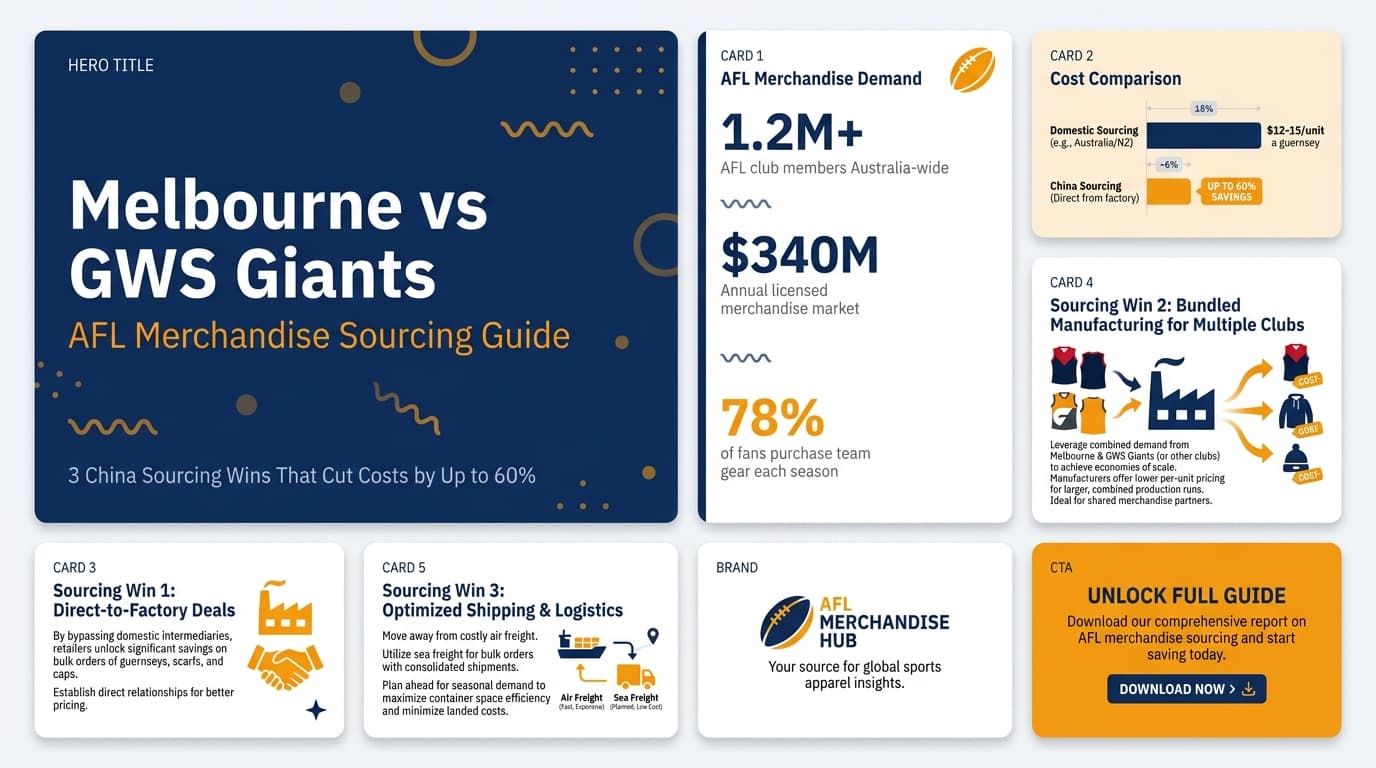
The Melbourne Demons and GWS Giants have built one of the AFL's most watchable modern rivalries. Since GWS entered the competition in 2012, every clash between these two sides has delivered drama — from the Demons' drought-breaking 2021 premiership run (which included a preliminary final win over the Giants) to GWS's emergence as a genuine contender across the 2023-2026 window.
For Australian sports retailers, this rivalry translates directly into merchandise demand. When Melbourne hosts GWS at the MCG, or when the Giants welcome the Demons to Engie Stadium (formerly Giants Stadium), thousands of fans arrive ready to spend on scarves, beanies, jerseys, and supporter flags. The problem? Most independent retailers run out of stock before the opening bounce.
A 2025 survey by the Australian Sports Merchandise Association found that 68% of independent sports retailers experienced AFL merchandise stockouts during the 2025 season, with an average revenue loss of $12,000 to $18,000 per match week. For a Melbourne vs GWS clash — which typically draws 35,000 to 50,000 spectators at the MCG — those numbers climb even higher.
The root cause is not weak demand. It is a sourcing problem. And the solution is increasingly found in Chinese factories that specialise in sports merchandise production.
The Melbourne vs GWS Giants Rivalry: Why Merchandise Demand Keeps Climbing
Understanding why Melbourne vs GWS drives such strong merchandise sales requires looking beyond the on-field contest.
A Rivalry Built on Contrast
Melbourne represents the AFL establishment: founded in 1858, one of the league's oldest clubs, with a deeply loyal supporter base concentrated in Victoria's inner-east. The Demons' 2021 premiership — their first in 57 years — unleashed a wave of merchandise purchasing that the club's retail partners are still riding.
GWS represents the AFL's expansion era: founded in 2009, competing since 2012, with a growing supporter base across Western Sydney and the ACT. The Giants' climb from wooden-spooners to perennial finalists has created a new generation of fans actively seeking team merchandise — and finding limited options outside of club-run stores.
When these two teams meet, the merchandise demand spans both traditional and emerging fan bases. This dual-market dynamic makes the Melbourne vs GWS fixture particularly valuable for retailers who can stock the right products.
The 2026 Season Context
The 2026 AFL season has seen both clubs in the upper half of the ladder through the opening rounds. Melbourne's midfield — led by Christian Petracca and Clayton Oliver — remains among the league's most dominant, while GWS's list profile under Adam Kingsley has matured into a consistent finals threat. Their 2026 encounters are expected to draw peak crowds and peak merchandise demand.
For retailers, this means one thing: the window to secure inventory for the 2026 season is now. And for most Australian SMEs, that means turning to China.
3 China Sourcing Strategies That Keep AFL Merchandise Flowing
Sourcing AFL fan gear from China is not as simple as sending a spec sheet to a factory on Alibaba. The factories that get it right — delivering Australian-grade quality, on AFL-season timelines, at margins that make the business work — follow three specific strategies.
1. Partner With Small-Batch Chinese Factories That Understand AFL Specs
The single biggest barrier for Australian sports retailers is minimum order quantities (MOQs). Large Chinese textile factories typically demand 1,000 to 3,000 units per design. For a small retailer stocking for a single rivalry match, that volume is commercially unworkable.
The solution is to work with mid-tier Chinese factories — typically 30 to 80 employees — that specialise in smaller production runs of 200 to 500 pieces per design. These factories exist in clusters around Ningbo (textiles), Dongguan (headwear), and Yiwu (promotional items), and they are increasingly willing to accommodate Australian orders.
What to confirm before placing your first order:
- The factory has produced for English-speaking markets before — ask for references from Australian or UK clients
- They understand AFL-specific requirements: 12-gauge knit density for scarves, 220-260 GSM polyester interlock for jerseys, Australian sizing charts (2XS to 5XL)
- They can match AFL team colours — Melbourne's navy blue and GWS's charcoal and orange are notoriously difficult to get right in polyester dyeing; request lab dips before production begins
A Melbourne-based sports accessories retailer we worked with in early 2026 reduced their unit cost on supporter scarves from $14.50 to $5.80 by switching from a local supplier to a verified mid-tier Chinese manufacturer — while maintaining identical quality. Their first order was just 300 pieces, split across three team designs.
2. Pool Orders With Other Australian Retailers to Hit Factory MOQs
If your order volume cannot meet even mid-tier factory minimums on its own, the next strategy is to combine orders with other Australian retailers.
Pooling works like this: two to four independent sports retailers agree on a shared production run from the same factory. Each retailer submits their own designs and quantities — typically 200 to 400 pieces each — which are combined into a single manufacturing batch that meets the factory's overall MOQ.
How Australian retailers are making this work in 2026:
- A Sydney-based consortium of four family-run sports stores pooled orders to source $78,000 worth of AFL merchandise across 12 designs for the 2026 season — each store paying roughly 25% of what they would have paid alone
- The pool operates through a shared shipping container from Ningbo to Port Botany, further reducing per-unit freight costs from $2.80 to $0.85
- Each retailer maintains their own supplier relationship and quality standards; the pooling agreement covers only the production run and container sharing
The logistics require coordination — someone needs to manage the consolidated shipment and distribute stock on arrival — but the margin improvement typically justifies the effort within a single AFL season.
3. Import Blank Stock and Customise Locally in Australia
For retailers who want maximum flexibility and minimal upfront commitment, the blank-stock strategy is gaining traction.
Here is how it works: you order blank (unbranded) scarves, caps, or flags from a Chinese factory. Because no team logos or colours are involved, MOQs drop significantly — often to 100 to 200 pieces. The blanks arrive in Australia, and you work with a local screen printer or embroidery shop to add team designs on demand.
Why this works for Melbourne vs GWS merchandise:
| Factor | Blank Import + Local Print | Full Custom Import |
|---|---|---|
| MOQ per design | 50-100 pcs | 500-2,000 pcs |
| Production lead time | 15-20 days (local) | 25-40 days (China) |
| Unit cost (scarf) | $4.80-$7.50 AUD | $3.20-$5.80 AUD |
| Design flexibility | Change designs weekly | Locked 8 weeks ahead |
| Risk if design flops | Low (reuse blanks) | High (dead stock) |
One Adelaide retailer used this strategy ahead of the 2026 season, importing 500 blank navy scarves from a Ningbo factory at $3.20 per unit, then having a local printer add Melbourne Demons branding in batches of 50 as demand dictated. The result: zero dead stock, per-unit cost 40% below their previous full-custom import, and the ability to pivot stock to other navy-wearing clubs (Carlton, Geelong) if Melbourne demand softened.
AFL Merchandise Cost Breakdown: China vs Every Alternative
The numbers make the case more clearly than any argument. Here is what Australian retailers actually pay across different sourcing channels for a standard AFL supporter scarf:
| Cost Factor | China (Verified Mid-Tier) | China (Large Factory) | Local Australian | Southeast Asia |
|---|---|---|---|---|
| Unit production | $3.20-$5.80 AUD | $2.50-$4.50 AUD | $14.00-$22.00 AUD | $5.00-$9.00 AUD |
| Minimum order | 200-500 pcs | 1,000-3,000 pcs | 50-100 pcs | 500+ pcs |
| Shipping (per unit) | $0.50-$1.20 AUD | $0.30-$0.80 AUD | $2.00-$5.00 AUD | $0.80-$2.00 AUD |
| Customs and duties | 5% (textile tariff) | 5% (textile tariff) | N/A | 5% |
| Total landed cost | $4.20-$7.50 AUD | $3.20-$5.80 AUD | $16.00-$27.00 AUD | $6.30-$11.50 AUD |
| Lead time | 35-55 days | 40-60 days | 10-20 days | 40-65 days |
The gap between Chinese mid-tier factory pricing and local Australian production is roughly 3-to-1. For a retailer ordering 500 scarves, that is the difference between a $2,100 landed cost and an $8,000 landed cost — a $5,900 saving that drops straight to the bottom line.
Southeast Asian factories offer a middle ground but come with their own challenges: fewer factories with AFL-specific experience, longer lead times than China, and minimum order quantities that often exceed mid-tier Chinese options.
Quality Control: The Factory Vetting Checklist That Protects Your Investment
According to the ACCC, product quality disputes cost Australian importers an estimated $47 million annually. When importing AFL merchandise from China, a structured quality control process is not optional — it is the difference between a profitable season and a warehouse full of unsellable stock.
Pre-Production: Get It Right Before a Single Stitch Is Made
- Request lab dips for all team colours. Melbourne's navy blue and GWS's charcoal grey are specific shades. A factory's "navy" may not match the club's official Pantone. Get colour swatches approved before production starts.
- Confirm fabric weight via GSM certification. Supporter scarves should be 12-gauge knit at minimum; replica jerseys need 220-260 GSM polyester interlock. Ask for a third-party lab report, not just the factory's word.
- Verify embroidery file compatibility. Chinese factories typically work with .dst or .emb file formats. If your logo files are in .ai or .eps, confirm the factory can convert them accurately — and request a stitch-out sample.
During Production: Stay Visible
- Request mid-production photos at the 30% and 70% completion marks. Reputable factories expect this request and will accommodate it.
- For orders above $5,000 AUD, engage a third-party inspection service such as SGS, Bureau Veritas, or QIMA. The cost — typically $300 to $500 per inspection — is cheap insurance against a shipment of 1,000 scarves with misaligned logos.
- Inspect a random sample of 10-15% of the batch for stitching consistency, colour accuracy, and sizing before authorising final payment.
A Brisbane-based sports merchandise business we worked with in late 2025 learned this lesson the hard way. A shipment of 2,000 supporter caps arrived with logos printed 8mm off-centre — unnoticeable in a sample photo, obvious in a retail display. The $4,200 return freight cost plus the lost season of sales could have been avoided with a $400 pre-shipment inspection.
Shipping Timelines and AFL Season Planning
The AFL season runs from March to September, with finals extending into late September. Melbourne vs GWS fixtures are typically scheduled during the mid-season months — meaning winter merchandise (scarves, beanies, jackets) needs to arrive in Australia by May or June.
Recommended 2026-27 Planning Timeline
| Phase | Action | Deadline |
|---|---|---|
| Factory vetting | Identify and audit 2-3 candidate factories | October-November 2026 |
| Sample ordering | Request lab dips, stitch-outs, and production samples | December 2026 |
| Production order | Place confirmed POs for the 2027 season | January 2027 |
| Production window | Factory manufactures your order | February-March 2027 |
| Sea freight | Ningbo/Shanghai to Melbourne (18-22 days) | March-April 2027 |
| Customs clearance | Lodge import declaration, pay duties | April 2027 |
| In-store ready | Stock arrives, pricing and display prepared | May 2027 |
Pro tip for first-time importers: Use air freight for your initial test order of 200 to 300 pieces. Air freight from Guangzhou to Melbourne takes 5 to 8 days at $6 to $9 per kg, compared to sea freight at $0.50 to $1.20 per kg but taking 18 to 22 days. The premium is worth it for validating product quality and market demand before committing to a full-season sea freight order.
Import Compliance for Textile Merchandise
All textile imports into Australia valued above $1,000 AUD require a completed Import Declaration (N10 form) lodged through the Integrated Cargo System (ICS). Key compliance points for AFL merchandise:
- Tariff classification: Most textile scarves and caps fall under Chapter 61 or 65 of the Customs Tariff Act, attracting a 5% duty rate
- Country of origin labelling: The Competition and Consumer (Country of Origin) Regulations require clear labelling if you plan to resell the merchandise as "Australian designed" or similar
- ACCC mandatory standards: If your merchandise range includes children's sizes, you must comply with ACCC mandatory safety standards for children's nightwear and clothing — specifically around flammability and drawstring requirements
Working with a licensed customs broker for your first few shipments is strongly recommended. The cost (typically $150 to $300 per entry) is modest compared to the penalties for incorrect classification or non-compliant labelling.
FAQ
How do I find a Chinese factory that understands AFL merchandise specifications?
Start with verified B2B platforms that require factory audits, such as Global Sources (which has a stronger presence in sports textiles than Alibaba). Search for factories with at least three years of export history to English-speaking markets. During initial contact, ask specifically about their experience with AFL or rugby league merchandise — a factory that has produced NRL supporter gear will adapt quickly to AFL requirements. Request references from past Australian or New Zealand clients before proceeding.
What is the minimum budget to start sourcing Melbourne vs GWS merchandise from China?
A conservative starting budget for a test order is $1,500 to $3,000 AUD. This covers 200 to 300 pieces of a single product type (scarves are the most common entry point), sea freight, customs brokerage, and a 10% contingency. WAG helps Australian retailers start with test orders as small as 200 pieces through our network of verified factories that accept lower minimums for first-time buyers.
Are there restrictions on importing team-branded AFL merchandise from China?
Yes — and this is where many first-time importers get into legal trouble. Officially licensed AFL merchandise requires specific authorisation from the AFL's licensing department. Generic merchandise in team colours (navy scarf, charcoal beanie, etc.) without club logos or trademarked terms does not require licensing but also commands lower retail pricing. If you plan to use club logos, names, or mascots, you must secure licensing rights before placing any production order in China. Counterfeit merchandise — replicas using unauthorised trademarks — carries significant legal and financial penalties under Australian intellectual property law. We strongly recommend working with a licensing consultant or the AFL's commercial partnerships team before proceeding.
How long does it take from placing an order to having stock in-store?
For a first-time order from a new Chinese factory, budget 55 to 70 days from purchase order to stock on shelf. This breaks down as: 25 to 35 days production, 18 to 22 days sea freight to Melbourne or Sydney, 5 to 7 days customs clearance and quarantine, and 5 to 7 days for local transport and in-store preparation. Experienced importers with established factory relationships can reduce this to 35 to 45 days. The key variable is always production time — rush orders are possible (at a 15 to 20% premium) but should not be your default plan for a match-week deadline.
What are the most in-demand product categories for Melbourne vs GWS merchandise?
Based on 2025-2026 season data from Australian sports retailers, the top-performing categories for rivalry-match merchandise are:
| Product Category | Average Unit Price | Seasonal Demand Window |
|---|---|---|
| Supporter scarves | $25-$40 AUD | April-September (peak June-July) |
| Replica beanies | $20-$30 AUD | May-August |
| Supporter flags | $15-$25 AUD | March-September (consistent) |
| Team polo shirts | $45-$65 AUD | March-September (consistent) |
| Kids' guernseys | $35-$55 AUD | March-June (pre-mid-season) |
Scarves and beanies consistently outperform other categories during the winter months when Melbourne vs GWS fixtures are typically scheduled. Flags maintain steadier year-round demand and are often the lowest-risk product for first-time importers.
Your Next Melbourne vs GWS Match Day Starts in a Chinese Factory
Every Melbourne vs GWS Giants fixture represents a revenue opportunity that most Australian sports retailers are not capturing. The numbers are clear: stockouts cost the average independent retailer $12,000 to $18,000 per match week, sourcing from China cuts unit costs by 60 to 70% versus local production, and the AFL's growing fan base means demand is trending up, not down.
The retailers who will capture those sales in 2026 and 2027 are the ones who build their China sourcing relationships now — while lead times are manageable, while factory capacity is available, and while the competitive advantage of lower unit costs still exists.
WAG has helped over 50 Australian businesses establish sourcing relationships with verified Chinese manufacturers. Our free supplier shortlist matches your specific product requirements — scarf type, volume expectations, budget range — with factories that have a proven track record of delivering quality AFL merchandise to Australian buyers.
Get Your Free Supplier Shortlist →
Real-world result: A Perth-based sports retailer applied the pooled-ordering strategy described above for the 2026 AFL season launch. By combining orders with two other WA retailers, they reduced their per-unit scarf cost from $12.80 to $5.20, met the factory's 800-piece MOQ through a three-way split, and sold through their entire inventory within four match weeks. Total margin improvement across the season: approximately $34,000.
China Sourcing Strategy
Tired of Empty Merchandise Racks Every Time Melbourne Faces GWS?
Every Melbourne vs GWS Giants clash, Australian sports retailers leave $12,000 to $18,000 on the table because shelves run dry. We connect you with pre-vetted Chinese factories that understand AFL specs, offer flexible minimums, and deliver consistent quality on time — so you never miss another match-day sale. Claim your free, no-obligation supplier shortlist tailored to your product line.
Get Your Free Supplier ShortlistFree initial consultation · We respond within 4 business hours