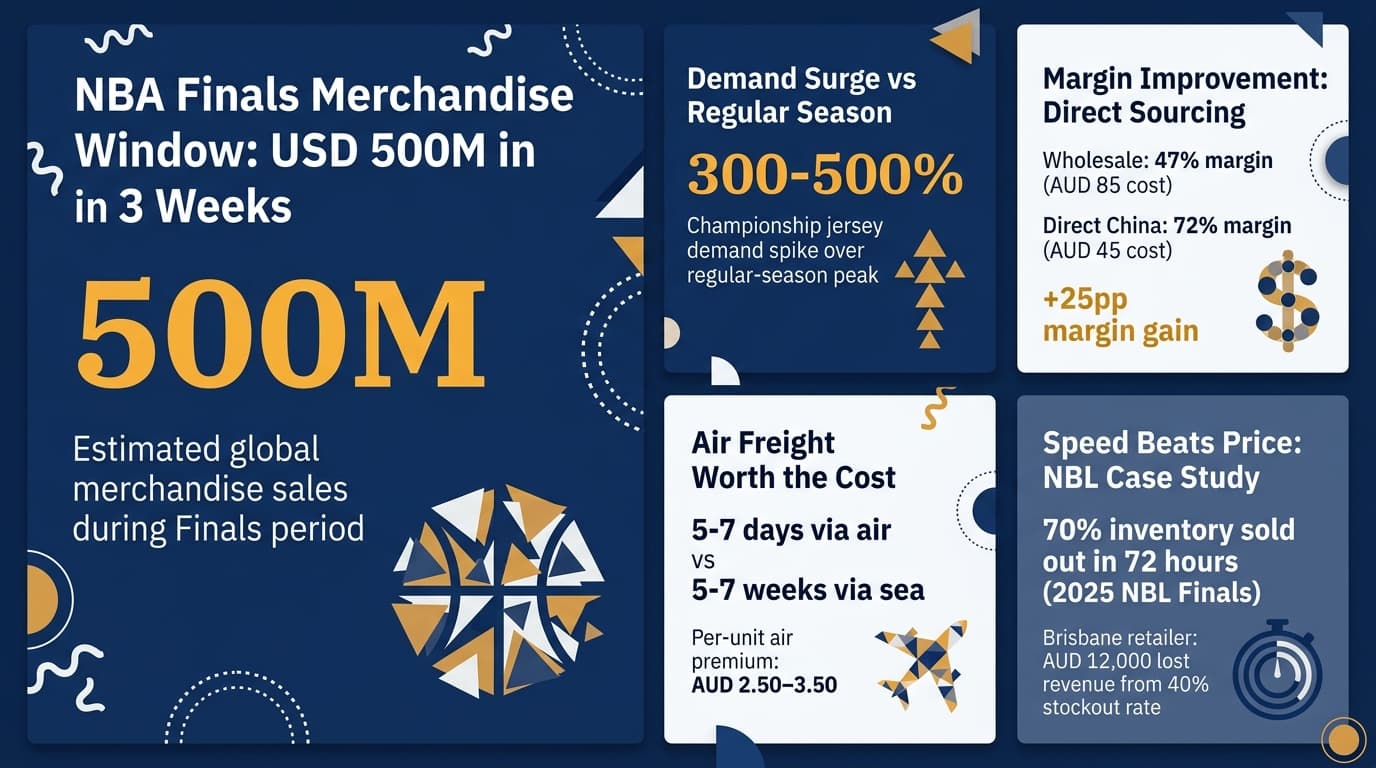
The NBA Finals generate an estimated USD 500 million in merchandise sales within the three weeks surrounding the championship series. For Australian importers, this represents one of the most concentrated profit opportunities in sports retail, and one of the most commonly missed.
Every June, Australian sports retailers watch championship jerseys, commemorative apparel, and limited-edition accessories sell out across US channels while local fans wait weeks for international shipping. The demand is real. Australian NBA fandom is among the strongest outside North America, driven by years of NBL growth, the success of Australian players in the league, and a sports culture that values authentic, official merchandise.
The problem is not demand. The problem is supply. Traditional wholesale supply chains are too slow for a championship window that lasts approximately four weeks from the Finals tip-off to the post-championship demand fade. By the time standard container shipments arrive, the peak has passed and the merchandise is headed for clearance racks.
This article explains how Australian importers can build a sourcing strategy specifically for the 2026 NBA Finals, using China-based manufacturing partnerships, pre-order models, and limited-edition production runs to capture demand while it is at its most profitable.
Winning Adventure Global works with Australian retailers to source championship-grade merchandise from verified Chinese manufacturers on timelines that match the Finals window. If you are planning your 2026 NBA Finals inventory, request a sourcing timeline and receive a detailed production schedule within 48 hours.
The 2026 NBA Finals: A Merchandise Window Most Australian Importers Miss
The NBA Finals represent something fundamentally different from regular-season basketball merchandise. Understanding how the championship window operates is the first step to capturing it.
How the Finals Window Differs from Regular-Season Demand
Regular-season NBA merchandise follows predictable seasonal patterns. Sales build through the season opener in October, spike during the December holiday period, rise again around the All-Star break in February, and decline as the regular season winds down. Importers can plan container shipments months in advance with reasonable confidence about which teams will sell.
The Finals window breaks all of these patterns. Demand does not build gradually. It ignites the moment a team clinches their conference championship and intensifies through each game of the Finals series. The championship-winning team sees a demand spike that can exceed regular-season peaks by 300 to 500 percent, concentrated into roughly 10 to 14 days after the final buzzer.
For Australian importers, this compressed window creates a logistics problem that standard supply chains cannot solve. A typical China-to-Australia sea freight shipment takes five to seven weeks door-to-door. If you order merchandise after the champion is crowned, your shipment arrives five to seven weeks after the demand peak has passed. You have missed the window.
What Australian Importers Leave on the Table
Consider the numbers. An Australian retailer selling licensed replica jerseys at AUD 160 with a typical wholesale cost of AUD 85 operates on a 47 percent gross margin. During the Finals window, that same jersey commands a premium. Consumers pay full retail without hesitation. Discounting is unnecessary. The product sells itself.
If that retailer could source the same championship jersey directly from a verified Chinese manufacturer at a landed cost of AUD 45, the gross margin rises to 72 percent. Across a Finals product run of 500 jerseys, the difference is AUD 20,000 in additional margin. Across a broader product line including t-shirts, caps, and accessories, the financial gap widens further.
The window is short, but the margin opportunity within that window is disproportionately large. Australian importers who build sourcing processes specifically designed for the Finals window capture margin that wholesale-dependent competitors cannot touch.
Championship vs. Regular-Season Merchandise: What Changes During the Finals
Championship merchandise is not the same product with a different tag. It differs from regular-season merchandise in branding, materials, pricing, and consumer psychology.
Official Finals Branding and Why It Matters
NBA Properties releases official Finals branding for each championship series. This includes the NBA Finals wordmark, the championship trophy iconography, team-specific Finals patches, and the "NBA Champions" designation for the winning team. These marks are distinct from regular-season team branding and carry specific licensing requirements.
For manufacturers, this means Finals merchandise requires separate artwork approvals, different print and embroidery setups, and distinct quality verification from NBA Properties or its authorized representatives. Production runs for Finals-specific items cannot simply reuse regular-season templates with minor modifications. They require dedicated production planning.
Australian importers who understand this distinction can work with manufacturers to prepare production setups in advance of the Finals, reducing lead times when the championship outcome is known.
Price Premiums and Consumer Willingness to Pay
Finals merchandise commands price premiums that regular-season products cannot sustain. An official NBA Finals replica jersey retails for 15 to 25 percent more than the equivalent regular-season jersey. Limited-edition championship apparel sells at 30 to 50 percent premiums. Commemorative items such as framed jerseys, signed basketballs, and championship ring replicas sit at the highest end of the pricing spectrum.
Australian consumers accept these premiums. The emotional significance of championship merchandise, combined with its limited availability, creates purchasing urgency that overrides price sensitivity. Importers who source Finals merchandise at competitive landed costs capture margin that would otherwise flow to intermediaries.
Finals Merchandise Categories and Demand Surge Patterns
Different product categories experience different demand patterns during the Finals window. Understanding these patterns helps importers allocate sourcing budgets and production capacity.
| Product Category | Demand Surge (vs. Regular Season) | Peak Window (Days After Championship) | Average Retail Premium (AUD) |
|---|---|---|---|
| Championship Replica Jersey | 350-500% | 1-14 | $30-50 |
| Finals T-Shirt | 400-600% | 1-7 | $15-25 |
| Championship Cap | 300-450% | 1-10 | $10-20 |
| Commemorative Basketball | 200-350% | 3-21 | $25-40 |
| Limited-Edition Hoodie | 250-400% | 3-14 | $20-35 |
| Championship Pin Set | 150-250% | 3-21 | $8-15 |
| Framed Memorabilia | 500-800% | 5-30 | $100-300 |
| Championship Ring Replica | 300-500% | 5-30 | $50-150 |
Apparel categories peak fastest and decline fastest. Memorabilia and collectibles have longer selling windows but require more production lead time. Importers should balance their product mix across both categories.
Limited-Edition Production: How Chinese Factories Handle Finals Runs
Limited-edition production differs fundamentally from standard manufacturing. The quantities are smaller, the timelines are compressed, and the quality expectations are higher.
Minimum Order Quantities for Limited Editions
Standard sports apparel MOQs from Chinese manufacturers typically start at 500 to 1,000 units per style. Limited-edition Finals runs can operate below these thresholds, but not automatically. Importers must negotiate specifically for small-batch championship production.
Experienced manufacturers who regularly handle sports merchandise understand the Finals dynamic. They can accommodate MOQs of 100 to 300 units for championship-specific items when the buyer has an established relationship, provides clear specifications upfront, and commits to multiple product categories within the same production window.
The key is not finding a factory that advertises low MOQs. It is building a relationship with a manufacturer who understands the urgency and economics of championship merchandise and is willing to adjust their production scheduling accordingly.
Production Lead Times Under Urgency
Standard custom apparel production from Chinese factories typically requires 20 to 30 days after sample approval. For Finals merchandise, that timeline is not viable if the order is placed after the champion is determined.
Manufacturers who specialize in time-sensitive sports merchandise can compress production to 10 to 15 days for simple items like printed t-shirts, and 15 to 20 days for more complex products like embroidered caps and detailed jerseys. This compression depends on several factors: pre-approved artwork, pre-positioned blank stock, dedicated production line allocation, and clear quality specifications that eliminate back-and-forth revision cycles.
Quality Control at Speed: The Non-Negotiable
Compressed timelines create quality risks. When a factory races to meet a Finals deadline, corner-cutting becomes more likely. Thread counts drop, print registration shifts, and packaging quality deteriorates.
Third-party quality inspection is essential for Finals production runs. An inspection service that can visit the factory during production, not just before shipment, catches quality issues early enough to correct them. The inspection cost, typically AUD 300 to 500 per production run, is a fraction of the cost of receiving a container of unsellable championship merchandise two weeks after the demand window has closed.
Australian retailers sourcing Finals merchandise should budget for in-process inspection as a standard cost of championship production, not an optional add-on. The margin from a single successful Finals product run covers inspection costs for an entire season.
Pre-Order Models: Selling NBA Finals Merchandise Before the Champion Is Crowned
The most effective strategy for capturing Finals demand does not involve predicting the champion. It involves pre-selling merchandise before the championship outcome is known.
How Pre-Order Systems Work for Championship Merchandise
A pre-order model allows Australian retailers to sell NBA Finals merchandise to customers during the championship series, before the winning team is confirmed. The customer selects their team preference when placing the order. If that team wins the championship, the order is fulfilled. If the team loses, the customer receives a full refund or store credit.
This model solves the fundamental timing problem. Production can begin during the Finals series using blank stock that receives team-specific decoration once the champion is confirmed. Orders are already sold before production begins, eliminating inventory risk. The compressed production timeline is manageable because the customer has already committed, and short delays of one to two weeks are acceptable when the alternative is no championship merchandise at all.
Winning Adventure Global helps Australian retailers set up pre-order systems with Chinese manufacturing partners who understand championship production timelines. If you are considering a pre-order model for the 2026 NBA Finals, request a sourcing plan and we will match you with manufacturers who have experience with time-sensitive sports merchandise.
Building the Pre-Sale Page: What Australian Retailers Need
A successful Finals pre-sale page requires several elements that go beyond a standard product listing. The page must clearly explain the pre-order terms, including the refund policy for non-winning teams. It must display estimated delivery timeframes that account for production and shipping. Product images should show championship-specific designs, even if the final artwork will include the champion-specific elements that cannot be confirmed until the Finals conclude.
Australian retailers should launch pre-sale pages no later than the start of the Conference Finals, approximately two weeks before the NBA Finals begin. This provides adequate time for search engines to index the pages, for social media promotion to build awareness, and for early orders to establish the production quantities needed.
The Multi-Team Coverage Strategy
No one can predict the NBA Finals matchup with certainty before the Conference Finals conclude. But importers can reduce their exposure to uncertainty through a multi-team coverage strategy.
Rather than sourcing merchandise for a single team, importers source blank stock that can be decorated with team-specific elements once the matchup is confirmed. Blank jerseys, plain t-shirts, and unbranded caps sit in a Chinese factory or Australian warehouse, ready for rapid decoration when the championship outcome is known.
This strategy requires coordination with manufacturers who can hold blank inventory and execute decoration on short notice. Heat-transfer printing, which can be applied to prepared blanks in hours rather than days, is particularly well-suited to this model. Embroidery and sublimation, while producing higher-quality results, require longer setup times and are better suited to products where the design is known in advance.
The cost of producing blanks that are never decorated is significantly lower than the cost of producing finished merchandise for a team that does not win. A multi-team coverage strategy limits downside risk while preserving the ability to respond to the actual championship outcome.
NBL Finals: What Australian Basketball Teaches Us About Championship Merchandise
The National Basketball League provides the closest domestic parallel to NBA Finals merchandise dynamics. NBL Finals generate championship-specific demand patterns that mirror, on a smaller scale, what happens during the NBA championship series.
During the 2025 NBL Finals, Australian sports retailers reported that championship merchandise for the winning team sold through 70 percent of available inventory within 72 hours of the final game. Retailers who had pre-ordered championship apparel from suppliers captured this demand. Retailers who waited to order after the champion was crowned received their inventory two to three weeks later, by which time the initial demand wave had subsided and markdowns had begun.
The lesson transfers directly to NBA Finals sourcing. Speed of supply chain response matters more than price negotiation. A higher unit cost that enables faster delivery produces better financial outcomes than a lower unit cost that arrives after the demand window has closed.
Case Study: Brisbane Sports Retailer Captures Championship Demand
A Brisbane-based sports merchandise retailer with two physical stores and an ecommerce operation serving approximately 8,000 monthly visitors identified NBA Finals merchandise as a growth opportunity after observing their NBL Finals sales data. During the 2025 NBL Finals, they had experienced a 40 percent stockout rate on championship products, losing an estimated AUD 12,000 in revenue during the two-week peak window.
For the 2026 NBA Finals, the retailer worked with Winning Adventure Global to establish a pre-order sourcing model with a verified Chinese sportswear manufacturer. The retailer launched pre-sale pages for the top four projected Finals contenders during the Conference Finals. They ordered blank stock of 200 jerseys, 300 t-shirts, and 150 caps to be held at the Chinese factory, with decoration to be applied based on the championship outcome.
When production windows are measured in days rather than weeks during the Finals, pre-positioned blank stock and manufacturer relationships become the difference between capturing demand and watching it pass to competitors.
Logistics for Time-Sensitive NBA Finals Shipments
The logistics of Finals merchandise differ from standard shipments in speed requirements, cost structure, and customs considerations.
Air Freight vs. Sea Freight: The Finals Math
For standard merchandise shipments, sea freight is the economically rational choice. At approximately AUD 2,500 to AUD 4,000 per 20-foot container from major Chinese ports to Australian ports, the per-unit freight cost is negligible for most product categories.
For Finals merchandise, the equation changes. A sea freight shipment that arrives five weeks after the championship game delivers merchandise into a market that has already moved on. The 15 to 25 percent premium that Finals merchandise commands shrinks to zero, and clearance pricing may be necessary to move inventory.
Air freight, at approximately AUD 6 to AUD 10 per kilogram, costs significantly more but delivers merchandise in five to seven days. For a shipment of 200 championship jerseys weighing approximately 80 kilograms, the air freight premium over sea freight is roughly AUD 500 to AUD 700. Spread across 200 units at retail prices of AUD 160 to AUD 200, the per-unit freight premium of AUD 2.50 to AUD 3.50 is easily absorbed by the Finals price premium.
The math is straightforward. If air freight enables the retailer to capture two additional weeks of full-price selling during the peak demand window, the freight premium is recovered within the first few units sold.
Customs Clearance for Urgent Championship Inventory
Australian Border Force does not process shipments faster because they contain championship merchandise. Standard customs clearance times apply regardless of commercial urgency. Importers should build customs processing time into their Finals logistics timeline and ensure all documentation is complete and accurate before the shipment departs China.
Key documents for fast customs clearance include accurate commercial invoices with HS codes, packing lists with SKU-level detail, certificates of origin for preferential tariff treatment under ChAFTA, and any NBA Properties authorization documentation for licensed products. Missing or incorrect documentation causes clearance delays that can consume the entire Finals demand window.
Seven Sourcing Wins for the 2026 NBA Finals
Based on the strategies outlined in this article, here are seven specific actions Australian importers can take to capture the 2026 NBA Finals merchandise opportunity.
1. Pre-position blank stock by late May 2026. Order blank jerseys, t-shirts, and caps before the Conference Finals begin. Stock held at a Chinese factory or Australian warehouse can receive team-specific decoration within 48 to 72 hours of the championship outcome.
2. Launch pre-sale pages during the Conference Finals. Have product pages live and accepting orders at least one week before the NBA Finals tip-off. Clear pre-order terms, including refund policies for non-winning teams, build customer confidence and establish order quantities before production begins.
3. Negotiate small-batch championship MOQs now. Do not wait until the Finals are underway to discuss minimum order quantities with manufacturers. Establish relationships and agree on production parameters during the off-season when factories have scheduling flexibility.
4. Budget for air freight on at least 30 percent of Finals inventory. The first shipment to arrive captures the highest-margin sales. Air freight a portion of your Finals production to have product live within one week of the championship game, with the balance following by sea for restocking.
5. Build a multi-team product strategy. Do not source for a single team. Prepare blanks that can be decorated for any Finals contender. The cost of unused blank stock is small relative to the cost of missing the championship window entirely.
6. Include third-party quality inspection in every Finals production run. Compressed timelines increase quality risk. An inspection during production, not just before shipment, catches issues before the window closes.
7. Work with a sourcing partner who understands championship timelines. Manufacturers who regularly handle time-sensitive sports merchandise operate differently from general apparel factories. Their production scheduling, communication practices, and quality processes are built for speed without sacrificing standards.
A Sourcing Window That Opens Once Per Year
The NBA Finals merchandise window is narrow, intense, and exceptionally profitable for Australian importers who are prepared for it. The three weeks surrounding the championship series generate demand that exceeds the rest of the postseason combined. Australian NBA fans are ready to purchase. The question is whether your supply chain can deliver before the window closes.
Winning Adventure Global specializes in connecting Australian retailers with verified Chinese manufacturers who understand championship merchandise production. From pre-order system setup and blank stock positioning to quality inspection and air freight coordination, we help Australian importers build Finals-specific sourcing processes that capture demand while competitors are still waiting for container shipments to arrive.
If you are planning your 2026 NBA Finals merchandise strategy, now is the time to act. Manufacturer production schedules fill quickly as the Finals approach, and the businesses that secure production capacity early are the ones with product on shelves when demand peaks.
Request your NBA Finals sourcing timeline and receive a detailed production plan, manufacturer recommendations, and cost estimates tailored to your product categories within 48 hours.
Frequently Asked Questions
How quickly can Chinese factories produce NBA Finals championship merchandise?
With pre-positioned blank stock and pre-approved artwork, Chinese sportswear manufacturers can produce decorated championship merchandise within 5 to 10 days for printed t-shirts and 10 to 15 days for more complex items like embroidered caps and detailed jerseys. Production can begin during the Finals series, with team-specific decoration applied once the champion is confirmed. Factories with established sports merchandise experience can compress these timelines further by allocating dedicated production lines and prioritizing Finals orders.
Can Australian retailers pre-sell NBA Finals merchandise before the champion is known?
Yes, and this is the recommended strategy. Australian retailers can set up pre-sale pages during the Conference Finals or early in the NBA Finals series. Customers select their team preference when ordering. If the selected team wins the championship, the order is fulfilled. If the team loses, the customer receives a full refund or store credit. The pre-sale terms must be clearly displayed on the product page, and the Australian Consumer Law requirements for refund policies apply as they would for any pre-order transaction.
What happens if the team I ordered merchandise for does not win the championship?
If you have ordered finished championship merchandise for a specific team and that team loses, you have limited options. The merchandise cannot legally be sold as official championship product. It may be sellable as general team merchandise if it does not include championship-specific branding, but the value is significantly reduced. This is why the multi-team coverage strategy, using blank stock with deferred decoration, is strongly recommended. Blanks that are never decorated represent a manageable loss. Finished championship merchandise for a non-winning team represents a near-total write-down.
What are the minimum order quantities for limited-edition Finals merchandise?
MOQs for limited-edition Finals runs typically start at 100 to 300 units per style for printed t-shirts and 200 to 500 units for embroidered apparel and caps, depending on the manufacturer and the complexity of the product. These quantities are achievable when the buyer has an established relationship with the manufacturer and can commit to multiple product categories within the same production window. New buyer relationships may face higher MOQs, which is why building manufacturer relationships before the Finals season is essential.
Is air freight worth the cost for NBA Finals merchandise?
For the initial shipment of Finals merchandise intended to capture the peak demand window immediately following the championship game, air freight is almost always worth the cost. The per-unit freight premium of approximately AUD 2.50 to AUD 5.00 for apparel items is recovered through the Finals price premium and the additional selling days air freight provides. Sea freight remains the appropriate choice for restocking inventory after the initial demand wave, when slightly longer delivery times are acceptable.
How do I verify that Chinese manufacturers can meet championship production quality standards?
Request samples from previous championship or limited-edition production runs. Ask specifically about their experience with sports merchandise that required compressed timelines. Verify that they have third-party quality inspection processes and are willing to accommodate in-process inspection during Finals production. Manufacturers who are hesitant to share samples or discuss quality control processes should be treated with caution. The cost of failed quality control during a Finals production run, when there is no time for rework, far exceeds the cost of diligent manufacturer verification.
WINNING ADVENTURE GLOBAL PTY LTD (ACN 697 886 150, ABN 94 697 886 150) connects Australian businesses with verified Chinese manufacturers across apparel, promotional products, and custom merchandise categories. Based in Adelaide, South Australia, the company provides end-to-end sourcing services including supplier verification, production coordination, quality control, and logistics management.
China Sourcing Strategy
Missing the NBA Finals merchandise window?
Winning Adventure Global helps Australian retailers source championship merchandise from China with pre-order models that capture Finals demand before the champion is crowned. Send us your product specs and receive a sourcing timeline within 48 hours.
Get Your Finals Sourcing PlanFree initial consultation · We respond within 4 business hours