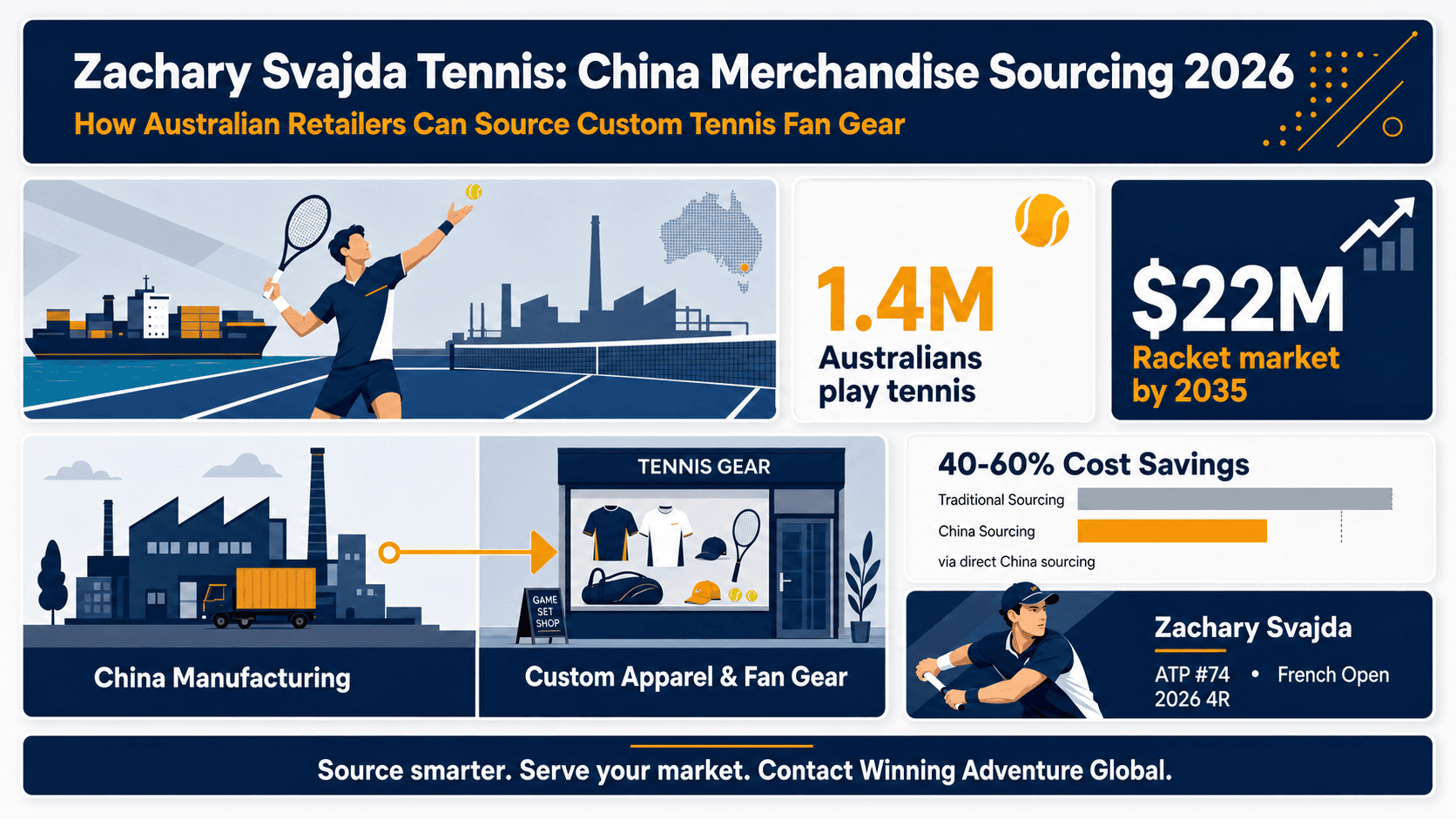
When Zachary Svajda stepped onto Court Suzanne-Lenglen at the 2026 French Open, he carried more than a racquet. The 23-year-old Californian was about to beat two Australians in succession -- Alexei Popyrin in the second round, then Adam Walton in the third -- before upsetting 25th seed Francisco Cerundolo to reach the fourth round of a Grand Slam for the first time. Australian tennis fans took notice. And when Australian tennis fans take notice of a player, they do what sports fans everywhere do: they want the gear.
Svajda cracked the ATP Top 100 in February 2026 and has not looked back. His career-high ranking of No. 74, achieved in May 2026, puts him squarely in the conversation as one of America's most promising players. For Australian retailers, his trajectory is not just a sports story -- it is a supply chain signal.
Why Tennis Merchandise Demand Is Growing in Australia
The numbers are too large to ignore. According to AusPlay data from Tennis Australia, more than 1.4 million Australians participated in tennis during the 2022-2023 financial year. Children's participation grew 7% year-on-year. More than 600,000 kids enrolled in Hot Shots Tennis. Primary school programs reached 467,434 students across 3,100-plus schools. Secondary school participation jumped 32%.
This is not a niche sport. Tennis is the second most-played organised sport in Australia by total participation, trailing only swimming. And participation drives merchandise demand. Every one of those 1.4 million players is a potential buyer of apparel, equipment, and fan merchandise. The question for Australian retailers is not whether demand exists -- it is whether their supply chain can meet it.
The Australian Open provides an annual demand spike that most retailers fail to fully capture. The 2026 tournament saw record attendance and broadcast viewership. International visitors poured into Melbourne. Local clubs reported enrolment surges in the weeks following the event. Yet walk into any suburban sports store in February and the merchandise section tells a different story: limited range, high prices, and stockouts on popular items.
The racket market alone tells the tale. IndexBox data shows the Australian tennis and badminton racket market is projected to reach $22 million in value by 2035, growing at a 4.7% compound annual rate. Domestic production is virtually nonexistent -- Australia imports nearly every racket sold, at an average import price of $15 per unit. The same dynamic applies to tennis apparel, bags, grips, strings, and accessories. Australian retailers are entirely dependent on international supply chains, and most are paying retail markups to domestic wholesalers rather than sourcing directly.
This is where emerging stars like Zachary Svajda create a specific, actionable opportunity. Svajda is not yet a household name -- which means the merchandise market around him is wide open. Unlike a Federer or Nadal, where every product category is saturated with licensed merchandise, Svajda represents a chance for Australian retailers to be first movers. No one owns the "Svajda fan gear" category yet. For a smart importer, that is not a gap. It is an invitation.
Struggling to find affordable tennis merchandise that actually sells? Winning Adventure Global connects Australian retailers with verified Chinese sportswear factories. We handle supplier vetting, quality inspection, and logistics -- so you receive shelf-ready product at 40-60% below domestic wholesale. Get your free supplier shortlist today.
The Rising Star Effect: Why Early-Stage Athletes Matter
Licensed merchandise for established global stars comes with prohibitive minimums and royalty structures that crush margins for small retailers. But the merchandise opportunity around rising players is different. Svajda, currently ranked No. 74 with a growing Australian following, sits in a sweet spot: recognisable enough to generate interest, not yet big enough for his likeness to be locked up by exclusive global licensing deals.
This dynamic -- call it the "rising star window" -- is where independent Australian retailers can compete. Generic tennis-themed apparel that references Svajda's playing style, his California roots, or his 2026 Grand Slam breakthrough can be produced without formal licensing, provided designs avoid trademarked logos or protected imagery. The key is moving fast. By the time a player cracks the Top 20, the licensing landscape has typically been carved up by major brands.
The same logic applies to other emerging talents with Australian connections. Players who have competed at the Australian Open, faced Australian opponents in notable matches, or trained in Australian facilities all carry residual recognition that translates to merchandising potential. The 2026 French Open run that saw Svajda eliminate two Australians -- Popyrin and Walton -- created exactly the kind of narrative that drives fan interest and, consequently, purchase intent.
For context on how sports merchandise demand operates in Australia, see our analysis of AFL scores and fan gear demand patterns, where we identified five sourcing trends that apply equally to tennis merchandise.
How to Source Custom Tennis Apparel from China
Sourcing tennis merchandise from China is not the same as sourcing generic sportswear. Tennis apparel has specific performance requirements, and fan merchandise has its own quality expectations. Here is how to approach it systematically.
Where the Factories Are
China's sportswear manufacturing clusters are concentrated in three provinces, each with distinct specialisations:
| Province | Key Cities | Specialisation |
|---|---|---|
| Fujian | Jinjiang, Shishi, Xiamen | Athletic footwear, performance apparel, moisture-wicking fabrics |
| Guangdong | Guangzhou, Dongguan, Shenzhen | Custom teamwear, sublimation printing, small-batch production |
| Zhejiang | Yiwu, Ningbo, Hangzhou | Accessories (caps, wristbands, bags), promotional merchandise |
Fujian is the heavyweight. Jinjiang alone produces an estimated 40% of the world's athletic footwear. Shishi specialises in performance knitwear and moisture-wicking polyester blends -- exactly the fabrics that tennis apparel demands. Guangdong's Dongguan and Shenzhen clusters excel at custom sublimation, making them the go-to for small-batch custom designs with full-colour graphics. Zhejiang's Yiwu market is unmatched for accessories: caps, headbands, wristbands, towels, and promotional items at unit costs that domestic wholesalers cannot approach.
Product Categories and Typical Pricing
Understanding the cost structure helps you evaluate supplier quotes realistically. Below are indicative FOB (Free on Board) prices from Chinese factories for tennis merchandise, based on mid-range quality specifications and MOQs of 100-300 units per design:
| Product | Unit FOB Price (USD) | Typical MOQ |
|---|---|---|
| Sublimated polyester tennis shirt | $4.50 - $7.00 | 100 pcs/design |
| Performance tennis shorts | $3.80 - $6.00 | 100 pcs/design |
| Tennis cap (structured, embroidered) | $1.80 - $3.50 | 200 pcs/design |
| Microfibre tennis towel | $1.20 - $2.50 | 300 pcs |
| Silicone wristband (debossed) | $0.15 - $0.35 | 500 pcs |
| Custom tennis bag (600D polyester) | $8.00 - $15.00 | 100 pcs |
| Tennis grip tape (overgrip, 3-pack) | $0.60 - $1.20 | 500 packs |
| Custom headband (elastic, sublimated) | $0.80 - $1.50 | 200 pcs |
These are FOB prices -- they do not include freight, duties, or GST. Add roughly 25-35% for landed cost to an Australian port, depending on shipment size and mode (air vs. sea). Even with freight factored in, landed costs typically run 40-60% below what Australian wholesalers charge for comparable products.
Finding and Vetting Suppliers
Do not rely on Alibaba alone. While Alibaba is useful for initial supplier discovery, the platform is saturated with trading companies posing as factories. A trading company adds a layer of margin without adding manufacturing value. Here is what to verify:
- Factory audit report. Request a recent third-party audit (SGS, Bureau Veritas, or TUV). This confirms the factory actually exists and meets basic operational standards.
- Production line photos with date verification. Ask for photos of the production floor with a handwritten date sign. AI-generated factory photos are increasingly common.
- Sample evaluation before deposit. Always order a pre-production sample. Evaluate fabric hand feel, stitching quality, print durability, and sizing accuracy against Australian fit expectations.
- Minimum order quantity (MOQ) negotiation. Chinese factories often quote high MOQs as an opening position. Negotiate. Many will accept 100 units per design for first orders, especially if you signal repeat business potential.
If you are planning to visit factories in person -- and for any order exceeding $10,000, you should -- our apparel factory tour guide covers fabric verification, construction quality checks, and what to look for in production capacity assessment.
Key Considerations for Sports Merchandise Manufacturing
Tennis merchandise sits at the intersection of fashion and function. Get the manufacturing wrong and your 1.4-million-player market will notice.
Performance Fabric Requirements
Tennis apparel must perform under physical stress. Players sweat. They move explosively. The fabric needs to handle both. Key specifications to communicate to your supplier:
- Moisture-wicking finish. Polyester blends with wicking treatment are standard. Specify 100% polyester with hydrophilic finish or polyester-spandex blends (85-90% polyester, 10-15% spandex) for stretch.
- UPF rating. Australian sun is unforgiving. Fabric should carry a UPF 30+ rating minimum. Many Chinese factories can achieve UPF 50+ with dense-weave polyester.
- Anti-microbial treatment. Reduces odour retention -- important for products aimed at the recreational player who might wear the same shirt from court to cafe.
- Stitch durability. Flatlock stitching on seams reduces chafing. This is a spec worth paying for. Cheap overlock stitching will generate returns.
Australian consumer law imposes statutory guarantees on product quality. If your tennis shirt falls apart after three washes, you are on the hook for refunds or replacements -- not the Chinese factory. Quality specifications in the purchase contract are your primary legal protection.
Lead Times and Seasonal Planning
The tennis retail calendar in Australia has two peaks: the summer of tennis (December-February, anchored by the Australian Open) and the winter club season (June-August). To hit these windows:
- Sea freight: 25-35 days port to port, plus 7-10 days for customs clearance and inland transport. Add 30-45 days for production. Total lead time: 10-12 weeks.
- Air freight: 5-7 days, plus customs. Add 20-30 days for production. Total lead time: 4-5 weeks. Air freight costs roughly 4-6 times sea freight per kilogram.
Plan production start dates by counting backwards from your target in-store date. For the Australian Open peak, production should begin no later than early October. For the winter club season, start by late March. Late orders become expensive orders.
Customs and Import Compliance
Tennis apparel and accessories imported from China into Australia attract 5% customs duty under most classifications, plus 10% GST on the landed value. However, items classified under certain Free Trade Agreement provisions may qualify for duty reduction. The China-Australia Free Trade Agreement (ChAFTA) eliminated duties on most manufactured goods, though textile products sometimes fall into carve-out categories. Consult a customs broker before finalising landed cost calculations.
Ensure your supplier provides a commercial invoice, packing list, and bill of lading that accurately describe the goods. Misclassification -- deliberate or accidental -- can result in border force holds, penalty duties, and GST audits. The Australian Border Force has increased textile import scrutiny in 2026, particularly around country-of-origin claims and undervaluation.
FAQ
Do I need a licence to sell tennis-themed merchandise featuring player names or likenesses?
It depends on what you are selling. Generic tennis apparel with phrases like "Svajda-style baseline grind" does not require a licence, provided you avoid using protected trademarks (player logos, tournament logos, official ATP branding). Direct use of a player's name or image on commercial merchandise typically requires a licensing agreement. The safest approach: produce tennis-themed designs inspired by playing styles or achievements without directly reproducing protected marks. If you plan to use player imagery or official tournament branding, consult an IP lawyer before placing a factory order.
What is a realistic MOQ for custom tennis apparel from Chinese factories?
For sublimated polyester shirts, most factories quote 100-200 pieces per design as a starting MOQ. However, many will accept 50-80 pieces for first-time orders if you negotiate and commit to larger follow-up orders. Accessories (caps, wristbands) typically have higher MOQs of 200-500 units due to lower per-unit margins. The trade-off: lower MOQs mean higher per-unit costs. A shirt that costs $5.50 at 200 units might cost $7.80 at 50 units.
How do I verify fabric quality before committing to a production run?
Request a pre-production sample (PPS) -- this should use the exact fabric, stitching, and print method specified for bulk production. Send the sample to a textile testing lab in Australia (SGS or Intertek have facilities in Melbourne and Sydney) for composition analysis, colourfastness testing, and shrinkage assessment. Expect to pay $200-400 per test. It is cheaper than a container of unsellable stock.
How long does it take from factory order to delivery at my Australian warehouse?
Plan for 10-12 weeks door-to-door via sea freight. This breaks down as: 3-4 weeks for bulk production after sample approval, 10-14 days for quality inspection and loading, 25-35 days ocean transit to an Australian port (typically Melbourne or Sydney), and 7-10 days for customs clearance and inland transport. Air freight cuts total time to 4-5 weeks but at roughly 4-6 times the per-kilogram cost. Rush production is possible but expect to pay a 15-25% surcharge.
What are the most common quality defects in Chinese-manufactured tennis apparel?
The five most frequent issues, in order: (1) inconsistent sizing -- a "medium" from one factory may not match Australian medium standards, so provide a detailed size chart with centimetre measurements; (2) colour variation between sample and bulk, particularly with sublimation printing -- specify Pantone colours in your purchase order; (3) loose threads and skipped stitches on seams -- request AQL 2.5 inspection standard; (4) fabric pilling after washing -- specify anti-pill treatment in your tech pack; (5) label errors -- Australian care labelling requirements differ from Chinese standards, so provide exact label copy in your specification sheet.
Capturing the 1.4-Million-Player Market Before Your Competitors Do
The gap in the Australian tennis merchandise market is not about demand. Over 1.4 million Australians play tennis. The Australian Open draws global attention every January. Emerging stars like Zachary Svajda are generating fresh fan interest with every Grand Slam breakthrough. The gap is on the supply side: too few retailers have figured out how to source quality tennis merchandise at prices that leave room for healthy margins.
Chinese factories in Fujian, Guangdong, and Zhejiang can produce tennis apparel, accessories, and fan gear at landed costs 40-60% below Australian wholesale. MOQs are negotiable. Lead times are predictable when you plan ahead of the seasonal peaks. And the rising star window -- where fan interest outpaces licensing restrictions -- is wide open for independent retailers who move first.
Ready to stock tennis merchandise that actually sells at a margin that actually works? Winning Adventure Global vets Chinese sportswear factories so you do not have to. We handle supplier shortlisting, sample coordination, quality inspection, and logistics planning. Every factory in our network has passed on-site verification. Tell us your product specs and receive a free supplier shortlist within 48 hours -- no obligation, no minimum order quantity.
Get your free supplier shortlist now.
China Sourcing Strategy
Want custom tennis merchandise without the high MOQ?
Australian sports retailers: we connect you with Chinese factories that specialise in small-batch, high-quality tennis apparel and fan gear. Free supplier shortlist, no minimum order quantity.
Get Free Supplier ShortlistFree initial consultation · We respond within 4 business hours