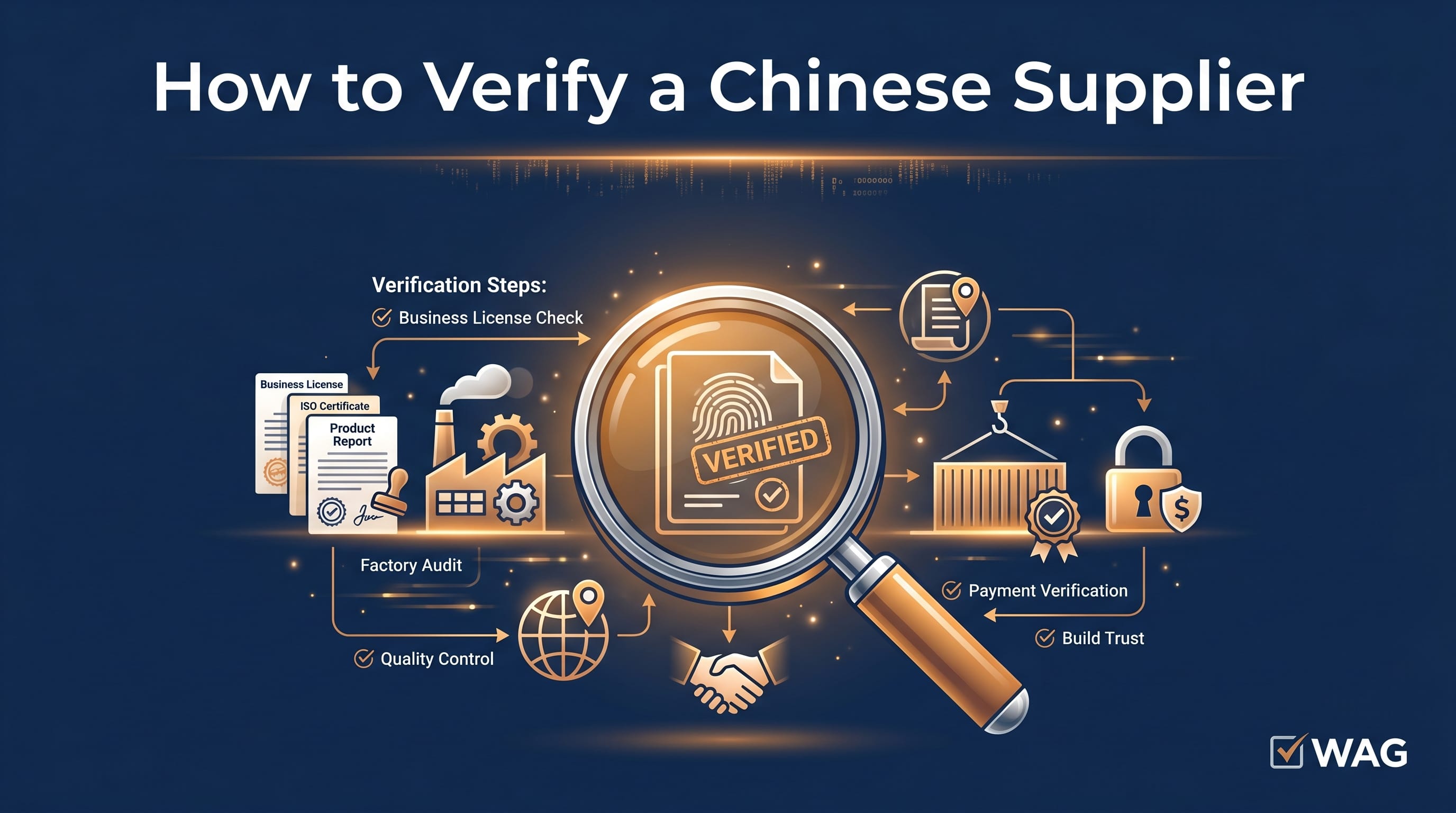
Key Takeaways
- 1A valid business license does not guarantee a factory. Check the business scope for production, processing, or manufacturing terms
- 2Use China's official SAMR registry to verify company details — not just file copies of certificates
- 3Cross-check addresses across business license, sample shipment, and invoicing documents
- 4Low MOQ combined with broad product catalog often indicates a trading intermediary
- 5Always verify certificates with the issuing body, not just accept file copies
For Sydney businesses, Winning Adventure Global conducts factory verification before any commitment is made to a Chinese supplier. After 200+ factory visits across China, I can tell you this: a supplier's website tells you almost nothing. Their catalog tells you almost nothing. Even their sample tells you almost nothing — until you know who you are actually dealing with.
In 2019, I visited a factory in Dongguan that looked perfect on paper. Professional website. ISO 9001 certification. Photographs of a large, modern facility. The sales manager spoke excellent English.
When I walked the production floor, I counted 12 employees. They claimed to produce 50,000 units per month. The math did not work. The equipment was real, but the operation was a fraction of what they advertised.
That day I learned what I already knew but sometimes needed to be reminded of: verification is not optional. It is the only thing that separates businesses that build reliable supply chains from businesses that lose deposits.
This is the verification framework we use for every supplier before Australian clients pay a deposit.
Why Supplier Verification Matters for Australian Importers
When you import from China, the legal responsibility for product quality, compliance, and supply chain integrity rests with you — the Australian importer. Not the factory. Not the freight forwarder. You.
Australian Consumer Law requires that goods meet Australian standards. If you cannot trace your products to a verified manufacturer, you carry all the risk yourself.
The cost of getting this wrong:
- Deposits lost to shell companies that take payment and disappear
- Quality issues because you never verified the actual production environment
- Compliance failures because the factory's certifications were invalid
- Supply chain disruption when mid-production you discover the supplier cannot deliver
I have seen all four. None of them are pleasant.
The 12-Step Supplier Verification Checklist
Use this checklist before paying any deposit to a Chinese supplier. Each step takes 10-30 minutes for remote checks, longer for on-site verification.
Step 1: Confirm the Business License is Real
Search the company on the official National Enterprise Credit Information Publicity System (GSXT) using the Chinese legal name or Unified Social Credit Identifier. Our step-by-step GSXT company registration guide explains how to read each field and distinguish the public portal from its regulator, SAMR.
What to check: The legal name and identifier match, and the exact registration status does not show that the entity has been deregistered or had its licence revoked.
If you find: No result, pause. Recheck the exact Chinese name and identifier, ask for a current full licence, and do not pay until the entity is reconciled.
Step 2: Verify the Business Scope Includes Manufacturing
Chinese companies are registered with a business scope. Manufacturing, production, or processing language supports a factory claim; wholesale, export, import, or trade language points towards an intermediary role. Neither conclusion is proven by the scope alone.
What to check: Whether the scope supports the role being claimed. If it says only "wholesale" or "export," ask who actually manufactures the goods and verify that entity separately.
What I have seen: Three cases where suppliers presented as manufacturers but their business scope described only trading operations. Each time, clients had already paid deposits.
Step 3: Confirm the Registered Address is in an Industrial Zone
Factory addresses in China appear in industrial zones or manufacturing districts. Commercial office addresses are a red flag.
What to check: The address on the business license is in an industrial park or manufacturing district, not a commercial business tower.
Red flag: A registered address in a downtown business district or commercial complex — factories require industrial zoning.
Step 4: Verify the Address with Satellite Imagery
Take the registered address and drop it into Google Maps or Baidu Maps. Look at the satellite view.
What to check: What is actually at that location? If the address describes an industrial zone but the satellite view shows a commercial building, that is a serious red flag.
What I have seen: A supplier's business license showed an address in Shenzhen's Bao'an District industrial park. The satellite view showed a commercial office building. When we visited, it was an office — not a factory. The factory photographs on their website belonged to a different company.
Step 5: Verify Certificates with the Issuing Body
Certificates can be faked, expired, or belong to a different company. Never accept a certificate file as proof of anything.
What to check: Every legitimate certification body (ISO 9001, CE, CB, etc.) has an online verification portal. Ask for the certificate number and verify it directly with the issuing organisation.
What I have seen: Two cases where certificates were valid but belonged to a parent company, not the subsidiary producing the goods. One expired certificate. One number that did not exist in the issuing body's database.
Step 6: Check Certificate Scope Matches Your Product
Even valid certificates may not cover the specific product you are ordering.
What to check: The certificate scope lists products or product categories that include what you are sourcing. A CE certificate for electronics does not cover mechanical equipment.
Step 7: Analyse the Product Range and MOQ
Factories are specialised. They invest in specific equipment and processes for specific product categories.
What to check: If a supplier offers products across unrelated categories — lighting, electronics, furniture, and promotional products — they are aggregating from multiple manufacturers. Also compare MOQ to what a genuine factory of that type would require.
Red flag: Broad catalog across unrelated product types + very low MOQ almost always indicates a trading intermediary.
Step 8: Ask for Specific Machine Models and Equipment
Manufacturing factories can answer detailed questions about their equipment.
What to ask: "What machine models do you use for this production?" "What is the production line setup?" Ask about specific equipment. Real factories answer precisely. Trading companies give vague responses.
What I have seen: A supplier advertising 12 product categories who could not name a single injection moulding machine model. They were brokering from multiple factories.
Step 9: Request a Live Video Walkthrough of the Production Line
Photographs are not proof. Videos can be pre-recorded. The strongest verification is a live, unedited video walkthrough of the actual production facility.
What to request: A live video call where the supplier walks through the specific production line that would handle your order. Ask them to show the machines, workers, testing equipment, and packaging area. If they resist or claim the line is "under maintenance," that is itself a signal.
Step 10: Verify Production Line Activity in Real Time
A live video can still be staged. Look for signs of actual production activity: workers actively working, materials being processed, finished goods in the packaging area.
What to look for: Active production versus a staged showroom walk. If the facility looks too clean and organized with no workers visible, it may be a curated demonstration, not actual production.
Step 11: Cross-Check Three Addresses
Compare the registered address from the business license, the sample shipment origin, and the invoicing company name.
What to check: The sample shipment address, the proforma invoice company name, and the business license address. If any of these do not match, there is a hidden intermediary in your supply chain.
What I have seen: A sample from Guangzhou, business license registered in Shenzhen, invoice issued under a third company name. Three different entities, none disclosing the connection.
Step 12: Assess the Supplier's Communication Behaviour
How a supplier communicates tells you as much as what they communicate.
Red flags in communication: Reluctance to provide documents, deflection from specific questions, pressure to decide quickly, frequent schedule changes for calls or visits. Experienced exporters with real production capability are accustomed to verification requests and respond promptly with specifics.
Red Flags That Should Stop You
These are the signals I have learned to treat as immediate stop signs:
- The business scope is trading or wholesale, not manufacturing
- The registered address shows a commercial building, not an industrial zone
- The supplier cannot or will not provide live video of the production line
- Certificates do not verify with the issuing body
- The sample was shipped from a different city than the factory's registered address
- The supplier's company has changed its registered address in the past 12 months
- The quoted price is significantly below market rate with no clear cost explanation
- The supplier pressures you to decide quickly before you complete verification
Before You Send a Deposit
Before you pay anything, you should have confirmed:
- Business license verified — checked against SAMR registry
- Factory address confirmed — matches an actual manufacturing location
- Certifications verified — checked with issuing bodies, not just provided as files
- Live factory evidence — video walkthrough or on-site visit completed
- Company name matches across all documents — license, invoice, shipping documents
If you cannot confirm all five, do not pay the deposit.
How We Help
I started Winning Adventure Global because I kept seeing Australian businesses make the same mistakes I made early in my career. The verification framework in this guide is the same framework we use for every client engagement.
We verify suppliers on the ground in China before Australian businesses pay deposits. Our supplier verification service visits factories, checks documents, and reports back with what we actually found — not what the supplier told us. For ongoing sourcing support beyond verification, see our China sourcing agent service for full procurement management.
The cost of a verification engagement is a fraction of what a lost deposit costs.
If you are about to pay a deposit to a Chinese supplier, contact us first.
Need someone to verify a Chinese supplier before you commit?
Our supplier verification service conducts in-person factory checks in China for Australian businesses — checking business licences, visiting production floors, and verifying certificates before you pay any deposit.
Get a Free Verification Plan →
Related Articles
- China Sourcing Risks & How to Mitigate Them — Understand common risks and proven strategies to protect your business
- Factory vs Trading Company — The 5 signs that reveal whether you are dealing with a factory
- How to Negotiate with Chinese Factories — What Australian businesses get wrong and what actually works
FAQ
Can I verify a supplier remotely?
Yes. Start with the SAMR registry check (Step 1) and address verification (Step 2) — both can be done from Australia in under an hour. For higher-value orders, arrange a live video walkthrough of the production line. For the highest-value orders, plan a physical visit.
How long does the full verification process take?
Remote verification takes 1–2 days. A physical factory visit typically takes 5–10 days from initial inquiry to written report. We usually run both in parallel.
What if the supplier refuses verification?
Treat refusal as a red flag. Legitimate factories are accustomed to verification requests from international buyers. Reluctance to verify is itself significant information.
Is a business license enough to prove a supplier is real?
No. A valid business license only proves the company exists. You still need to verify the business scope, address, and actual production capability.
What is the biggest mistake Australian buyers make?
Relying on a professional website, a fluent English speaker, and a good sample without verifying who is actually making the product. This is how deposits get lost.
How do I verify certificates are genuine and not expired?
Every legitimate certification body provides online verification portals where you can check certificate numbers. Ask the supplier for their certificate number and verify it directly with the issuing organisation. Do not accept certificate files alone as proof — file copies can be outdated, faked, or belong to a different company.
What address should I look for on a Chinese business licence?
The registered address should be in an industrial zone or manufacturing district. If the address shows a commercial office building in a business district, that is a red flag — factories require industrial zoning. Cross-check the registered address on Google Maps or Baidu Maps to confirm what is actually at that location.
How do I know if a supplier is a trading company posing as a factory?
Look at the business scope for manufacturing terms. Ask to see the production floor — not the showroom. Ask specific questions about equipment and production processes. A trading company will be vague about manufacturing details while a real factory can describe their processes precisely.
What should I do before paying any deposit to a Chinese supplier?
Confirm the business licence against the SAMR registry, verify the factory address matches an industrial location, check all certifications with the issuing bodies, complete a live video walkthrough or physical visit, and confirm the company name matches across all documents including the invoice. If you cannot verify all five, do not pay the deposit.
Can Winning Adventure Global conduct factory verification on my behalf before I travel to China?
Yes. Winning Adventure Global conducts factory verification in China for Australian businesses before any commitment is made. We check business licences, visit production facilities, verify certificates, and provide written reports on what we actually found versus what the supplier claimed.
How long does supplier verification take?
A basic verification — document checks, business license confirmation, and certificate verification — typically takes 3-7 business days. More thorough verification that includes on-site factory inspection may take 5-10 business days, depending on factory location and scheduling. Rush verification is available for time-sensitive orders.
What documents should a legitimate Chinese supplier provide?
A legitimate manufacturer should provide: a valid business license (营业执照) showing manufacturing in the business scope, export license, quality management certifications (ISO 9001 or industry-specific), and bank account verification matching the company name. If the supplier hesitates to provide these documents or provides incomplete copies, treat it as a red flag.
How much does professional supplier verification cost?
Verification costs vary by depth and scope. Basic remote verification covers document checks and registry searches, while comprehensive verification adds an on-site factory visit and a written report. We quote each engagement based on the factory's location, the order value, and how deep the checks need to go — contact us for a tailored quote. For high-value orders, the cost of verification is a fraction of what a lost deposit costs.
Can you verify a supplier without visiting China?
Yes. Remote verification is possible through document checks, live video walkthroughs of the production line, third-party database searches (SAMR registry, customs records), and certificate authentication with issuing bodies. However, remote verification is less thorough than on-site inspection — a physical visit can catch issues that documents and video cannot reveal, such as actual production scale and working conditions.
What is the difference between a trading company and a real factory?
A trading company resells products from multiple factories without owning production equipment. A real factory manufactures its own products on-site with its own equipment and workforce. Verification confirms which you are dealing with because trading companies often present themselves as manufacturers. Check the business scope for manufacturing terms, ask specific equipment questions, and request a live video of the production line — real factories answer precisely while trading companies are vague.
Need a professional verification? Our team visits Chinese factories on your behalf.
Get a Supplier Verification Quote →
Andy Liu
2026-03-08 · 9 min read
How Winning Adventure Global helps
Whichever way you source from China, you get someone you can trust on the ground. Choose the approach that fits your business.
One-Time Procurement
A single purchase executed well — travel to China with our guide or let us handle it remotely.
Compare servicesFactory Tour + Supply Chain
Visit China with a bilingual guide, audit production in person, and build a long-term supply chain.
Compare servicesRemote Verification + Supply Chain
Deep supplier verification and ongoing procurement management — without leaving Australia.
Compare servicesFactory Visits
Planning a China factory visit?
Winning Adventure Global accompanies Australian businesses to verified manufacturers. Before you pay a deposit, let us verify the supplier on your behalf.
Free initial consultation · We respond within 4 business hours