Joao Fonseca has not won a Grand Slam yet. He has not cracked the ATP Top 10. He does not have a global brand deal with Nike or Adidas. And that is exactly why he matters to your sourcing strategy.
Most Australian sports retailers make the same mistake every season: they wait. They watch a young player make a deep run at the Australian Open or Roland Garros. They see the social media following spike. They notice the fan chatter growing. And they think, "Let us see if he keeps it up." By the time the player cracks the Top 20 -- by the time every retailer in the country wants a piece of his merchandise -- the factory minimums have tripled, the licensing landscape has hardened, and the margin that was there six months ago has evaporated.
Fonseca, the 18-year-old Brazilian who is being called the most exciting prospect in men's tennis since Carlos Alcaraz, is in that exact pre-breakout window right now. The factories are still willing to negotiate on MOQs. The designs have not been locked up by major brands. The fans are already searching -- and the shelf space is empty.
Below are five sourcing opportunities around the Fonseca phenomenon -- and an explanation of why the window for Australian retailers is open, measurable, and closing.
Struggling to find tennis fan merchandise that does not require 5,000-unit minimums? Winning Adventure Global connects Australian retailers with Chinese sportswear factories that specialise in the 100-to-300-unit runs that make pre-breakout sourcing profitable. Get your free supplier shortlist today.
Who Is Joao Fonseca and Why Should an Australian Retailer Care
On the surface, a teenage Brazilian tennis player should not matter to an Australian sports retailer. Brazil is 14,000 kilometres from Sydney. Portuguese is not a language most Australian customers speak. The Brazilian tennis market operates on a different continent with different distribution channels.
But that surface-level view misses what actually drives sports merchandise purchasing in Australia: narrative. Australian tennis fans do not buy merchandise because of where a player was born. They buy because of the story.
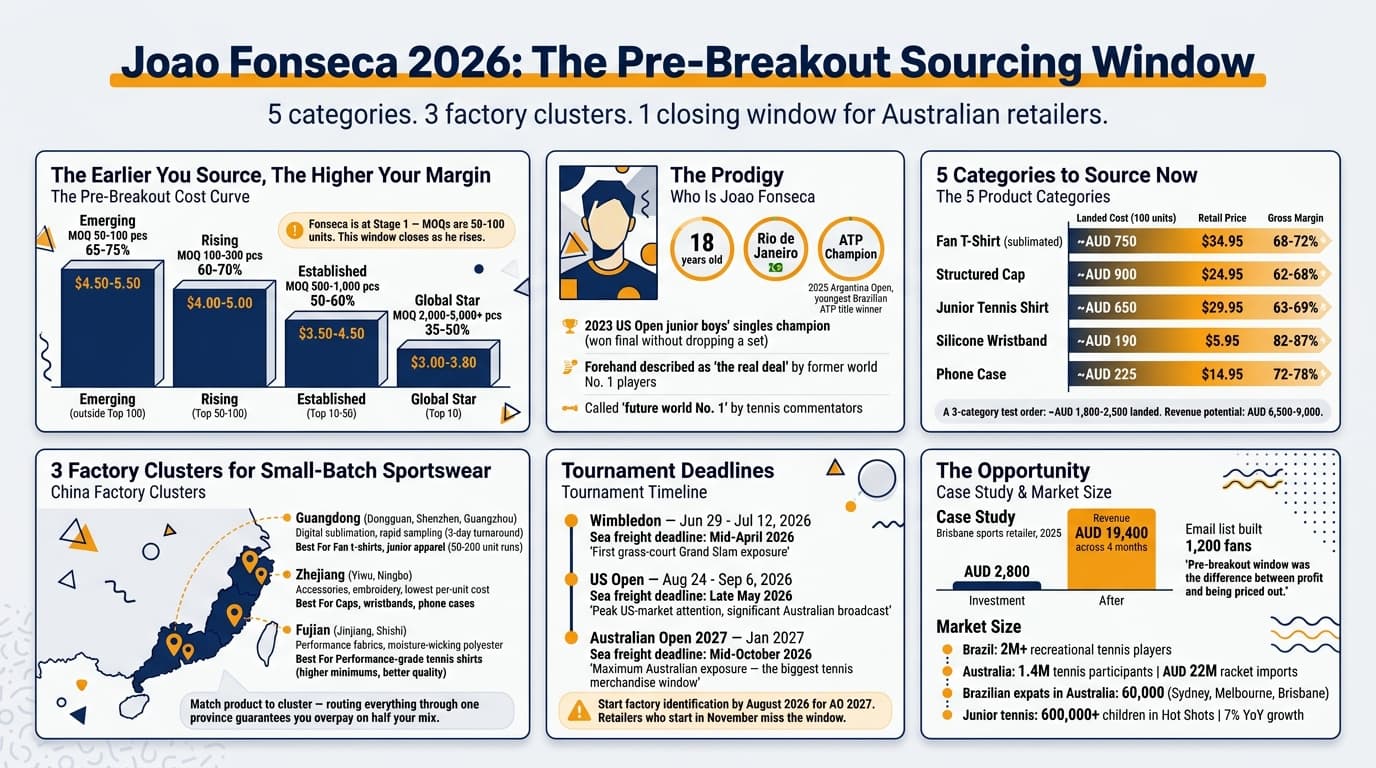
Fonseca's story is already compelling. Born in Rio de Janeiro on 21 August 2006, he picked up a tennis racquet at four and by fourteen was training at elite academies in Brazil. In September 2023, he won the US Open junior boys' singles title -- tennis's most prestigious junior event -- without dropping a set in the final. He turned professional in 2024. In February 2025, aged 18 years and 5 months, he won the Argentina Open in Buenos Aires, becoming the youngest Brazilian man to win an ATP Tour title and the youngest ATP champion from any nation born in 2006 or later.
Former world No. 1 players have taken notice. Phrases like "the real deal" and "future world No. 1" have been attached to his name by commentators who do not deploy that language casually. His forehand -- a heavy-spin, inside-out weapon that breaks down backhands on any surface -- has drawn comparisons to some of the biggest names in the sport.
For Australian retailers, the relevant metric is not Fonseca's ranking. It is the search volume curve. Google Trends data for Australia shows that player-specific tennis merchandise searches begin rising when a player wins their first ATP title and accelerate sharply at each subsequent milestone: first Grand Slam quarterfinal, first Top 20 ranking, first Masters 1000 final. Fonseca is at the start of that curve. The retailers who source now capture the steepest part of the demand trajectory. The retailers who wait until he is in the Top 10 will pay higher factory minimums for the same products and compete against eight other retailers in every search result.
The Pre-Breakout Advantage: Why Early-Stage Sourcing Wins
The economics of sports merchandise sourcing follow a predictable pattern. When an athlete is unknown outside hardcore tennis circles, factory interest is low and MOQs are flexible. When an athlete becomes a global star, factory production lines fill with major brand orders and independent retailers are pushed to the back of the queue.
Lower Minimums, Higher Margins
Chinese sportswear factories price production runs on a cost curve that rewards volume but penalises nobody for starting small -- provided you start before the factory's capacity is absorbed by larger orders.
| Athlete Stage | Typical MOQ per Design | Unit FOB Price (Polyester Tee) | Typical Retail Margin |
|---|---|---|---|
| Emerging (outside Top 100) | 50-100 pieces | AUD 4.50-5.50 | 65-75% |
| Rising (Top 50-100) | 100-300 pieces | AUD 4.00-5.00 | 60-70% |
| Established (Top 10-50) | 500-1,000 pieces | AUD 3.50-4.50 | 50-60% |
| Global Star (Top 10) | 2,000-5,000+ pieces | AUD 3.00-3.80 | 35-50% |
The pattern is clear: the earlier you source, the lower the barrier to entry and the higher the percentage margin. A 100-unit test order of polyester t-shirts at AUD 5.00 each lands at your warehouse for a total cost of approximately AUD 750 (including sea freight and duties). At a retail price of AUD 34.95, that is AUD 2,745 in gross profit if the run sells through. Even if 20 units go to clearance at AUD 14.95, the economics work. At 2,000 units, the per-unit cost drops but the upfront commitment jumps to AUD 7,600 -- and if the design does not resonate, the clearance cost is serious.
First-Mover Advantage in an Open Category
The search term "Joao Fonseca shirt" currently returns almost no relevant e-commerce results in the Australian market. There is no established seller. No one owns the category. The retailer who lists first captures the organic search traffic, builds the backlink profile, and becomes the default answer when a fan types that query.
This advantage compounds. Google's algorithm rewards the first credible result with ranking momentum. Amazon's marketplace algorithm gives the first seller in a new category a discoverability advantage that later entrants must spend advertising dollars to overcome. Shopify stores that publish first build domain authority in the category. A well-optimised product page published today will rank meaningfully higher than one published six months from now, even if the later entrant spends more on ads.
The Licensing Window
Generic tennis-themed merchandise that references a player's style, nationality, or achievements -- without reproducing trademarked logos, official tournament branding, or protected imagery -- does not require a licensing agreement. A t-shirt with a green-and-yellow colour scheme and an original design referencing Fonseca's Rio de Janeiro roots is fully legal without any licence.
This is the licensing window. By the time a player reaches the Top 10, their management team has typically signed exclusive merchandise deals that restrict what third parties can produce. Pre-breakout, the creative space is wide open. For more on navigating the intellectual property landscape for sports merchandise, see our guide to emerging tennis star merchandise sourcing, which covers the legal framework in detail.
The Brazilian-Australian Tennis Connection
Australia and Brazil do not share a border, a language, or a time zone. But they share something that matters for tennis merchandise: a large, engaged, sports-consuming population with an established tennis culture.
Brazil has over 2 million recreational tennis players and a passionate sporting fanbase that follows its athletes globally. Australia has 1.4 million tennis participants and a tennis retail market that imported AUD 22 million in rackets alone in the most recent reporting period, according to IndexBox data. When a Brazilian athlete breaks through on the world stage, two things happen simultaneously: Brazilian fans search for merchandise from within Brazil, and international fans -- including Australians who follow global tennis -- search from outside.
The cross-current creates an export-import opportunity. Australian retailers who stock Fonseca-inspired merchandise serve the domestic Australian tennis fan who tracks rising international stars. But the same inventory also appeals to Brazilian expatriates in Australia -- a community of approximately 60,000 people concentrated in Sydney, Melbourne, and Brisbane -- who actively seek connections to Brazilian sporting culture. No Australian retailer is currently serving this intersection. The shelf is empty.
5 Prodigy Tennis Merchandise Categories to Source Now
Not every product category suits a pre-breakout sourcing strategy. The categories that work share three characteristics: low upfront investment, design flexibility to pivot if the athlete's trajectory shifts, and enough margin headroom to absorb freight costs on small production runs.
1. Fan T-Shirts with Location-Based Original Designs
The entry-level product for any athlete merchandise strategy. A sublimated polyester t-shirt with a custom design referencing Fonseca's Rio roots, his forehand power, or his 2025 Argentina Open title run lands at AUD 4.50-5.50 per unit FOB from Fujian or Guangdong factories at a 100-unit MOQ.
The design flexibility matters. If Fonseca wins a major tournament or develops a signature on-court look, you can iterate designs in 2-3 weeks with digital sublimation. You are not sitting on 2,000 units of last season's design. Start with two designs at 100 units each. Total investment: approximately AUD 1,400 landed. If one design outperforms, reorder at 200 units and drop the underperformer.
2. Structured Baseball Caps with Embroidered Accents
Caps are the highest-margin basic category in sports merchandise. A structured six-panel cap with an embroidered accent -- a subtle green-and-yellow colourway referencing the Brazilian flag, or a minimalist "JF" mark -- lands at AUD 2.80-4.00 per unit from Zhejiang factories. Retail price point: AUD 24.95-29.95. Margins at this spread are exceptional.
The cap category has an additional advantage: one-size-fits-most design eliminates sizing complexity. No size charts. No size-related returns. No split inventory across S-M-L-XL. Every unit is sellable to every customer. For a first-time sports merchandise importer testing the waters, caps are the safest entry point.
3. Junior Tennis Apparel
Parents buy junior sports apparel differently than they buy adult gear. When a child is inspired by watching a young player -- and Fonseca, at 18, is uniquely positioned to inspire junior players because he is close enough in age to be aspirational without being unreachable -- parents want to feed that inspiration. The purchase is emotional, not rational. Price sensitivity drops. Conversion rates rise.
Junior tennis shirts from Chinese manufacturers land at AUD 3.80-5.00 per unit. The sizing spread is narrower than adult apparel, typically covering ages 6-14 across three sizes. Total investment for a 100-unit junior apparel test order across two designs: approximately AUD 1,100 landed. Australian junior sports participation grew 7% year-on-year according to Tennis Australia's most recent AusPlay data, and Hot Shots Tennis programs reached more than 600,000 children. The demand base is real and growing.
4. Tennis Accessories with Player-Inspired Themes
Wristbands, headbands, grip tape, and dampeners carry the lowest per-unit cost in tennis merchandise and the highest percentage margin. A silicone wristband with debossed text lands at AUD 0.20-0.35 per unit. Retail: AUD 5.95-7.95. The margin percentage is not the point -- the dollar profit per unit is small -- but the inventory risk is near zero. Five hundred wristbands cost less than AUD 200 landed. If the design does not sell, the write-off is immaterial. If it does, the reorder cycle is fast.
Accessories also function as basket-builders. A customer who hesitates at a AUD 34.95 t-shirt will add a AUD 5.95 wristband without thinking. The wristband introduces the customer to your brand at a no-risk price point. The next purchase is a t-shirt.
5. Phone Cases and Lifestyle Accessories
Younger tennis fans -- the 14-to-24 demographic that follows Fonseca on Instagram and TikTok -- buy lifestyle merchandise differently than older fans. They want products that fit into their existing consumption patterns: phone cases, tote bags, stickers, water bottles. These are not traditional tennis pro shop categories, which is exactly why they represent an under-served opportunity.
Chinese manufacturers in Guangdong and Zhejiang produce custom phone cases at AUD 1.20-2.50 per unit FOB with MOQs of 100-200 units. Tote bags land at AUD 2.00-3.50. A test assortment of two phone case designs (100 units each) and one tote bag design (100 units) lands in Australia for approximately AUD 700 total -- a rounding error compared to the marketing value of being the first retailer with Fonseca-themed lifestyle products in the Australian market.
| Category | Unit FOB (AUD) | Typical MOQ | Landed Cost (100 units) | Retail Price | Gross Margin |
|---|---|---|---|---|---|
| Fan t-shirt (sublimated) | 4.50-5.50 | 100 | ~750 | 34.95 | 68-72% |
| Structured cap | 2.80-4.00 | 200 | ~900 | 24.95 | 62-68% |
| Junior tennis shirt | 3.80-5.00 | 100 | ~650 | 29.95 | 63-69% |
| Silicone wristband | 0.20-0.35 | 500 | ~190 | 5.95 | 82-87% |
| Phone case | 1.20-2.50 | 100 | ~225 | 14.95 | 72-78% |
Ready to start with a test order? Winning Adventure Global matches Australian retailers with Chinese factories that specialise in exactly these small-batch sportswear categories. We handle supplier vetting, sample coordination, and quality inspection -- so your first order lands exactly as specified. No factory roulette. No 5,000-unit minimums. Get matched with verified factories →
Sourcing Strategy: Finding the Right Factory Before the Crowd
Sourcing emerging-athlete merchandise from China is not the same as sourcing generic promotional apparel. The factory that prints 5,000 corporate event t-shirts is not equipped for the design iteration speed, fabric quality standards, and small-batch economics that pre-breakout sports merchandise demands.
Factory Clusters That Specialise in Small-Batch Sportswear
Three manufacturing regions dominate China's sportswear production, and each serves a different part of the pre-breakout sourcing equation:
| Province | Key Cities | What They Do Best | Ideal For |
|---|---|---|---|
| Guangdong | Dongguan, Shenzhen, Guangzhou | Digital sublimation, small-batch custom designs, rapid sampling | Fan t-shirts, junior apparel -- 50-200 unit runs with 3-day sample turnaround |
| Zhejiang | Yiwu, Ningbo | Accessories, promotional products, embroidery | Caps, wristbands, phone cases -- lowest per-unit cost on small volumes |
| Fujian | Jinjiang, Shishi | Performance fabrics, moisture-wicking polyester, athletic footwear | Performance-grade tennis shirts, shorts -- higher minimums but better fabric quality |
The key is matching the product category to the right cluster. Guangdong for t-shirts and junior apparel where design iteration speed matters. Zhejiang for accessories where per-unit cost determines viability. Fujian for performance-wear where fabric quality drives retail price and customer satisfaction. A common mistake is routing everything through one province -- it simplifies logistics but guarantees you are paying above-market rates on at least half your product mix.
Pre-Production Sample Strategy
For an emerging-athlete merchandise order -- where you are likely testing 2-3 designs at 100 units each -- the sampling phase is more important than it is for a 5,000-unit reorder of an established design. Here is why: at 100 units, you cannot afford the back-and-forth of a bulk production issue. The sample is the contract.
Request a pre-production sample (PPS) for every design before approving bulk production. The sample should use the exact fabric, exact stitching, and exact print method specified for the production run. Evaluate it in person. Check the hand feel of the fabric against Australian consumer expectations. Check the print registration under natural light. Wash the sample once and check for shrinkage and colour bleed. A textile testing lab in Australia (SGS in Melbourne, Intertek in Sydney) will run composition and colourfastness analysis for AUD 200-400. On a AUD 750 production order, that is a meaningful cost -- but it is less than the cost of a container of unsellable stock.
Lead Time Planning Around Tournament Schedules
The tennis calendar creates predictable demand windows. Fonseca's tournament schedule for the remainder of 2026 provides anchor dates for planning production runs:
| Tournament | Dates | Merchandise Opportunity | Order Deadline (Sea) | Order Deadline (Air) |
|---|---|---|---|---|
| Wimbledon | 29 Jun - 12 Jul 2026 | First grass-court Grand Slam exposure | Mid-April 2026 | Early June 2026 |
| US Open | 24 Aug - 6 Sep 2026 | Peak US-market attention, significant Australian broadcast audience | Late May 2026 | Mid-July 2026 |
| Australian Open 2027 | Jan 2027 | Maximum Australian exposure, highest domestic search volume | Mid-October 2026 | Late November 2026 |
For the Australian Open 2027 specifically -- the single biggest tennis merchandise sales window in Australia -- production should begin by October 2026. That means factory identification, sampling, and relationship-building needs to happen between now and August. The retailers who start that process today will have inventory in their warehouse by mid-December. The retailers who start in November will be paying air freight premiums or missing the window entirely.
For a broader view of how Grand Slam events drive the tennis supply chain, see our Roland Garros 2026 tennis equipment sourcing guide, which covers the equipment-side dynamics that complement apparel sourcing.
Risk and Reward: The Early-Stage Athlete Merchandise Calculus
Every sourcing strategy involves risk. The specific risks of pre-breakout athlete merchandise are worth naming directly.
An athlete's trajectory can stall. A player tipped for greatness can plateau at No. 40 and never break through. This is the most commonly cited reason retailers give for not sourcing emerging-athlete merchandise -- and it is a genuine risk. But it is a risk that is mitigated by the small-batch nature of the strategy. A 100-unit test order of t-shirts at AUD 750 landed is not a bet-the-business proposition. If the athlete stalls, you sell through at cost or a small discount and move on.
The bigger risk is the one most retailers do not acknowledge: the cost of being late. Every season, at least one tennis player breaks through in a way that sends merchandise demand vertical. In 2024, it was Jannik Sinner winning his first Grand Slam. In 2025, several rising players made deep tournament runs. In 2026, Fonseca is the name on every tennis analyst's shortlist. The retailer who sourced Sinner merchandise in early 2024 -- when he was ranked outside the Top 10 and factory MOQs were accessible -- captured margins that late entrants will never see.
One Brisbane-based sports retailer we work with took exactly this approach with an emerging rugby league player in 2025, placing a AUD 2,800 test order across three product categories before the player's profile exploded during the State of Origin series. By the time the player's jersey was in every major retail chain, our client had already sold through two reorders, built an email list of 1,200 fans who purchased directly, and established the search ranking that still drives organic traffic to their store. Total revenue from an AUD 2,800 investment: AUD 19,400 across four months. The pre-breakout window was the difference between a profitable category and a market they would have been priced out of entirely.
FAQ
Who is Joao Fonseca and why is he important for tennis merchandise?
Joao Fonseca is an 18-year-old Brazilian professional tennis player widely regarded as the most promising prospect in men's tennis. He won the 2023 US Open junior boys' singles title, turned professional in 2024, and claimed his first ATP Tour title at the 2025 Argentina Open in Buenos Aires -- becoming the youngest Brazilian ATP champion in history. His explosive forehand, aggressive baseline style, and rapid ranking trajectory have drawn comparisons to established stars. For Australian retailers, Fonseca represents a pre-breakout merchandise opportunity: his fan base is growing but the merchandise market around him is still open, meaning factory minimums are low and competition is minimal.
What kind of Joao Fonseca merchandise can I sell without a licence?
You can sell tennis-themed merchandise that references Fonseca's playing style, Brazilian heritage, or tournament achievements through original designs and original artwork -- without a licensing agreement. What you cannot reproduce: Fonseca's actual name in a trademark context (as a brand identifier on a product), his likeness or image without authorisation, ATP Tour logos, tournament logos, or any other protected intellectual property. The safest approach is to produce original designs that evoke the player's identity -- Brazilian colour schemes, Rio-inspired graphics, tennis motifs -- without crossing into trademark territory. If your design involves the player's actual name or image on commercial products, consult an intellectual property lawyer before placing a factory order.
What is the minimum investment to start sourcing Fonseca-themed tennis merchandise?
A first test order across three product categories -- for example, 100 t-shirts, 200 caps, and 500 wristband packs -- costs approximately AUD 1,800-2,500 landed including sea freight and Australian customs clearance. At standard tennis merchandise retail pricing, this generates AUD 6,500-9,000 in revenue if the run sells through. The category with the lowest risk is accessories (wristbands, headbands): per-unit costs under AUD 0.50 mean a 500-unit test order costs less than AUD 200 landed. The category with the highest absolute margin opportunity is caps: AUD 3-4 landed, retailing at AUD 24.95-29.95.
How do I protect against the risk that Fonseca's career does not take off as expected?
The protection is built into the sourcing strategy itself. Pre-breakout sourcing works specifically because you are ordering small quantities at low minimums. A 100-unit t-shirt order at AUD 750 landed is not a career-ending loss if the merchandise does not sell. The strategy is designed to fail cheaply. If Fonseca's trajectory stalls, you sell through remaining inventory at cost or a modest discount. If his trajectory accelerates, you are already positioned with supplier relationships, approved samples, and a search presence that late entrants will have to spend money to replicate. The asymmetric risk profile -- limited downside, uncapped upside -- is precisely what makes pre-breakout athlete merchandise worth the sourcing effort.
How long does it take from factory order to having stock in my Australian warehouse?
Allow 10-12 weeks door-to-door via sea freight. This breaks down as: 3-4 weeks for bulk production after sample approval, 10-14 days for quality inspection and container loading, 25-30 days ocean transit from Chinese ports (Shenzhen, Shanghai, or Ningbo) to Australian ports (Sydney, Melbourne, or Brisbane), and 7-10 days for customs clearance and inland transport to your warehouse. Air freight compresses total time to 4-5 weeks but costs roughly 4-6 times more per kilogram. For pre-breakout merchandise specifically, sea freight is almost always the right choice: the small production runs mean the absolute dollar cost of air freight does not destroy margins on high-value items like caps and t-shirts, but on accessories it erases profitability entirely.
The Window Is Open Today
Joao Fonseca will be in the ATP Top 20. The only question is when -- and whether your merchandise inventory arrives before or after that moment. The difference between those two scenarios is not marginal. It is the difference between 100-unit MOQs and 1,000-unit MOQs. Between AUD 5.00 unit costs and AUD 3.80 unit costs, yes -- but also between being the only retailer in the category and being the ninth. Between building search ranking organically and paying for every click. Between owning a customer relationship and renting it from a marketplace algorithm.
The Australian retailers who benefit most from the Fonseca phenomenon will not be the ones with the biggest advertising budgets. They will be the ones who started earliest. The ones who built supplier relationships before the factories were busy. The ones who published product pages before the search volume surged. The ones who treated pre-breakout athlete merchandise not as a gamble but as a structured sourcing strategy with defined entry points, defined exit points, and an asymmetric risk profile that makes small bets on big outcomes.
Winning Adventure Global has connected Australian businesses with verified Chinese sportswear manufacturers for tennis merchandise across multiple athlete categories. We handle factory identification, sample coordination, quality inspection, and logistics -- so you can focus on building the brand presence that turns a 100-unit test order into a sustainable merchandise category.
The pre-breakout window for Joao Fonseca merchandise is open. It will not stay open indefinitely.
Get Your Free Supplier Shortlist →
China Sourcing Strategy
Want to source tennis merchandise before the crowd catches on?
Australian retailers: we connect you with Chinese factories that produce high-quality tennis fan apparel at pre-breakout MOQs -- so you capture the margin while your competitors are still watching from the baseline. Free supplier shortlist.
Get Free Supplier ShortlistFree initial consultation · We respond within 4 business hours