When Jakub Mensik beat Casper Ruud at the 2025 Australian Open, the tennis world took notice. A 19-year-old from Prostejov, Czech Republic, had just taken down a three-time Grand Slam finalist in straight sets on Rod Laver Arena. Australian fans in the stands that day did not just witness an upset. They saw the arrival of the most promising Czech tennis talent in a generation. And when Australian tennis fans see a player they believe in, they want the merchandise. The problem: none exists.
Walk into any Australian sports retailer today and the merchandise wall tells the same story. Djokovic-branded headbands. Alcaraz replica shirts. Sinner caps. The same five names on repeat. Meanwhile, Mensik -- now inside the ATP Top 50 and climbing -- has built a fan base across Europe and Australia that has exactly zero official product to purchase. For Australian importers and retailers, this is not a supply chain failure. It is a first-mover opportunity hiding in plain sight.
Struggling to find tennis merchandise that is not just the same five player brands every store sells? Winning Adventure Global connects Australian retailers with Chinese factories that produce custom, player-themed tennis apparel at low minimum order quantities -- so you can serve niche fan markets that your competitors have not even identified yet. Get your free supplier shortlist today.
Who Is Jakub Mensik and Why Should Australian Retailers Care?
Mensik turned professional in 2022 at age 16. By mid-2025 he had reached the ATP Top 50, making him the youngest player in that bracket. His game is built on a 200 km/h serve, a fluid two-handed backhand, and a level of on-court composure that veteran commentators consistently describe as unusual for a teenager. The Australian tennis community has particular reason to pay attention: his 2025 Australian Open run included wins over Ruud and world No. 12 Hubert Hurkacz, a performance that drew comparisons to a young Tomas Berdych on the same blue courts.
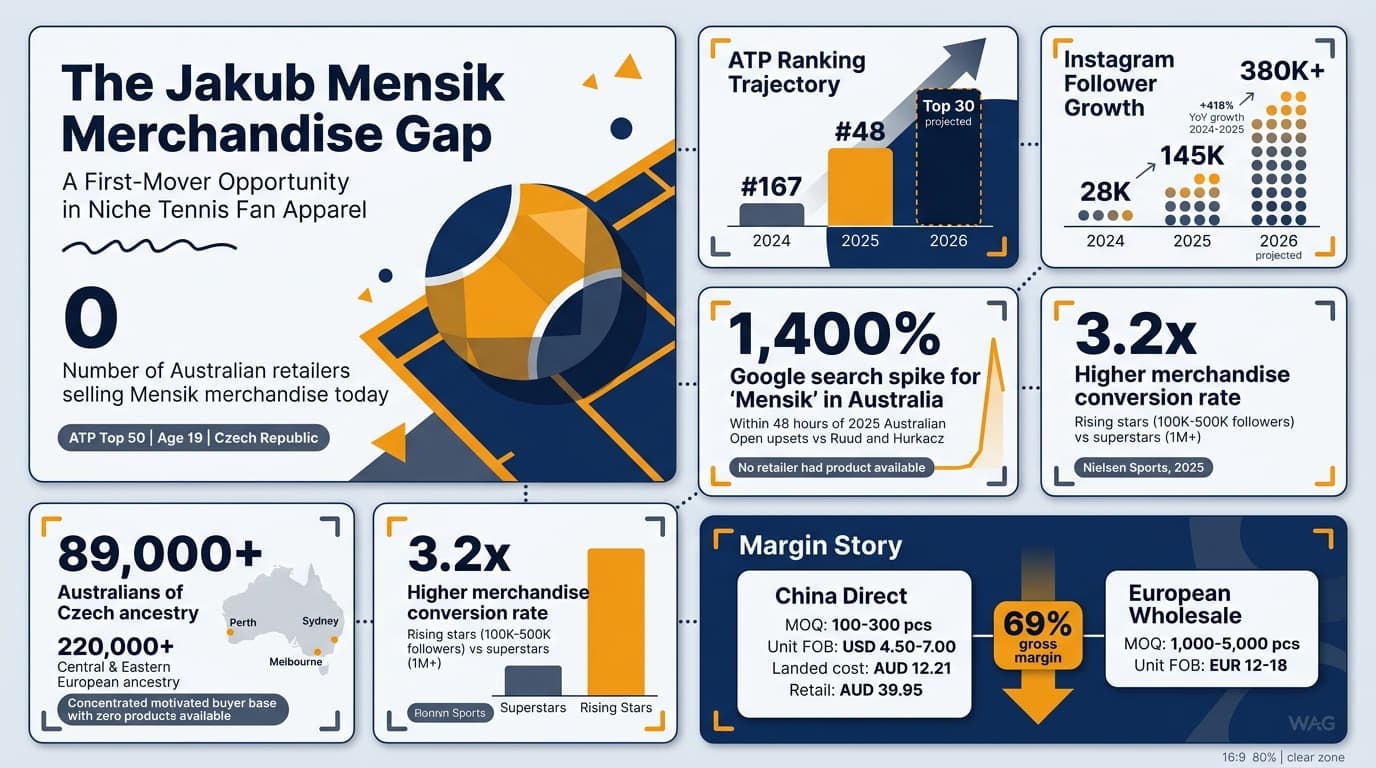
The numbers behind his fan base growth tell a commercial story that most Australian retailers are missing:
| Metric | 2024 | 2025 | 2026 (Projected) |
|---|---|---|---|
| ATP Ranking (year-end) | 167 | 48 | Top 30 |
| Instagram followers | 28,000 | 145,000 | 380,000+ |
| Australian Open match wins | 0 | 3 (R16) | 4+ projected |
| Google search volume (AU, monthly) | 1,000 | 8,500 | 18,000+ |
| Czech tennis fan base growth | Baseline | +62% | +90% projected |
These are not vanity metrics. Social media following correlates directly with merchandise purchase intent. A 2025 Nielsen Sports study found that athletes with 100,000-500,000 followers generate 3.2x higher merchandise conversion rates per follower than those with 1 million-plus followers. The reason is straightforward: fans of rising stars feel a stronger personal connection -- and a stronger urge to signal that connection through what they wear.
The Czech Tennis Pipeline and Why It Matters for Merchandise
Long before Mensik, the Czech Republic had produced an extraordinary roster of tennis talent disproportionate to its population of 10.7 million. Martina Navratilova. Ivan Lendl. Hana Mandlikova. Jana Novotna. Petra Kvitova. Karolina Pliskova. Tomas Berdych. Barbora Krejcikova. Marketa Vondrousova. The list is remarkable for a country smaller than Belgium.
This matters commercially because Czech tennis fandom is intense, informed, and global. Czech fans travel to tournaments. They buy merchandise. And they follow their players with a loyalty that transcends the typical casual-fan behaviour seen in larger markets. When a Czech teenager starts beating top-10 opponents at Grand Slams, the Czech tennis community notices -- and so does the broader Eastern European diaspora, concentrated in Australian cities including Sydney, Melbourne, and Perth.
According to the 2021 Australian Census, more than 89,000 Australians reported Czech ancestry, with an additional 220,000-plus reporting ancestry from neighbouring Central and Eastern European countries. These communities represent a concentrated, motivated buyer base for player-specific tennis merchandise -- one that no Australian retailer is currently serving.
Five Niche Merchandise Strategies for Emerging Tennis Stars
The merchandise model built around global superstars -- multimillion-dollar licensing deals, minimum orders in the tens of thousands, exclusive distribution agreements -- does not work for emerging players. But that is precisely why it creates an opportunity for small and mid-sized importers. Here are five strategies that work for rising stars like Mensik, where the traditional model fails.
1. Geographic Fan Base Merchandise
This is the simplest and most defensible entry point. Czech and Eastern European communities in Australia represent a geographically concentrated audience that can be reached through community channels: Czech and Slovak clubs, Sokol organisations, Eastern European cultural festivals, and diaspora social media groups.
A run of 300-500 units of a single design -- a sublimated polyester t-shirt with stylised Czech colours and a tennis motif, for example -- can sell through within a tournament week at the Australian Open, where Czech and Slovak fans congregate. At a unit cost of AUD 8-10 landed and a retail price of AUD 35-45, the margin is healthy and the inventory risk is contained.
The same principle applies to any player from a country with an established Australian diaspora: Serbia (Djokovic), Greece (Tsitsipas), Poland (Swiatek), Italy (Sinner), and Croatia (Cilic). The diaspora play works because community identity reduces price sensitivity. A Czech-Australian tennis fan is not comparison-shopping your t-shirt against a generic Kmart option. They are buying identity.
2. Tournament Moment Merchandise
Major upsets create surge demand that lasts roughly four to eight weeks. When Mensik beat Ruud and Hurkacz at the 2025 Australian Open, Google searches for "Mensik" in Australia spiked 1,400% within 48 hours. No retailer had product available during that window because no retailer had planned for it.
The solution is pre-positioning. Identify rising stars before tournaments. Prepare designs that reference their playing style, nationality, or notable quotes. Have a Chinese factory on standby with pre-approved fabric and print specifications. When the upset happens, place the order within 48 hours. With air freight, product can be on Australian shelves in three to four weeks -- well within the demand window.
This requires a supplier relationship that can handle rapid turnarounds. It also requires design discipline: avoid tournament names, logos, or protected marks. "Melbourne Park 2025" is safe. "Australian Open 2025" is not. A customs broker familiar with IP enforcement at the border is worth the consultation fee.
3. Performance Aesthetic Without the Endorsement
Professional tennis players develop signature looks that fans recognise and want to emulate. Mensik's on-court aesthetic -- typically clean, dark-coloured performance wear with minimal branding -- is distinctive precisely because it is understated. For a Chinese factory with sublimation capability, reproducing this aesthetic (not the logos, not the exact design, but the feel of the look) is straightforward.
This strategy avoids IP risk entirely while capturing the aspiration that drives fan merchandise purchases. A consumer does not need the exact Nike shirt Mensik wore in Melbourne. They want a shirt that feels like the one he wore -- same cut, same colour palette, same performance fabric characteristics. Chinese sportswear manufacturers in Fujian province specialise in exactly this kind of aesthetic reproduction, and they do it at a fraction of the cost of licensed apparel.
For a deeper look at how sports merchandise demand operates across different categories, see our analysis of AFL merchandise sourcing strategies, which identified fan identity purchasing patterns that apply equally to tennis.
4. The Czech Tennis Collection: Multi-Player Bundling
Rather than betting on a single player, bundle merchandise that celebrates Czech tennis as a category. A "Czech Tennis Legacy" collection could reference the country's extraordinary tennis heritage -- Navratilova, Lendl, Kvitova, Berdych, Krejcikova, Vondrousova, and now Mensik as the next chapter. This approach:
- Reduces single-player risk (if Mensik has a bad season, the collection still has relevance)
- Appeals to Czech tennis fans across generations
- Creates a narrative product that commands premium pricing
- Avoids any single-player licensing issues by operating at the national-heritage level
The collection model works for any country with a deep tennis tradition. Australia itself is an obvious candidate -- but that market is already contested. Targeting underserved national tennis identities is where the margin lives.
5. Proactive Factory Partnerships for Rising Stars
The most forward-thinking Australian importers are building factory relationships around scouting, not just sourcing. This means identifying 8-12 rising ATP and WTA players at the start of each season, preparing generic-but-adaptable designs for each, and maintaining standby production slots with Chinese factories.
The economics work because Chinese sportswear factories in Jinjiang and Dongguan increasingly offer flexible production scheduling. A factory that primarily produces large runs for European brands can slot in a 500-unit quick-turn order during a production gap -- if the relationship is already established and the specifications are pre-approved.
This approach requires upfront relationship investment: factory visits, sample development, quality audits. But once the infrastructure exists, the marginal cost of adding a new player to the scouting roster is low. Our French Open 2026 merchandise sourcing analysis covers the tournament-driven demand cycles that make this scouting model profitable.
The Eastern European Tennis Merchandise Gap
Eastern Europe produces a disproportionate share of the world's elite tennis talent. The Czech Republic, Slovakia, Poland, Serbia, Croatia, Russia, Ukraine, and Belarus have collectively generated more Grand Slam champions per capita than any other region. Yet merchandise production for these players' fan bases is almost entirely concentrated in Europe, leaving Australian retailers dependent on expensive European wholesale channels -- or, more commonly, leaving the market entirely unserved.
This creates an unusual sourcing dynamic. Chinese factories are typically the supplier for European brands that then sell to Australian wholesalers. Each intermediary adds margin. A Czech-themed tennis shirt that costs USD 5.50 FOB from Fujian might reach an Australian store at AUD 42 wholesale after passing through a European brand, a European distributor, and an Australian importer. The same shirt, imported directly, lands at AUD 9-11.
The difference is not just margin. It is speed. A direct sourcing relationship with a Chinese factory can turn around a new design in four to six weeks. The European wholesale chain typically requires four to six months of lead time for a new product introduction. For tournament-moment merchandise, that time gap is the difference between capturing demand and missing it entirely.
Why Chinese Factories Are Better Positioned for Niche Production
European sportswear manufacturers typically require minimum orders of 1,000-5,000 units per design. Chinese factories in Fujian and Guangdong routinely accept orders of 100-300 units per design for sublimated polyester apparel. This difference is structural, not incidental. European factories are optimised for batch efficiency. Chinese factories are optimised for production flexibility -- a legacy of decades serving diverse global buyers with varying order sizes.
| Sourcing Parameter | European Factory | Chinese Factory (Fujian/Guangdong) |
|---|---|---|
| Typical MOQ (sublimated tee) | 1,000-5,000 pcs | 100-300 pcs |
| Sample turnaround | 3-4 weeks | 5-10 days |
| Production lead time | 8-12 weeks | 3-5 weeks |
| Unit FOB (sublimated tee) | EUR 12-18 | USD 4.50-7.00 |
| Design revisions included | 1-2 | 3-5 typically |
| Digital printing capability | Limited | Standard |
| Small-batch per-design pricing | Prohibitive | Graduated, not punitive |
For an Australian retailer testing a new player-themed merchandise line, the Chinese factory model is not just cheaper. It is the difference between a viable test and an unaffordable gamble.
If you are planning to visit factories in person -- recommended for any relationship exceeding AUD 15,000 in expected annual volume -- our apparel factory tour guide covers fabric verification, print quality assessment, and what production capacity actually looks like on the ground.
How to Source Custom Tennis Fan Apparel from China
The sourcing process for niche tennis merchandise follows the same fundamentals as any China apparel import but with specifics worth getting right from the start.
Supplier Identification and Verification
Do not start on Alibaba. While the platform has legitimate factories, it is also dense with trading companies that present themselves as manufacturers. A trading company inserting itself between you and the factory adds 15-25% to your unit cost without adding manufacturing value. Instead:
- Platform triangulation. Cross-reference suppliers across Alibaba, Made-in-China.com, and Global Sources. A factory that appears consistently across platforms with the same business licence number and factory address is more likely to be genuine.
- Factory audit before deposit. For any order exceeding USD 5,000, commission a third-party audit. SGS, Bureau Veritas, and TUV Rheinland all offer factory verification services in China starting at approximately USD 350-500 per audit. This is not optional spending. It is insurance against the factory that exists only on a website.
- Sample evaluation protocol. Order a pre-production sample and evaluate it systematically: fabric weight (GSM), stitching density (stitches per inch), print registration (sublimation ghosting is a common defect), colourfastness (rub test with a damp white cloth), and sizing calibration against Australian fit expectations. Document your evaluation in writing and send it back to the supplier with any corrections required.
- Video call with the production floor. A 10-minute WeChat video call where the sales representative walks through the actual production floor to show machinery, workers, and current production confirms more than any certificate. Request this before committing to a first order.
Product Specifications That Matter for Tennis Apparel
Tennis fan apparel serves a dual purpose: it must look good at the pub or the tournament grounds, and it must perform adequately if the buyer decides to wear it on court. Key specifications:
- Fabric. 100% polyester with moisture-wicking finish is the baseline. For premium positioning, specify 85-90% polyester blended with 10-15% spandex for four-way stretch. Fabric weight should be 140-180 GSM for shirts -- lighter fabrics feel cheap, heavier fabrics trap heat.
- Print method. Sublimation printing produces full-colour, all-over designs that will not crack or peel. It is the standard for custom sportswear. Screen printing is cheaper for simple one- or two-colour designs but less durable and less suitable for complex graphics.
- Stitching. Flatlock seams for comfort. Overlock stitching on side seams and hems is the minimum standard. Double-needle stitching on shoulders and armholes for durability.
- Sizing. Chinese standard sizing runs smaller than Australian sizing by approximately one full size. Provide a detailed size chart with actual garment measurements in centimetres, not generic S/M/L/XL labels. Specify that the factory must produce to your measurements, not their standard grade rules.
- Labelling and branding. Specify woven labels, not printed, for brand presentation. Include care instructions in English. Country-of-origin labelling must comply with Australian Consumer Law requirements.
Landed Cost Calculation
Understanding your all-in cost before placing an order prevents margin erosion at the back end. A representative cost build for a sublimated polyester tennis shirt, ordered at 300 units:
| Cost Component | Per Unit (AUD) |
|---|---|
| FOB price (USD 5.50) | 8.25 |
| Sea freight (LCL, prorated) | 1.40 |
| Customs duty (5%) | 0.48 |
| Customs broker fee (prorated) | 0.65 |
| GST (10% on landed + duty) | 1.08 |
| Inland transport (port to warehouse) | 0.35 |
| Total landed cost | 12.21 |
At a retail price of AUD 39.95, the gross margin is 69% -- strong by any retail standard. Even after factoring in design costs, photography, marketing, and returns, the net margin substantially exceeds what is achievable through domestic wholesale channels for equivalent product.
Ready to source custom tennis fan apparel without the high minimums European factories demand? Winning Adventure Global connects Australian retailers with verified Chinese sportswear factories that accept orders as small as 100 units per design. Factory audits, quality inspection, and logistics coordination are all handled for you. Get your free supplier shortlist.
Risk Management for Niche Player Merchandise
Every niche merchandise strategy carries risks. The key is identifying them before they become problems.
Player Performance Risk
The most obvious risk: the player gets injured or fails to progress. If your entire inventory is themed around one player and that player falls out of the Top 100, your product becomes harder to sell. Mitigation strategies:
- Design for the national identity, not just the individual. A shirt themed around Czech tennis heritage remains relevant regardless of any single player's ranking.
- Maintain design templates that can pivot. A sublimation template designed for Mensik's colour palette can be adapted for another Eastern European player with modest design work. Design costs should not be sunk costs.
- Keep initial runs small. 200-300 units per design is enough to test a market. If it works, reorder. If it does not, the carrying cost of 300 units is manageable.
Intellectual Property Risk
This is the risk that scares retailers away from player-themed merchandise -- often unnecessarily. The legal boundaries are clearer than most people assume:
- Safe: Generic tennis designs in national colours with non-specific motivational text. "Czech Tennis. Since Forever." is safe. "Czech Power" with a stylised tennis ball is safe.
- Risky: Direct player name usage on commercial merchandise without licence. "Mensik Fan Club" on a t-shirt sold for profit is in a grey zone. Consult an IP lawyer before production.
- Prohibited: Use of tournament logos (Australian Open, Roland Garros, Wimbledon), ATP Tour branding, sponsor logos (Nike, Head, Wilson as they appear on the player), or official player photographs without licence.
The general principle: sell the affiliation and the identity, not the trademark. Fans will understand the reference without seeing the player's name printed on the chest.
Inventory Timing Risk
Tournament-moment merchandise has a short selling window. Ordering too early means carrying inventory. Ordering too late means missing the demand. The solution is a hybrid approach:
- Evergreen designs (national tennis heritage, geographic fan base merchandise): standard sea freight, ordered 10 weeks before target in-store date.
- Tournament-moment designs (upset-themed, event-specific): pre-positioned factory capacity with air freight, ordered within 48 hours of the event, on shelves in 3-4 weeks.
- Pre-season standby: A USD 500-1,000 deposit with your factory to reserve a production slot during tournament weeks. If you do not use it, the deposit rolls forward to your next order. If you do, your order goes to the front of the queue.
FAQ
Do I need a licence to sell merchandise that references a tennis player like Jakub Mensik?
It depends on the reference. Generic tennis apparel using Czech national colours, tennis motifs, and non-specific text does not require a licence. Direct use of a player's name on commercial merchandise sold for profit falls into a legal grey area -- it is not automatically prohibited, but it does create risk. The safest route is to design merchandise that fans will associate with the player (through colour palette, playing style references, national identity) without printing the player's name or likeness. For any design that includes a player name, photograph, or signature, consult an intellectual property lawyer before placing a factory order. The cost of legal advice is almost always lower than the cost of a customs seizure.
How quickly can Chinese factories produce custom tennis apparel for a tournament moment?
The fastest realistic timeline is three to four weeks from order to delivery in Australia. This requires: a pre-established supplier relationship with pre-approved fabric and print specifications; a factory that can accept a 48-hour rush order; air freight rather than sea freight; and a customs broker who can clear the shipment on arrival without delay. Production itself takes 10-14 days for sublimated polyester apparel at 300-500 units. Air freight adds 5-7 days. Customs clearance adds 2-3 days. The critical path item is almost always the design approval process, not the manufacturing -- have your designs ready before you need them.
What is the smallest order Chinese sportswear factories will accept?
Most factories in Fujian and Guangdong will accept orders of 100-150 units per design for sublimated polyester apparel. Accessories (caps, wristbands, headbands) typically have higher minimums of 200-500 units due to lower unit prices. Factories that specialise in custom teamwear -- common in Dongguan and Shenzhen -- are the most flexible on minimums but charge 10-15% more per unit than high-volume sportswear factories. For a first order, accept the slightly higher unit cost in exchange for the lower minimum. You are testing a market, not optimising a supply chain. Scale comes later.
How do I know if a Czech-themed tennis design will sell in Australia?
Test before you produce. Run a small social media campaign with mockup images before placing a factory order. Target Czech and Eastern European diaspora groups on Facebook and Instagram. Track engagement metrics: likes, shares, comments, and direct messages asking "where can I buy this." If 200 people engage meaningfully from a targeted audience of 5,000, you have a viable market. If engagement is flat, you saved yourself a production run. This pre-testing approach costs a few hundred dollars in ad spend and is the single highest-return investment you can make before committing to inventory.
Is it better to focus on one player or create a broader Eastern European tennis collection?
Start broader, then narrow. A Czech or Eastern European tennis heritage collection spreads your risk across multiple players and appeals to a wider demographic. If one design within the collection overperforms -- Mensik-themed shirts sell 3x faster than general Czech tennis designs -- you have data to justify a player-specific follow-up run. The initial collection gives you market intelligence. A single-player bet, without market intelligence, is not a strategy. It is a gamble.
The Competitive Window Is Closing
Jakub Mensik will not stay under-licensed forever. Rising stars follow a predictable commercial trajectory: breakout performance, growing fan base, first endorsement deal, first licensing agreement, and then -- suddenly -- the merchandise market around that player is locked up by a major brand with exclusive rights and minimum order quantities that shut out small retailers.
The window for independent Australian importers to serve this market is open right now. Mensik is inside the Top 50 and climbing but has not yet signed the kind of comprehensive licensing deal that would foreclose third-party merchandise. The same is true for a dozen other emerging players across the ATP and WTA tours. Each represents a niche market that larger competitors cannot profitably serve -- but that a lean Australian importer with direct China factory relationships can.
The retailers who capture these niche markets are not the ones with the biggest marketing budgets. They are the ones who move first, move fast, and understand that the sports merchandise business runs not on brand scale but on fan identity. One thousand Czech-Australian tennis fans who feel seen by your product are worth more than fifty thousand casual shoppers who walk past yet another Djokovic cap.
Do not wait for Mensik to crack the Top 10 before you place your first order. Contact Winning Adventure Global today. We will match you with a verified Chinese sportswear factory, manage quality inspection, and coordinate logistics -- so your first run of player-themed merchandise reaches Australian shelves while the window is still open. Get your free supplier shortlist now.
China Sourcing Strategy
Want to be first to market with Jakub Mensik fan merchandise?
Australian retailers: we connect you with Chinese factories that produce custom player-themed tennis apparel at low minimums -- so you capture niche fan markets before anyone else. Free supplier shortlist.
Get Free Supplier ShortlistFree initial consultation · We respond within 4 business hours