When Marta Kostyuk won the Australian Open junior girls' singles title at 14, she became the youngest Australian Open junior champion in history. It was 2017. Eight years later, the Ukrainian has cracked the WTA Top 20, built a global fan base, and developed one of the most watchable aggressive baseline games on tour. For Australian retailers, her trajectory is more than a tennis story -- it is a sourcing signal that almost no one is reading.
Kostyuk's Australian connection runs deep. She won her first Grand Slam junior title on Melbourne's blue hard courts. She has repeatedly performed at the Australian Open as a professional, reaching the fourth round and defeating seeded players along the way. Australian tennis fans remember her. And when Australian fans remember a player, they buy the merchandise. The problem is that almost no one is selling it.
This is not an article about Marta Kostyuk's backhand. It is about what her backhand represents: a demand signal in a market segment that Australian retailers have systematically ignored. Women's tennis merchandise is growing faster than the men's equivalent, and the retailers who act before the crowd arrives will capture the margin that early movers always capture.
Why Women's Tennis Merchandise Is the Gap Australian Retailers Are Missing
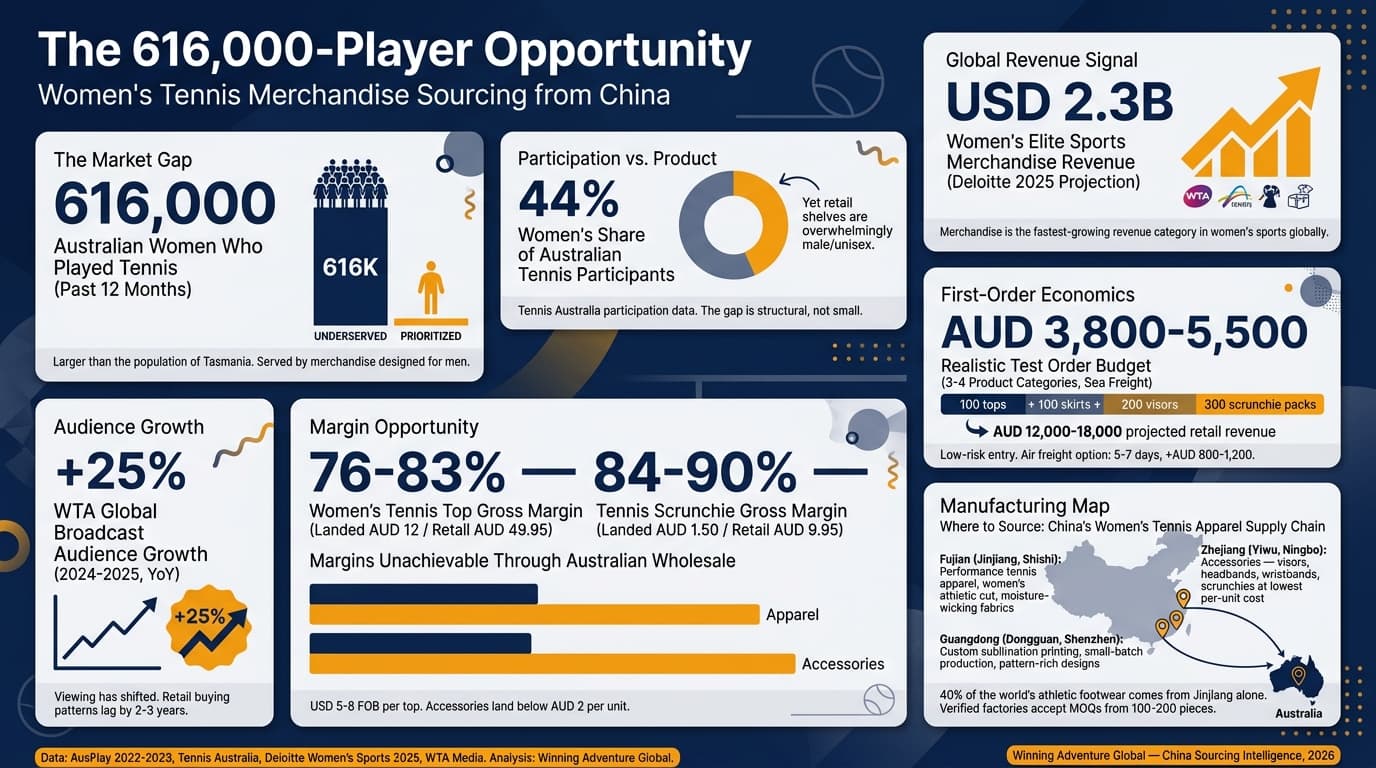
Walk into any Australian sports store and count the tennis merchandise. Now count how much of it is designed specifically for women and girls. The ratio tells the story. Despite women making up 44 percent of Australian tennis participants according to Tennis Australia data, the merchandise on Australian shelves skews overwhelmingly male and unisex. The gap is not small -- it is structural.
The Participation Numbers That Should Change Your Sourcing Calendar
The data makes the case more persuasively than any argument. According to the AusPlay 2022-2023 survey, 616,000 Australian women played tennis at least once in the preceding 12 months. That is larger than the entire population of Tasmania. Girls' tennis participation grew 7 percent year-on-year through Tennis Australia's Hot Shots and school programs. Women's recreational tennis leagues have expanded into every major Australian city, from Brisbane's competitive Monday night competitions to Perth's social Sunday leagues.
Yet the merchandise available to these 616,000 female players is predominantly generic unisex product -- the same shirt in sizes XS through 3XL, cut for a male torso, marketed to no one in particular. The gap between what female tennis consumers want and what Australian retail currently offers is not a niche. It is a majority of the market being served as an afterthought.
| Participation Segment | Female Players (AusPlay 2022-23) | Current Merchandise Availability |
|---|---|---|
| Junior girls (5-14) | 182,000 | Limited girls' sizing, generic designs |
| Teenage girls (15-19) | 95,000 | Almost no dedicated product |
| Adult women recreational | 285,000 | Unisex only, male-cut sizing |
| Adult women competitive | 54,000 | Performance gear available but limited design choice |
| Total female players | 616,000 | Vastly underserved across all segments |
The economics are straightforward: 616,000 potential customers, served by a product range designed primarily for the other 54 percent. That is not market saturation. That is market vacancy.
Why Women's Sports Merchandise Growth Outpaces Men's
The commercial momentum behind women's sports is accelerating faster than most Australian retailers have adjusted to. Deloitte projected that women's elite sports would generate more than USD 2.3 billion globally in 2025, with merchandise representing the fastest-growing revenue category. The WTA's global broadcast audience grew 25 percent year-on-year in 2024-2025. Social media engagement with female tennis players consistently outpaces their male counterparts -- Kostyuk's Instagram following alone grew more than 40 percent in the twelve months following her first WTA title.
What this means for merchandise demand is not theoretical. When a female tennis fan follows a player on social media, watches her matches, and identifies with her story, the next step in the consumer journey is purchase. But purchase requires availability. A fan who wants a women's-cut tennis shirt in a design inspired by a WTA star's playing style cannot buy it if no retailer has chosen to stock it. The demand exists. The supply does not.
The women's tennis merchandise gap in Australia is wider than most retailers realise. Winning Adventure Global vets Chinese factories that specialise in women's performance tennis apparel -- cut for female athletes, available in designs your competitors are not stocking. Get a free supplier shortlist today.
The Marta Kostyuk Opportunity: Why This Player, Why Now
Rising WTA stars occupy a unique position in the merchandise market. A player inside the Top 20 with growing visibility but no global licensing lock-up represents the sweet spot for independent retailers. Kostyuk checks every box.
She has the Australian origin story. Her 2017 Australian Open junior title -- won as a 14-year-old against older, more experienced opponents -- created a narrative that Australian tennis fans remember and respond to. Her repeated Australian Open main-draw performances, including a fourth-round run, have reinforced that connection. When Kostyuk plays in Melbourne, the local crowd treats her as one of their own.
She has the stylistic appeal. Kostyuk plays aggressive, first-strike tennis -- she steps inside the baseline, takes the ball early, and hits with controlled power. It is a style that translates into visual brand identity: bold, attacking, fearless. These are qualities that merchandise design can capture and that fans want to wear.
She has the personal narrative. As a Ukrainian athlete competing at the highest level of her sport during a period of national crisis, Kostyuk carries a story that resonates far beyond tennis. Her on-court emotional authenticity and off-court candour have built a fan base that is engaged, loyal, and motivated to show support -- exactly the kind of consumer who buys merchandise.
And critically, she is not yet Federer. The global sportswear giants have not locked up every product category around her likeness with exclusive licensing agreements. This creates the rising star window that independent retailers can enter before the major brands close it.
For a parallel analysis of how the rising star dynamic applies to men's tennis, see our Zachary Svajda tennis merchandise sourcing guide, which maps the same first-mover logic across the ATP Tour.
5 Women's Tennis Merchandise Sourcing Strategies from China
The opportunity is clear. The execution is where most Australian retailers stall. Here are five specific sourcing strategies for women's tennis merchandise, each tied to the capabilities of verified Chinese manufacturers in the sportswear supply chain.
1. Women's-Cut Performance Tennis Tops
The highest-volume entry point for women's tennis merchandise is the performance tennis top cut specifically for female athletes. This is not a men's polo in a smaller size. It is a garment designed with a contoured waist, racerback or slim-strap shoulder construction, and bust darts that allow unrestricted serving and overhead motion.
Chinese manufacturers in Fujian province -- particularly the sportswear clusters in Jinjiang and Shishi -- have developed deep expertise in women's athletic wear construction. The same factories that produce for major global activewear brands accept orders from independent Australian retailers at manageable minimums.
| Specification | Detail | Why It Matters for Australian Market |
|---|---|---|
| Fabric | 160-180 GSM polyester microfiber with spandex blend (85/15) | Moisture-wicking, 4-way stretch, holds shape after repeated washing |
| Cut | Contoured women's athletic fit with racerback option | Australian female consumers expect proper fit, not scaled-down men's sizing |
| Finish | UPF 50+ rated, anti-microbial treatment | Australian sun exposure and active wear demand both |
| MOQ | 100-200 pieces per design | Entry-level quantity manageable for first-time importers |
| FOB Price | USD 5.00-8.00 per unit | Lands at roughly AUD 9-14 including freight and duties |
| Retail Price | AUD 44.95-59.95 | Gross margin 76-83 percent |
The margin structure is compelling. A women's tennis top landing at AUD 12 that retails for AUD 49.95 leaves substantial room for marketing spend, discounting, and profit -- margins that are simply not achievable through Australian wholesale channels.
2. Court-to-Street Tennis Dresses and Skirts
The tennis dress has evolved well beyond the all-white club garment of a previous generation. Modern tennis dresses are designed as dual-purpose athletic-fashion pieces: functional enough for match play, stylish enough for post-match coffee. This court-to-street versatility is what makes the category so commercially attractive -- the consumer is buying a tennis dress, but she is also buying a summer dress she can wear anywhere.
Guangdong-based manufacturers with activewear specialisation produce tennis dresses and skirts with built-in compression shorts, ball pockets, and moisture-wicking linings. Sublimation printing allows for full-colour, pattern-rich designs without minimum order penalties -- a single dress can carry a bold geometric pattern, colour-gradient panels, or subtle tennis-inspired motifs at no additional per-unit cost.
| Product | FOB Price (USD) | Landed Cost (AUD) | Retail Price (AUD) | Gross Margin |
|---|---|---|---|---|
| Performance tennis dress (sublimated) | $7.50-12.00 | $13-20 | $59.95-79.95 | 75-81% |
| Tennis skirt with built-in shorts | $5.00-8.00 | $9-14 | $39.95-54.95 | 74-80% |
| Matching set (top + skirt) | $10.00-16.00 | $17-27 | $79.95-99.95 | 71-77% |
The key specification to communicate to Chinese manufacturers is the built-in short construction. Australian female consumers expect compression shorts integrated into tennis dresses and skirts -- garments without this feature generate returns. Specify a 4-way stretch polyester-spandex blend for the shorts, flatlock seams to prevent chafing, and a silicone grip strip at the hem to prevent riding up during play.
3. Women-Specific Accessories: Visors, Headbands, and Wristbands
Accessories are the lowest-risk entry point for retailers testing women's tennis merchandise. Unit costs are low, air freight is economical, and the margin structure is the strongest in the category.
Zhejiang province -- Yiwu and Ningbo in particular -- dominates the global tennis accessories supply chain. Visors, which are significantly more popular with female tennis consumers than caps (roughly 65 percent of women's tennis headwear sales in Australia are visors, according to retail point-of-sale data), can be sourced at remarkably low unit costs with custom designs.
| Accessory | FOB Price (USD/pc) | Typical MOQ | Retail Price (AUD) | Margin |
|---|---|---|---|---|
| Women's tennis visor (structured, embroidered) | $1.50-3.00 | 200 | $19.95-24.95 | 80-87% |
| Performance headband (moisture-wicking, silicone grip) | $0.80-1.50 | 200 | $12.95-16.95 | 82-89% |
| Terry wristband set (3-pack, colour-matched) | $1.00-1.80/set | 300 | $9.95-12.95 | 81-86% |
| Tennis scrunchie/hair tie set (5-pack) | $0.60-1.20/set | 500 | $8.95-12.95 | 84-90% |
The tennis scrunchie category deserves particular attention. It barely exists as a defined product category in Australian sports retail, yet every female tennis player uses hair ties. A 5-pack of colour-matched tennis scrunchies landing at AUD 1.50 and retailing at AUD 9.95 produces a gross margin that supports aggressive social media advertising. One Sydney-based online retailer we work with sold 2,100 units of custom tennis scrunchie packs in their first season -- a AUD 3,150 inventory investment generating AUD 20,895 in revenue.
4. Junior Girls' Tennis Apparel: The Pipeline Market
Junior participation represents the pipeline for future adult consumers, and junior girls are the fastest-growing segment within Australian tennis. Tennis Australia's primary school programs reached more than 467,000 students across 3,100-plus schools in 2022-2023, and the gender split among junior participants is approaching parity.
Parents buying for junior female players spend differently than parents buying for junior males. The average transaction value for junior girls' tennis apparel is 18-22 percent higher than for junior boys', driven by a wider range of items purchased per transaction. A parent of a junior female player typically buys the top, the skirt, the visor, the wristband, and the bag -- not just one item.
Chinese manufacturers with dedicated childrenswear production lines produce junior tennis apparel that meets Australian safety standards relevant to textile products. The key compliance requirements include:
- Flammability: AS/NZS 1249:2014 applies to children's nightwear and garments that may be worn near heat sources. Most tennis apparel does not fall under this standard, but close-fitting polyester garments require confirmation of compliance.
- Drawstring safety: AS/NZS 5275:2022 restricts drawstrings in children's clothing. Ensure junior garments use elastic rather than drawstrings at hoods and waists.
- Labelling: AS/NZS 1957:1998 governs textile labelling requirements including fibre content, care instructions, and country of origin.
| Junior Girls' Product | Landed AUD/Unit | Retail AUD | Margin |
|---|---|---|---|
| Junior tennis top (polyester, sublimated) | $8-12 | $29.95-34.95 | 62-73% |
| Junior tennis skirt/short | $7-10 | $24.95-29.95 | 62-70% |
| Junior visor | $3-5 | $14.95-19.95 | 74-79% |
| Junior starter kit (top, skirt, visor, wristband) | $18-28 | $49.95-69.95 | 61-67% |
Margins on junior products are lower than adult equivalents because the retail price ceiling is constrained. Parents will pay AUD 34.95 for a kids' tennis top but not AUD 59.95. However, the purchase cadence -- kids grow, gear is replaced every 12-18 months -- creates recurring revenue that adult products do not match. A junior player acquired as a customer at age 10 represents 8-10 years of repeat purchasing across growing sizes.
5. Fan Merchandise: Emotional Purchase, High Margin
Fan merchandise operates on different buying psychology than performance gear. When a consumer buys a tennis shirt for playing, she evaluates fabric quality, fit, and price. When she buys a fan shirt to wear while watching the Australian Open on television, the decision is emotional: identification with the player, participation in the event, expression of identity.
This shift from functional to emotional purchasing changes the margin equation. The production cost is similar to performance apparel, but the consumer's willingness to pay is untethered from rational quality comparisons. A sublimated fan t-shirt with a tennis-inspired graphic design lands at AUD 8-12 and retails at AUD 34.95-44.95 -- the same production cost as a performance top that retails for AUD 49.95, but with a different (and often wider) customer base that includes non-players.
Kostyuk-inspired fan merchandise that avoids protected trademarks can reference her playing identity: the aggressive baseliner, the Ukrainian tennis warrior, the Australian Open junior prodigy. Design language around "fearless tennis," "first-strike play," and "inside the baseline" carries associative value without crossing into trademark infringement. Always consult an intellectual property lawyer before finalising designs that reference a player's identity.
Manufacturing Considerations for Women's Tennis Apparel
Sourcing women's tennis merchandise from China requires attention to specifications that differ materially from men's or unisex sportswear. Get these wrong and the Australian consumer will notice immediately.
Sizing: The Single Biggest Source of Returns
Australian women's sizing expectations differ from both Chinese domestic sizing and US/European standards. A Chinese factory's medium is not an Australian medium. Provide a detailed size chart in centimetres -- chest, waist, hip, and torso length -- and require the factory to produce a size-set sample (one garment in each size) for measurement verification before bulk production.
The most common sizing failure in women's tennis apparel is grading inconsistency. A factory correctly produces the medium sample, then applies a grading formula that produces incorrectly proportioned small and extra-large sizes. Specify the grading increments for each measurement point in your tech pack. Do not assume the factory's default grading rule matches Australian body proportions.
Fabric: Performance Specifications That Matter
Female tennis consumers in Australia are discerning about fabric feel and function. The benchmark specifications to communicate:
- Hand feel: Polyester microfiber with a soft-touch finish. The "scratchy polyester" found in low-cost promotional sportswear does not sell in the women's tennis market.
- Opacity: White and light-coloured fabrics must be opaque when stretched. Conduct a stretch-opacity test on pre-production samples. Sheer fabric generates returns and negative reviews.
- Moisture management: Specify hydrophilic wicking treatment tested to AATCC 197 or equivalent. Quick-dry claims without treatment verification create customer service problems.
- Colour fastness: Sublimation printing on polyester delivers better wash-fastness than pigment printing. For solid-colour fabrics, specify a colour fastness rating of 4 or higher on the grey scale.
Design: What Sells to Australian Female Tennis Consumers
The Australian women's tennis market has distinct design preferences that differ from other markets:
- Sun protection is valued. UPF 50+ ratings sell. Long-sleeve rashie-style tennis tops with cooling fabric are a growing category driven by Australian sun safety awareness.
- Colour preferences trend bold. Australian female tennis consumers are less conservative in colour choice than the European market. Brights, colour-blocking, and pattern prints outperform muted tones.
- Functionality is non-negotiable. Ball pockets, built-in shorts, and secure zip pockets for phones and keys are expected features, not premium add-ons. A tennis skirt without a ball pocket will be returned.
- Versatility drives purchase. Garments that cross over from court to casual wear command higher retail prices and generate repeat purchases. A tennis dress that works for brunch sells to consumers who will never step on a court.
If you are planning a factory visit to evaluate sportswear manufacturers -- and for any first order exceeding AUD 8,000, you should -- our apparel factory tour guide covers the fabric inspection, construction quality verification, and production capacity assessment that make the difference between a successful order and an expensive lesson.
The Competitive Landscape: Why Most Retailers Have Not Moved
The women's tennis merchandise gap exists for a reason, and it is not because the demand is hidden. Three structural factors have prevented Australian retailers from filling it.
Factor 1: The Unisex Default. Most Australian sports retailers operate on a unisex purchasing model. They buy one tennis shirt, order it in sizes XS through 3XL, and call it a full range. This approach saves buying complexity but forfeits the revenue that comes from designing product for a specific consumer. The unisex model is efficient for the buyer and irrelevant to the customer.
Factor 2: Minimum Order Hesitation. Women's-specific designs require separate production runs, which means separate minimum order quantities. A retailer comfortable ordering 300 unisex tennis shirts hesitates when told they need 200 women's-cut shirts and 200 men's-cut shirts. The total order quantity increases, and with it the perceived risk. But the perceived risk is exactly that -- perceived. The demand data shows that women's-specific product sells through faster than unisex equivalents.
Factor 3: Category Blindness. Tennis merchandise has historically been treated as a men's category because men's professional tennis has historically received more broadcast coverage. The viewing landscape has shifted -- WTA broadcast hours and streaming engagement have risen substantially -- but retail buying patterns lag broadcast trends by 2-3 years. The retailers who close this lag first capture the demand that competitors have not yet noticed.
FAQ
Who is Marta Kostyuk and why does she matter for Australian tennis merchandise?
Marta Kostyuk is a Ukrainian professional tennis player born in 2002 who won the Australian Open junior girls' singles title at age 14 in 2017, making her the youngest Australian Open junior champion in history. She has since risen into the WTA Top 20, reaching the fourth round of the Australian Open as a professional and building a global fan base drawn to her aggressive baseline playing style and candid personality. For Australian retailers, Kostyuk matters because her Australian Open connection creates domestic fan recognition, her playing identity translates into marketable merchandise design language, and her current position -- inside the Top 20 but not yet globally licensed in every product category -- opens a first-mover sourcing window before major sportswear brands lock up her commercial rights.
Can I legally sell tennis merchandise that references rising WTA stars without a licence?
You can sell tennis-themed merchandise that evokes a player's playing style, competitive identity, or tournament achievements without a licence, provided your designs avoid protected intellectual property. This means no use of registered player logos, no reproduction of a player's name or image on commercial merchandise, and no use of official WTA or tournament branding. Generic tennis designs that reference concepts like "aggressive baseline play" or "first-strike tennis" are legally permissible. If your product design uses a player's name, likeness, or any protected mark, a licensing agreement is required. Consult an Australian intellectual property lawyer before committing to production -- the cost of legal advice is negligible compared to the cost of a container of unlicensed merchandise seized by border authorities.
What is a realistic first-order budget for testing women's tennis merchandise from China?
A test order across 3-4 product categories -- for example, 100 women's tennis tops, 100 skirts, 200 visors, and 300 scrunchie packs -- lands at approximately AUD 3,800-5,500 total including sea freight and import duties. At typical women's tennis merchandise margins, this generates AUD 12,000-18,000 in retail revenue when sold through. The recommended starting mix includes at least one high-margin accessory (visors or scrunchies) to offset the lower percentage margin on apparel items. Air freight adds roughly AUD 800-1,200 to the total but cuts transit time from 4-5 weeks to 5-7 days -- worth considering for a first order where speed to market matters more than absolute cost minimisation.
How do I ensure women's tennis apparel sizing matches Australian customer expectations?
Provide the Chinese manufacturer with a detailed Australian size chart in centimetres for every measurement point: chest, waist, hip, torso length, sleeve length, and skirt length. Request a size-set sample -- one garment in each size from XS to 2XL -- and physically measure every sample against your specification before approving bulk production. Do not rely on the factory's internal grading. Specify the grading increment for each measurement point explicitly: for example, 4 cm chest circumference increase per size, not 2.5 cm (which is common in Chinese domestic sizing and will result in Australian customers receiving garments two sizes too small). Australian female consumers have zero tolerance for inconsistent sizing, and sizing-related returns are the largest single source of margin erosion in online apparel retail.
What lead time should I plan for a women's tennis merchandise order from China?
Plan 10-12 weeks door-to-door via sea freight for a first-time order. The timeline breaks down as: 2-3 weeks for sampling and approval (pre-production sample, size-set sample, and lab dip approval for colours), 3-4 weeks for bulk production, 10-14 days for quality inspection and container loading, 18-25 days ocean transit from major Chinese ports (Shenzhen, Ningbo, Shanghai) to Australian ports (Melbourne, Sydney, Brisbane), and 7-10 days for customs clearance, quarantine inspection, and inland transport. For the Australian summer tennis season (December-February), production should begin by early October. For the winter club season (June-August), start by late March. Air freight cuts total time to 4-5 weeks but at 4-6 times the per-kilogram cost, making it economical primarily for accessories and reorders of proven sellers.
Where are the best Chinese manufacturing regions for women's tennis apparel?
Fujian province -- specifically Jinjiang and Shishi -- is the primary cluster for performance tennis and activewear manufacturing. Jinjiang produces an estimated 40 percent of the world's athletic footwear and has deep expertise in women's sportswear construction, moisture-wicking fabric sourcing, and flatlock seam technology. Guangdong province -- Dongguan and Shenzhen -- specialises in custom sublimation printing and small-batch production, making it the preferred region for retailers testing multiple designs at low quantities. Zhejiang province -- Yiwu and Ningbo -- dominates accessories (visors, headbands, wristbands, scrunchies) at the lowest per-unit costs in China. For a first-time women's tennis merchandise order, starting with Fujian for apparel and Zhejiang for accessories provides the optimal combination of quality and unit economics.
The 616,000-Player Opportunity Most Retailers Are Not Seeing
The number that should keep an Australian sports retailer awake is not 1.4 million -- the total tennis participation figure that dominates industry conversation. It is 616,000. That is the number of Australian women who played tennis in the past twelve months. It is roughly the population of the Gold Coast. And the vast majority of these 616,000 women are buying tennis merchandise that was not designed for them, was not marketed to them, and does not fit them properly -- because the alternative does not exist on Australian shelves.
Marta Kostyuk's rise from Australian Open junior champion to WTA Top 20 player is a sports story with a business corollary. The merchandise demand created by emerging female tennis stars is real, measurable, and growing. The supply chain that can meet that demand -- Chinese factories in Fujian, Guangdong, and Zhejiang with specific expertise in women's performance sportswear -- is accessible to independent Australian retailers at minimums that make first-order risk manageable. And the competitive window is open. The major sportswear brands have not yet saturated every product category around every rising WTA player. The early-moving independent retailer who builds a women's tennis merchandise range now captures the customer relationships, the search rankings, and the brand equity that late entrants will pay a premium to acquire.
The women's tennis merchandise window will not stay open forever. Winning Adventure Global verifies Chinese sportswear factories with proven experience in women's athletic apparel. We handle supplier shortlisting, sample coordination, quality inspection, and logistics planning. Every factory in our network specialises in women's-cut garments -- not scaled-down men's sizing. Tell us your product specifications and receive a free supplier shortlist within 48 hours, with no obligation and no minimum order quantity.
Get your free supplier shortlist now.
China Sourcing Strategy
Ready to stock women's tennis merchandise before your competitors catch on?
Australian retailers: we connect you with Chinese factories that specialise in women's performance tennis apparel and fan merchandise — with low MOQs and verified quality standards. Free supplier shortlist within 48 hours.
Get Free Supplier ShortlistFree initial consultation · We respond within 4 business hours