If you import goods from China, you already know the maths. A 40-foot container of furniture costs AUD 60,000 to AUD 120,000. Your supplier in Guangdong wants 30% before production and 70% before shipping. That is the full amount paid before the container even leaves Shenzhen port. By the time your goods clear customs in Melbourne or Sydney, you have been out of pocket for four to eight weeks with zero revenue to show for it.
Macquarie Bank, one of Australia's largest financial institutions with over AUD 380 billion in assets under management, offers trade finance products that specifically address this problem. Yet most Australian SMEs importing from China either do not know these options exist, or assume they are only available to large corporations.
This article breaks down the three Macquarie Bank trade finance routes that Australian importers can use today, what each one costs, and how to structure your first China import deal with bank-backed financing instead of draining your working capital.
Why Macquarie Bank Matters for China Importers
The Cash Flow Reality of China Sourcing
Chinese manufacturers operate on a different payment model than most Australian SMEs are used to. Australian domestic suppliers typically offer 30-day terms. Chinese factories, by contrast, almost universally demand upfront payment. According to the Australian Bureau of Statistics, Australia imported AUD 108.7 billion in goods from China in 2025, making China Australia's largest trading partner. Behind that figure are thousands of Australian SMEs funding inventory out of their own working capital.
A typical payment timeline for a first-time importer looks like this:
| Stage | Timing | Payment Required | Cumulative Outlay |
|---|---|---|---|
| Order confirmation | Day 1 | 30% deposit | AUD 24,000 (on AUD 80K order) |
| Production complete | Day 30-45 | 70% balance | AUD 80,000 |
| Shipping | Day 45-60 | Freight + insurance | AUD 85,000 |
| Customs clearance | Day 60-75 | Duty + GST + port fees | AUD 95,000 |
| Goods in warehouse | Day 75-90 | — | Still AUD 95,000 out of pocket |
For a business turning over AUD 500,000 annually, having AUD 95,000 tied up for three months is the difference between placing one order and placing three.
How Trade Finance Bridges the Gap
Trade finance is a broad term covering financial instruments that facilitate international trade. Instead of using your own cash to pay Chinese suppliers, a bank like Macquarie Bank steps in and pays on your behalf — or guarantees payment — while giving you extended time to sell the goods and generate revenue before the bank needs to be repaid.
For Australian importers, trade finance solves three problems simultaneously:
- Cash flow: You do not need to tie up working capital in each shipment
- Supplier trust: Chinese factories receive guaranteed payment from an Australian bank
- Growth capacity: You can place larger or more frequent orders without hitting cash flow limits
"Trade finance allowed us to triple our order volume in 12 months without taking on debt," said James R., a Melbourne-based furniture importer who worked with Winning Adventure Global to structure his first Macquarie Bank letter of credit in 2025. "We went from one container per quarter to one per month, and the bank-backed payment terms gave our Chinese supplier the confidence to prioritise our orders."
3 Macquarie Bank Trade Finance Routes for Importers
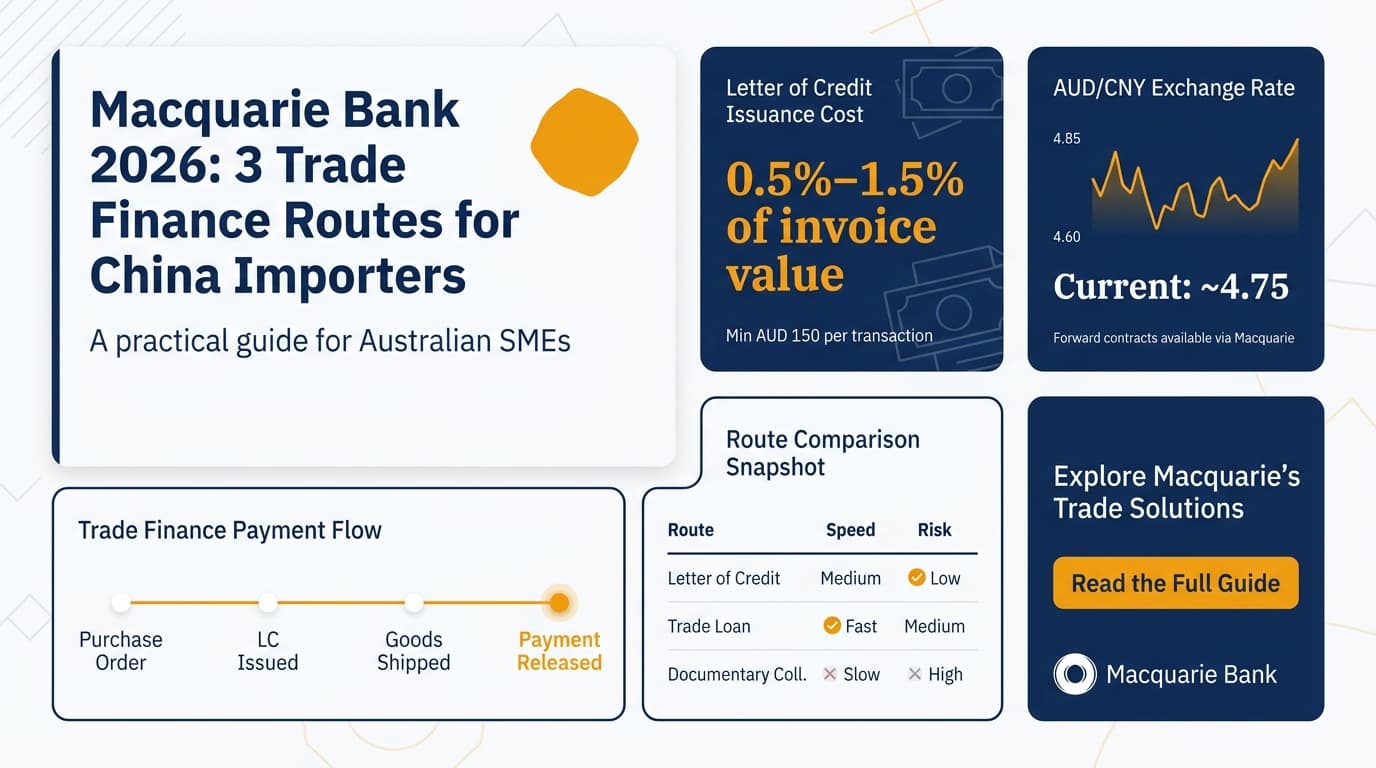
Macquarie Bank's business banking division offers three primary trade finance routes relevant to Australian businesses importing from China. The right choice depends on your order volume, supplier relationship, and how urgently you need the goods.
Route 1: Import Letters of Credit (LC)
A letter of credit is a guarantee issued by Macquarie Bank on your behalf. The bank promises to pay your Chinese supplier once specific conditions are met — typically, once the supplier provides shipping documents proving the goods have been dispatched. The supplier gets payment security from a major Australian bank, and you get the certainty that you only pay for goods that have actually shipped.
How it works for a typical China import:
- You and your Chinese supplier agree on terms (product spec, price, delivery date)
- Macquarie Bank issues an LC in favour of the supplier
- The supplier manufactures and ships the goods
- The supplier presents shipping documents to their bank (bill of lading, commercial invoice, packing list, certificate of origin)
- Documents are forwarded to Macquarie Bank for verification
- Macquarie Bank pays the supplier (at sight, or on a deferred basis if you negotiated a term LC)
- You receive the documents, clear the goods through customs, and repay Macquarie Bank on the agreed schedule
Best for: First-time importers, orders over AUD 50,000, new supplier relationships where trust has not yet been established
Typical Macquarie Bank LC fees: 0.5% to 1.5% of the LC value per quarter, depending on your business credit profile and the tenor (payment term). An AUD 100,000 LC typically costs AUD 500 to AUD 1,500 per quarter in bank fees.
Route 2: Trade Finance Working Capital Loans
Macquarie Bank offers trade-specific working capital facilities that are structured differently from a standard business loan. Rather than providing a lump sum, the facility is drawn down per shipment, with each draw secured against the goods being imported.
How it works:
- You apply for a trade finance facility with Macquarie Bank (typically AUD 100,000 to AUD 2 million for SMEs)
- Each time you place an order with a Chinese supplier, you draw from the facility to cover the deposit and balance payments
- The bank may take a security interest in the goods (via a warehouse lien or receivables assignment)
- As you sell the goods and collect revenue from your Australian customers, you repay the draw
- The facility revolves — repayments free up capacity for the next shipment
Key advantage over an LC: Speed. You pay the Chinese supplier directly using facility funds, without the document verification process that an LC requires. This matters when your supplier in Guangdong needs payment within 48 hours to start production.
Typical Macquarie Bank trade loan rates: Variable rate linked to the bank bill swap rate (BBSW) plus a margin of 2% to 5%, depending on your business's credit profile and security offered. At current BBSW rates of approximately 4.3%, expect an all-in rate of 6.3% to 9.3% per annum.
Best for: Established importers placing regular orders, those needing fast payment execution, businesses with at least 12 months of trading history
Route 3: AUD/CNY Currency Hedging
Currency risk is the hidden cost that erodes margins on China imports. If you agree to pay a Chinese supplier CNY 500,000 for an order when the AUD/CNY exchange rate is 4.90, and the rate drops to 4.75 by the time you make the final payment six weeks later, your effective cost in AUD terms goes up.
On a CNY 500,000 order:
- At 4.90 AUD/CNY: You pay AUD 102,041
- At 4.75 AUD/CNY: You pay AUD 105,263
- Difference: AUD 3,222 — a 3.2% margin hit on a single shipment
Macquarie Bank offers forward exchange contracts (FECs) that let you lock in today's exchange rate for a future payment date. This eliminates uncertainty and makes your landed cost predictable.
How it works:
- You negotiate a price with your Chinese supplier in CNY (or USD, with Macquarie also offering USD/AUD hedging)
- You book a forward contract with Macquarie Bank for the amount and date you need
- When the payment to your supplier falls due, you buy CNY at the pre-agreed rate regardless of where the spot rate has moved
- Macquarie Bank settles the difference — you never worry about the exchange rate again
Important: Forward contracts require a deposit (typically 5% to 10% of the contract value), which Macquarie Bank holds as margin against adverse rate movements. This is not a fee — it is returned when the contract settles, but you need to factor it into your cash planning.
Best for: Any importer whose supplier invoices in CNY or USD, particularly those placing orders with 30-90 day lead times where the exchange rate can move materially
Trade Finance Options: A Side-by-Side Comparison
| Feature | Import Letter of Credit | Trade Working Capital Loan | Currency Forward Contract |
|---|---|---|---|
| Primary function | Guarantees supplier payment | Provides cash to pay suppliers | Locks in exchange rate |
| Minimum order size | AUD 50,000+ | AUD 100,000 facility (AUD 20K+ draws) | No minimum on individual contracts |
| Setup time | 5-10 business days | 2-4 weeks for facility approval | Same-day execution |
| Supplier sees | Macquarie Bank guarantee | Your direct payment (from facility) | Nothing (you handle payment) |
| Typical cost | 0.5-1.5% of LC value per quarter | BBSW + 2-5% margin p.a. | 5-10% deposit + spread over spot |
| Best for | New supplier relationships | Regular importers with trading history | Any importer exposed to FX |
| Key risk | Document discrepancies delay payment | Interest cost if goods sell slowly | Missed favourable rate moves |
How to Structure Your First China Import Deal with Trade Finance
Step 1: Know Your Numbers Before Approaching the Bank
Macquarie Bank, like any Australian financial institution, will ask for specific documentation before approving a trade finance facility. Prepare these before your first meeting:
- Purchase order history: Even if limited, show what you have ordered from China to date, including supplier names, order values, and payment terms
- Supplier details: Business licence (营业执照), bank account details, and at least one reference order from each Chinese supplier you plan to use
- Cash flow forecast: 12-month projection showing when you expect to receive goods, sell inventory, and collect revenue
- Business financials: Last two years of tax returns and BAS statements, plus current management accounts
- Product landed cost calculation: Show you understand the full cost — factory price + freight + insurance + duty + GST + bank fees (see our complete China sourcing cost guide for a detailed cost breakdown)
Step 2: Start with a Test Transaction
Do not apply for a AUD 500,000 facility on day one. Structure a single import letter of credit for AUD 50,000 to AUD 100,000, execute it cleanly from start to finish, and use that successful transaction as evidence when applying for a larger revolving facility.
Banks value demonstrated capability. A flawlessly executed AUD 80,000 LC carries more weight with a credit assessor than a business plan claiming you will import AUD 2 million next year.
Step 3: Negotiate Better Supplier Terms Using Bank Backing
Once you have a Macquarie Bank LC or trade finance facility in place, use it as leverage with Chinese suppliers. The conversation shifts from "Will you pay?" to "How quickly can we start?" because the bank guarantee removes the supplier's credit risk entirely.
A letter of credit from a major Australian bank often allows you to negotiate:
- Lower deposit requirements (15% instead of 30%)
- Faster production slot allocation
- Volume discounts (bank-backed buyers are treated as lower risk)
- Extended validity on pricing (the supplier holds quoted prices longer because the order is considered firm)
Step 4: Layer the Hedging
Once your trade finance facility is operational, add a forward exchange contract for each order. Paying a Chinese supplier through a Macquarie Bank LC while simultaneously hedging the AUD/CNY rate gives you two forms of certainty: payment security and cost predictability. No other combination delivers both.
5 Common Trade Finance Mistakes Australian Importers Make
1. Applying Too Late
Trade finance is not something you arrange the week before your supplier demands payment. Macquarie Bank trade finance facilities take two to four weeks to approve. Letters of credit require five to ten business days to issue. Start the process at least four weeks before you plan to place your first order.
2. Ignoring the Document Requirements
A letter of credit is a document-based instrument. The bank pays against documents, not goods. If your Chinese supplier's commercial invoice does not exactly match the LC terms — right down to the product description wording — Macquarie Bank can and will reject the documents, delaying payment by days or weeks. Brief your supplier on exactly what documents are required and in what format before production starts.
Winning Adventure Global's China-based sourcing team routinely helps Australian importers review supplier documentation for LC compliance before submission — a step that catches discrepancies before they become payment delays. (Our China factory visit service includes pre-shipment document verification as standard.)
3. Using All Your Working Capital on One Order
Even with trade finance in place, resist the temptation to max out your facility on a single shipment. If that container arrives damaged, faces customs delays, or takes longer than expected to sell, you have no buffer. Leave at least 30% of your facility undrawn for contingencies.
4. Ignoring Incoterms When Pricing
Your trade finance cost calculation must account for the Incoterm you are using. An LC issued for goods on FOB Shenzhen terms covers the factory price plus local charges. The same goods on CIF Melbourne terms include freight and insurance in the LC amount — making the bank fee proportionally higher. Know which Incoterm your supplier is quoting and structure the finance accordingly.
5. Forgetting About the RMB (CNY) Angle
Many Australian importers negotiate with Chinese suppliers in USD, assuming it simplifies things. But most Chinese factories convert USD quotes from their internal CNY pricing anyway — and they build a margin into the conversion. If you are able to negotiate directly in CNY and use a Macquarie Bank forward contract to manage the AUD/CNY rate, you often capture 2% to 4% in hidden savings that the supplier's USD conversion margin would otherwise absorb.
Frequently Asked Questions
Can I get trade finance from Macquarie Bank as a new importing business with no trading history?
Yes, but the path is more limited. Macquarie Bank will typically require a director's guarantee or a secured facility (backed by property or other assets) for first-time importers with less than 12 months of trading history. An import letter of credit is generally easier to obtain than a working capital facility in this scenario, because the LC is self-liquidating — the bank knows the transaction will generate cash.
If Macquarie Bank declines, alternative trade finance providers such as Octet and TIM Finance specialise in SME importers and have more flexible credit criteria, though at higher rates.
How long does it take to set up a letter of credit with a Chinese supplier?
The Macquarie Bank LC issuance process takes five to ten business days from application to issuance. However, the full timeline also includes:
- Supplier document preparation: 2-3 days (the supplier needs to provide pro-forma invoice, packing specifications, and shipping details)
- LC amendment cycles: 1-2 rounds are common (terms are adjusted after initial review)
- Total: 2-3 weeks from start to LC being in the supplier's hands
Build this into your production timeline. Chinese factories will not begin manufacturing — even with a 30% deposit paid — until they hold the LC or have confirmed it is en route from the issuing bank.
What documents do Chinese factories need to provide for Macquarie Bank trade finance?
For a standard import letter of credit, your Chinese supplier must provide:
- Commercial invoice — matching the LC description exactly
- Bill of lading — clean on board, issued by the shipping line
- Packing list — itemised by carton, with weights and dimensions
- Certificate of origin — issued by CCPIT (China Council for the Promotion of International Trade), required for Australian customs to apply the correct duty rate
- Inspection certificate (if required by the LC terms) — from a third-party inspection company such as SGS or Bureau Veritas
For working capital loans, the documentary requirements are lighter — typically just the commercial invoice and bill of lading — but the bank may request additional documentation during the credit assessment process.
Is Macquarie Bank trade finance available for orders under AUD 50,000?
Letters of credit become uneconomical below AUD 50,000 because the fixed bank charges and document handling fees consume a disproportionate percentage of the transaction value. A trade finance working capital facility is more suitable for smaller orders — you can draw as little as AUD 20,000 per shipment once the facility is established.
For Australian businesses placing regular small orders from China (AUD 10,000 to AUD 30,000 per shipment), a combination approach often works best: negotiate 30-day supplier payment terms for the deposit portion, fund the balance from a trade finance facility, and use the 30-day window to reduce the amount drawn from the bank.
Does Macquarie Bank trade finance work for Alibaba orders?
Macquarie Bank's trade finance products are designed for direct supplier relationships, not marketplace transactions. Alibaba Trade Assurance provides its own buyer protection and payment mechanism. If you are sourcing through Alibaba, the platform's built-in financing options — including Alibaba Pay Later and third-party integrations with Australian fintech lenders — are generally more suitable than a traditional bank LC.
That said, once you move from Alibaba sampling to placing container-sized orders directly with the factory behind the Alibaba storefront, Macquarie Bank trade finance becomes the more cost-effective option. The unit economics of bank trade finance improve significantly at order values above AUD 50,000.
Winning Adventure Global has helped Australian businesses across furniture, building materials, consumer electronics, and industrial equipment sectors structure their first China trade finance arrangements. Our team handles supplier vetting, document compliance checks, and trade finance introductions — so you focus on selling, not on funding.
Contact us for a free trade finance assessment and find out which Macquarie Bank route fits your importing profile.
China Sourcing Strategy
Cash flow stuck between paying Chinese suppliers and waiting for goods to land?
Winning Adventure Global helps Australian importers structure trade finance, negotiate supplier payment terms, and connect with Macquarie Bank trade specialists who understand China sourcing. Start with a free finance options assessment.
Get Free Finance AssessmentFree initial consultation · We respond within 4 business hours