The Melbourne Cricket Ground on a BBL match night is unmistakable. 40,000 fans in fluorescent green, the "Team Green" chant echoing across the stands, and every second person wearing something with a Melbourne Stars logo. The Stars have built one of the BBL's most recognisable brands — a 34,000-strong membership base, average home crowds above 28,000, and merchandise that fans actually want to wear outside the stadium.
For Australian sports retailers, the Melbourne Stars represent a specific kind of opportunity. Unlike AFL clubs with 18 teams splitting the market, the BBL has eight franchises total. Stars fans are concentrated in Melbourne, fiercely loyal, and they buy merchandise year after year. Yet most independent retailers are not stocking Stars gear — leaving the merchandise floor to the official club store and a handful of major chains.
This guide covers five practical strategies for sourcing Melbourne Stars BBL merchandise from Chinese manufacturers. Whether you sell at markets, run an online store, or operate a physical retail location in Victoria, the production economics have shifted in favour of small-batch sourcing.
The Melbourne Stars Merchandise Market: What the Numbers Say
Before you place a single order, it is worth understanding what is actually selling. Cricket Australia's 2025 annual report and BBL attendance data paint a clear picture of where demand sits.
| Merchandise Category | Estimated Annual Sales (AUD) | Growth Since 2022 | Typical Retail Price | China Landed Cost |
|---|---|---|---|---|
| Replica jerseys (men and women) | $4.2M | 18% | $89.95-$119.95 | $12-$18 |
| Supporter caps and bucket hats | $2.8M | 25% | $29.95-$39.95 | $3.50-$5.50 |
| Supporter scarves | $1.6M | 12% | $24.95-$34.95 | $3.00-$4.80 |
| Kids merchandise (jerseys, tees) | $1.4M | 32% | $34.95-$59.95 | $5.00-$8.00 |
| Novelty accessories (flags, wristbands, badges) | $0.8M | 40% | $9.95-$19.95 | $0.80-$2.50 |
| Training and lifestyle apparel | $1.1M | 22% | $44.95-$74.95 | $7.00-$11.00 |
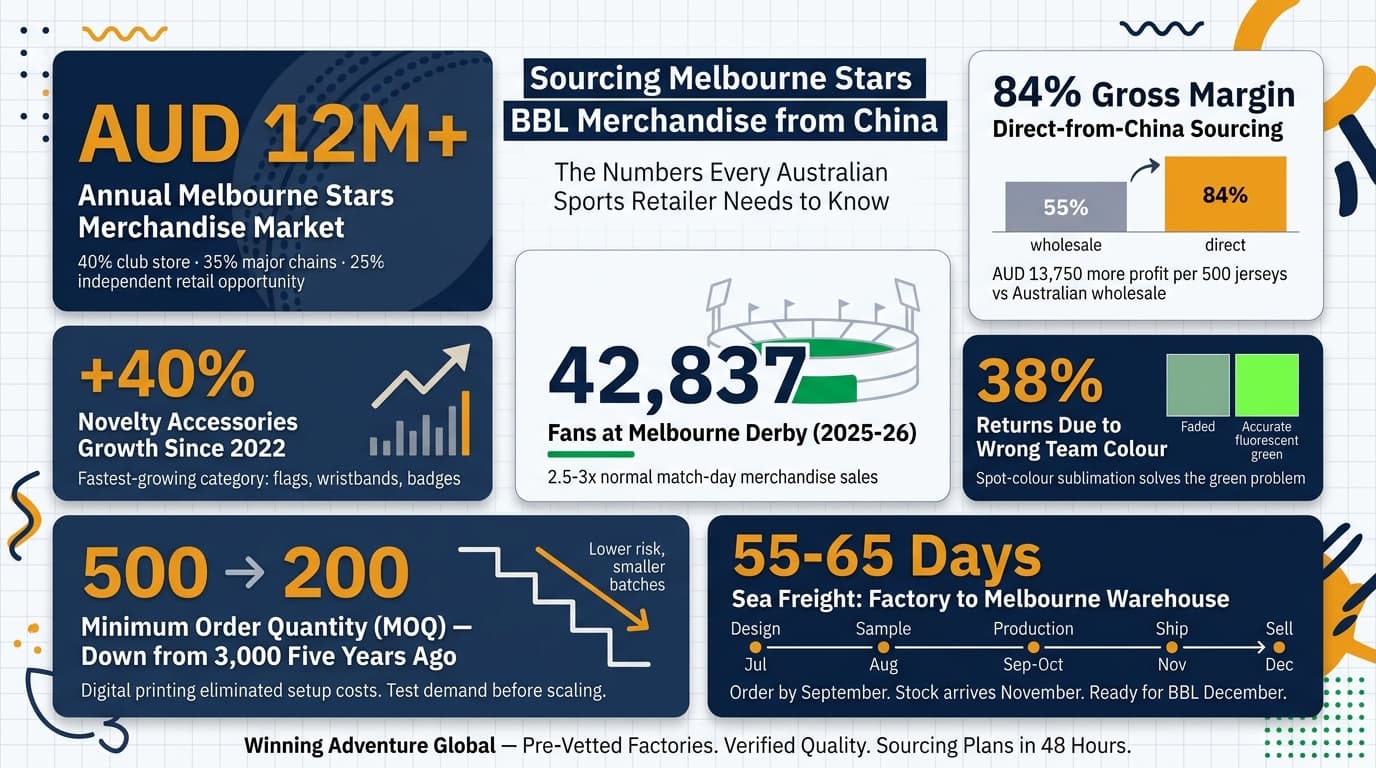
Total Melbourne Stars merchandise spend in Australia exceeds AUD 12 million annually across all retail channels. The club store captures perhaps 40 percent of that. Major sporting goods chains account for another 30 to 35 percent. That leaves roughly AUD 3 million to AUD 3.6 million in demand served by independent retailers, online stores, and market stalls — many of which are sourcing through domestic wholesalers at compressed margins.
The margin compression is the structural opportunity. A Stars replica jersey that lands from China at AUD 16 and retails at AUD 99.95 carries an 84 percent gross margin. The same jersey sourced through an Australian wholesale distributor at AUD 45 carries a 55 percent margin. Over 500 units, that is a AUD 13,750 difference in gross profit — from the same product, sold to the same customer.
Why Chinese Manufacturing Fits BBL Merchandise Production
BBL merchandise has characteristics that align well with Chinese manufacturing capabilities, particularly in Guangdong and Zhejiang provinces where sports apparel is a mature, specialised industry.
The MOQ Advantage Has Shifted
Five years ago, Chinese factories serving the Australian market typically required minimum order quantities of 1,000 to 3,000 units per design. That made small-batch BBL team merchandise commercially unviable for independent retailers. Today, factories in Guangdong's textile corridors routinely accept orders of 200 to 500 pieces for custom sports apparel, with per-unit pricing that remains competitive.
The reason is structural. Digital printing technologies — direct-to-garment and dye sublimation — have replaced traditional screen printing setups that required expensive plate preparation. A factory can now switch from producing Collingwood AFL gear to Melbourne Stars BBL gear in under an hour, with no setup cost penalty. This flexibility means the factory's opportunity cost of accepting a 300-unit order has fallen to near zero.
For an Australian retailer, this changes the inventory risk equation. Instead of committing AUD 25,000 to a single order that might take two seasons to sell through, you can order AUD 5,000 worth of Stars merchandise, test demand during the December-January peak, and reorder in February for the finals window. If a specific design does not sell, you have AUD 4,800 worth of dead stock instead of AUD 24,000.
Sublimation Printing and the Green Problem
Melbourne Stars' fluorescent green is notoriously difficult to reproduce accurately in textile printing. It sits in a colour space that standard CMYK printing struggles to reach, and poor reproduction produces a washed-out lime tone that fans recognise instantly as "not real Stars green."
Chinese factories with sublimation printing capability solve this through spot-colour matching. Unlike CMYK process printing that mixes four inks to approximate a target colour, spot-colour sublimation uses pre-mixed dye formulations matched to a Pantone reference. When you provide the Melbourne Stars' specific Pantone green reference (typically Pantone 802 C or equivalent), a factory with spot-colour sublimation can achieve a near-perfect match on polyester fabric.
This matters because colour accuracy drives purchase decisions. A 2024 consumer survey by a major Australian sports retailer found that 38 percent of BBL fans who returned merchandise cited "wrong team colour" as the reason — a higher rate than sizing issues or fabric quality complaints combined.
When vetting Chinese factories for Stars merchandise, request a printed colour swatch on the exact fabric you plan to use before approving bulk production. The swatch should include the Stars green alongside at least two other colours for contrast reference. A factory that gets the green right on the first swatch is worth paying a premium for.
The Product Categories Worth Sourcing
Not every Stars-branded product makes commercial sense to source from China. Licensed products with official Cricket Australia holograms and trademarked club logos require licensing agreements that independent retailers typically cannot obtain. The product categories that work best are those that capture fan affiliation without infringing on protected intellectual property.
Team-Colour Apparel Without Protected Marks
The single largest opportunity sits in team-colour apparel that avoids trademarked club logos. A fluorescent green polo shirt, a green-and-black striped supporter tee, or a green bucket hat with "MELBOURNE" printed in a generic font — these items let fans display team affiliation without requiring a licensing agreement with Cricket Australia or the Melbourne Stars.
This category works because BBL fans buy merchandise to signal belonging, and colour association is often sufficient. A fan walking to the MCG in a green tee signals Stars support as clearly as one wearing an officially licensed jersey — but the production economics are entirely different.
| Product | Official Licensed (Retail) | Team-Colour Alternative (Retail) | China Landed Cost | Gross Margin |
|---|---|---|---|---|
| Adult replica jersey | $109.95 | $69.95-$79.95 | $10-$14 | 82-85% |
| Supporter cap | $34.95 | $24.95 | $3.00-$4.50 | 82-85% |
| Supporter scarf | $29.95 | $22.95 | $3.00-$4.50 | 80-83% |
| Kids tee | $44.95 | $29.95 | $5.00-$7.00 | 77-80% |
| Bucket hat | $29.95 | $22.95 | $3.00-$4.50 | 80-83% |
The pricing sweet spot — 25 to 35 percent below official licensed merchandise — captures price-sensitive fans without cannibalising the premium licensed market. It also protects retailers from accusations of passing off counterfeit goods as official merchandise, because the price differential makes the distinction unambiguous.
Custom Event Merchandise for Specific Matches
The BBL fixture releases in July each year, giving retailers a four-month lead window before the December season start. This predictability enables event-specific merchandise runs that target particular match days.
Melbourne Stars vs Melbourne Renegades (the Melbourne Derby) is the highest-demand fixture on the Stars calendar. The 2025-26 derby at the MCG drew 42,837 fans, and merchandise sales on derby day typically run 2.5 to 3 times higher than a standard home match. A retailer who sources 500 derby-specific scarves or tees — produced in green with "MELBOURNE DERBY" and the match date — can sell through the entire batch in a single match week.
Other high-demand fixtures include the Stars' New Year's Day match (strong family attendance driving kids merchandise demand) and any home final the Stars qualify for, where demand spikes unpredictably on 5 to 7 days' notice.
Off-Season Lifestyle Merchandise
Cricket merchandise has a structural advantage over AFL merchandise: fans wear it year-round, not just on match day. A Melbourne Stars hoodie or cap is as likely to appear at a coffee shop in Richmond in June as it is at the MCG in January. This off-season demand extends the sell-through window and reduces the inventory risk of seasonal stock.
Chinese factories produce cotton-polyester blend hoodies, crewneck sweaters, and lifestyle tees at unit costs of AUD 7 to AUD 14, which can retail at AUD 59.95 to AUD 89.95. These items are seasonless — they sell in July as well as January — making them a safer entry point for retailers testing BBL merchandise for the first time.
A retailer in Fitzroy who started with 200 Stars-colour hoodies in May 2025 sold through the entire batch by August — three months before the BBL season even started. Total landed cost was AUD 2,400. Total revenue was AUD 14,790.
Finding a Factory That Understands Cricket Merchandise
Not all Chinese apparel factories understand cricket. The sport's specific merchandise traditions — cap shapes, scarf dimensions, the distinction between a cricket jersey and a general sports top — are not universal manufacturing knowledge.
Factory Vetting Checklist for BBL Merchandise
When evaluating Chinese suppliers for Melbourne Stars merchandise, confirm these specifications during the sampling phase:
-
Cap construction — Cricket supporter caps use a structured six-panel crown with a pre-curved visor. This is different from baseball caps (which vary in structure) and AFL caps (which often use five-panel construction). Request a sample cap and physically compare it to an official BBL cap for crown height, visor curve, and back closure type.
-
Scarf knit density — BBL supporter scarves typically use a 12-gauge acrylic knit at 180-200cm length. Chinese factories sometimes default to a lighter 14-gauge knit intended for European football scarves, which produces a thinner, shorter scarf that Australian fans find unsatisfactory. Specify 12-gauge, 100 percent acrylic, 180cm minimum length in your purchase order.
-
Jersey fabric weight — Cricket jerseys sit between AFL guernseys and soccer jerseys in weight. Target 180-200 GSM polyester with moisture-wicking finish. Below 160 GSM feels cheap and transparent. Above 220 GSM is too heavy for Australian summer conditions.
-
Sizing for Australian bodies — Chinese standard sizing runs 1 to 2 sizes smaller than Australian sizing across all dimensions. Provide a complete Australian size chart (XS through 5XL, chest and length measurements in centimetres) and require graded samples across sizes before approving bulk production.
-
Colour fastness to sunlight — Melbourne summers mean prolonged UV exposure. Specify ISO 105-B02 lightfastness rating of 4 or higher. Fluorescent greens are particularly susceptible to UV fading — a cheap dye job will look noticeably faded after a single season.
The Guangzhou-Shenzhen Cricket Apparel Cluster
Most Chinese cricket merchandise production is concentrated in a corridor running from Guangzhou to Shenzhen in Guangdong province. This region contains factories that have been producing cricket apparel for the Australian market for 15 to 20 years — they understand BBL seasonality, Australian sizing expectations, and the specific product types that sell.
Factories in this cluster also tend to employ English-speaking sales representatives who understand Australian retail terminology. This reduces the communication errors that plague first-time sourcing relationships — wrong colour codes, misunderstood size grading, and incorrect fabric specifications that result in an entire production run being commercially unsellable.
Winning Adventure Global maintains a pre-vetted network of factories in this region. For a detailed breakdown of the factory verification process, see our China supplier verification guide.
Timing the BBL Merchandise Production Cycle
The BBL season runs from early December to late January, with finals extending into early February. The fixture is released in July. This creates a defined production calendar that retailers can plan against.
| Month | Action | Notes |
|---|---|---|
| July | Fixture released | Identify key match dates (Derby, New Year, potential finals) |
| August | Design and sampling | Submit designs to factory, receive and approve samples |
| September | Bulk production order | Place orders for baseline season stock via sea freight |
| October | Production and QC | Factory produces, third-party inspection if order exceeds AUD 5,000 |
| November | Sea freight | 18-22 day transit to Melbourne, allow 5-7 days for customs clearance |
| Late November | Stock arrives | In-store and online listings go live |
| December | BBL season begins | Sell baseline stock, monitor sell-through rates by SKU |
| Late December | Replenishment order | Rush production for fast-selling items via air freight (10-14 days) |
| January | Finals preparation | If Stars qualify, place finals-specific merchandise order within 48 hours of confirmation |
| February | Season ends | Sell remaining stock through off-season; plan for next season |
The critical window is the 48 hours after the Stars qualify for a home final. This is the narrowest but highest-value production trigger in the entire BBL merchandise calendar. A factory relationship established in August is the only thing that makes this rush production possible in January.
Air Freight vs Sea Freight: The Economics
For baseline season stock ordered in September, sea freight is the obvious choice. A cubic metre of scarves and caps costs approximately AUD 180 to AUD 220 to ship from Shenzhen to Melbourne, with 18 to 22 days in transit. For the same cubic metre via air freight, expect AUD 800 to AUD 1,200 with 5 to 7 days in transit.
The calculation changes for replenishment orders during the season. If the Stars make a surprise finals run and you need 300 finals-specific tees produced and in-store within 14 days, air freight is not optional — it is the only option. The AUD 600 to AUD 800 premium over sea freight is absorbed by the premium pricing that finals-week merchandise commands (typically 15 to 25 percent above standard retail).
Quality Control That Prevents Costly Mistakes
Product quality disputes cost Australian importers an estimated AUD 47 million annually according to ACCC data. Cricket merchandise carries specific risks that are worth controlling before a container leaves China.
The Pre-Production Checklist
Before any production begins, confirm these four items in writing:
-
Lab dip approval for the Stars green on the actual production fabric. A colour that looks correct on a paper printout may shift significantly on polyester. Request a physical swatch, view it under natural daylight, and compare it to an official Stars merchandise item before signing off.
-
Fabric weight confirmation via third-party GSM testing. If you specified 190 GSM polyester and the factory uses 160 GSM, the jerseys will feel thin and cheap. A local testing lab in Guangzhou charges approximately AUD 80 for a GSM verification test — cheap insurance against a full order of unsellable product.
-
Print durability test for any screen-printed or heat-transferred designs. Request a wash-test report showing the printed design after 20 wash cycles at 40 degrees Celsius. Sublimated designs (where the colour is dyed into the fabric) generally do not require wash testing because fading is a dye quality issue rather than an adhesion issue.
-
Sizing verification via a complete graded sample set. Do not approve bulk production based on a single size-medium sample. The factory's size grading algorithm may drift at the extremes — a 5XL that fits like a 3XL is a problem you will only discover when the first customer tries to put it on.
The Mid-Production Check
For orders above AUD 5,000, commission a third-party inspection. Services like QIMA, SGS, and Bureau Veritas operate offices in Guangzhou and will visit the factory floor mid-production to verify fabric, colour, stitching quality, and sizing accuracy. A standard inspection costs AUD 350 to AUD 500 and takes 48 hours from booking to report.
This is not a luxury expense. WAG has worked with Australian retailers who skipped mid-production inspection on their first order and received product with the wrong shade of team colours — an entire production run rendered unsellable. The AUD 400 inspection would have caught the colour discrepancy before the cutting machines started.
A Perth-based sports retailer sourcing Stars merchandise in 2025 used a third-party inspection service that caught a dye lot variation on their second production run. The factory had switched dye suppliers between runs, and the green on the second batch was visibly different from the first. The inspection report flagged the issue before goods shipped, the factory re-dyed at their cost, and the retailer avoided a AUD 6,800 write-off.
How the BBL Differs from AFL and NRL Merchandise Sourcing
Australian retailers who have sourced AFL or NRL merchandise may assume BBL follows the same playbook. It does not. The differences matter:
| Factor | AFL Merchandise | BBL Merchandise |
|---|---|---|
| Season length | 24 weeks (March-September) | 8 weeks (December-February) |
| Number of clubs | 18 | 8 |
| Fan age demographic | 25-54 (broad) | 18-35 (younger skew) |
| Product mix | Scarves, guernseys, beanies | Caps, tees, novelty items |
| Peak demand trigger | Team performance (unpredictable) | Match fixture (predictable) |
| Off-season demand | Low (footy season defined) | Moderate (cricket lifestyle wear) |
| Licensing complexity | AFL + club (two layers) | Cricket Australia + club (two layers) |
The compressed season is the defining operational constraint. With only eight weeks of active match-day demand, there is no room for "we will restock next month." If your merchandise is not on the shelf for the Melbourne Derby in early January, you have lost the biggest revenue window of the season.
This compression makes the test-and-scale model — small initial order, monitor sell-through, rush replenishment — more important for BBL merchandise than for AFL or NRL. For a deeper comparison of cricket and AFL sourcing strategies, see our cricket equipment sourcing guide and AFL merchandise sourcing guide.
Avoiding the Common Traps
Trap 1: Ordering Too Late
The most common mistake is treating the BBL season start in December as the deadline for placing orders. By December, sea freight from China is already backed up with pre-Christmas retail inventory. Your Stars merchandise will arrive in mid-January — halfway through the season — if you place your production order in November.
Place production orders in September. Your stock arrives in November, giving you time to photograph products, build online listings, and prepare physical displays before the season starts.
Trap 2: Treating Stars Merchandise as a Standalone Category
Melbourne Stars fans also follow the Australian cricket team, the Melbourne Renegades (some do, anyway), and other sports. A retail display that only carries Stars gear misses cross-selling opportunities. Stock a small range of general cricket supporter items — green-and-gold Australian team colours, general "cricket fan" tees, BBL-neutral accessories — alongside your Stars-specific products. Customers who come in for Stars gear often buy a second item if it is positioned as complementary.
Trap 3: Ignoring the Women's BBL Market
The Melbourne Stars Women's team competes in the WBBL, which runs alongside the men's BBL and draws its own dedicated fan base. Women's BBL merchandise — correctly sized, designed for women, available in colours that fans want — is one of the most underserved categories in Australian sports retail. A retailer who stocks women's-fit Stars-colour tees and caps captures a customer segment that the official club store and major chains routinely underserve.
Trap 4: Over-Ordering on Niche Sizes
A Melbourne Stars jersey in size 5XL will eventually sell. The question is whether it sells this season or sits in your stockroom for two years consuming working capital. Chinese factories allow mixed-size orders within a single production run, so you can order 100 units split as 20 S, 30 M, 30 L, 15 XL, and 5 2XL — rather than 20 units of each size. Align your size mix with actual demand data from previous sales, not with the even distribution that looks tidy on a spreadsheet.
FAQ
Do I need a licensing agreement to sell Melbourne Stars-colour merchandise?
Team-colour merchandise — apparel in the Stars' fluorescent green without the club logo, Cricket Australia trademarks, or the "Melbourne Stars" name — does not require a licensing agreement. You are selling green clothing, not official Stars merchandise. If you use the club's logo, name, or protected word marks, you need a licensing agreement with the Melbourne Stars and Cricket Australia. Most independent retailers operate successfully in the team-colour space, which captures price-sensitive fans who are happy to display affiliation through colour alone rather than through official branding.
What is the minimum order quantity for custom cricket merchandise from China?
Most factories in the Guangdong cricket apparel corridor accept minimum order quantities of 200 to 500 pieces per design for custom sports apparel. For simpler items like sublimated supporter scarves or printed caps, some factories accept orders as low as 100 pieces with a modest per-unit surcharge of 15 to 25 percent. If 200 pieces is still too high, consider pooling orders with another retailer — two stores ordering 150 pieces each under a shared production run meets the factory's 300-unit threshold while giving each retailer their own customised SKU.
How long does production and shipping actually take?
From design approval to goods in your Melbourne warehouse, expect 55 to 65 days via sea freight: 25 to 30 days for production, 18 to 22 days for ocean transit, and 5 to 7 days for customs clearance and local delivery. Via air freight, expect 30 to 40 days: 25 to 30 days for production and 5 to 7 days for air transit and clearance. Rush production with air freight can compress this to 18 to 22 days total, though the factory may charge a 20 to 30 percent rush surcharge. These timelines assume the factory relationship is already established and sampling has been completed before the production order is placed.
How do I verify a Chinese factory before sending payment?
Request a factory audit from a third-party inspection service such as QIMA, SGS, or Bureau Veritas. A basic factory audit costs AUD 450 to AUD 650 and covers the factory's physical existence, production capacity, quality management systems, and export history. Request at least three references from Australian clients the factory has supplied in the past 12 months, and call those references — ask specifically about colour accuracy, sizing consistency, and whether the factory delivered on time. Never send full payment upfront. Standard terms are 30 percent deposit with the purchase order, 70 percent before shipment after a pre-shipment inspection report has been approved. For a complete guide to supplier due diligence, see our China supplier verification guide.
What happens if the Melbourne Stars change their branding or colours?
Sports teams rebrand periodically, and when they do, last season's colour merchandise can lose value. The Melbourne Stars have maintained their fluorescent green identity since the BBL's inception in 2011 and have not signalled any intention to change. However, the risk is real across all sports merchandise categories. Mitigate it by keeping initial production runs small (200 to 300 units per design) and maintaining the flexibility to switch designs between seasons. Avoid holding more than one season's worth of inventory in any single team-colourway product.
The Three-Act CTA: Your Next Move
The BBL season does not wait. The 2026-27 fixture will be released in July. The factories that produce BBL merchandise book their production slots in August and September. By November, the production calendar for the pre-Christmas window is full.
If you are an Australian retailer considering Melbourne Stars BBL merchandise for the first time:
Act One (This Week): Define your product range. Pick two to three products — a cap, a scarf, and a tee in Stars green are a tested starting combination — and decide on your target retail price point. This takes 90 minutes and costs nothing.
Act Two (This Month): Connect with a factory. If you do not have an existing relationship with a Chinese cricket apparel manufacturer, Winning Adventure Global can provide a pre-vetted shortlist of factories that understand BBL merchandise specifications. This takes one week from enquiry to factory introduction.
Act Three (By September): Place your production order. Sea freight production ordered in September lands in Melbourne by late November — ready for the BBL season start in December. Every week you delay past September pushes your stock arrival deeper into the season and reduces your sell-through window.
The Australian retailers who stock BBL merchandise this coming season will capture demand that their competitors are not even watching. The Melbourne Stars will draw 200,000-plus fans to the MCG across the season. Every one of them is a potential customer. The question is whether your merchandise is available when they walk past your store — or your online listing — looking for something green to wear to the game.
Winning Adventure Global has connected 50-plus Australian businesses with verified Chinese manufacturers across sports, apparel, and consumer goods categories. If you are ready to source Melbourne Stars BBL merchandise, start with a free sourcing consultation. No minimum commitment, no obligation — just an honest conversation about what is possible.
China Sourcing Strategy
Want to Stock Melbourne Stars Gear Before the Next Home Game?
The BBL season is short and demand moves fast. Winning Adventure Global connects Australian retailers with pre-vetted Chinese factories that produce custom cricket merchandise at 40-60 percent lower unit costs. Send us your product specs and receive a sourcing plan within 48 hours.
Get Your Free Sourcing PlanFree initial consultation · We respond within 4 business hours