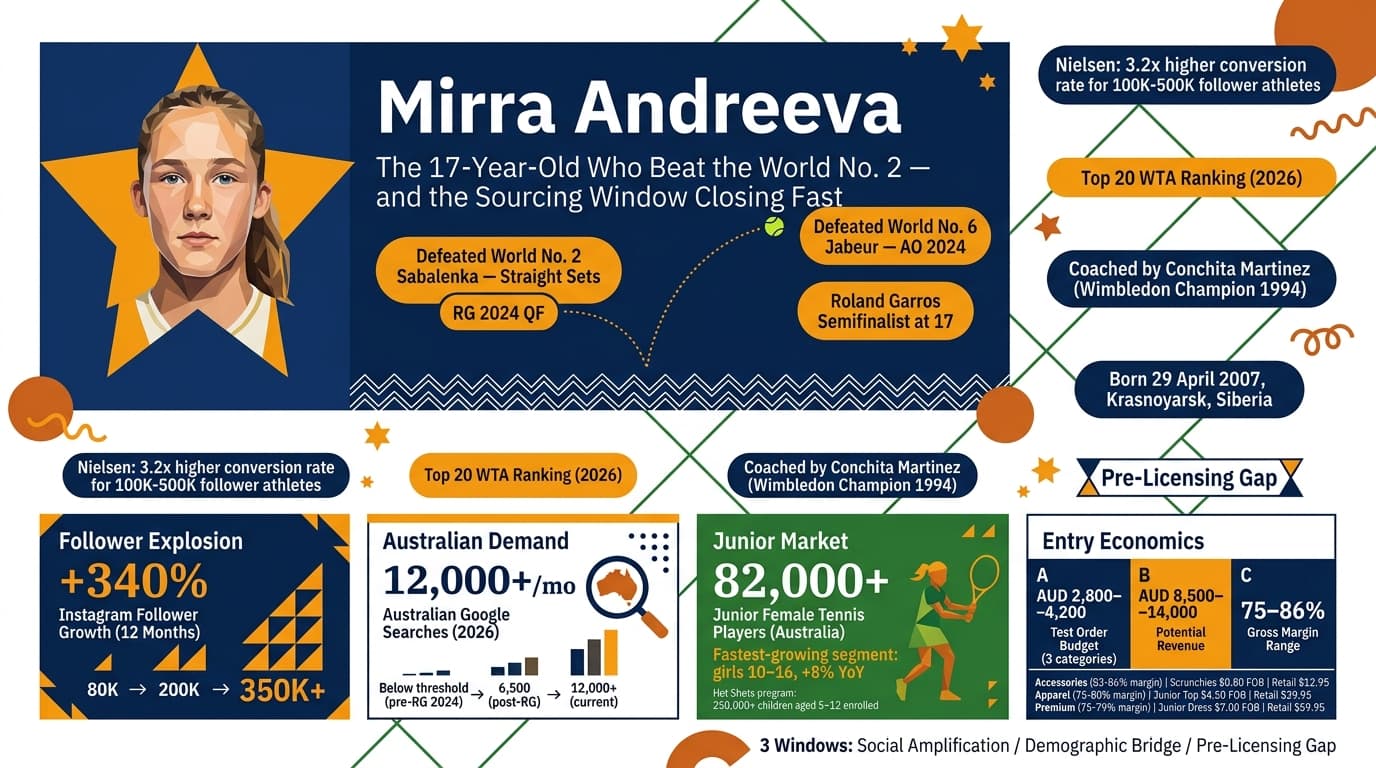
When Mirra Andreeva beat Aryna Sabalenka -- the world No. 2 and the most feared power player in women's tennis -- in the 2024 Roland Garros quarterfinals, the tennis world did not just witness an upset. It witnessed the arrival of the most compelling teenage talent in the sport. Andreeva was 17 years old. She was playing in only her fifth Grand Slam main draw. She stood across the net from a woman who had won two Australian Open titles, including the one contested five months earlier on the same surface where Australian retailers do their biggest tennis merchandise business of the year. And she won in straight sets.
The 2024 Roland Garros semifinal that followed -- Andreeva versus eventual finalist Jasmine Paolini -- drew a global broadcast audience that placed a 17-year-old Russian at the centre of tennis's most-watched clay-court event. Australian viewership numbers, driven by the time-zone-friendly evening broadcasts that Roland Garros provides to the eastern Australian market, were substantial. Australian tennis fans saw Andreeva. They heard the commentators call her the future of the sport. They searched her name. And when they searched for merchandise, they found nothing.
This is not an article about Mirra Andreeva's backhand, though her backhand is worth an article. It is about what happens when a 17-year-old breaks through at the highest level of tennis and the merchandise supply chain has not caught up. Specifically, it is about the three sourcing windows that open when a teen prodigy arrives -- and why Australian retailers who understand those windows capture margins that late entrants never see.
Australian retailers watching teen tennis stars break through on global television -- but finding no product to sell when fans start searching -- are watching revenue leak to the brands that moved earlier. Winning Adventure Global connects Australian importers with Chinese sportswear factories that specialise in the 100-to-300-unit production runs that make pre-breakout teen merchandise profitable. Get a free supplier shortlist within 48 hours.
Who Is Mirra Andreeva and Why Should an Australian Retailer Care
Mirra Andreeva was born on 29 April 2007 in Krasnoyarsk, Siberia -- a Russian city closer to the Mongolian border than to Moscow. She started playing tennis at six, moved to Cannes, France, to train at the Elite Tennis Center at 13, and by 15 was beating professionals on the ITF circuit. Her Grand Slam main-draw debut came at Roland Garros 2023, where as a 16-year-old qualifier she reached the third round and knocked out a seeded player along the way. No 16-year-old had reached the third round at Roland Garros since 2005.
The Australian Open connection is direct and commercially relevant. At the 2024 Australian Open, Andreeva -- still 16 -- beat world No. 6 Ons Jabeur in the second round, a victory that placed her on Rod Laver Arena during the tournament's first week and introduced her to the Australian tennis public. She reached the fourth round, the youngest player to advance that far at the Australian Open since 2015. Australian broadcasters ran features. Australian tennis commentators pronounced her name with the kind of emphasis reserved for players they expect to see on Melbourne's blue courts for the next fifteen years.
Her trajectory since has been steep. Roland Garros 2024 semifinalist. Top 20 debut in 2025. A playing identity -- aggressive baseline tennis built on court coverage, shot tolerance beyond her years, and an unusual ability to problem-solve during matches -- that commentators compare to players a decade older. She is coached by Conchita Martinez, the 1994 Wimbledon champion and a former world No. 2, who has spoken publicly about Andreeva's work ethic and tactical maturity. Martinez does not deploy praise casually. When she says Andreeva is the most disciplined teenage player she has encountered, the tennis industry listens.
For Australian retailers, the relevant fact is not Andreeva's ranking. It is the gap between fan interest and merchandise availability. Andreeva's Instagram following grew from approximately 80,000 to more than 350,000 in the twelve months following Roland Garros 2024 -- a 340 percent increase. Her post-match interviews, in which she discusses everything from Dostoevsky novels to studying Andy Murray's tactical patterns, generate engagement rates that outperform most WTA Top 10 players. Her fans are engaged. They are motivated. And they have almost nothing to buy.
The Teen Prodigy Merchandise Effect: 3 Windows Most Retailers Are Missing
Most Australian retailers treat tennis merchandise sourcing as a single equation: identify a star, license their likeness, and print t-shirts. That model works for Roger Federer in 2018. It does not work for Mirra Andreeva in 2026. The teen prodigy creates a different kind of merchandise demand -- one that follows three distinct windows that most retailers have never learned to read.
Window 1: The Social Media Amplification Effect
Teenage tennis stars do not build fan bases the way established players do. They build them on TikTok, Instagram, and YouTube -- platforms where younger demographics discover athletes through short-form video, fan edits, and behind-the-scenes content rather than through traditional broadcast coverage. The consumer behaviour that follows is fundamentally different.
A 50-year-old Federer fan buys a polo because it carries the RF logo and signals membership in a known community. A 17-year-old Andreeva fan buys a tennis skirt because a creator on TikTok styled it with streetwear and the video got 2 million views. The discovery mechanism is different. The purchase trigger is different. And the window of peak demand is compressed -- it arrives faster, burns hotter, and fades more quickly than the slow-building demand curve of an established star.
This compression creates the first sourcing window. The retailer who has product available within three to four weeks of a viral moment captures the surge. The retailer who operates on a standard six-month sourcing calendar arrives after the moment has passed and wonders why the inventory is not moving. For Australian retailers, the implication is clear: factory relationships must be established before the viral moment happens. Design templates must be approved. Fabric specifications must be on file. When Andreeva makes a deep tournament run and the search volume spikes, the order goes to the factory within 48 hours -- not six weeks later, after the sourcing manager has finished researching suppliers.
| Social Platform | Andreeva Follower Growth (12 Months Post-RG 2024) | Primary Merchandise Discovery Mechanism |
|---|---|---|
| 80K to 350K+ (+340%) | Match highlights, player lifestyle content, brand collaborations | |
| TikTok | Emerging presence, fan-edited content surging | Viral outfit styling, match-point compilations, behind-the-scenes WTA content |
| YouTube | WTA channel features generating 500K+ views | Full match replays, player documentaries, training footage |
The social media amplification effect means that teen prodigy merchandise demand does not follow the slow, predictable curve of traditional sports licensing. It spikes. And the retailers who can respond to a spike are the ones who did their factory groundwork during the quiet period.
Window 2: The Demographic Bridge
Teen prodigies attract younger consumers. This is obvious. What is less obvious is that younger consumers bring their parents into the purchase funnel -- and the parents have the credit cards.
The demographic bridge operates as follows: a 13-year-old Australian tennis player watches Andreeva on TikTok. She shows the video to her mother, who played club tennis in her twenties and still follows the sport casually. The daughter wants an Andreeva-inspired tennis outfit for her Saturday morning Hot Shots session. The mother, who would never buy a generic unisex sports top for herself, is happy to buy a properly fitted junior tennis dress for her daughter. And once she is on the retailer's site, she notices the women's tennis apparel section. The teen prodigy has just bridged two demographics through a single sourcing category.
According to Tennis Australia's 2025 participation report, junior tennis enrolment in Australia grew 8 percent year-on-year, with girls aged 10-16 representing the fastest-growing segment. These 82,000-plus junior female players are not buying men's tennis shirts in size small. They are looking for merchandise that reflects the players they follow -- and the players they follow are increasingly the teenagers on the WTA Tour, not the established names their parents grew up watching.
The merchandise implication is straightforward. A retailer stocking junior-cut tennis apparel inspired by rising teen stars captures two purchase decisions in a single transaction: the junior player and the parent. The customer acquisition cost per transaction drops. The lifetime value rises. And the competitive moat deepens, because most Australian sports retailers have not built a junior-female tennis category at all.
Window 3: The Pre-Licensing Gap
The global sportswear giants do not license every rising star. They wait. They watch trajectory. They sign players when the commercial return is proven, not when it is projected. This creates a gap -- sometimes eighteen months, sometimes three years -- during which independent retailers can produce merchandise that references a player's playing identity, competitive achievements, and stylistic associations without competing against an exclusive global licensing deal.
Andreeva is in this gap. She has equipment and apparel sponsorship, but her likeness and name have not been locked into exclusive merchandise categories across every product type and every territory. For an Australian retailer producing 200 sublimated tennis skirts with design elements inspired by her aggressive baseline style and her Roland Garros breakout, the legal landscape is navigable -- provided the designs avoid protected marks, tournament logos, and direct name-and-likeness use on commercial products.
The pre-licensing window does not last forever. When a player cracks the Top 10 and wins a Grand Slam, the licensing landscape hardens quickly. The brands move in. The legal teams file the registrations. The factory production lines fill with major-brand orders. The independent retailer who was sourcing 200 units at AUD 9 landed is now competing for factory capacity against a global brand ordering 20,000 units. The margins that were there six months ago are gone.
Mirra Andreeva's Demand Data: What the Numbers Tell Australian Importers
The commercial case for teen prodigy merchandise is built on data, not intuition. The numbers below represent the gap between fan interest and product availability -- and that gap is the definition of a sourcing opportunity.
| Metric | Pre-Roland Garros 2024 | Post-Roland Garros 2024 | 2026 Current |
|---|---|---|---|
| WTA Ranking | Outside Top 100 | Inside Top 40 | Top 20 |
| Instagram Followers | ~80,000 | ~200,000 | 350,000+ |
| Google Search Volume (AU, monthly) | Below threshold | 6,500 | 12,000+ |
| Australian Open Best Result | N/A | 4th Round (2024) | 4th Round+ (2025) |
| Roland Garros Best Result | 3rd Round (2023) | Semifinal (2024) | Contending |
| Merchandise Availability (AU Retail) | Zero | Zero | Near zero |
The number that matters most is the last row. Across two years of rising global visibility, three deep Grand Slam runs, a Top 20 ranking, and a 340 percent social media following increase, Australian retail shelves have added effectively zero Mirra Andreeva-adjacent product. The demand signal exists. The supply does not.
A Nielsen Sports study found that athletes with 100,000 to 500,000 social media followers generate 3.2 times higher merchandise conversion rates per follower than those with more than 1 million followers. The explanation is fan psychology: followers of rising stars feel a stronger personal connection to the athlete and a stronger motivation to signal that connection through merchandise. The fan of an established superstar owns the merchandise because the player is famous. The fan of a rising teenager owns the merchandise because they discovered the player before everyone else did. The emotional driver is different, and it converts at a higher rate.
Most Australian retailers are still sourcing tennis merchandise as if the only profitable market is the established-superstar segment -- and they are paying premium factory minimums to chase margins that have already been competed down. Winning Adventure Global connects you with Chinese manufacturers that specialise in teen-focused sportswear at pre-breakout order quantities. Get your free supplier shortlist.
Sourcing Teen Tennis Merchandise from China: What to Order First
The sourcing strategy for teen prodigy merchandise differs from the generic tennis apparel approach in three dimensions: sizing, design language, and accessory mix. Getting each dimension right is the difference between a category that sells through at full margin and inventory that ends up on a clearance rack.
Junior and Teen Sizing: The Specification Gap
The single largest error Australian retailers make when sourcing teen-focused tennis apparel is ordering scaled-down adult sizing. A women's XS is not a junior medium. The grading increments are different. The torso proportions are different. The shoulder-to-waist ratio is different. And the Australian teenage consumer who receives a garment that fits like a shrunken adult shirt will not buy from that retailer again.
Chinese manufacturers with specific junior sportswear experience -- concentrated in Fujian province's activewear clusters -- maintain separate grading tables for junior and teen body dimensions. The specification to communicate to the factory is not "make it smaller." It is a complete size chart covering chest, waist, hip, torso length, and sleeve length in centimetres for every size in the range, with grading increments appropriate for the 10-16 age bracket.
| Specification | Junior/Teen Tennis Apparel | Adult Women's Tennis Apparel |
|---|---|---|
| Size range | AU 6-16 (junior) | AU 6-18 (women's) |
| Chest grading increment | 5 cm per size | 4 cm per size |
| Torso length | Shortened by 3-5 cm vs adult | Standard women's length |
| Fabric weight | 140-160 GSM (lighter for smaller frames) | 160-180 GSM |
| Design preference split | 65% colour/pattern, 35% solid | 50% colour/pattern, 50% solid |
| Price sensitivity | Higher (parent purchase decision) | Moderate to lower |
| MOQ (Fujian factories) | 100-200 pieces per design | 200-300 pieces per design |
Social-Media-Ready Design Language
Teen consumers discover merchandise differently, and they evaluate it differently. A design that looks good on a retail rack -- under fluorescent lighting, folded on a shelf -- is not necessarily a design that looks good in a TikTok video or an Instagram mirror selfie. The social-media-first design principle changes the sourcing brief.
Bold colour-blocking, geometric patterns, and high-contrast design elements photograph better on social media than subtle tonal designs. Sublimation printing -- available from Guangdong-based manufacturers at no per-unit premium regardless of design complexity -- allows for full-colour, pattern-rich designs that pop on a phone screen. The design brief for teen-focused tennis merchandise should include the question: "How does this look at 200 pixels wide on Instagram?"
The colour palette also shifts. Australian teen tennis consumers are less conservative in colour choice than the adult market. Brights -- hot pink, electric blue, neon green accents -- outperform muted tones by a significant margin in the under-18 segment. The factories in Guangdong that specialise in sublimation-printed activewear can produce these designs without minimum-order penalties, making it economically viable to test 100 units of a bold design that would never clear a traditional retail buying committee.
Accessories: The Low-Risk Entry Point
For Australian retailers testing the teen tennis merchandise category for the first time, accessories provide the lowest-risk entry point. Unit costs are low. Air freight is economical. The margin structure is the strongest in the category. And accessories serve as both a revenue line and a marketing tool -- a AUD 12.95 tennis scrunchie set introduces a customer to the brand at a price point that requires no deliberation.
| Product | FOB Price (USD) | Landed Cost (AUD) | Retail Price (AUD) | Gross Margin |
|---|---|---|---|---|
| Sublimated tennis scrunchie (3-pack) | $0.80-1.20 | $1.80-2.50 | $12.95-14.95 | 83-86% |
| Custom tennis visor | $2.00-3.00 | $3.50-5.00 | $19.95-24.95 | 80-83% |
| Performance tennis wristband set | $1.00-1.50 | $2.00-2.80 | $14.95-16.95 | 82-85% |
| Sublimated junior tennis top | $4.50-6.50 | $8.00-11.00 | $39.95-49.95 | 75-80% |
| Junior tennis skirt with shorts | $5.00-7.00 | $9.00-12.00 | $44.95-54.95 | 76-80% |
| Junior tennis dress (sublimated) | $7.00-10.00 | $12.00-17.00 | $59.95-74.95 | 75-79% |
Zhejiang province -- Yiwu and Ningbo -- produces tennis accessories at per-unit costs that make test orders almost risk-free. A 500-unit scrunchie order lands at approximately AUD 1,000 including air freight. At AUD 12.95 retail, that is AUD 5,475 in gross profit if the run sells through. The economics of failure are equally manageable: even if half the inventory goes to clearance at AUD 5.00, the order still breaks even. The cost of learning whether teen tennis accessories sell in your market is approximately zero.
For performance apparel, Fujian province -- Jinjiang and Shishi -- provides the best balance of fabric quality, construction expertise, and manageable minimum order quantities for first-time importers. The factories in this cluster have produced for global activewear brands and understand the flatlock seam, moisture-wicking fabric, and 4-way stretch specifications that Australian tennis consumers expect. A factory visit is recommended for first orders exceeding AUD 5,000 in total value. Our apparel factory tour guide covers the inspection protocols that distinguish a verified supplier from an expensive mistake.
How to Time Your Order Around the Australian Tennis Calendar
The Australian tennis merchandise market follows a predictable seasonal rhythm. The January Australian Open is the peak. The summer club season (December through February) is the secondary window. The winter club season (June through August) provides steady baseline demand. For teen prodigy merchandise specifically, the tournament calendar adds surge-demand spikes that can be captured with proper lead-time planning.
| Tournament Window | Dates | Merchandise Opportunity | Order Deadline (Sea Freight) |
|---|---|---|---|
| Australian Open 2027 | January 2027 | Peak Australian exposure, maximum domestic search volume | Mid-October 2026 |
| Summer Club Season | December 2026 - February 2027 | Sustained recreational demand | Early October 2026 |
| Roland Garros 2026 | Late May - Early June 2026 | Social media surge, Andreeva's best surface | Already passed for 2026 |
| Wimbledon 2026 | Late June - Mid July 2026 | Global visibility spike | Already urgent for sea freight |
For the Australian Open 2027 window -- the most lucrative tennis merchandise sales period in the Australian retail calendar -- factory identification, sampling, and relationship-building should be complete by September 2026. This means the sourcing process for an Andreeva-adjacent product line needs to begin now. The Australian retailers who start the supplier identification process today will have approved samples by August, production underway by October, and inventory in their warehouse by mid-December. The retailers who start in November will be paying air freight premiums to hit the January window or missing it entirely.
Roland Garros 2026 -- the tournament that put Andreeva on the global map in 2024 -- provides a secondary surge opportunity. Even if sea freight deadlines have passed, air freight on accessories (where per-kilogram cost impacts margins least) can put product on Australian shelves within the social media buzz window that follows a deep Andreeva run. Pre-approved designs and factory relationships make this possible. Without them, the moment passes before the order can be placed.
Why Most Australian Retailers Have Not Acted
The teen prodigy merchandise gap exists for reasons worth understanding -- not because the demand is hidden, but because three structural factors have kept Australian retailers on the sidelines.
Factor 1: The Established-Star Default. Most Australian sports retail buyers build their merchandise calendar around the same five to eight global tennis names. The buying process is institutionalised: identify players with proven global licensing programs, order the licensed product from the authorised distributor, and stock the shelf. This process works for established stars. It completely fails for rising teenagers, because rising teenagers do not have global licensing programs and authorised distributors do not carry their product. The buyer who only sources through established channels will never source rising-star merchandise at all.
Factor 2: Minimum Order Quantity Paralysis. Teen-focused designs require separate production runs from adult merchandise, which means separate minimum order quantities. A retailer comfortable ordering 500 unisex tennis shirts hesitates when told they need 200 junior-cut shirts to launch a teen category. The hesitation is understandable but economically incorrect. The demand data shows that junior female tennis merchandise turns inventory faster than unisex adult product because the competitive landscape is emptier. A 200-unit junior order in an uncrowded category generates higher sell-through rates than a 500-unit unisex order in a saturated one.
Factor 3: The Age Bias. Tennis merchandise has historically been treated as an adult category because professional tennis marketing has historically targeted adult demographics. But the consumer base is shifting. Tennis Australia's Hot Shots program has enrolled more than 250,000 Australian children aged 5-12 since its inception, creating a pipeline of young tennis consumers who are aging into the merchandise-buying demographic just as teen prodigies like Andreeva are rising through the professional ranks. The retailers who recognise that a 13-year-old tennis player is a merchandise customer -- not a future customer, but a current one -- will capture a market segment that their competitors have not yet identified as existing.
FAQ
Who is Mirra Andreeva and why does she matter for Australian tennis merchandise?
Mirra Andreeva is a 17-year-old Russian professional tennis player born on 29 April 2007 who broke through at Roland Garros 2023 as a 16-year-old qualifier reaching the third round, then reached the 2024 Roland Garros semifinals -- defeating world No. 2 Aryna Sabalenka in straight sets in the quarterfinals along the way. She also reached the fourth round of the 2024 Australian Open, beating world No. 6 Ons Jabeur, which established her connection with Australian tennis audiences. Coached by former Wimbledon champion Conchita Martinez, Andreeva has risen into the WTA Top 20 and built a social media following exceeding 350,000. For Australian retailers, she matters because the gap between her fan interest and merchandise availability is effectively total -- Australian shelves carry zero Andreeva-adjacent product despite measurable search demand -- creating a first-mover sourcing opportunity before global sportswear brands lock up her commercial rights across every product category.
What kind of Mirra Andreeva merchandise can Australian retailers legally sell without a licence?
Australian retailers can produce and sell tennis-themed merchandise that references Andreeva's playing identity, competitive achievements, and stylistic associations through original designs -- without requiring a licensing agreement with the player -- provided the products avoid protected intellectual property. This means no reproduction of Andreeva's name as a brand identifier on commercial products, no use of her image or likeness without authorisation, no use of WTA logos or tournament marks, and no reproduction of any registered player logo. Permissible approaches include original graphic designs incorporating Russian cultural motifs, colour schemes associated with Andreeva's on-court presence, text references to her playing style ("aggressive baseline tennis"), and designs inspired by the tournaments where she has performed. The legal boundary between permissible reference and impermissible use is fact-specific. Consult an Australian intellectual property lawyer before committing to production. The cost of legal advice is negligible compared to the cost of a container of unlicensed merchandise.
What is a realistic first-order budget for testing teen tennis merchandise from China?
A test order across three product categories -- for example, 100 junior-cut sublimated tennis tops, 100 tennis skirts with built-in shorts, and 300 accessory packs (scrunchies, visors, wristbands) -- lands at approximately AUD 2,800-4,200 total including sea freight and Australian customs clearance. At standard junior tennis merchandise retail pricing, this generates AUD 8,500-14,000 in revenue if the run sells through. The lowest-risk starting category is accessories: a 500-unit scrunchie order costs less than AUD 1,000 landed and can serve as both a revenue line and a brand-building tool. Air freight on accessories adds AUD 200-350 but compresses transit time from 4-5 weeks to 5-7 days, making it worth considering for the first order where speed to market matters.
How long does it take from placing a factory order to having teen tennis merchandise in an Australian warehouse?
Plan 10-12 weeks door-to-door via sea freight for a first-time order. The timeline breaks down as: 2-3 weeks for sampling and approval (pre-production sample, size-set sample for junior grading, and lab dip approval for colours), 3-4 weeks for bulk production, 10-14 days for quality inspection and container loading, 18-25 days ocean transit from major Chinese ports to Australian ports, and 7-10 days for customs clearance, quarantine inspection, and inland transport to your warehouse. For the Australian Open 2027 window, production should begin by mid-October 2026. Air freight compresses the total timeline to 4-5 weeks but at 4-6 times the per-kilogram cost -- making it viable for accessories and small-batch reorders of proven sellers, but margin-destructive for first-run apparel at test-order quantities.
Which Chinese manufacturing regions are best for teen tennis apparel and accessories?
Three provinces dominate, each serving a different part of the sourcing equation. Fujian province -- specifically Jinjiang and Shishi -- is the primary cluster for performance tennis and activewear manufacturing, producing an estimated 40 percent of the world's athletic footwear with deep expertise in moisture-wicking fabrics, flatlock seam technology, and junior garment grading. Guangdong province -- Dongguan and Shenzhen -- specialises in digital sublimation printing and small-batch custom designs, making it the preferred region for retailers testing multiple bold, social-media-optimised designs at 50-200 units per design. Zhejiang province -- Yiwu and Ningbo -- dominates tennis accessories at the lowest per-unit costs in China, ideal for scrunchies, visors, wristbands, and headbands. For a first-time teen tennis merchandise order, starting with Zhejiang for accessories and Guangdong for sublimated junior apparel provides the optimal combination of unit economics and design flexibility at test-order quantities under AUD 5,000.
The Window That Will Not Stay Open
Mirra Andreeva will be in the WTA Top 10. The questions are when -- and whether Australian retailers have merchandise inventory in their warehouses before or after that moment. The difference between those two scenarios is not marginal.
It is the difference between 100-unit MOQs and 1,000-unit MOQs. Between AUD 6.50 FOB pricing on a sublimated junior tennis top and AUD 4.80 -- which sounds like a cost saving but arrives attached to a 10x increase in minimum order commitment and total financial exposure. It is the difference between being the only retailer with Andreeva-adjacent product in the Australian market and being the eighth. Between building search ranking organically on a category page that has no competition and paying for every click in an auction that five other retailers have entered. Between owning a customer relationship that can last through the player's entire career and renting access to a consumer through a marketplace algorithm that charges incrementally more each season.
The teen prodigy merchandise opportunity is not a gamble on whether Andreeva becomes the next global tennis icon. It is a structured sourcing strategy built on three windows -- social media amplification, demographic bridging, and the pre-licensing gap -- that exist independently of whether she wins ten Grand Slams or two. The demand data is real. The factory capacity is accessible. The competitive landscape is empty. And the Australian retailers who act before the crowd arrives will capture the margin that early movers in sports merchandise have always captured.
The pre-breakout window for Mirra Andreeva merchandise will not stay open through 2027. Winning Adventure Global verifies Chinese sportswear factories with proven experience in junior and teen athletic apparel. We handle supplier shortlisting, sample coordination, quality inspection, and logistics planning -- so you can focus on building the brand presence that turns a AUD 3,000 test order into a sustainable teen tennis merchandise category. Every factory in our network has been vetted for junior garment grading expertise. Tell us your product specifications and receive a free supplier shortlist within 48 hours, with no obligation and no minimum order quantity.
Get your free supplier shortlist now.
China Sourcing Strategy
Ready to capture teen tennis merchandise demand before your competitors notice?
Australian retailers: we connect you with Chinese factories that specialise in small-batch, teen-focused tennis apparel and accessories -- with verified quality standards and MOQs that make first-order risk manageable. Free supplier shortlist within 48 hours.
Get Free Supplier ShortlistFree initial consultation · We respond within 4 business hours