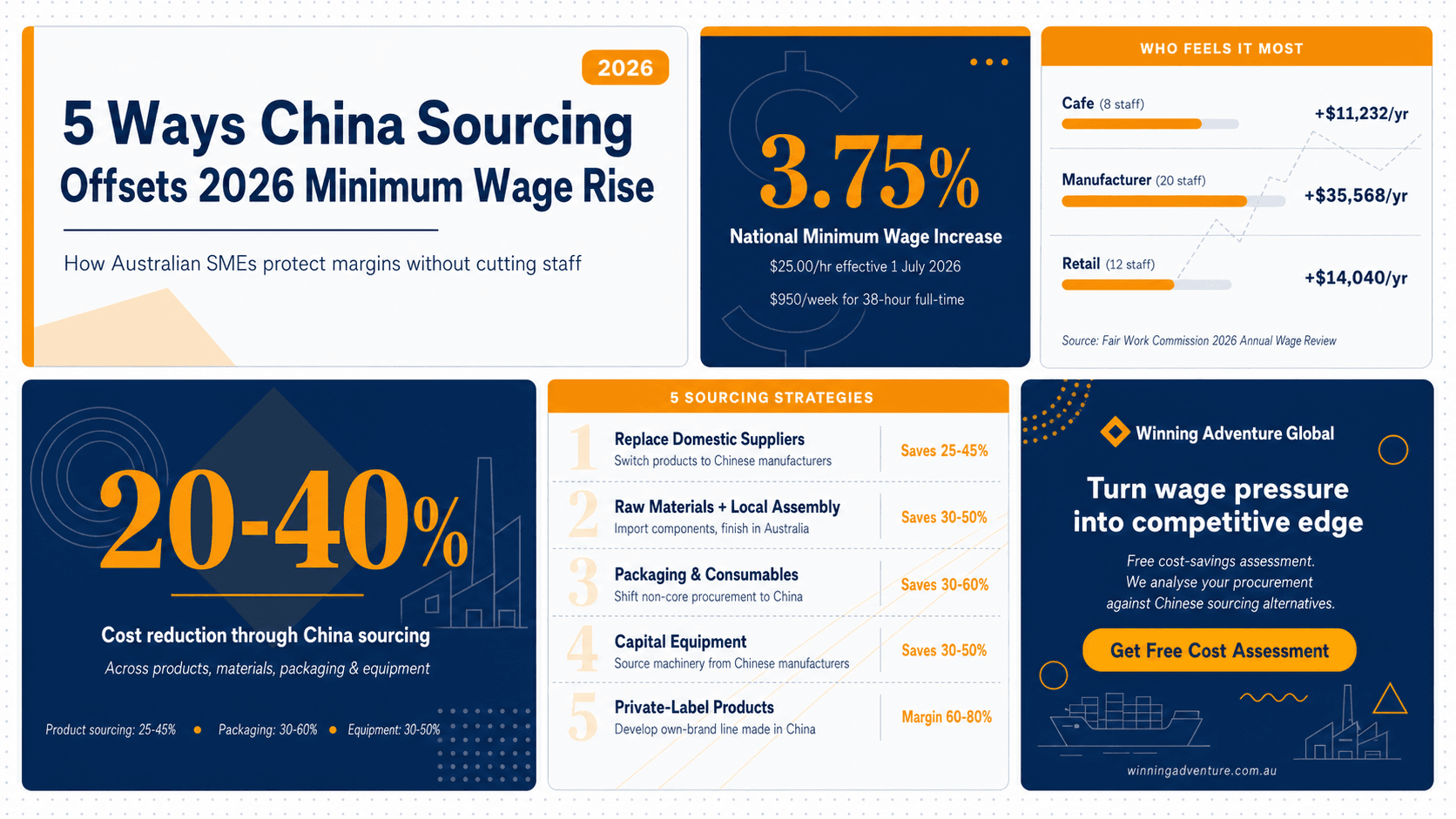
A Brisbane-based hospitality business with 12 full-time staff will pay roughly A$23,000 more in wages this financial year. A Melbourne manufacturer employing 25 production workers faces an additional A$48,000. A Perth retailer with 8 casual staff is looking at A$15,000 in extra wage outlays. These are the direct arithmetic of the Fair Work Commission's 2026 Annual Wage Review — a 3.75% increase in the national minimum wage and all modern award rates, effective from 1 July 2026.
The question most business owners ask us is not whether the increase is justified. It is whether their business can absorb it without cutting staff, raising prices, or shrinking margins.
There is a third option, and we see it working for our clients every quarter: Australian SMEs that source products, materials, packaging, and equipment from Chinese manufacturers routinely reduce their cost of goods sold by 20 to 40% compared to domestic or established-market alternatives. Applied strategically, that cost differential can offset the entire minimum wage increase — and then some.
This article explains exactly how that arithmetic works, with real client examples and dollar figures.
The Math That Matters
For an SME assessing the impact, the calculation is straightforward: total award-reliant employees × average hours × 3.75% increase + superannuation (now 12%). The result is the annualised wage increase the business must absorb.
| Business Type | Staff Count | Annual Wage Increase (incl. super) |
|---|---|---|
| Small cafe | 8 | A$11,232 |
| Retail store | 12 | A$14,040 |
| Light manufacturer | 20 | A$35,568 |
| Commercial cleaner | 15 | A$14,040 |
| Wholesale distributor | 10 | A$17,784 |
The strategic question is not whether these numbers are manageable in isolation. It is whether there are structural changes to your cost base that can offset the increase without compromising quality or service.
5 Sourcing Strategies That Work
1. Replace Existing Domestic Suppliers with Chinese Manufacturers
The most direct approach: identify products currently purchased from Australian or established-market suppliers and source functionally equivalent alternatives from Chinese manufacturers.
Real example from our client work: An Adelaide-based promotional products business was paying A$4.80 per unit for branded drink bottles from an Australian wholesaler (who in turn imported from China). By sourcing directly from the Chinese manufacturer, the landed cost dropped to A$1.95 per unit — a 59% reduction. On an annual order of 15,000 units, that freed up A$42,750 in cash flow — more than the business's entire minimum wage increase across a team of six.
The prerequisite is quality verification. We include supplier verification as a standard step — checking the manufacturer's business license, export history, and production capability before any money changes hands.
2. Source Raw Materials and Components, Assemble Locally
Instead of sourcing finished products from China, import the raw materials or components and perform final assembly in Australia. This preserves an Australian-made claim for marketing or compliance while capturing Chinese material cost advantages.
Real example: A Melbourne furniture manufacturer was purchasing cut-to-size hardwood panels from Australian timber merchants at A$78 per square metre. They sourced kiln-dried, precision-cut panels from a Chinese timber processor at A$38 per square metre landed. On annual consumption of 400 square metres, the material cost saving was A$16,000 — enough to cover the wage increase for two of the workshop's five production staff.
3. Source Packaging, Consumables, and Non-Core Inputs
This is often the easiest entry point for businesses new to importing. Packaging materials, point-of-sale displays, cleaning supplies, uniforms, and consumable tooling typically deliver 30–60% cost reduction with minimal operational disruption.
Real example: A medium-sized bakery chain with 8 locations was purchasing approximately A$48,000 per year in branded paper bags, coffee cups, and takeaway containers from an Australian distributor. Sourcing directly from a verified Chinese packaging manufacturer dropped the cost to approximately A$27,000 — a saving of A$21,000. That covered the wage increase for 3–4 junior retail staff.
4. Source Capital Equipment and Machinery from China
For businesses planning equipment purchases, Chinese manufacturers can reduce capital expenditure by 30–50% compared to equivalent machinery from European or American suppliers — without sacrificing quality in most categories.
Real example: A Brisbane commercial printer was quoted A$180,000 for a new digital press from a European manufacturer. A comparable Chinese-manufactured press was sourced for A$98,000 landed including installation support. The A$82,000 capital saving, amortised over the equipment's 7-year life, reduced annual depreciation by approximately A$11,700 — covering the wage increase for two full-time production assistants.
The critical factor is technical due diligence. We recommend a factory audit for any capital equipment supplier before placing an order — verifying specifications, warranty terms, and after-sales support on the ground.
5. Develop Private-Label Products Manufactured in China
The most ambitious strategy and the one with the largest potential return. Instead of reselling other brands' products, design or specify your own, have it manufactured in China, and capture the full brand margin — typically 60–80% on manufactured cost.
Real example: If a business retails a branded product at A$49.95 with a wholesale cost of A$28.00 (44% margin), and can produce a private-label equivalent in China at a landed cost of A$12.00 per unit, the margin expands to 76%. On annual sales of 2,000 units, that is an additional A$32,000 in gross profit — covering the minimum wage obligation for a team of 5 with profit left over.
Many Chinese manufacturers now accept minimum orders of 500–1,000 units, making this accessible for SMEs.
Real Comparison: Labour Cost vs Sourcing Savings
The pattern across all five strategies is consistent: even a single sourcing strategy typically achieves savings that exceed the annual wage increase. Businesses implementing two or three strategies simultaneously find the combined savings not only cover the increase but create meaningful margin expansion.
| SME Type | Annual Wage Increase | Typical Sourcing Saving | Net Effect |
|---|---|---|---|
| Cafe (8 staff) | A$11,232 | A$15,000–25,000 | +A$4,000–14,000 |
| Retail (12 staff) | A$14,040 | A$25,000–50,000 | +A$11,000–36,000 |
| Manufacturer (20 staff) | A$35,568 | A$40,000–80,000 | +A$4,500–44,500 |
| Cleaner (15 staff) | A$14,040 | A$8,000–20,000 | -A$6,000 to +A$6,000 |
| Distributor (10 staff) | A$17,784 | A$30,000–60,000 | +A$12,000–42,000 |
How to Start (Without Getting Burned)
For an SME that has never imported from China, the process is structured and repeatable:
Step 1: Identify your highest-impact opportunity. Review your last 12 months of procurement spend. Pick the top 5 line items and ask: is this product already manufactured in China somewhere in my supply chain?
Step 2: Find and verify suppliers. Use Alibaba.com or Made-in-China.com to shortlist candidates. Then verify them — not by their website or trade assurance badge, but by an independent check of their business license, actual factory location, and production capability. That is where we come in: we conduct in-person factory verifications across Guangdong, Zhejiang, Jiangsu, Fujian, and Shandong.
Step 3: Sample, negotiate, and order. Get production samples, inspect against your specification, then place a small trial order before scaling. Include a pre-shipment quality inspection on every significant order to confirm goods meet your specification before they leave the factory.
Turning Cost Pressure into Competitive Advantage
The 2026 minimum wage increase is a reality every Australian SME must navigate. Some will absorb it and watch margins shrink. Some will pass it through to customers and risk losing market share. And some — the ones that move early — will use it as the catalyst to restructure their cost base permanently.
China sourcing is not a corner-cutting exercise. It is a structural improvement to your cost base that compounds over time as supplier relationships deepen and procurement expertise accumulates. The businesses that move first gain the most.
Get your free cost-savings assessment — we will analyse your current procurement spend and identify the highest-impact China sourcing opportunities for your business. No obligation.
Andy Liu
2026-06-02 · 9 min read
How Winning Adventure Global helps
Whichever way you source from China, you get someone you can trust on the ground. Choose the approach that fits your business.
One-Time Procurement
A single purchase executed well — travel to China with our guide or let us handle it remotely.
Compare servicesFactory Tour + Supply Chain
Visit China with a bilingual guide, audit production in person, and build a long-term supply chain.
Compare servicesRemote Verification + Supply Chain
Deep supplier verification and ongoing procurement management — without leaving Australia.
Compare servicesChina Sourcing Strategy
Ready to offset rising costs through smarter sourcing?
We help Australian SMEs reduce product and material costs through verified Chinese suppliers — so you can absorb wage increases without cutting staff. Free cost-savings assessment.
Free initial consultation · We respond within 4 business hours