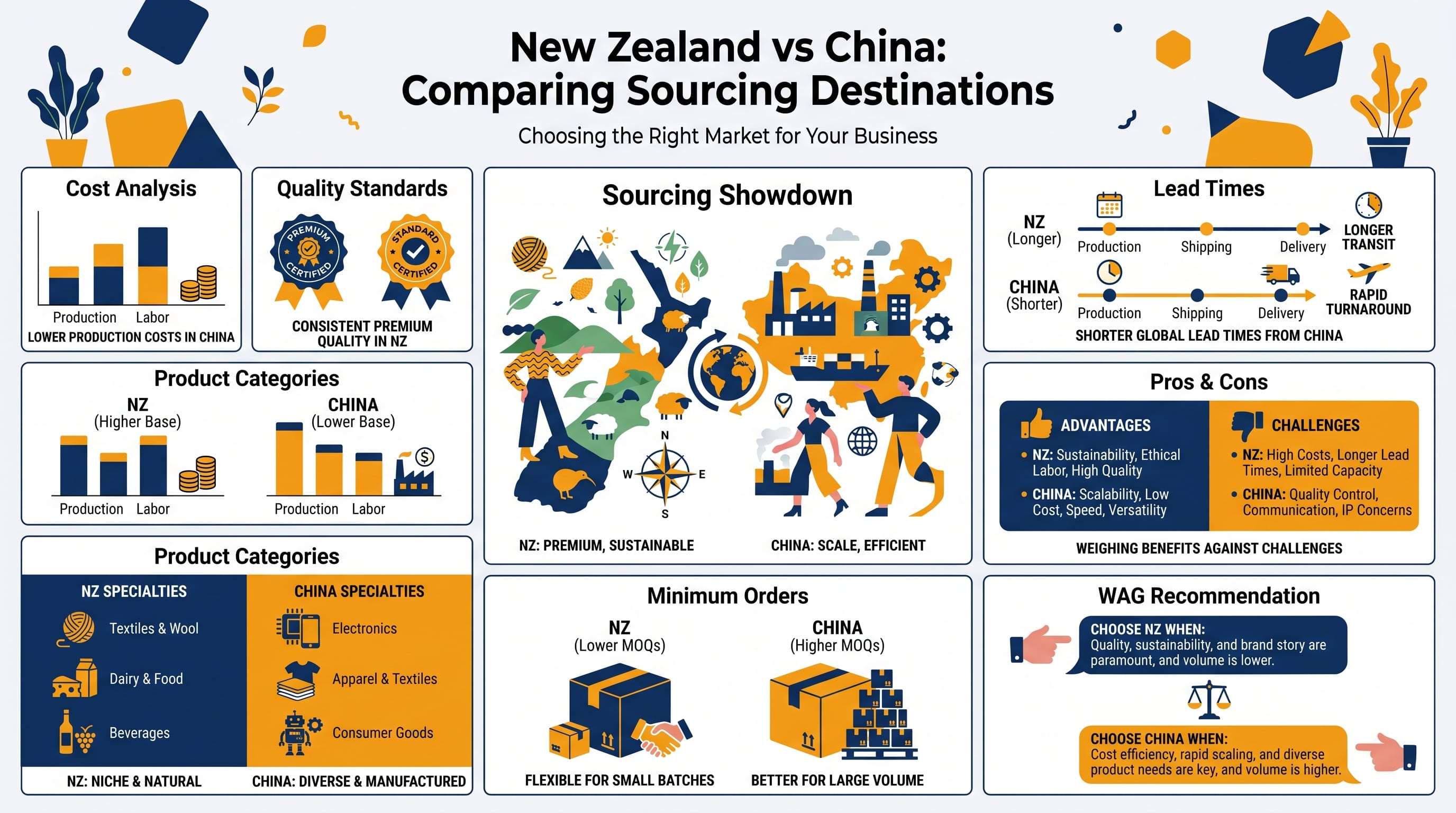
Several times a month, an Australian business owner asks us a version of the same question: "Should I be diversifying my sourcing away from China? What about New Zealand?"
It is a fair question. Geopolitical risk, pandemic supply chain lessons, and rising Chinese manufacturing costs have all pushed diversification higher on the priority list. And New Zealand — proximate, English-speaking, with a clean regulatory reputation — is the most obvious alternative for Australian buyers.
Our answer is always the same: New Zealand is a valuable complementary source for specific products, but it is not a wholesale replacement for China. The businesses that get this right are the ones that understand what each market is actually good at, and build a hybrid strategy accordingly.
This guide gives you the framework we use when clients ask us this question. It is based on what we see in Chinese factories every day and on the real economics of cross-Tasman vs China supply chains.
The Diversification Question, Honestly Assessed
Let us state the premise directly: China will remain the dominant manufacturing source for Australian importers for the foreseeable future, for the simple reason that nothing else matches its combination of cost, scale, and ecosystem depth.
New Zealand manufacturing has genuine strengths — quality, proximity, regulatory alignment — but in most product categories it costs substantially more and cannot scale to match China's output. The businesses that benefit most from NZ sourcing are those that treat it as a strategic complement, not a replacement.
What NZ Manufacturing Actually Excels At
| Industry Sector | Capability Level | Why It Matters for Australian Buyers |
|---|---|---|
| Dairy and food processing | World-class | Premium quality, established regulatory pathways under CERTA |
| Wood products and furniture | Strong | Sustainable plantation forestry, short lead times |
| Pharmaceutical and supplements | Growing | TGA-recognised manufacturing standards |
| Specialty chemicals | Moderate | Niche applications where certification matters |
| Light manufacturing | Limited | Labour costs constrain competitiveness |
| Electronics assembly | Limited | Final assembly capability, but components come from Asia |
The Cost Reality
NZ manufacturing wages (approximately NZ$23–24/hour minimum) significantly exceed Chinese manufacturing wages even in coastal provinces. Trans-Tasman shipping runs A$500–1,500 per container with 1–3 days transit, compared to A$2,000–5,000 from China with 2–4 weeks.
For many product categories, NZ simply cannot compete on manufacturing cost alone. The value proposition lies in quality premium, speed to market, and risk diversification — not in matching China's unit economics.
The Hybrid Approach: When to Use Each Source
In our experience working with Australian importers, the most effective approach is not NZ-or-China but NZ-and-China, with each source assigned to the categories where it genuinely adds value.
NZ Works Best For
- Products with premium-quality positioning where provenance drives purchase decisions
- Items needing sustainable or organic certification that China cannot match
- Short-lead-time requirements (1–3 day shipping vs 2–4 weeks)
- Regulated products where NZ's TGA-aligned standards provide market access advantages
- Products covered by CERTA preferential tariff treatment
China Remains Superior For
- Cost-sensitive commodity products where margin depends on unit price
- Complex manufactured goods requiring sophisticated component ecosystems
- High-volume production where scale economies are essential
- Products where NZ simply lacks manufacturing capability
- Standard consumer goods where differentiation is marketing-driven, not origin-driven
Building the Hybrid Model
The businesses that diversify successfully typically follow a phased approach:
Phase 1 — Identify what to keep in China. Start by determining which of your product categories genuinely require China's cost structure and manufacturing ecosystem. These are products where NZ sourcing would double your costs or is unavailable entirely.
Phase 2 — Identify what to move to NZ. Look for the subset of products that meet NZ's sweet spot: premium quality, small to medium volumes, time sensitivity, or regulatory advantage. These are the candidates.
Phase 3 — Manage the two supply chains deliberately. Hybrid sourcing adds complexity — two sets of supplier relationships, logistics arrangements, and quality management processes. Businesses that succeed at it treat the hybrid model as an intentional strategy, not a reactive spread of suppliers across markets.
What This Means for Your China Sourcing
If you decide to add NZ sourcing to your mix, the China side of your supply chain does not stay static. A few patterns we see regularly:
NZ suppliers buy Chinese components. Many NZ manufacturers import components or semi-finished goods from China before adding local value. If your NZ supplier is doing this, you have created an additional intermediary in a China-origin supply chain — without necessarily improving resilience.
The best China supplier relationships deepen over time. Businesses that maintain consistent volume with Chinese manufacturers get better pricing, priority production slots, and first access to new products. Distributing volume across too many sources can weaken these relationships.
China remains the baseline for cost and scale. Whatever diversification decisions you make, the benchmark pricing and capability reference will be China. Maintaining visibility into Chinese manufacturing costs — even if you are not currently sourcing from China for a specific product — keeps your NZ negotiations grounded in market reality.
Practical Implementation
For businesses considering a hybrid China/NZ approach, the practical steps are:
Audit your total cost of ownership per product category. Manufacturing cost is only one factor. Include freight, inventory carrying costs (NZ's 1–3 day transit reduces these significantly), tariffs under CERTA vs ChAFTA, and the cost of managing an additional supplier relationship.
Verify the NZ supplier's own supply chain. If your NZ manufacturer relies on Chinese components, you have not eliminated China dependency — you have just added a middleman. Ask for material declarations before committing.
Use China sourcing as your leverage. In our experience, knowing the landed cost of a Chinese equivalent is the single most effective negotiation tool when evaluating NZ suppliers. It keeps pricing grounded and prevents NZ suppliers from assuming they have no competition.
FAQ
Can New Zealand manufacturing replace China sourcing entirely?
No. NZ's manufacturing sector lacks the scale, ecosystem depth, and cost competitiveness to replace China sourcing for most Australian businesses. It serves as a complementary source for specific product categories where quality, proximity, or regulatory alignment create value.
What products are most suitable for NZ sourcing?
Dairy products, wood products and furniture, pharmaceutical ingredients, specialist chemicals, and products needing organic or sustainable certification. In each case, NZ's premium manufacturing capability must be balanced against higher unit costs.
How do total costs compare?
Direct manufacturing costs in NZ will be higher for most products. However, total landed cost comparison must account for NZ's lower shipping costs (A$500–1,500 vs A$2,000–5,000+ per container), faster transit (1–3 days vs 2–4 weeks), and preferential tariff treatment under CERTA.
How do I find capable suppliers in NZ?
Industry associations, trade shows, New Zealand Trade and Enterprise (NZTE), and freight forwarders with cross-Tasman networks are good starting points. Allow 12–18 months from initial supplier identification to full production scale.
If I add NZ sourcing, should I reduce my China sourcing?
Not necessarily. Most businesses that diversify successfully maintain or grow their China volume while adding NZ as a complementary source for specific categories. The goal is a resilient portfolio of supply options, not a binary choice between markets.
Whether you are diversifying into NZ, deepening your China relationships, or building a hybrid model — the China supply chain needs the same things: verified suppliers, quality control, and reliable logistics. For end-to-end factory shortlisting through shipment, see our China sourcing agent service. Start with a free sourcing consultation to discuss your specific product categories and sourcing goals.
Andy Liu
2026-05-27 · 12 min
How Winning Adventure Global helps
Whichever way you source from China, you get someone you can trust on the ground. Choose the approach that fits your business.
One-Time Procurement
A single purchase executed well — travel to China with our guide or let us handle it remotely.
Compare servicesFactory Tour + Supply Chain
Visit China with a bilingual guide, audit production in person, and build a long-term supply chain.
Compare servicesRemote Verification + Supply Chain
Deep supplier verification and ongoing procurement management — without leaving Australia.
Compare servicesChina Sourcing Strategy
Evaluating your sourcing strategy?
Whether you diversify into NZ or deepen your China relationships, we help Australian businesses find and verify suppliers. Free consultation.
Free initial consultation · We respond within 4 business hours